Quick answer: Dual fisheye to equirectangular is converting a side-by-side OO still — two fisheye circles in one file — into a 2:1 equirectangular PNG a tour viewer can orbit. This page stitches that still locally with WebGL2, optional HDR or blend merge, and auto-align. It does not open a finished 360, stitch video, or write GPano tags.
Last updated: September 10, 2026
What is dual fisheye to equirectangular?
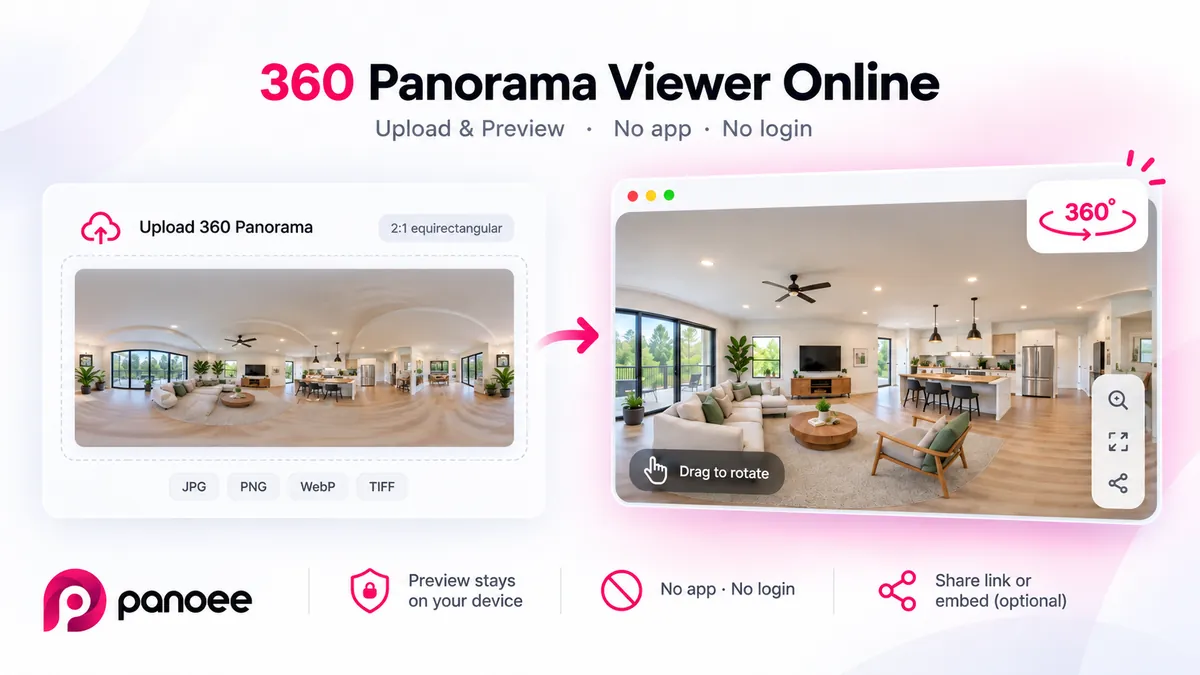
Dual fisheye to equirectangular is a projection convert: map two opposite fisheye hemispheres onto a latitude–longitude rectangle whose width is twice its height. Tour platforms assume that 2:1 layout. A USB dump from Insta360, Ricoh THETA, or a Trisio-class camera often still shows two circles. Until you stitch, a viewer cannot treat the file as a sphere.
It is not the same as opening an already-stitched equirect. It is not multi-row Hugin work, not PTGui control-point sets, and not Insta360 video / .insv. The UI name on this page is Panorama Lab. Search demand is the convert job, not the lab name.
Kuula’s fisheye notes describe the same blocker: publishers want equirectangular, and dual-fisheye files fail that check. See the Kuula dual fisheye tutorial. TeliportMe’s help article walks the same convert before a tour will publish: convert fisheye projection to equirectangular.
Why USB OO files break tour workflows
One-shot 360 cameras make capture easy and handoff messy:
- A card or USB copy can be an OO still (two fisheyes side by side) instead of a stitched JPEG
- Vendor desktop apps expect their own pipeline; a browser tour builder will not
- HDR brackets stay as separate OO frames until someone merges them
- Social and many viewers look for a 2:1 sphere, not two circles
This tool is the free browser lane for that still. Stitch and preview run in WebGL 2.0 on the device. Defaults you can verify in the UI: lens FOV 190°, radius scale 0.97, auto-align proxy 640px wide, merge pixel cap about 4096×2048 (8,388,608 px), export always at scale 2. Those are Panoee Panorama Lab defaults, verified September 10, 2026.
What this tool covers (and what it does not)
Covered here:
- One dual-fisheye OO still, or 2+ OO frames merged with HDR or blend, then stitch
- Lens geometry (FOV, radius, centers, roll, seam) plus Auto Align
- Live HDR preview on the current texture
- 2D strip and 360 orbit preview
- PNG export at 2× (even width, height = width / 2)
Not covered — do not expect them on this page:
- Camera profile import/export
- A color-grade panel (use 360 photo color correction)
- JPEG + GPano XMP
- Upload to Panoee media
- Finished equirectangular input
- Video or
.insv - A 1× / 2× quality toggle (export is always 2×)
If the horizon still leans after stitch, open Level 360 panorama. Tripod hole work stays on Nadir Fixer.
How to stitch dual fisheye to equirectangular
- Drop one OO still (JPG, JPEG, PNG, or WebP). Side-by-side fisheye only — a finished 2:1 sphere is rejected by intent, not by a second stitcher.
- Optional: HDR Merge OO for exposure brackets, or Merge OO to stack matching frames. Both need at least two files of the same size.
- Check the 2D strip, then switch to 360° and drag to inspect the seam.
- Nudge FOV, radius, centers, roll, or seam if the overlap looks wrong. Hover Auto to preload calibration, then run it. Cancel anytime.
- Use live HDR sliders only if you want a different grade than the baked merge. Toggle preview off to skip the shader pass; merge still used the curve numbers.
- Export PNG. Width is about
2 × source width(even), height half. If you were in 360 view, the tool re-renders the orbit after the 2D snapshot. - Open the PNG in the 360 panorama viewer online to confirm the sphere. For Facebook or other Photo Sphere hosts, convert/tag a JPEG with the 360 EXIF Fixer — this PNG has no GPano.
HDR merge and Auto Align
HDR Merge weights pixels by luma with a Gaussian bell (default σ 0.3, center 0.5, base weight 0.08, exposure 0 EV). After a merge, live sliders start near identity because the texture already baked that curve. Moving them grades relative to that baseline.
Blend Merge uses weight 1 per frame — a simple stack for noise, not exposure fusion.
Auto Align runs on a 640px-wide proxy. It samples the left/right overlap band and does coordinate descent on centers, FOV, radius, and rolls, staying near your starting lens. If overlap is too weak, adjust FOV and centers by hand first.
How does this compare to Insta360 Studio or PTGui?
| Tool | Best when | Tradeoff |
|---|---|---|
| This page (Panorama Lab) | OO still in a browser, local, optional HDR/blend | PNG only, no GPano, no video |
| Insta360 Studio / THETA Stitcher | Vendor files, official color, video | Desktop or app install; USB OO stills still need a path |
| PanoCool Stitcher | Some drone UP/DOWN pairs in a browser | Different camera geometry than consumer OO |
| PTGui / Hugin | Multi-row, control points, print-grade | Desktop; overkill for one OO still |
This page is not “better than Insta360 Studio.” It is the no-install convert when you already have an OO still and need a 2:1 PNG.
When to stitch before you build a tour
Use it when:
- A USB or AirDrop file shows two fisheye circles
- You searched how to convert or stitch dual fisheye without installing Studio
- You have HDR brackets as OO frames and want a merged sphere
- The next step is a tour viewer, not a video timeline
Skip it when you already have an equirect, when you need .insv video, or when you need JPEG + GPano in one click (not shipped in v1).
After the PNG looks right, start a tour on the free virtual tour app or continue in Panoee Studio.
Key takeaways
- Search is dual fisheye to equirectangular / stitch OO — not “Panorama Lab”
- This page stitches OO stills only to a 2× PNG; no finished 360 in, no video, no GPano
- Auto Align and HDR/blend merge are optional; export is always 2D at scale 2
- Pair with viewer, level, color, nadir, and EXIF for the rest of the prep pipeline
- Files stay on the device; WebGL2 is required
FAQ
What is dual fisheye to equirectangular? It is the conversion of a side-by-side dual-fisheye (OO) still into a 2:1 equirectangular panorama so tour viewers and publishers can treat the file as a full sphere.
Can I drop a finished 360 photo here? No. This tool accepts dual-fisheye OO stills only. An already-stitched equirect belongs in the viewer, level, color, nadir, or EXIF tools.
Does the PNG include GPano tags for Facebook? No. v1 exports PNG without GPano XMP. Convert or tag a JPEG with the 360 EXIF Fixer before social share.
Do you stitch Insta360 video or .insv files? No. Still images only. Video and .insv stay in the camera vendor app or a desktop stitcher.
Do you upload my photos? No. Stitch, merge, and export run locally in the browser. Files never leave the device.