
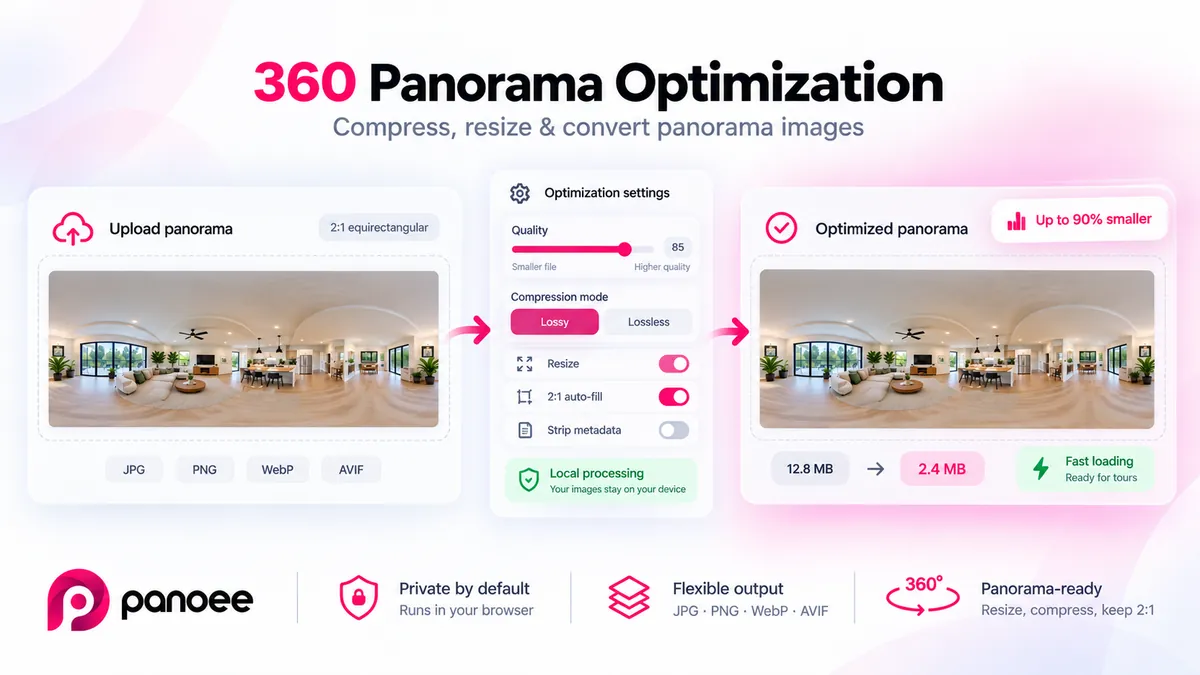
360 panorama optimization shrinks an equirectangular photo in the browser so tours and shares load faster. Drop a JPEG, PNG, or WebP, pick quality and output format, then download. Files stay on your device. Shipped UI copy cites up to 90% size reduction on typical lossy exports.
Last updated: September 8, 2026
What is 360 panorama optimization?
360 panorama optimization is a free, local tool that compresses, resizes, and optionally pads a 360° image to a 2:1 sphere. Input is JPEG, PNG, or WebP. Output is WebP, AVIF, JPEG, or PNG. The file is never uploaded.
Key takeaways
- Free browser 360 panorama optimization — no account, no server upload
- Input: JPEG, PNG, WebP · output: WebP, AVIF, JPEG, PNG
- Quality 80–90 is the UI default sweet spot for lossy mode
- After a lossy pass, run 360 EXIF Fixer if you still need GPano tags
- Preview the result in the 360 panorama viewer
Key Features
-
Compress locally: Lossy or lossless, with a quality slider (1–100).
-
Change format: Export WebP, AVIF, JPEG, or PNG.
-
Resize: Scale while keeping aspect ratio.
-
Auto-fill 2:1: Add black borders when the source is not a full sphere.
-
Strip metadata: Optional — the UI notes this can cut another 10–20%.
-
Private: Processing stays in the browser.
How to Use
-
Upload a panorama
- Drag and drop a JPEG, PNG, or WebP, or click to browse.
-
Choose quality and format
- Pick lossy or lossless.
- Set quality (80–90 for most shares).
- Choose WebP, AVIF, JPEG, or PNG.
- Resize or auto-fill to 2:1 if needed.
-
Download
- Compare original vs optimized size, then download.
-
Fix tags, then preview
- Browser compression strips Photo Sphere XMP. Run 360 EXIF Fixer on the JPEG before Facebook or Google Photos.
- Open the file in the 360 panorama viewer to confirm it still spins.
When to optimize before you publish
Run 360 panorama optimization before you publish a tour or send a client preview. A 2:1 JPEG from a 360 camera or stitcher is often tens of megabytes. A WebP or AVIF at quality 80–90 is usually small enough for a phone on a mid-range connection, without opening a desktop batch app.
Optimize before Facebook or Instagram only if you will re-inject GPano tags afterward. Those platforms treat a file as a 360 photo when it is JPEG plus Photo Sphere XMP. Compress first, then EXIF Fixer, then upload. If you export WebP or AVIF for the web, keep a tagged JPEG for social.
Skip a second pass if the file is already a few megabytes and already 2:1. Another lossy encode rarely helps and can soften fine stitch lines.
Use resize when the source is wider than you need on the tour (for example a 16K export that will only play at 8K). Keep 2:1. Auto-fill is for a crop that is close to a sphere, not for turning a flat wide photo into a real 360.
Modern formats are worth the switch when the host supports them. web.dev on image compression explains why WebP and AVIF usually beat JPEG at the same visual quality — that is the reason this tool defaults to WebP.
Supported Formats
-
Input: JPEG, PNG, WebP (the optimizer rejects other types).
-
Output: WebP, AVIF, JPEG, PNG.
-
Recommended: Equirectangular 2:1. Use auto-fill if the stitch is close but not exact.
FAQ
Is there a file size limit? The UI states no file size limit. Very large panoramas can still fail if the browser runs out of memory.
Do you upload my files to a server? No. Optimization runs locally in the browser.
What quality setting should I choose? The tool tips recommend 80–90 for most images.
What’s the difference between lossy and lossless? Lossy makes a smaller file with a quality trade-off. Lossless keeps pixels and usually shrinks less.
Why enforce a 2:1 ratio? Most 360 viewers expect a full sphere. Auto-fill adds black borders to reach 2:1.
Can I optimize several files at once? No. The tool processes one image at a time.
Can I optimize photos from my phone? Yes. It runs in a mobile browser the same way as on desktop.
Summary
360 panorama optimization is the local way to compress and prepare one 360° photo for a faster tour or share. Upload a JPEG, PNG, or WebP; set quality and format; download. Nothing leaves the device.
If the next step is Facebook or Google Photos, convert or keep JPEG and restore GPano tags. If the next step is a Panoee tour or a client preview, WebP or AVIF at 80–90 is usually enough. Check the sphere in the viewer before you publish a walkthrough — this page compresses one photo; it does not build a multi-scene tour.