Why This Camera & Lens Are Great for Panoramas
The Sony a7R V paired with the Laowa 4mm f/2.8 Circular Fisheye is a fast, lightweight, and highly flexible way to capture immersive 360° panoramas. The a7R V’s 61MP full-frame BSI sensor (approx. 9504 × 6336 pixels, ~3.76 µm pixel pitch) offers excellent base-ISO dynamic range (~14.5–15 EV at ISO 100), rich color, and superb detail. That means clean shadows and highlight headroom when you’re blending windows and interior lighting, or holding a bright sky at sunset. The body’s 5-axis IBIS (up to ~8 stops rated) helps when shooting handheld previews; you’ll usually switch it off on a tripod for consistency.
The Laowa 4mm f/2.8 Circular Fisheye is an ultra-compact manual lens with a huge field of view (circular image with ~210° diagonal FOV on APS-C/MFT). Mounted on the a7R V, you’ll get the best results by using APS-C crop mode to match the lens’s image circle and minimize useless black border. The trade-off is resolution (the camera drops to ~26MP in APS-C mode), but the benefit is speed: you can cover a full sphere with as few as 3 shots around, which is ideal for fast-moving environments or elevated pole work.
Fisheyes do introduce extreme distortion, but modern stitchers (PTGui/Hugin) are optimized for fisheye projections and can produce clean equirectangular outputs. The Sony E mount ensures solid compatibility and easy manual focus with focus magnification. Overall, this combo is excellent when you value speed, portability, and reliability over maximum gigapixel output.
Quick Setup Overview
- Camera: Sony a7R V — Full-frame 35mm sensor, 61MP, excellent base ISO DR, strong color depth. APS-C crop mode: ~26MP.
- Lens: Laowa 4mm f/2.8 Circular Fisheye — circular fisheye, ~210° diagonal FOV (APS-C), sharpest around f/5.6–f/8, mild purple fringing possible on high-contrast edges.
- Estimated shots & overlap:
- 3 around (120° yaw) at 0° pitch — often enough to close a sphere with a circular fisheye; capture an extra nadir for clean tripod removal.
- Safety set: 4 around (90° yaw) + nadir — yields more overlap and more reliable stitches in complex scenes.
- Difficulty: Easy–Intermediate (fast to shoot, requires careful nodal alignment and clean workflow).
Planning & On-Site Preparation
Evaluate Shooting Environment
Scan for lighting extremes (bright windows, sun in frame), reflective surfaces (glass, polished stone, cars), and moving subjects (people, trees, flags). If shooting through glass, get as close as possible (2–5 cm) and shade the lens to minimize reflections. Check for vibrations (bridges, rooftops in wind), and ensure you can safely complete a 360° rotation without obstructions.
Match Gear to Scene Goals
The a7R V’s deep dynamic range lets you hold highlight detail in bright windows and preserve shadow texture indoors. For interiors, aim to stay at ISO 100–400 and bracket when necessary; outdoors, ISO 100–200 is ideal. The Laowa 4mm circular fisheye minimizes shot count, speeding up capture in crowds and on rooftops. The trade-off is lower equirectangular resolution than multi-row rectilinear methods, but for virtual tours and fast 360s, it’s a great balance.
Pre-shoot Checklist
- Batteries charged, ample storage, lens/sensor clean (dust shows up strongly on skies and walls).
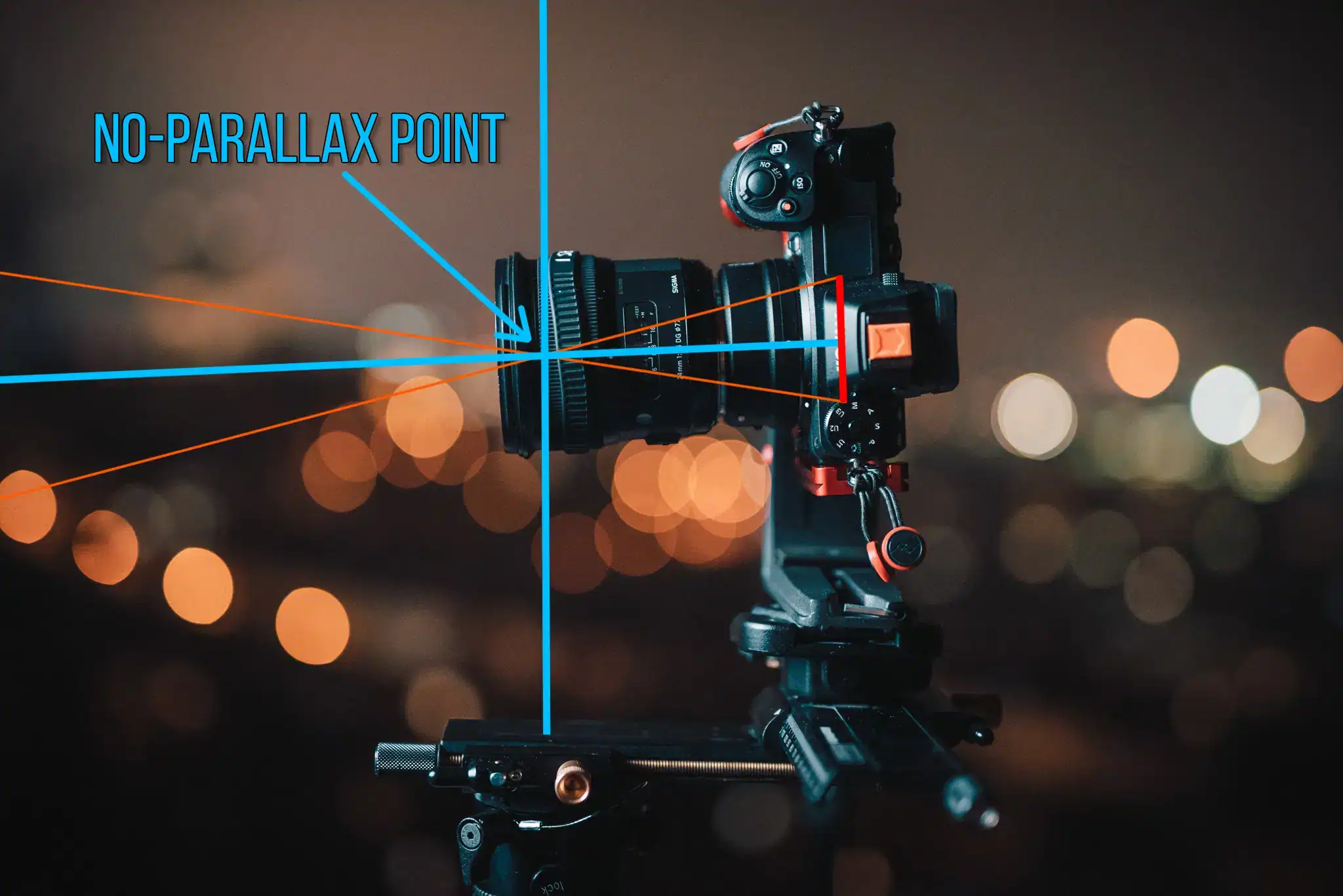
- Tripod leveled; panoramic head calibrated to the no-parallax (nodal) point for this lens.
- Safety checks: secure on rooftops and poles; tether camera; avoid high winds or use ballast.
- Backup workflow: shoot an extra round from the same position in case of stitching issues or motion ghosts.
Essential Gear & Setup
Core Gear
- Panoramic head: Enables rotation around the lens’s no-parallax point to eliminate foreground/background shifts. This is critical even with fisheyes when you have close objects or intricate interiors.
- Stable tripod with leveling base: Leveling saves time; it keeps the horizon straight and your yaw steps precise.
- Remote trigger or app: Use the Sony Imaging Edge app or a remote to avoid vibrations and keep exposure timing consistent.
Optional Add-ons
- Pole or car mount: Always safety-tether the camera; verify clamps; beware of wind load and vibrations. Move slowly and keep shutter speeds higher when elevated or vehicle-mounted.
- Lighting aids: Small LED panels to lift shadow corners in dark interiors; keep color temperatures consistent.
- Weather protection: Rain covers, lens cloths, and silica packs; fisheyes are front-element heavy and can catch droplets and dust fast.
Step-by-Step Shooting Guide
Standard Static Scenes
- Level and align the nodal point: On your pano head, move the camera fore–aft until foreground and background points stay aligned while panning. Mark this rail position for the Laowa 4mm so you can set up quickly next time.
- Manual exposure and WB: Set M mode and lock white balance (Daylight, Tungsten, or a custom Kelvin). This prevents exposure flicker and color shifts that cause visible seams.
- Capture sequence:
- 3-around method: yaw 0°, 120°, 240° at 0° pitch. This typically covers the full sphere with a circular fisheye.
- For maximum reliability: 4-around at 90° increments. More overlap helps with tricky textures and closer objects.
- Nadir shot: Tilt down or reframe to capture a clean ground shot for tripod patching. You can also shift the tripod slightly and shoot a clean floor texture.
HDR / High Dynamic Range Interiors
- Bracket ±2 EV (3–5 frames) to balance bright windows and interior shadows. Keep the same aperture across brackets.
- Lock WB and turn off any auto-ISO changes; use a consistent shutter-speed bracket.
- Merge HDR per view before stitching (preferred) or stitch first then merge (depends on software). PTGui and other tools handle HDR fisheye workflows well.
Low-Light / Night Scenes
- Use tripod and remote. Start at f/4–f/5.6, ISO 100–400, and extend shutter time as needed. The a7R V can go to ISO 800–1600 cleanly, but longer exposures at low ISO usually produce better 360s.
- Disable IBIS on tripod to prevent micro-shifts between frames.
- Review star trails, light flicker, and any moving lights (cars, signs) and plan masks later if necessary.
Crowded Events
- Shoot two passes: one quick lap to lock in coverage, then wait for gaps in movement and shoot a second lap. Blend the best regions during stitching.
- Favor higher shutter speeds (1/200+) to freeze motion if you want crisp subjects.
- Use the 4-around method for more overlap when people move unpredictably.
Special Setups (Pole / Car / Drone)
- Secure and tether: On poles or cars, double-check all clamps and lanyards. Keep the camera’s center aligned over the rotation axis; pack a small spirit level.
- Mitigate vibration: Use faster shutter speeds (1/250–1/500), IBIS on for handheld/pole shots only, and take multiple rounds to have clean alternatives.
- Mind the wind: Even a small fisheye can act like a sail. Brace, minimize exposure time, and review frames before moving on.
Field-Proven Mini Case Studies
- Indoor real estate: 4-around + HDR (±2EV), ISO 100, f/8, on a leveled pano head. Quick, clean windows, minimal ghosting.
- Outdoor sunset: 3-around at ISO 100, f/8, 1/100–1/250. Underexpose by 0.3–0.7 EV to protect highlights; lift shadows in post.
- Event crowds: 4-around at f/5.6, 1/200–1/400, ISO 400–800. Two passes; mask best faces and poses later.
- Rooftop pole: 3-around at 1/250–1/500, f/5.6, ISO 200–400. Safety tether; shoot extra coverage for redundancy.
- Car-mounted: 4-around, 1/500–1/1000, f/5.6–f/8, ISO 400–800. Stop the vehicle if possible; if rolling, plan for motion blur and edge masking.
Recommended Settings & Pro Tips
Exposure & Focus
| Scenario | Aperture | Shutter | ISO | Notes |
|---|---|---|---|---|
| Daylight outdoor | f/8–f/11 | 1/100–1/250 | 100–200 | Lock WB (Daylight or custom Kelvin) |
| Low light/night | f/4–f/5.6 | 1/30–1/60 (or longer on tripod) | 100–800 | Tripod & remote; disable IBIS on tripod |
| Interior HDR | f/8 | Bracket ±2 EV | 100–400 | Protect highlights; merge HDR per view when possible |
| Action / moving subjects | f/5.6–f/8 | 1/200+ | 400–800 | Freeze motion; consider two-pass capture |
Critical Tips
- Manual focus at near-hyperfocal: With a 4mm fisheye at f/8, setting focus around 0.3–0.5 m typically yields sharpness from very close to infinity. Confirm with focus magnification.
- Nodal point calibration: Use two vertical objects (one close, one far). Pan and adjust the rail until they don’t shift relative to each other. Mark the rail position for the Laowa 4mm.
- White balance lock: Mixed lighting can vary per angle; a fixed WB avoids color seams.
- Shoot RAW: Maximizes a7R V’s DR advantage for HDR and color grading. JPEGs are fine for quick previews only.
- IBIS usage: On tripod, turn stabilization off for consistent alignment; enable only for handheld/pole shots.
Stitching & Post-Processing
Software Workflow
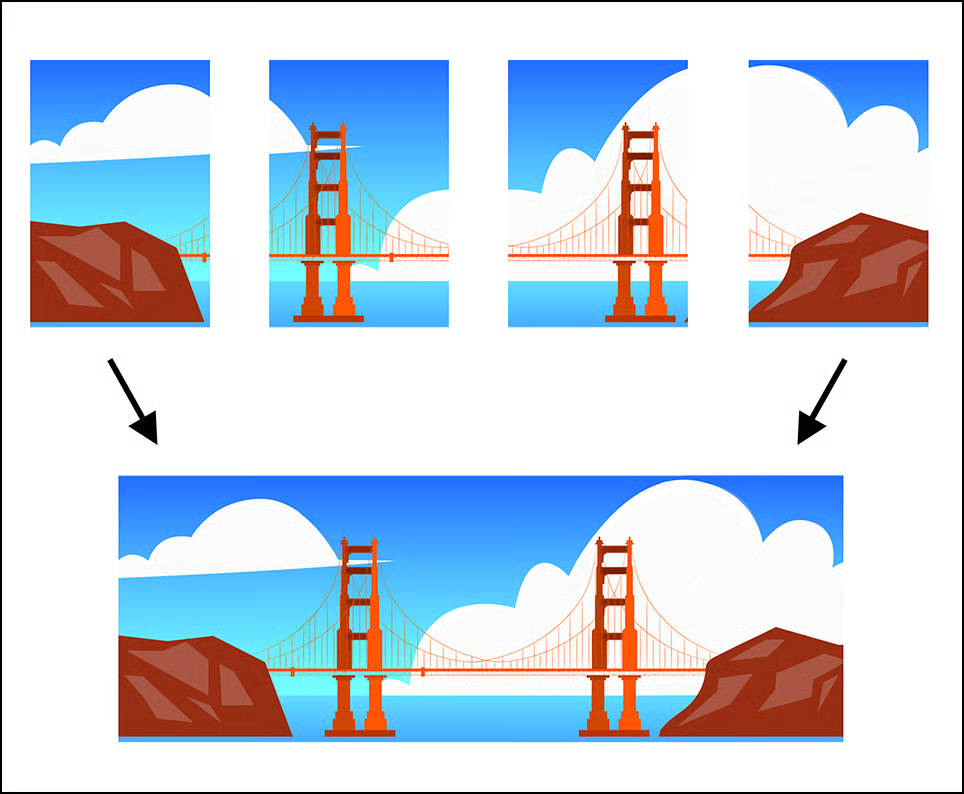
Import your RAWs into Lightroom or Capture One for initial tone and color consistency. If you bracketed, merge each view to HDR first to keep noise low and highlight detail intact. Then send the frames to PTGui or Hugin. Fisheye inputs are straightforward—define lens type as “circular fisheye” and let the optimizer place control points. Industry practice targets ~25–35% overlap for fisheyes and ~20–25% for rectilinears. PTGui’s optimizer, control point editor, and masking tools make resolving ghosting and parallax issues fast, especially with only 3–4 shots per panorama.
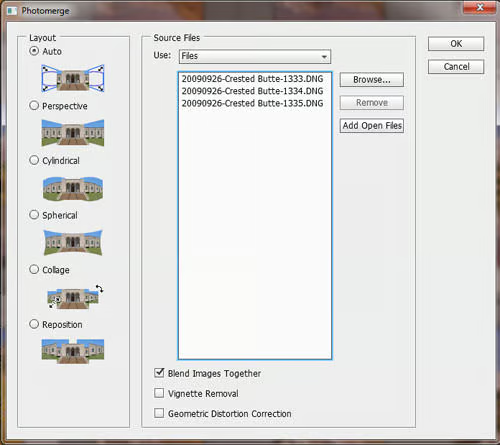
If your shots include moving subjects, use PTGui’s masks to choose the cleanest regions from each frame. For nadir cleanup, export a layered file to Photoshop/Affinity and patch the tripod using Clone/Heal or an AI content-aware fill. When satisfied, export an equirectangular JPEG/TIFF (commonly 8K–12K wide for this combo, depending on circle diameter and overlap) ready for virtual tour platforms.
For deeper background on panoramic heads and high-end DSLR/MI workflows, see this clear panoramic head guide and professional 360 pipeline resources. Panoramic head tutorial (workflow and alignment). Set up a panoramic head for high-end 360 photos.
PTGui remains a go-to for many pros because of speed and masking power. A helpful review that highlights why it’s a favorite among panorama shooters is here: PTGui review and use cases.
Useful Tools & Resources
Software
- PTGui panorama stitching
- Hugin (open source alternative)
- Lightroom / Photoshop / Affinity Photo
- AI tripod removal tools (Content-Aware Fill, Generative Fill)
Hardware
- Panoramic heads (Nodal Ninja, Leofoto, Sunwayfoto)
- Carbon fiber tripods with leveling bases
- Wireless remote shutters
- Pole extensions / car suction mounts (with safety cables)
Disclaimer: software/hardware names provided for search reference; check official sites for details.
Common Mistakes & How to Avoid Them
- Parallax error: Always align the no-parallax point. Even with a fisheye, close objects will cause stitching errors if the camera rotates around the tripod socket instead of the nodal point.
- Exposure flicker: Use manual exposure and locked WB. Don’t let auto-ISO or auto-WB vary per frame.
- Tripod shadows/feet in frame: Capture a dedicated nadir shot and patch it cleanly in post.
- Ghosting from movement: Shoot two rounds and mask; increase overlap (4-around) for flexibility.
- High-ISO noise at night: Prefer low ISO and longer shutters on a stable tripod; the a7R V files respond well to denoise if needed.
- IBIS on tripod: Turn stabilization off for multi-shot stitching consistency.
Frequently Asked Questions
- Can I shoot handheld panoramas with the Sony a7R V?
Yes, especially with the Laowa 4mm fisheye because you need only 3–4 frames. Enable IBIS and use higher shutter speeds (1/250+). However, for critical quality and perfect nadirs, a pano head on a tripod is more reliable.
- Is the Laowa 4mm f/2.8 wide enough for a single-row 360?
Yes. In APS-C crop mode, the circular fisheye covers ~210° (diagonal), so 3 shots around usually completes the sphere. For complex interiors, 4-around provides safer overlap and cleaner stitches.
- Do I need HDR for interiors with bright windows?
Often yes. Bracket ±2 EV (3–5 frames) to capture both window highlights and interior shadows. Merge HDR per view before stitching for the cleanest results and minimal noise.
- How do I avoid parallax issues with this lens?
Use a panoramic head and calibrate the no-parallax point. Slide the camera along the rail until foreground and background alignment doesn’t shift while panning. Mark that position to repeat it quickly on future shoots. For background on best practices: Best techniques to take 360 panoramas.
- What ISO range is safe on the a7R V in low light?
For 360s, aim for ISO 100–400 on tripod. ISO 800–1600 is acceptable for darker scenes, but prioritize longer exposures over high ISO to preserve color and detail for stitching.
- Can I set custom modes for panorama work?
Yes—assign a C1 or C2 mode to store Manual exposure, fixed WB, manual focus, drive mode (single), and IBIS off (for tripod). This reduces setup time and prevents mistakes under pressure.
- How can I reduce flare with a circular fisheye?
Avoid aiming directly into strong light sources; use your hand or a flag to shade the lens just outside the frame. Slightly adjust yaw to move the sun away from seam lines, and consider bracketing for easier highlight control.
- What panoramic head should I choose?
Look for a compact head with fore–aft and lateral adjustments, clear degree markings, and a click-stop rotator. Nodal Ninja, Leofoto, and similar brands are proven options.
Important Notes and Limitations
Lens format vs. sensor: The Laowa 4mm f/2.8 Circular Fisheye is designed for smaller sensors (APS-C/MFT). On a full-frame a7R V, activate APS-C crop mode to get a useful circular image. This reduces sensor area and thus output resolution compared to full-frame circular fisheyes (e.g., 7.5–8mm). Expect typical final equirectangular outputs of roughly 8K–12K width with good overlap—plenty for web and VR tours, though not “gigapixel-level.”
Real-world quality: The a7R V’s high resolving power means even in APS-C mode your source frames are clean and flexible in post. Keep ISO low, expose consistently, and you’ll get professional-looking 360s with minimal frames.
Safety, Care & Backup Workflow
Always tether when elevated, weigh down your tripod in wind, and never lean over railings with unsecured gear. Protect the fisheye’s front element—use a soft pouch and keep a microfiber handy. For data safety, shoot a second lap if possible and back up immediately to dual cards or a portable SSD. Keep a simple naming convention per node (e.g., LOC01_SETA, LOC01_SETB) so you can recover quickly if one set fails to stitch perfectly.