Why This Camera & Lens Are Great for Panoramas
If you’re wondering how to shoot panorama with Fujifilm GFX 50S / 50R & Peleng 8mm f/3.5, you’re pairing a high-resolution medium-format body with a classic circular fisheye. The GFX 50S/50R use a 43.8×32.9 mm “44×33” sensor at 51.4 MP (8256×6192), delivering excellent color depth and roughly 14 stops of usable dynamic range at base ISO 100. Pixel pitch is about 5.3 µm, which is generous for clean shadows and tight detail in big stitches.
The Peleng 8mm f/3.5 is a fully manual circular fisheye. On a 35 mm full-frame sensor it produces a circular 180° FOV image. On the larger GFX sensor, you’ll still get a circular image inside the frame (the image circle doesn’t expand), meaning you leverage a subset of the sensor area, but you gain the fisheye’s key advantage: very few shots cover the whole sphere. That’s perfect for fast 360 photo workflows, real estate, event documentation, or mast/pole shooting where speed and overlap reliability matter more than edge-to-edge rectilinear perfection.
Practically: the GFX’s clean base ISO and tonal latitude help when you’re bracketing windows or sunsets, and the Peleng’s 180° circular coverage lets you complete a full 360×180 with as few as 3–4 shots around, plus an optional nadir and zenith for cleanup. The trade-offs are predictable and manageable—manual focus, manual aperture, stronger flare/CA than modern fisheyes, and the need for a G-mount adapter. But once the nodal point is dialed in, the combo delivers fast, robust panoramas with excellent tonality.
Quick Setup Overview
- Camera: Fujifilm GFX 50S / 50R — Medium format 44×33 mm, 51.4 MP, ~14 EV DR at ISO 100; no in-body stabilization; EFCS available to minimize shutter shock.
- Lens: Peleng 8mm f/3.5 — Circular fisheye, fully manual focus/aperture, 180° FOV circle; notable flare and CA if shot into bright sources; sharpens up well around f/8.
- Estimated shots & overlap:
- Fast 360: 3 shots around at yaw 120° (tilt 0°), ~30% overlap; optional nadir for tripod removal.
- Safe 360: 4 around at yaw 90°, ~35% overlap + nadir; optional zenith if indoors with ceiling detail.
- On a pole or car mount: 4 around recommended to absorb motion/lean.
- Difficulty: Easy–Intermediate (easy capture; intermediate when calibrating nodal point and handling flare/ghosting).
Planning & On-Site Preparation
Evaluate Shooting Environment
Look for moving elements (people, cars, trees in wind), reflective or transparent surfaces (glass, polished floors), and small, near-camera objects that can amplify parallax errors. Indoors, mind mixed lighting and window contrast. Near glass, work at least 30–50 cm from the surface to reduce reflections and flare. Outdoors, note sun direction; a circular fisheye sees almost everything—plan one frame with the sun partially shaded by your hand or a flag placed just out of frame, then patch later.
Match Gear to Scene Goals
The GFX 50S/50R’s sensor has ample dynamic range at ISO 100–200 for sunsets and interiors with window highlights. Indoors, ISO 400–800 is a safe working range with low noise, especially if you expose to protect shadows and keep shutter speeds reasonable on a tripod. The Peleng 8mm’s fisheye projection lets you cover a full sphere with 3–4 frames, ideal for scenes where speed matters or where people move. Distortion is expected and handled by stitching software—what matters most is consistent overlap and nodal alignment.
Pre-shoot Checklist
- Charge batteries; carry spares. Use fast, high-capacity SD cards. Clean lens front element—fisheye coatings flare easily.
- Calibrate pano head beforehand; mark rails for the Peleng + GFX body. Level tripod with a leveling base for repeatable results.
- Safety: add a tether on rooftops or poles; watch for wind gusts; avoid setup near edges. For car mounts, secure via multiple points and drive slowly in safe areas.
- Backup workflow: shoot a second safety round at a different yaw offset (e.g., start 45° off your first position) in case of stitching gaps.
Essential Gear & Setup
Core Gear
- Panoramic head: Use a head with fore-aft and lateral adjustment to align the entrance pupil (nodal point). Proper alignment eliminates parallax and makes stitches painless.
- Stable tripod with leveling base: Level the base first; then your pan will stay level throughout the sweep.
- Remote trigger or app: Trigger via a cable release or the Fuji app to avoid vibrations. EFCS reduces shutter shock on the GFX.
Optional Add-ons
- Pole or car mount: Always tether the camera, monitor wind, and rotate slowly between shots to keep overlap. Avoid crowded public areas for safety.
- Lighting aids: Small LED panels for interiors; bounce cards to control reflections in chrome or glass.
- Weather gear: Rain covers for the GFX; the Peleng’s bulbous front requires extra care. No front filter—use a hood/flag technique instead.
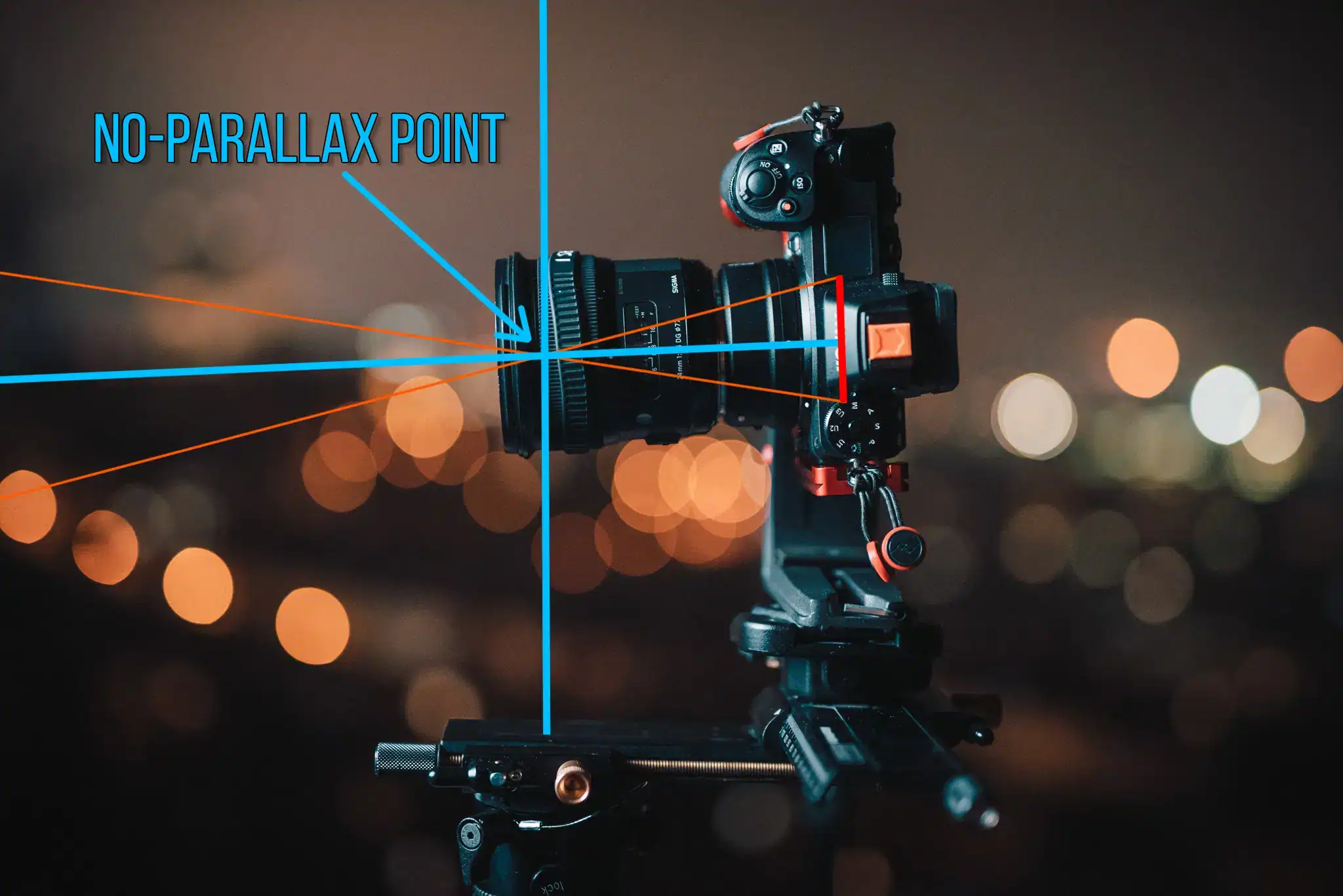
Panoramic Head Basics (Recommended Video)
If this is your first time setting a panoramic head, this short video accelerates your setup and avoids common mistakes.
Step-by-Step Shooting Guide
Standard Static Scenes
- Level and align:
- Level the tripod with a leveling base.
- Mount the GFX + Peleng on your pano head. Enable “Shoot Without Lens” in the GFX menu (required for manual lenses via adapters).
- Calibrate the nodal point: place a near object (1–2 m) aligned with a far object; pan left/right. Adjust fore-aft until their relative position stays fixed through the pan.
- Manual exposure and WB:
- Set manual mode. Meter the brightest part (e.g., near windows or sunlit sky); expose to protect highlights.
- Fix white balance (Daylight outdoors, custom Kelvin indoors) to avoid color shifts between frames.
- Capture sequence:
- 3 shots: yaw 0° / 120° / 240° (tilt 0°). Overlap ~30%.
- Or 4 shots: yaw 0° / 90° / 180° / 270° for safer overlap and cleaner tripod/nadir coverage.
- Use 2 s self-timer or remote. Use EFCS. Keep aperture around f/8 for optimal sharpness and depth of field.
- Nadir shot:
- Tilt down ~-90° for a dedicated ground shot, or move the tripod and shoot a handheld patch at the same nodal position if your head supports it.
HDR / High Dynamic Range Interiors
- Bracket 3–5 frames at ±2 EV to balance bright windows and interior shadows. The GFX 50 supports AE bracketing; choose steps that fully cover the dynamic range.
- Lock WB and aperture; vary shutter only. Keep ISO low (100–200) to maximize highlight recovery and color fidelity.
Low-Light / Night Scenes
- Use longer exposures with a solid tripod; start at ISO 100–400. The GFX files stay clean up to around ISO 800 if needed.
- Enable EFCS and use a remote trigger to prevent vibrations. Consider Long Exposure NR only if hot pixels become an issue; otherwise, handle noise in post.
Crowded Events
- Do two passes: the first quickly for coverage; the second waiting for clean gaps in critical overlap zones.
- Mark your yaw angles on the rotator for consistent framing, making it easier to mask moving subjects during stitching.
Special Setups (Pole / Car / Drone)
- Secure the camera with a tether; avoid high winds. On a pole, shoot 4 around with slightly higher overlap (~40%) to compensate for sway.
- In a car mount, balance speed and vibration; pick smooth pavement, drive slowly, and consider electronic shutter if rolling shutter artifacts are manageable for your exposures.
Recommended Settings & Pro Tips
Exposure & Focus
| Scenario | Aperture | Shutter | ISO | Notes |
|---|---|---|---|---|
| Daylight outdoor | f/8–f/11 | 1/100–1/250 | 100–200 | Lock WB (Daylight); EFCS + remote |
| Low light/night | f/4–f/5.6 | 1/4–1/30 | 100–800 | Tripod; remote; use noise reduction in post |
| Interior HDR | f/8 | Bracket ±2 EV | 100–400 | Expose for windows; merge HDR per angle before stitching |
| Action / moving subjects | f/5.6–f/8 | 1/200+ | 400–800 | Freeze motion; consider 4-shot around for better overlap |
Critical Tips
- Focus: Set the Peleng to manual focus around 1 m and stop to f/8; depth of field will cover from near foreground to infinity with a fisheye.
- Nodal point calibration: Use the two-object method (near/far) and adjust the fore-aft rail until parallax disappears while panning. Mark the rail for this combo to speed future setups.
- White balance: Fix WB (Kelvin or preset) to avoid stitch seams caused by per-frame auto adjustments.
- RAW over JPEG: Shoot 14-bit RAW for maximum dynamic range and better highlight roll-off, especially when bracketing interiors or sunsets.
- Shutter behavior: Use EFCS on the GFX 50S/50R to minimize shutter shock; a 2 s self-timer or remote reduces micro-blur.
- Flare control: Shade the sun with your hand or a small flag just outside the circle in one frame and patch later. Clean the front element frequently.
Stitching & Post-Processing
Software Workflow
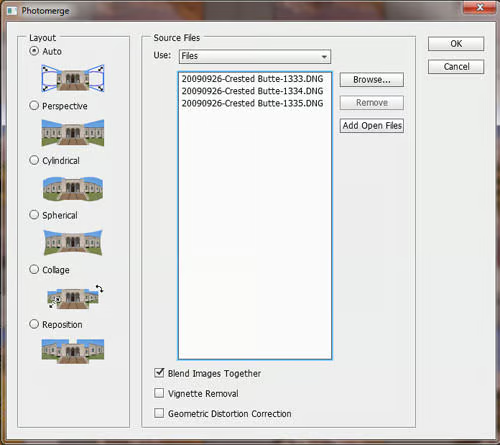
For a circular fisheye, set your stitcher to “circular fisheye” at 8 mm. PTGui is the industry favorite for speed and control; Hugin is an excellent open-source alternative. Typical overlap for circular fisheyes is 25–35%. With 3–4 images around, modern control point detectors usually nail the alignment if nodal calibration is solid. If you shoot HDR brackets, first merge each angle to an HDR TIFF, then stitch the tone-mapped or HDR intermediates for consistent blending. Learn more about pro-grade stitching in PTGui reviews and tutorials. PTGui: in-depth review and pro tips.
Cleanup & Enhancement
- Nadir patch: Use a dedicated nadir shot or AI removal tools; patch with a logo, floor tile clone, or content-aware fill.
- Color and noise: Apply global color corrections after stitching; use masking for mixed lighting. Denoise at RAW or final stage as needed.
- Leveling: In your stitcher, set horizon and optimize roll/yaw/pitch so the equirect is level for VR viewers.
- Export: For web/VR, export equirectangular JPEG at 8,192×4,096 or higher. With 3–4 clean circular-fisheye frames from the GFX 50, expect robust detail in 8–10K width equirects.
For fundamentals on panoramic heads and best practices with DSLRs/mirrorless cameras for VR, see these primers. Panoramic head setup explained. Using a mirrorless camera to shoot and stitch 360 photos.
Useful Tools & Resources
Software
- PTGui (fast, pro-grade stitching)
- Hugin (open-source alternative)
- Lightroom / Photoshop (RAW, color, masks, sky/window balance)
- AI tripod removal tools (for quick nadir patching)
Hardware
- Panoramic heads (Nodal Ninja, Leofoto) with fore-aft and vertical rails
- Carbon fiber tripods with leveling bases
- Wireless remote shutters or intervalometers
- Pole extensions / car mounts with safety tethers
Disclaimer: software/hardware names provided for search reference; check official sites for specs and compatibility.
Field-Proven Scenarios & Case Studies
Indoor Real Estate
Use 4-around with HDR brackets (±2 EV) and a dedicated nadir shot. Keep ISO at 100–200 on the GFX for maximal dynamic range and clean shadow lifts. Fix WB to a Kelvin value to avoid per-frame color shifts. Watch for mirrors and glass—stand slightly off-center to minimize your reflection, and take an extra frame for patching if needed.
Outdoor Sunset
3-around often works, but 4-around gives safer overlap as light falls quickly. Expose for highlights at ISO 100–200, f/8. Consider an extra sky-focused frame for a cleaner zenith. Shade the sun in one frame to reduce flare, then patch from an adjacent frame during masking.
Event Crowds
Speed is critical—shoot 3-around if possible. Use 1/200 s or faster and ISO 400–800. Ask nearby people to hold still for a second as you rotate; if not feasible, capture two passes and mask moving people where needed.
Rooftop or Mast
Use 4-around at ~90° increments with 40% overlap. Tether the camera and keep the pole vertical. The GFX is heavier than a typical APS-C rig; be mindful of wind. Rotate slowly and wait a beat after each movement before firing to reduce sway blur.
Car-Mounted Capture
Secure multiple mounting points and a safety line. Drive slow, choose smooth pavement, and avoid traffic. 4-around with higher overlap gives the stitcher more redundancy. Consider shooting at 1/500 s, ISO 800 if needed, to freeze vibration-induced blur.
Common Mistakes & How to Avoid Them
- Parallax error → Verify nodal alignment with near/far objects; mark the rail for your Peleng–GFX combo.
- Exposure flicker → Manual mode; fixed WB; bracket consistently if doing HDR.
- Tripod intrusion → Shoot a dedicated nadir or patch with a handheld offset shot.
- Ghosting from motion → Two passes and mask; increase overlap to give your stitcher options.
- Night noise → Keep ISO ≤800 when possible; use longer shutter and a remote; denoise in RAW or final equirect.
- Flare and veiling → Clean front element; shade the sun strategically in one frame and patch from another.
Frequently Asked Questions
-
Can I shoot handheld panoramas with the GFX 50S/50R?
Yes, but expect more stitching errors. Use 4-around for extra overlap, keep shutter 1/250 s or faster, and rotate around your body’s approximate nodal point. For critical work, a leveled tripod and pano head are strongly recommended.
-
Is the Peleng 8mm f/3.5 wide enough for a single-row 360?
Yes. It’s a circular fisheye with 180° FOV, so 3–4 frames around typically cover the full sphere. Add a nadir for tripod removal and a zenith if ceiling detail matters.
-
Do I need HDR for interiors with bright windows?
Often, yes. Bracket ±2 EV (3–5 frames) so windows retain detail without crushing shadows. Merge HDR per angle, then stitch for consistent tone across the panorama.
-
How do I avoid parallax issues with this combo?
Use a panoramic head and calibrate the entrance pupil. Adjust the fore-aft rail until near and far objects stay aligned as you pan. Mark the rail once set so you can repeat the position quickly.
-
What ISO range is safe on the GFX 50 in low light?
For tripod work, aim for ISO 100–400. ISO 800 remains very usable if you need faster shutter speeds (events, wind on a pole). Above that, expect more noise and reduced highlight headroom.
-
Can I create a custom panorama setup preset?
Yes—save a Custom Setting with manual exposure, fixed WB, EFCS, RAW, single-shot drive, and your preferred bracketing setup to speed field work.
-
How do I reduce flare with a circular fisheye?
Keep the front element immaculate; shoot at f/8; avoid direct sun when possible; shade the sun with a hand/flag just outside the circle in one frame and patch using an adjacent frame during stitching.
-
What adapter do I need for the Peleng?
The Peleng 8mm was made in mounts like M42 and Nikon F. Use a high-quality M42–GFX or F–GFX adapter, enable “Shoot Without Lens,” and set exposure manually (the lens has no electronics).
Advanced Notes, Specs, and References
Technical notes: the GFX 50 sensor’s large photosites (~5.3 µm) and 14-bit RAW files deliver excellent highlight recovery and clean shadows, ideal for multi-frame stitches. With a circular fisheye on medium format, the effective resolution is determined by the lens’s image circle (roughly 4.5–5K pixels in diameter on this sensor), but you’ll compound resolution with multiple overlapping frames for a high-detail equirect. For deeper reading on focal lengths, FOV, and stitching math, see the PanoTools and pro tutorials. PanoTools: DSLR spherical resolution primer. DSLR/virtual tour FAQs and lens guidance.