
Why This Camera & Lens Are Great for Panoramas
If you’re here to learn how to shoot panorama with Sony a7R V & Nikon Z 14-24mm f/2.8 S, there’s one crucial compatibility note first: the Nikon Z 14-24mm f/2.8 S cannot be mounted on a Sony E-mount body (like the a7R V). The Nikon Z mount has a shorter flange distance, so no mechanical or electronic adapter exists that preserves infinity focus or aperture control to use this Z-mount lens on Sony E bodies. That said, the techniques, overlap math, and workflow below apply perfectly to the a7R V paired with a comparable rectilinear ultra-wide (e.g., Sony FE 12–24mm, Sony 14mm GM, Sony 16–35mm) and also apply if you shoot the Nikon 14–24 S on a Nikon Z body. We’ll call out lens-specific guidance for rectilinear 14–24mm framing throughout.
Why this pairing concept works so well: the Sony a7R V’s 61MP full-frame BSI sensor (approx. 3.76 µm pixel pitch) delivers exceptional detail for 360 photo and gigapixel panoramas, with around 15 stops of usable dynamic range at base ISO. Its 5-axis IBIS (up to 8 stops claimed) is great handheld, but for tripod panoramas you’ll typically disable stabilization. A rectilinear 14–24mm f/2.8 zoom gives you flexible coverage: 14mm captures wide swaths for fewer shots and faster stitching, while 24mm yields higher per-frame detail when you need premium resolution or long tele rows for gigapixel mosaics. Modern rectilinear UWA zooms (like Nikon’s 14–24 S and Sony’s 12–24 GM) offer excellent corner sharpness stopped down to f/5.6–8 and low distortion that stitches predictably in PTGui, Hugin, or Lightroom.
Quick Setup Overview
- Camera: Sony a7R V — Full-frame 61MP BSI sensor; excellent dynamic range at ISO 100; usable ISO 100–800 for clean 360 photo.
- Lens: Nikon Z 14–24mm f/2.8 S (rectilinear UWA) — note: not mountable on a7R V. Use an equivalent Sony-fit rectilinear ultra-wide (e.g., 12–24mm/14mm/16–35mm). Sharp between f/5.6–f/8; low distortion and CA well-corrected.
- Estimated shots & overlap (full-frame rectilinear):
- At 14mm: 8 shots around × 2 rows at ±30° tilt + zenith + nadir (≈18 total) with ~25–30% overlap. Advanced: 6 around per row if overlap is tight and nodal is precise.
- At ~20–21mm: 10–12 around × 2–3 rows + zenith + nadir (≈24–38 total), 25% overlap.
- At 24mm: 12 around × 3 rows (+60°, 0°, −60°) + zenith + nadir (≈38 total), 25% overlap.
- Difficulty: Intermediate (requires nodal alignment and methodical shooting for 360×180 coverage).
Planning & On-Site Preparation
Evaluate Shooting Environment
Before you start, assess light quality, sun direction, and sources of parallax risk (nearby railings, furniture, tree branches). For interiors with windows or glass panels, watch for reflections, and if you must shoot against glass, get as close as possible (1–2 cm) to reduce internal reflections and flare. In high-contrast scenes (sunset cityscapes, interiors with bright windows), plan for HDR bracketing. For windy rooftops, bring a heavier tripod or add weight to the center column hook.
Match Gear to Scene Goals
The Sony a7R V excels in dynamic range and resolution—ideal for meticulous 360 photo work and gigapixel panoramas. In interior real estate, shoot at ISO 100–200 for maximum DR; outdoors at sunset, bracket ±2 EV and keep ISO at 100. For night scenes, ISO 400–800 is safe on the a7R V when tripod-mounted. A rectilinear 14–24mm equivalent reduces shot count at the wide end; use longer focal lengths if you need more detail or if you must avoid ultra-wide perspective stretch near frame edges.
Pre-shoot Checklist
- Charge batteries; format fast UHS-II/CFexpress cards; clean front/rear elements and sensor.
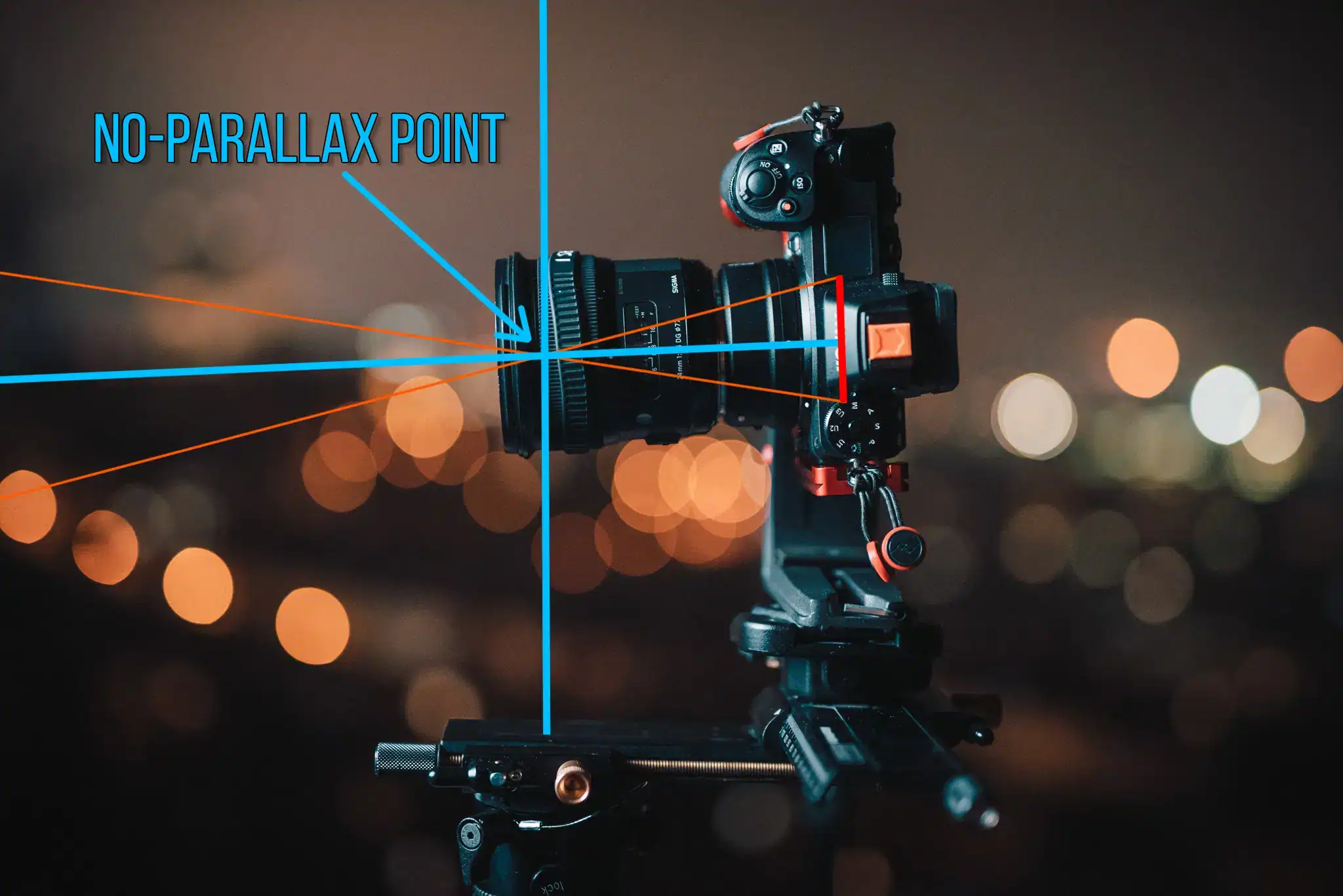
- Level your tripod; verify panoramic head calibration; confirm entrance pupil (no-parallax point) marks for your focal lengths.
- Perform safety checks: tripod on firm ground, tether on rooftops, avoid exceeding pole limits in windy conditions, verify car mounts and speed limits.
- Backup workflow: after your main set, rotate again to capture a safety pass—tiny variations often save a stitch later.
Essential Gear & Setup
Core Gear
- Panoramic head: Lets you rotate around the lens’s entrance pupil (nodal point) to eliminate parallax, essential when foreground objects are close. A dual-axis head (upper rotator + vertical arm) enables consistent multi-row capture.
- Stable tripod with leveling base: A leveling base speeds setup—level once, and your head’s rotation stays true. Carbon fiber legs cut vibration.
- Remote trigger or app: Use Sony Imaging Edge or a wired remote to avoid touching the camera and to speed through bracketed sequences.
Optional Add-ons
- Pole or car mount: Use a safety tether and watch wind loading; rotate slowly and keep shutter speeds reasonable to fight vibration.
- Lighting aids: Small LED panels for dark interiors or to fill shadowy corners; keep light consistent across the set.
- Weather protection: Rain covers, microfibers, and lens hoods to control flare and droplets.
Step-by-Step Shooting Guide
Standard Static Scenes
- Level and lock. Set up the tripod, level the base, and verify your panoramic head’s horizontal index is zeroed.
- Align the nodal point. Shift the camera forward/back on the rail until near and far objects maintain alignment as you pan left/right. Mark rail positions for your 14mm, 18mm, and 24mm settings so you can repeat them fast.
- Manual exposure and white balance. Meter a mid-tone area, then switch to M mode. Lock white balance (e.g., Daylight for outdoors, custom Kelvin indoors). Shoot RAW.
- Capture your rows. For 14mm: a reliable pattern is 8 around at +30°, 8 around at −30°, plus 1 zenith and 1 nadir. Rotate evenly (e.g., 45° increments if shooting 8 per row) and maintain ~25–30% overlap.
- Take a clean nadir (ground) shot. After the main set, tilt the camera straight down and take extra frames for tripod removal later.
HDR / High Dynamic Range Interiors
- Bracket ±2 EV at each position to hold window highlights and lift shadows cleanly. On the a7R V, 3-shot AEB at 2 EV steps is fast and reliable.
- Keep WB locked and focus fixed so the stitched panorama has consistent color and sharpness across brackets.
- Trigger with a remote; pause a beat between bracket bursts to damp vibrations.
Low-Light / Night Scenes
- Use a sturdy tripod, turn IBIS OFF (tripod), and consider electronic front-curtain shutter to minimize shock. Start at f/4–f/5.6, ISO 400–800, and 1/30–1/60 s (longer if wind is calm).
- Enable 2-second self-timer or remote trigger. Avoid Pixel Shift Multi Shooting for moving city lights or clouds.
- Take an extra pass if fast-moving clouds or traffic streaks cause inconsistent frames.
Crowded Events
- Shoot two passes: first for coverage, second to fill gaps when people move. Mark a floor reference so you can maintain tripod position.
- Mask in post to remove duplicates or ghosts; prioritize frames where subjects are least intrusive.
Special Setups (Pole / Car / Drone)
- Secure the rig with a safety tether. On poles, keep the lens as close as practical to the rotation axis and avoid long exposure times in wind.
- On vehicles, use vibration-damped mounts, increase shutter speed (1/250–1/500) and shoot bursts to pick the sharpest frame at each angle.
Recommended Settings & Pro Tips
Exposure & Focus
| Scenario | Aperture | Shutter | ISO | Notes |
|---|---|---|---|---|
| Daylight outdoor | f/8–f/11 | 1/100–1/250 | 100–200 | Lock WB (Daylight), RAW |
| Low light/night | f/4–f/5.6 | 1/30–1/60 | 400–800 | Tripod, remote, IBIS off |
| Interior HDR | f/8 | Bracket ±2 EV | 100–400 | Balance windows & lamps |
| Action / moving subjects | f/5.6–f/8 | 1/200+ | 400–800 | Freeze motion, shoot two passes |
Critical Tips
- Manual focus at hyperfocal. At 14–16mm and f/8, focusing ~1–1.5 m keeps most scenes sharp. Use magnified MF to verify.
- Nodal calibration. Place a near object (~1 m) and a far object. Pan and adjust the fore-aft rail until their alignment doesn’t shift. Mark rail scales for 14, 18, 24mm.
- White balance lock. Avoid AWB drift. Use Kelvin or a custom preset per location.
- RAW capture. Maximizes dynamic range for stitching and HDR merging; reduces banding and color seams.
- IBIS off on tripod. Prevents micro-corrections that can slightly blur or shift frames.
- Use EFCS or mechanical shutter. EFCS reduces shutter shock; full electronic shutter can cause artificial banding under some lights.
Stitching & Post-Processing
Software Workflow
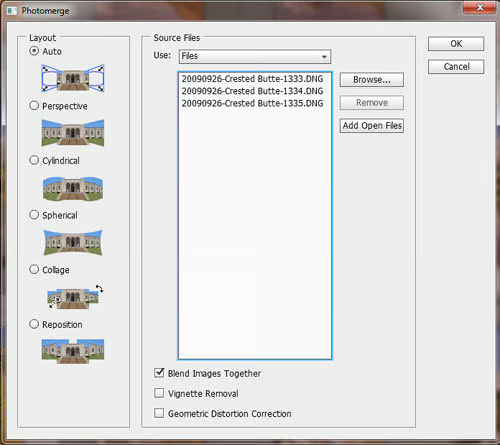
For rectilinear ultra-wides, PTGui gives you fine control over control points, lens models, and horizon leveling. Hugin is an excellent open-source alternative; Lightroom/Photoshop can handle simpler single-row sets. Industry norms: aim for 25–30% overlap at ultra-wide focal lengths; 20–25% can work at longer focal lengths if nodal alignment is precise. Fisheye lenses stitch with fewer frames but need defishing; rectilinear lenses need more frames yet keep straight lines cleaner at the edges.
PTGui’s optimizer and mask tools help tame moving people or trees. For HDR, either pre-merge brackets per angle (e.g., in Lightroom) then stitch, or use PTGui’s HDR workflow to merge and stitch in one pass. After stitching, export an equirectangular 2:1 (e.g., 16000×8000) JPEG or TIFF for VR platforms, then run a nadir patch to remove the tripod.
Cleanup & Enhancement
- Nadir patch: Capture a dedicated down shot and patch manually in Photoshop, or use AI tools for quick tripod removal.
- Color correction: Match white balance across rows; use HSL and local adjustments to even out mixed lighting.
- Noise reduction: Apply modest NR to shadow brackets; preserve detail in textures and fine patterns.
- Horizon leveling: Use the viewer in PTGui/Hugin to fine-tune yaw/pitch/roll for a level output.
Video: Pro Stitching & Panoramic Head Setup
Watch this hands-on tutorial to reinforce the concepts of head setup and stitching for high-end 360 photo.
Further reading on panoramic head principles and 360 photo workflow is available from respected resources such as a panoramic head tutorial and camera/lens guides for virtual tours. Comprehensive panoramic head tutorial • Using a mirrorless to shoot and stitch a 360 photo.
Useful Tools & Resources
Software
- PTGui panorama stitching — industry standard controls and masking. Pro review of PTGui
- Hugin open source — free and capable for multi-row work.
- Lightroom / Photoshop — pre-merge HDR brackets, color matching, nadir patching.
- AI tripod removal tools — speed up nadir cleanup.
Hardware
- Panoramic heads: Nodal Ninja, Leofoto, Sunwayfoto (dual-axis; clear rail scales help repeatability).
- Carbon fiber tripods — stiff, lighter to carry; choose wide leg angles for stability.
- Leveling bases — faster than adjusting tripod legs.
- Wireless remotes — hands-off bracketing and quicker cadence.
- Pole extensions / car mounts — always tether and follow manufacturer load specs.
Disclaimer: software/hardware names provided for search reference; check official sites for details.
Field Notes & Case Studies
Indoor Real Estate
At 14–16mm, shoot two rows at ±30°, f/8, ISO 100–200, AEB ±2 EV. Keep the camera height consistent (1.3–1.5 m) so furniture proportions look natural. Close blinds or time your shoot to avoid extreme sun patches that complicate HDR blending.
Outdoor Sunset Cityscape
Start 5–10 minutes before peak color. Use f/8, ISO 100, and bracket ±2 EV. Do two passes in case wind shakes the tripod on high rooftops. Apply dehaze and warm tone to enhance sky gradations, then ensure straight verticals with the vertical line tool in PTGui.
Event Crowds
At ~20mm, shutter 1/200–1/400, ISO 400–800, f/5.6–f/8. Shoot two full rotations; mask movement where needed. If a key moment happens mid-row, mark your index and return to the missed angles to avoid gaps.
Rooftop Pole Capture
Use a short, rigid pole; avoid fully extended lengths in wind. Pre-focus at hyperfocal, 1/250 s shutter, and rotate slower. Consider fewer, wider shots (14–16mm) to minimize time aloft.
For estimating final resolution vs. focal length and rows, see the spherical resolution reference. Spherical resolution and coverage basics.
Common Mistakes & How to Avoid Them
- Parallax error → Calibrate and mark your nodal positions per focal length; re-check if you change the zoom.
- Exposure flicker → Manual exposure + locked WB; avoid auto ISO; shoot RAW.
- Tripod shadows and footprints → Capture a clean nadir; patch in post.
- Ghosting from movement → Shoot multiple passes; use masks and choose the cleanest individuals per angle.
- Night noise → Keep ISO ≤800 on the a7R V when possible; lengthen exposure and shield from wind.
Frequently Asked Questions
- Can I actually mount the Nikon Z 14–24mm f/2.8 S on the Sony a7R V?
No. The Z-to-E combination is not physically adaptable while retaining infinity focus and aperture control. Use a Sony E-mount ultra-wide (e.g., 12–24mm/14mm/16–35mm) on the a7R V, or use the Nikon 14–24 S on a Nikon Z body. The shooting workflow in this guide applies to either scenario.
- Is a 14–24mm rectilinear wide enough for single-row 360?
Not reliably for full 360×180 coverage. At 14mm, a single row leaves gaps at zenith/nadir. Plan two rows at ±30° plus dedicated zenith and nadir shots. For quick single-row work, a fisheye is preferred.
- Do I need HDR for interiors with bright windows?
Yes, in most cases. Bracket ±2 EV (3 frames) at each angle to preserve window detail and interior shadows. Merge brackets consistently before or during stitching.
- How do I avoid parallax issues with a zoom like 14–24?
Parallax changes with focal length. Calibrate and mark the entrance pupil for 14, 18, and 24mm on your panoramic head rails. Don’t change focal length mid-set.
- What ISO range is safe on the a7R V for low light panoramas?
Aim for ISO 100–400 whenever possible on a tripod. ISO 800 is still clean; beyond that, noise rises and reduces stitch latitude. Favor longer exposures over higher ISO if wind allows.
- Can I set up custom modes to speed pano shooting?
Yes. Save a panorama preset to a Memory Recall (MR): Manual mode, RAW, fixed WB, IBIS off, EFCS on, manual focus at hyperfocal, bracketing settings saved if you use AEB.
- How do I reduce flare with an ultra-wide at sunset?
Use a hood, shade the front element with your hand/flag out of frame, avoid aiming directly at the sun if possible, and bracket to protect highlights.
- What’s the best tripod head for this setup?
A dual-axis panoramic head with fore–aft and side–to–side rail adjustments and clear markings. Smooth, indexed rotators (e.g., 30°/45° detents) reduce framing errors and speed multi-row capture.
Safety, Limitations & Trust Notes
Compatibility first: the Nikon Z 14–24mm f/2.8 S cannot be used on Sony E-mount a7R V bodies. Use native Sony-mount lenses or the Nikon lens on a Nikon Z body. On rooftops or poles, always tether gear and monitor wind. Turn off IBIS on a tripod, use a remote trigger, and avoid electronic shutter under flickering artificial lights. Back up your raws to two locations immediately after the shoot, and keep a written record of head rail settings for consistent results on future jobs.
For deeper technique on panoramic heads and capture flow, see: Set up a panoramic head for high-end 360 photos.