Why This Camera & Lens Are Great for Panoramas
If you want to know how to shoot panorama with Sony a7R V & Laowa 8-15mm f/2.8 FF Zoom Fisheye, this guide walks you through everything from field setup to stitching. The Sony a7R V pairs a 61MP full-frame BSI CMOS sensor (approx. 35.7 × 23.8 mm, ~3.76 µm pixel pitch) with excellent dynamic range at base ISO (around 14–15 stops), giving you clean files that stitch beautifully. Its 5-axis IBIS, AI-assisted AF system, and robust build make it a reliable platform for high-end 360° work. The Laowa 8–15mm f/2.8 is a unique full-frame zoom fisheye: at 8mm it creates a circular fisheye image with a 180°+ field of view, and at 15mm it behaves as a diagonal (full-frame) fisheye covering 180° diagonally. For panographers, that means fewer shots to cover the sphere and fast capture in complex environments.
Compared to rectilinear wide-angles, a fisheye minimizes shot count and stitching seams, at the cost of fisheye distortion you’ll manage in software. The Laowa is fully manual (aperture and focus), which is perfect for pano consistency, and its compact size balances well on panoramic heads. On the Sony a7R V, you also benefit from lossless compressed 14-bit RAW, dual slots supporting CFexpress Type A/SD UHS-II, and dependable battery life—key for long sessions in the field.
Quick Setup Overview
- Camera: Sony a7R V — Full-frame 61MP BSI sensor, ~3.76 µm pixel pitch, excellent base ISO DR, 5-axis IBIS.
- Lens: Laowa 8–15mm f/2.8 FF Zoom Fisheye — Zoom fisheye (circular at 8mm, diagonal at 15mm), fully manual, sharp stopped down, minimal lateral CA when corrected in post.
- Estimated shots & overlap:
- 8mm (circular fisheye): 3 around (0° tilt) + optional zenith + nadir; 35–45% overlap.
- 10–12mm: 4 around + zenith + nadir; ~30% overlap.
- 15mm (diagonal fisheye): 6 around + zenith + nadir for clean seams and higher resolution; ~25–30% overlap.
- Difficulty: Easy for single-row panos; moderate for full 360° with clean nadir replacement.
Planning & On-Site Preparation
Evaluate Shooting Environment
Before setting up, scan the scene for strong light sources, reflections (glass/metal), moving subjects, and wind. For interiors with glass, keep the lens as close as possible (1–2 cm) to reduce internal reflections; shoot perpendicularly to the glass when you can. Outdoors, note the sun’s position—flares can be more pronounced on fisheyes. If you must include the sun, plan a frame where it’s partially hidden (e.g., behind a lamppost) to capture a cleaner source to blend later.
Match Gear to Scene Goals
The a7R V excels in high dynamic range scenes at low ISO, and the Laowa fisheye reduces your total frame count—perfect for busy events or windy rooftops. Indoors, you can safely operate at ISO 100–400; in darker spaces ISO 800–1600 is usually clean with careful exposure. The fisheye’s advantage is speed and reliability: fewer shots, fewer seams, less parallax risk. Its trade-off is pronounced distortion (managed in software) and susceptibility to flare. For bright windows in real estate or museums, plan on bracketing for an HDR panorama using the a7R V’s bracketing drive mode.
Pre-shoot Checklist
- Charge batteries and carry spares; format high-speed cards (prefer lossless compressed RAW).
- Clean front element thoroughly—fisheyes see everything, including dust.
- Level the tripod and verify your panoramic head’s nodal alignment for this lens at your chosen focal length.
- Safety: secure straps, watch wind gusts, use tethers for rooftop/car-mount work, avoid pedestrian traffic zones.
- Backup workflow: capture a second full round with 10–15° extra overlap as insurance, especially in crowds or rapidly changing light.
Essential Gear & Setup
Core Gear
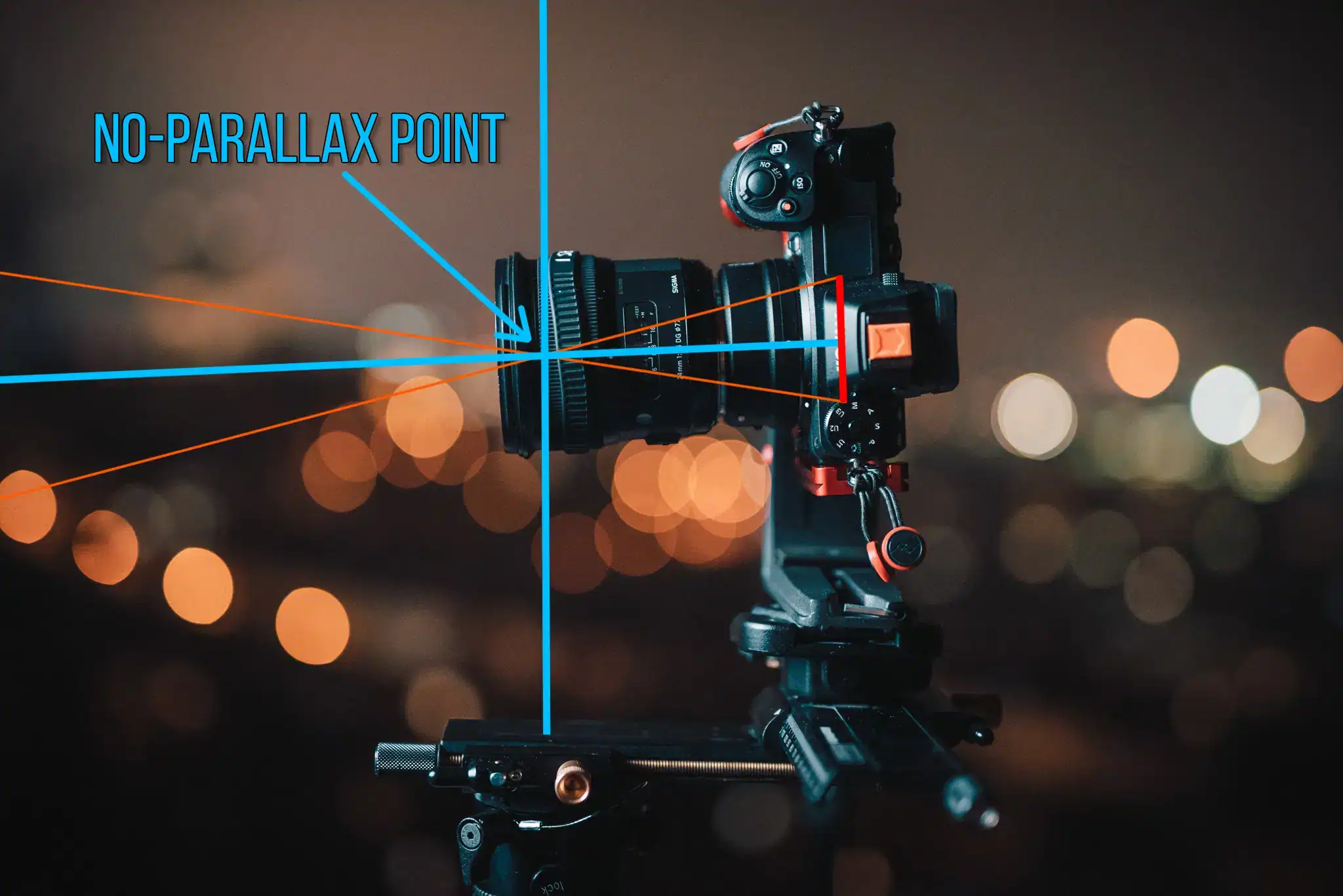
- Panoramic head: Use a rotator with click-stops and an adjustable rail to align the entrance pupil (nodal point) of the Laowa. Proper nodal alignment minimizes parallax, producing clean stitches even in tight interiors.
- Stable tripod with leveling base: A leveling base speeds setup; keep the rotator level so yaw rotation stays consistent.
- Remote trigger or app: Use Sony Imaging Edge Mobile or a wired remote; engage a 2-second self-timer to dampen residual vibrations.
Optional Add-ons
- Pole or car mount: Use safety tethers and guy lines; add vibration damping and avoid high winds. Rotate slower and shoot multiple passes to blend motion blur.
- Lighting aids: Small LEDs or bounced flash for dim interiors—avoid hotspots and keep lighting consistent across frames.
- Weather protection: Rain covers, chamois cloth, and lens hoods (when compatible) to reduce flare and protect the front element.
New to panoramic heads? A practical primer on setup and technique can accelerate your learning curve. See this panoramic head tutorial for step-by-step basics. Learn panoramic head fundamentals
Step-by-Step Shooting Guide
Standard Static Scenes
- Level and align: Level the tripod with the bubble on the leveling base. Mount the a7R V and Laowa, then slide the camera on the rail so the entrance pupil sits over the rotation axis. Verify by aligning near/far objects and pan—if the relative position shifts, adjust until it doesn’t.
- Lock exposure and white balance: Set Manual (M) mode. Dial a fixed shutter, aperture, and ISO; lock white balance (e.g., Daylight 5500K outdoors or custom WB indoors). This prevents frame-to-frame exposure flicker and color shift that cause stitch seams.
- Focus: Use manual focus with focus peaking. For 15mm at f/8, set near the hyperfocal distance (roughly 0.7 m) to keep everything sharp from ~0.35 m to infinity. At 8–10mm, hyperfocal can be as close as 0.25–0.4 m—still set a conservative distance to avoid foreground softness.
- Capture sequence:
- 8mm (circular): 3 shots around at 120° intervals. If you need a clean ceiling, add one zenith; for the ground, capture a nadir or plan to patch.
- 10–12mm: 4 shots around at 90° intervals, plus zenith and nadir.
- 15mm: 6 shots around at 60° intervals, plus zenith and nadir for seamless coverage and higher resolution.
- Nadir shot: Tilt up or shift the tripod slightly and shoot the ground plate so you can patch the tripod area in post.
HDR / High Dynamic Range Interiors
- Bracket ±2 EV (3 or 5 frames) to balance bright windows and interior shadows. Keep WB locked so brackets share the same color.
- Use the a7R V’s continuous bracketing and a remote; keep the camera still between brackets to maintain stitch accuracy.
- Merge HDR per view before stitching, or stitch exposure stacks directly in PTGui. Both workflows work; merging first gives you more control over halos and color.
Low-Light / Night Scenes
- Stabilize and lengthen exposure: With a tripod, use f/4–f/5.6, longer shutters (1–4 seconds), and keep ISO to 100–800 when possible; 1600–3200 is usable if needed, but expose carefully.
- Disable IBIS when on a tripod to prevent micro-blur. Use EFCS for vibration control; avoid full electronic shutter if banding from artificial lights is present.
- Use a remote or 2s timer to prevent shake; review a 100% zoom for sharpness before moving on.
Crowded Events
- Two passes strategy: First pass for framing; second pass waiting for people to move out of overlaps. This gives you clean seams for masking.
- Shoot faster: At 8–12mm you can capture the sphere quickly; use 1/200s+ if possible to freeze motion and reduce ghosting.
- Mask later: In the stitcher, pick the cleanest people-free regions from each frame.
Special Setups (Pole / Car / Drone)
- Safety first: Use tethers and secure clamps. On poles, keep the center of gravity aligned; on cars, avoid highways and test at low speeds.
- Wind and vibration: Short exposures, higher ISO if necessary, and multiple passes. Consider adding a dampener to the mount.
- Rotation cadence: Rotate more slowly and allow oscillations to settle before each exposure.
Recommended Settings & Pro Tips
Exposure & Focus
| Scenario | Aperture | Shutter | ISO | Notes |
|---|---|---|---|---|
| Daylight outdoor | f/8–f/11 | 1/100–1/250 | 100–200 | Lock WB (Daylight/5500K). Disable IBIS on tripod. |
| Low light/night | f/4–f/5.6 | 1/30–1s | 100–800 (1600–3200 if needed) | Use remote/2s timer. Check for banding under LEDs. |
| Interior HDR | f/8 | Bracket ±2 EV | 100–400 | Merge per view or stitch exposure stacks. |
| Action / moving subjects | f/5.6–f/8 | 1/200+ | 400–800 | Double-pass method to minimize ghosting. |
Critical Tips
- Manual focus: Use focus peaking and set near hyperfocal (15mm at f/8 ≈ 0.7 m) to keep near-to-far sharpness.
- Nodal calibration for this combo: Start with the camera plate so the tripod’s rotation axis sits roughly 6–7 cm in front of the sensor plane at 8–10mm, and ~5–6 cm at 15mm. Fine-tune by aligning a near and far object in the frame; pan and adjust until there’s no relative shift.
- White balance lock: Mixed lighting creates seam color shifts; pick a consistent WB or shoot a custom WB card per location.
- RAW recommended: Use 14-bit lossless compressed RAW for maximum DR and cleaner stitch transitions.
- IBIS and shutter choice: Turn off IBIS on a tripod. Use EFCS for most exposures; switch to mechanical if you see EFCS artifacts with very fast shutter speeds or certain light sources.
- File management: Use dual-card writing (RAW to Slot 1, backup to Slot 2) for safety. Name folders per location and sequence for easy PTGui batch processing.
Stitching & Post-Processing
Software Workflow
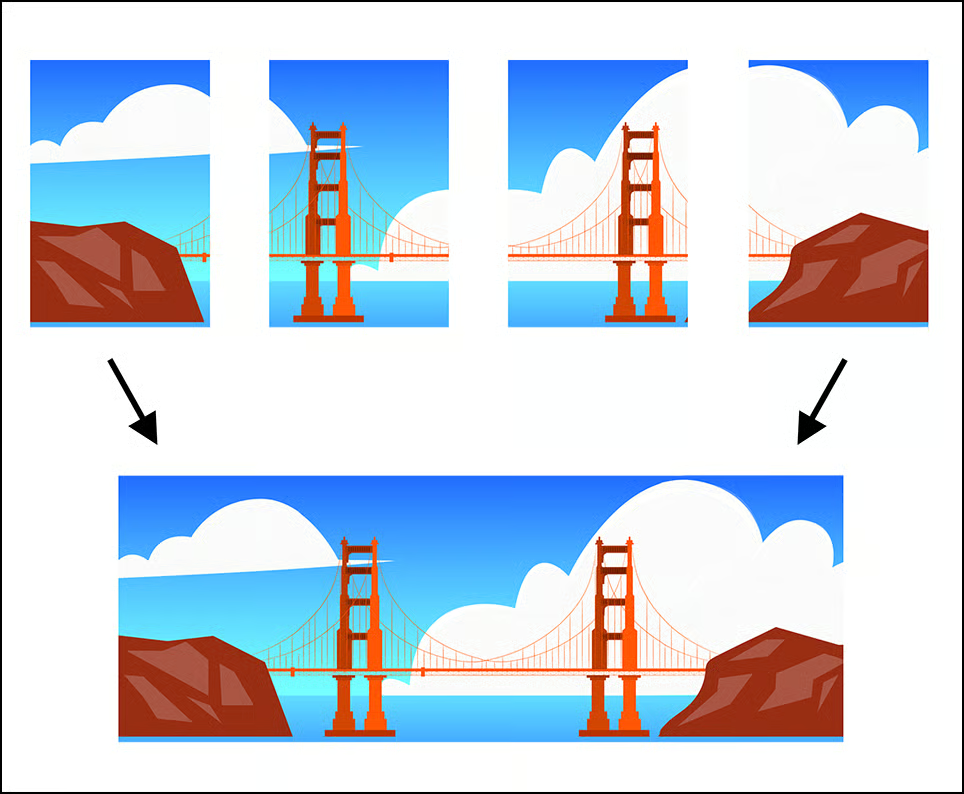
For fisheye panoramas, PTGui is an industry favorite thanks to robust control point detection and lens modeling. With the Laowa 8–15mm, set lens type to “circular fisheye” at 8mm or “full-frame fisheye” at 10–15mm, and start with 25–35% overlap between frames. Hugin is an excellent open-source alternative. Lightroom/Photoshop can stitch simple panos but are less flexible with 360 projections and nadir optimization. For reference-quality VR deliverables, export an equirectangular 2:1 image from PTGui, then finalize color in Lightroom or Photoshop. A hands-on review of PTGui’s strengths is worth a read if you’re evaluating tools. Why PTGui excels for complex panoramas
Cleanup & Enhancement
- Nadir patching: Use a dedicated nadir shot or clone/AI tools to remove the tripod. Plan your nadir capture to simplify patching.
- Color and noise: Match tones across frames, reduce noise in shadows (especially at ISO 1600+), and ensure consistent WB.
- Geometry: Level the horizon; adjust pitch/roll/yaw. In PTGui, set verticals and use the “Level Panorama” tool.
- Export formats: For VR, export 8K–12K equirectangular JPEG/TIFF depending on platform. Follow Oculus’ guidance for file specs and metadata. Oculus recommendations for DSLR/mirrorless 360 photos
Tip: Want a benchmark for expected output resolution with fisheyes and different shot counts? The Panotools spherical resolution guide is a great resource. Estimate spherical resolution for your setup
Tutorial Video
Prefer to see the process? This video offers a practical walk-through of panorama shooting and stitching fundamentals.
For more on high-end head setup, see the panoramic head setup principles. Set up a panoramic head for high-end 360°
Useful Tools & Resources
Software
- PTGui panorama stitching (batch-friendly, powerful control point handling)
- Hugin open source (great value, deep controls)
- Lightroom / Photoshop for color and retouching after stitching
- AI tripod removal tools for fast nadir patching
Hardware
- Panoramic heads: Nodal Ninja, Leofoto, and other rail-based systems
- Carbon fiber tripods with leveling bases for speed and stability
- Wireless remote shutters or app-based triggers
- Pole extensions / car mounts with safety tethers for specialized shots
Disclaimer: software/hardware names provided for search reference; check official sites for details.
Common Mistakes & How to Avoid Them
- Parallax error: Misaligned entrance pupil causes stitching ghosts. Recalibrate your rail whenever you change focal length.
- Exposure flicker: Auto exposure/WB introduces seams. Use manual mode and a fixed WB.
- Tripod shadows and clutter: Shoot a dedicated nadir and plan a clean patch.
- Ghosting from movement: Use faster shutters, multiple passes, and mask during stitching.
- High-ISO noise: Keep ISO low on a tripod; expose to the right without clipping highlights.
- Flare and veiling: Shade the front element with your hand (kept out of frame), change your angle, or capture a cleaner frame to blend.
Field-Proven Scenarios with the a7R V + Laowa 8–15mm
Indoor Real Estate
At 10–12mm, capture 4 around + zenith + nadir. Bracket ±2 EV for bright windows and warm lamps. Keep ISO 100–200, f/8, and a shutter around 1/4–1s on a tripod. Lock WB to a custom value for consistent colors across rooms. The fisheye keeps your total frames low, enabling quick multi-room coverage.
Outdoor Sunset
Use 15mm for higher resolution: 6 around + zenith + nadir, f/8, 1/100s, ISO 100–200. Expose to preserve highlight detail in the sky; you can lift shadows later thanks to the a7R V’s strong base ISO dynamic range. If wind picks up, increase shutter speed and add a safety pass.
Event Crowds
Work at 8–10mm to minimize shot count. Shoot two passes: one quick capture during peak action, and another when gaps appear. In PTGui, prioritize the cleaner regions to remove ghosted people.
Rooftop or Pole Shooting
Use a lightweight panoramic head and carbon fiber pole. At 8mm, 3 around is fast and stable. Add a tether to the camera body and pole top, and stabilize with a belt or guy line. Rotate slowly and use 1/200s+ to fight vibrations.
Workflow & Data Safety
Use dual-slot recording for redundancy (RAW to Slot 1 and backup to Slot 2). After each location, quickly review a few frames at 100% to check sharpness and flare. Keep a consistent naming convention per location and row, and write brief notes (focal length used, number of shots, overlap) to speed up PTGui template selection later. Back up to a second storage device at the end of the day. For complex sessions, capture an extra safety round with slightly different overlaps; it can save a critical job if one frame was soft or obstructed.
Frequently Asked Questions
-
Can I shoot handheld panoramas with the Sony a7R V?
Yes, for simple single-row panoramas or quick 360s in bright light. Use 8–10mm to minimize shot count and set 1/250s+ to avoid motion blur. However, for professional 360s with close foregrounds, use a tripod and nodal alignment to avoid parallax errors.
-
Is the Laowa 8–15mm wide enough for single-row 360?
Absolutely. At 8mm (circular fisheye), 3 around often covers the horizon; add zenith/nadir as needed. At 15mm (diagonal fisheye), 6 around + zenith + nadir provides high-resolution coverage with clean seams.
-
Do I need HDR for interiors with bright windows?
In most cases, yes. Bracket ±2 EV (3–5 frames) at each camera position. Merge HDR per view or stitch exposure stacks in PTGui to hold detail in windows and shadows without noise or banding.
-
How do I avoid parallax issues with this lens?
Use a panoramic head and align the entrance pupil. Start with the rail offset of ~6–7 cm ahead of the sensor plane at 8–10mm and ~5–6 cm at 15mm; fine-tune using near/far object alignment tests. Recalibrate when changing focal lengths.
-
What ISO range is safe on the a7R V in low light?
On a tripod, keep ISO 100–800 when possible and lengthen shutter. ISO 1600–3200 is usable for events or wind, but expose carefully to protect shadows. Always shoot RAW for optimal noise handling.
Safety & Gear Protection
Rooftops, poles, and car mounts require extra caution. Always tether the camera and head; avoid edges and high winds; keep the tripod’s center column low; and never leave gear unattended. In crowds, maintain a visible perimeter and use a spotter if possible. Weatherproof your kit and wipe off moisture immediately—fisheye front elements are exposed and prone to droplets and fingerprints.
Final Thoughts
The Sony a7R V and Laowa 8–15mm f/2.8 FF Zoom Fisheye make a fast, flexible, and high-quality combination for 360° work. With the right panoramic head, careful nodal calibration, and a disciplined workflow, you can consistently produce detailed, seamless panoramas—whether it’s a high-contrast interior, a windy rooftop, or a bustling event. For deeper dives into pano best practices and gear choices, this guide offers a thorough overview of virtual tour techniques and camera/lens selection. 360 virtual tour best practices and gear insights