Why This Camera & Lens Are Great for Panoramas
If you want to know how to shoot panorama with Sony A7R IV & Pentax DA 10-17mm f/3.5-4.5 ED Fisheye, you’re combining a class-leading high-resolution mirrorless body with an ultra-wide fisheye that dramatically reduces shot count. The Sony A7R IV’s 61MP full-frame sensor (approx. 35.7 × 23.8 mm, ~3.76 µm pixel pitch) provides exceptional detail and roughly 14.5 EV of dynamic range at base ISO—excellent for both bright landscapes and high-contrast interiors. Its in-body stabilization (IBIS), reliable manual focus aids (magnification and peaking), silent/electronic front curtain shutter options, and dual UHS-II card slots all contribute to robust pano workflows on location.
There are two practical considerations with this combo. First, the Pentax DA 10–17mm is an APS-C diagonal fisheye designed for the K-mount, so on the A7R IV you’ll use an adapter and switch the camera to APS-C crop mode, yielding 26MP files—still more than enough for high-quality 360 photos and virtual tours. Second, ensure your K-to-E adapter provides aperture control. A “smart” adapter (e.g., one that actuates the Pentax aperture lever) or a mechanical lever adapter is strongly recommended. Without aperture control, you’d be stuck wide open, which is suboptimal for edge-to-edge sharpness.
The fisheye’s huge field of view (up to ~180° diagonal at 10mm on APS-C) means you need fewer frames for a full spherical pano. Distortion is expected with fisheyes, but modern stitchers like PTGui handle fisheye projections natively, making stitching straightforward and fast. This gives you speed on site, fewer chances for parallax errors, and a lighter data footprint without sacrificing resolution.
Quick Setup Overview
- Camera: Sony A7R IV — full frame 61MP sensor, used in APS-C crop mode (~26MP) for this lens; excellent dynamic range, strong manual focus aids.
- Lens: Pentax DA 10–17mm f/3.5–4.5 ED Fisheye — diagonal fisheye for APS-C; best sharpness around f/5.6–f/8; moderate CA that’s easily corrected in post.
- Estimated shots & overlap (APS-C, 10mm):
- Safe: 6 around at 0° tilt (every 60°) + 1 zenith + 1 nadir (~30% overlap).
- Speed: 4 around at +10° tilt (every 90°) + 1 zenith + 1 nadir (~30–35% overlap).
- Detail: 8 around at 0° tilt + Z + N for very high-quality floors/ceilings.
- Difficulty: Moderate (fisheye simplifies capture, but adapter/aperture control and nodal alignment add complexity).
Planning & On-Site Preparation
Evaluate Shooting Environment
Before setting up, scan the scene for moving elements (people, cars, trees in wind), reflective surfaces (glass, polished floors), and strong backlights that could cause flare. If shooting through glass, keep the lens nearly parallel and as close as possible (1–2 cm) to reduce reflections and ghosting. For interiors with bright windows, plan on HDR bracketing to retain highlights without crushing shadows.
Match Gear to Scene Goals
The A7R IV’s deep dynamic range at ISO 100 makes it a great base for HDR panoramas. In most real estate or museum interiors, ISO 100–400 with longer shutter speeds is ideal. Outdoors at sunset, expect to use bracketing or careful exposure placement to maintain highlight texture. The Pentax 10–17mm fisheye’s huge coverage means fewer frames and faster captures—very helpful in crowds or changing light—at the cost of fisheye distortion that you’ll manage during stitching. For night scenes, the A7R IV remains clean up to ISO ~800–1600; on a tripod, keep ISO low and extend shutter times instead.
Pre-shoot Checklist
- Charge batteries and bring spares; format high-speed UHS-II cards.
- Clean the front element and sensor; fisheyes are unforgiving with dust/flaring.
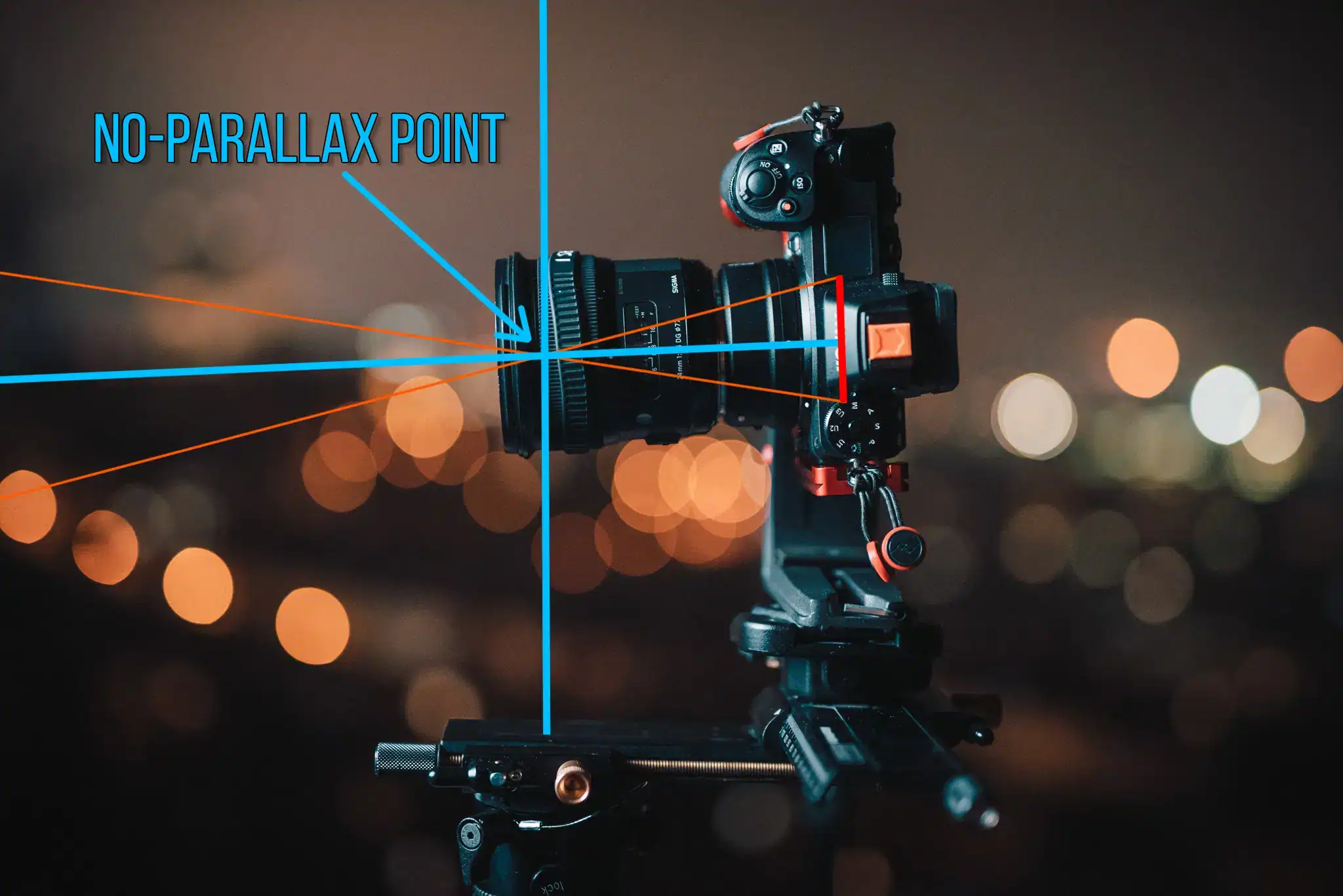
- Calibrate your panoramic head to the lens’ no-parallax point (entrance pupil).
- Level the tripod with a leveling base for fast horizon correction.
- Safety checks: secure straps/tethers on rooftops or over railings; avoid strong winds, and never leave a pole unattended.
- Backup workflow: if time allows, do one extra safety round of the panorama.
Essential Gear & Setup
Core Gear
- Panoramic head: A two-axis pano head (e.g., Nodal Ninja, Leofoto) lets you place the lens’ entrance pupil over the rotation axes to eliminate parallax. This is critical for clean stitches, especially indoors near furniture and railings.
- Stable tripod with leveling base: A leveling base speeds setup and helps maintain consistent roll across frames.
- Remote trigger or Sony Imaging Edge app: Keep hands off the camera to avoid vibrations.
Adapter Notes for This Combo
Use a K-to-E mount adapter that provides aperture control for the Pentax DA lens. Smart adapters that actuate the Pentax aperture lever are ideal; mechanical lever adapters are acceptable but may offer coarse control. Set the A7R IV to APS-C crop mode to avoid severe vignetting. Expect to shoot in manual focus (recommended for panos anyway) and manual exposure for consistent stitching.
Optional Add-ons
- Pole or car mount: Great for elevated or vehicle-based 360 photos. Always use a safety tether, minimize wind exposure, and watch vibration—short, deliberate stops between exposures reduce blur.
- Low-light aids: Small LED panels or bounced strobes can even out interior lighting. Keep it consistent across frames.
- Weather protection: Rain covers and lens hoods help with drizzle and flare. Fisheyes are prone to flare; bring a microfiber and a small flag or your hand to block stray light out of frame.
Step-by-Step Shooting Guide
Standard Static Scenes
- Level and Align Nodal Point
- Mount the A7R IV + adapter + 10–17mm on your panoramic head. Start at 10mm.
- Use a simple parallax test: place two vertical objects (one close, one far) near a frame edge; rotate the rig. Adjust the fore-aft position until the near/far alignment doesn’t shift as you pan. Mark the rail for this lens and focal length.
- Set Manual Exposure and WB
- Switch to Manual exposure; expose for midtones while protecting highlights. For interiors with windows, plan HDR.
- Lock White Balance (e.g., Daylight outdoors, custom Kelvin indoors) to avoid color shifts between frames.
- Focus and Stabilization
- Use Manual Focus with magnification; focus at or near the hyperfocal distance at f/8 for maximum depth of field.
- Turn IBIS off on a tripod to prevent micro-corrections during exposure.
- Capture Sequence (10mm APS-C)
- Safe quality: 6 shots around at 0° tilt (every 60°), plus 1 zenith (+90°) and 1 nadir (−90°). Aim for ~30% overlap.
- Fast: 4 shots around at +10° tilt (every 90°) + 1 zenith + 1 nadir. Check edges for coverage gaps before leaving.
- Use a remote or 2-sec self-timer; EFCS on to reduce shutter shock.
- Dedicated Nadir Shot
- After the main round, remove the camera/tripod head and take a hand-held or offset nadir frame to simplify tripod removal during post.
HDR / High Dynamic Range Interiors
- Bracket ±2 EV or ±3 EV per angle to balance bright windows and shadowed interiors. The A7R IV’s DR is excellent, but HDR maintains highlight texture in extreme contrast.
- Lock WB and keep aperture fixed. Only change shutter speed during bracketing.
- Use continuous bracket mode with a remote for quick, consistent capture around the rig.
Low-Light / Night Scenes
- Prefer ISO 100–400 on a tripod; extend shutter time as needed (several seconds is fine). If people move, capture multiple frames for later masking.
- Enable EFCS; use a 2–5 s timer or remote. Shield the lens from stray streetlights to reduce flare.
- On the A7R IV, ISO 800–1600 is still usable if wind or vibration forces shorter shutter times.
Crowded Events
- Shoot two passes around: one quickly, one waiting for gaps. This gives you clean patches to mask out moving subjects during stitching.
- Consider 6-around for more coverage, which helps with seam placement away from faces.
Special Setups (Pole / Car / Drone)
- Pole: Keep the pole vertical (use a bubble level), reduce wind exposure, and trigger via app. Use a short pause after each rotation stop.
- Car mount: Park safely, turn off engine to prevent vibration, and use faster shutter speeds (1/200+). Never shoot from a moving vehicle without proper permits and safety measures.
Recommended Settings & Pro Tips
Exposure & Focus
| Scenario | Aperture | Shutter | ISO | Notes |
|---|---|---|---|---|
| Daylight outdoor | f/8–f/11 | 1/100–1/250 | 100–200 | Lock WB (Daylight); turn IBIS off on tripod |
| Low light/night | f/4–f/5.6 | 1/30–several s | 100–800 | Tripod & remote; EFCS; shield lens from flare |
| Interior HDR | f/8 | Bracket ±2 EV | 100–400 | Protect highlights; keep WB fixed |
| Action / moving subjects | f/5.6–f/8 | 1/200+ | 400–800 | Freeze motion; do two-pass capture |
Critical Tips
- Manual focus near hyperfocal at f/8. Use focus magnification to confirm critical detail.
- Nodal point calibration: expect the entrance pupil to be near the front group at 10mm. Use a parallax test and mark the rail for 10, 12, 14, and 17mm if you plan to vary focal length.
- White balance lock: Avoid automatic WB shifts frame-to-frame, especially under mixed lighting.
- RAW capture: Gives maximum leverage for color, CA correction, and noise control.
- IBIS: Off on tripod; On only if shooting handheld or on a flexing platform.
- Pixel Shift: Not recommended for typical panos due to time/registration overhead, but useful for static detail tiles if you’re building gigapixel composites in segments.
Prefer to watch a quick walkthrough on pano head setup? This short video complements the steps above.
For a deeper dive into panoramic head alignment theory and practice, this illustrated guide is a solid reference: Panoramic head tutorial.
Stitching & Post-Processing
Software Workflow
With a fisheye, stitching is faster because you have fewer frames. PTGui is a popular pro choice thanks to robust fisheye handling, masking, and viewpoint correction. Hugin is an excellent open-source alternative. Typical flow: import all images (and bracket sets if HDR), specify lens type as “diagonal fisheye,” let the software estimate FOV, run alignment/optimization, then preview seams. For fisheye shots, aim for ~25–35% overlap; rectilinear workflows usually prefer ~20–25%. After alignment, apply HDR fusion or tonemapping if bracketed, then output an equirectangular 2:1 panorama for VR players.
For a practical evaluation of PTGui’s strengths (speed and control), see this review: PTGui review on Fstoppers.
Cleanup & Enhancement
- Nadir/tripod removal: Use a dedicated nadir shot and PTGui’s Viewpoint Correction or patch in Photoshop/Affinity. AI-based retouch tools can speed up floor fixes.
- Color and CA: Correct chromatic aberration and vignetting. Fisheyes can show purple/green fringing; RAW profiles help.
- Noise reduction: Apply selectively to shadows in low-light panos.
- Leveling: Ensure the horizon is flat; adjust yaw/pitch/roll in your stitcher for true verticals.
- Export: Save a 16-bit TIFF master and a compressed JPEG. For VR, export a 2:1 equirectangular (e.g., 12k–16k on this combo). For web/Meta Quest pipelines, see best practices here: Using a DSLR/mirrorless to shoot and stitch a 360 photo.
If you want to estimate how many shots you need for a given lens and sensor density, this classic reference is handy: DSLR spherical resolution (PanoTools Wiki).
Useful Tools & Resources
Software
- PTGui panorama stitching
- Hugin open source
- Lightroom / Photoshop / Affinity Photo
- AI tripod removal tools (e.g., generative fill)
Hardware
- Panoramic heads: Nodal Ninja, Leofoto, Fanotec
- Carbon fiber tripods with leveling bases
- Wireless remote shutters or Sony Imaging Edge Mobile
- Pole extensions and car mounts with safety tethers
- K-to-E adapter with aperture control for Pentax DA lens
Disclaimer: product names are for reference; confirm compatibility and current documentation before purchase.
Field Cases: What Works and Why
Indoor Real Estate (Mixed Light)
Set the A7R IV to ISO 100–200, f/8, and bracket ±2 EV per angle. Use 6-around + Z + N for robust overlap around window frames—these are common seam trouble spots. Lock WB (e.g., 4000–4500K if warm tungsten dominates) and keep it consistent. In PTGui, set lens type to fisheye and mask out moving people or flickering TVs. The 26MP APS-C output still resolves fine texture in wood and fabrics while keeping file sizes manageable for tour platforms.
Outdoor Sunset (High DR)
Sun near the horizon produces extreme contrast and flare risk. Use the lens hood and shade the sun just outside the frame if possible. Bracket ±2 or ±3 EV to preserve highlight gradations in clouds. Shoot 6-around to move seams away from the sun direction, making flare cleanup easier. Keep ISO at 100 for clean tones; shutter speed will vary widely between brackets—use a remote and avoid moving the tripod between angles.
Crowded Event (Motion Control)
Use 4-around + Z + N to be fast. If people keep walking through seams, do two rounds and later mask the cleaner areas. At 10mm fisheye, people near the camera will distort—position the tripod where subjects are a few meters away to reduce exaggerated scaling at the edges.
Rooftop / Pole (Exposure Stability)
Wind is your enemy. Lower the pole height to reduce sway, accelerate shutter to 1/200–1/400 at ISO 200–400, and limit to 4-around to minimize time aloft. Use a safety tether. If the pole flexes, pause and let oscillations settle before each exposure.
Safety, Limitations, and Honest Advice
- Adapter realities: The Pentax DA 10–17mm requires aperture control via a K-to-E adapter. Test aperture operation at home to avoid discovering you’re stuck wide open on site.
- Coverage on full frame: Use APS-C crop mode on the A7R IV to avoid heavy vignetting. Some shave the DA’s hood to squeeze more coverage, but that’s an irreversible mod—proceed only if you fully understand the risks.
- Weather and wind: Fisheyes have big front elements—keep a microfiber handy, and avoid shooting in salt spray without a protective filter or cover.
- Backup plan: If the scene is critical, shoot an extra full pass. Cards can fail and people can walk into frames—redundancy is cheaper than reshoots.
Common Mistakes & How to Avoid Them
- Parallax error → Always align the entrance pupil and use a pano head; verify with a simple near/far alignment test.
- Exposure flicker → Manual exposure and locked WB. Don’t rely on auto modes for 360 photo sequences.
- Tripod in frame → Capture a clean nadir or plan to patch it later with a dedicated nadir shot.
- Ghosting from movement → Shoot two passes and mask in post; increase overlap for more seam options.
- Night noise → Keep ISO low and extend shutter; the A7R IV’s base ISO DR is excellent—use it.
Frequently Asked Questions
- Can I shoot handheld panoramas with the Sony A7R IV?
Yes for partial panos; risky for full 360s, especially indoors with near objects. Handheld introduces parallax and level errors. If you must, use high overlap (40%+), faster shutter speeds, and stitch with robust control point cleanup. A tripod+pano head remains the reliable option.
- Is the Pentax DA 10–17mm wide enough for a single-row 360 on APS-C crop?
Yes. At 10mm, 6-around at 0° tilt plus a zenith and nadir is a safe single row. You can do 4-around at a slight upward tilt (+10°) in a pinch but check coverage near the zenith/nadir edges.
- Do I need HDR for interiors with bright windows?
Usually yes. Bracket ±2 EV or ±3 EV to retain window detail while keeping interior shadows clean. Merge in PTGui or Lightroom, then stitch, or let PTGui handle both alignment and HDR fusion.
- How do I avoid parallax issues with this combo?
Use a panoramic head and calibrate the entrance pupil at 10mm. Place two vertical objects near a frame edge (one close, one far) and adjust the fore-aft slider until relative positions don’t shift as you pan. Mark your rail for repeatability.
- What ISO range is safe on the A7R IV in low light for panos?
On a tripod, stick to ISO 100–400 and extend shutter time. If wind or vibrations demand it, ISO 800–1600 is still very usable, especially when you’re merging multiple frames (and possibly HDR) which averages noise.
- Can I set up custom modes for pano shooting?
Yes. Program a custom mode with Manual exposure, Manual focus, IBIS off, EFCS on, WB locked, and drive mode set for bracketing or 2-sec timer. This speeds up your field workflow and ensures consistency.
- How do I reduce flare with a fisheye?
Avoid pointing directly at strong light sources; shade the lens with a hand or flag outside the frame; keep the front element spotless; and review each angle for ghosts. You can also place seams away from the sun to make cleanup easier.
- What’s the best tripod head for this setup?
A lightweight, rigid panoramic head with precise fore-aft and lateral adjustments (e.g., Nodal Ninja or Leofoto) is ideal. Add a leveling base and a rotator with fixed detents (e.g., 60° stops for 6-around) to speed up repeatable captures.
Extra Visual References
Wrap-Up
Now you know how to shoot panorama with Sony A7R IV & Pentax DA 10-17mm f/3.5-4.5 ED Fisheye: leverage the A7R IV’s high dynamic range and manual control, pair it with the fisheye’s expansive coverage to minimize frames, and use a calibrated panoramic head to eliminate parallax. Stick to locked exposure and WB, favor RAW, and stitch with proven tools like PTGui or Hugin. With practice—and a reliable adapter that provides aperture control—you’ll capture fast, clean 360 photos indoors and out.
For additional background on DSLR/mirrorless 360 workflows and best practices, this overview is a helpful companion: DSLR virtual tour FAQ and lens guide.