Why This Camera & Lens Are Great for Panoramas
The Sony A7R III paired with the Samyang 12mm f/2.8 ED AS NCS Fish-Eye is a powerful, efficient combo for 360° and ultra-wide panoramas. The A7R III is a 42.4MP full-frame mirrorless camera (35.9 × 24 mm sensor, approx. 4.5 µm pixel pitch) with excellent dynamic range (~14.5 EV at base ISO), low read noise, and class-leading battery life (NP‑FZ100). It delivers clean files from ISO 100–800 and remains very usable to ISO 1600–3200 for night scenes. You also get 5-axis IBIS (turn it off on a tripod), dual card slots, and responsive live view—great for manual focus and precise alignment.
The Samyang 12mm f/2.8 is a diagonal fisheye for full-frame with an approx. 180° diagonal field of view (about 124° horizontal, ~94° vertical). As a fisheye, it lets you cover the sphere with fewer shots than a rectilinear lens, reducing time on site and minimizing stitching complexity—especially helpful in fast-changing light or crowded scenes. Its manual focus and aperture control are simple and reliable; the Nano Coating System (NCS) helps tame flare, although as with any bulbous fisheye, strong light sources can still produce ghosts. Mounted on a calibrated panoramic head, this combo creates highly stitchable frames with consistent overlap.
Quick Setup Overview
- Camera: Sony A7R III — Full-Frame 42.4MP BSI-CMOS, ~14.5 EV DR at base ISO, 5-axis IBIS (turn off on tripod), dual SD slots.
- Lens: Samyang 12mm f/2.8 ED AS NCS Fish-Eye — diagonal fisheye, ~180° diagonal FOV, manual focus/aperture, sharpest around f/5.6–f/8, moderate CA that’s easily corrected in RAW.
- Estimated shots & overlap:
- Fast 360°: 6 shots around (60° yaw intervals) + 1 zenith + 1 nadir (25–35% overlap).
- Precision architecture: 8 around (45°) + zenith + nadir (more control near edges).
- High-res multirow: 2 rows × 8 around (±30° pitch) + zenith + nadir.
- Difficulty: Moderate (easy once your nodal point is calibrated).
Planning & On-Site Preparation
Evaluate Shooting Environment
Scan the scene for moving subjects, strong light sources, reflective surfaces, and tight spaces. Reflections (glass, polished floors) amplify parallax and ghosting, so prioritize careful nodal alignment and higher overlap. If shooting against glass, keep the front element close (a few centimeters) to reduce reflections and flare—use a cloth hood or your body to block stray light when possible. Outdoors, note wind and tripod stability; on rooftops and coastal areas, gusts are common and can ruin a set.
Match Gear to Scene Goals
The A7R III’s deep dynamic range and clean files at ISO 100–800 make it ideal for HDR panoramas and low-light interiors. The fisheye’s wide coverage means fewer frames—perfect for sunset color or quickly clearing gaps in crowds—but be mindful of peripheral distortion on straight architectural lines. If the job demands super-precise corners and minimal edge distortion, consider the 8-around workflow or a multirow approach for higher effective resolution.
Pre-shoot Checklist
- Charge batteries and bring spares; format dual SD cards; clean lens and sensor.
- Calibrate your panoramic head for the lens’s nodal (no-parallax) point; level the tripod with a leveling base.
- Safety checks: weigh down tripod, tether on rooftops/poles, watch for traffic and public paths.
- Backup workflow: after your main set, shoot a second safety round in case of missed frames.
Essential Gear & Setup
Core Gear
- Panoramic head: A two-axis panoramic head lets you align the lens’s entrance pupil to the rotation axis, eliminating parallax between near and far objects. This is critical with the Samyang 12mm in interiors and tight spaces.
- Stable tripod with leveling base: A leveling base speeds setup and ensures consistent yaw steps without tilting errors.
- Remote trigger or app: Use a wireless remote or Sony Imaging Edge Mobile to avoid touching the camera during exposure.
Optional Add-ons
- Pole or car mount: Excellent for elevated or moving capture. Always tether the camera, check wind, and minimize vibration.
- Lighting aids: Small LED panels or bounced flash for dim interiors (avoid mixed color casts).
- Weather protection: Rain cover, lens hooding for flare control, silica packs for humidity.
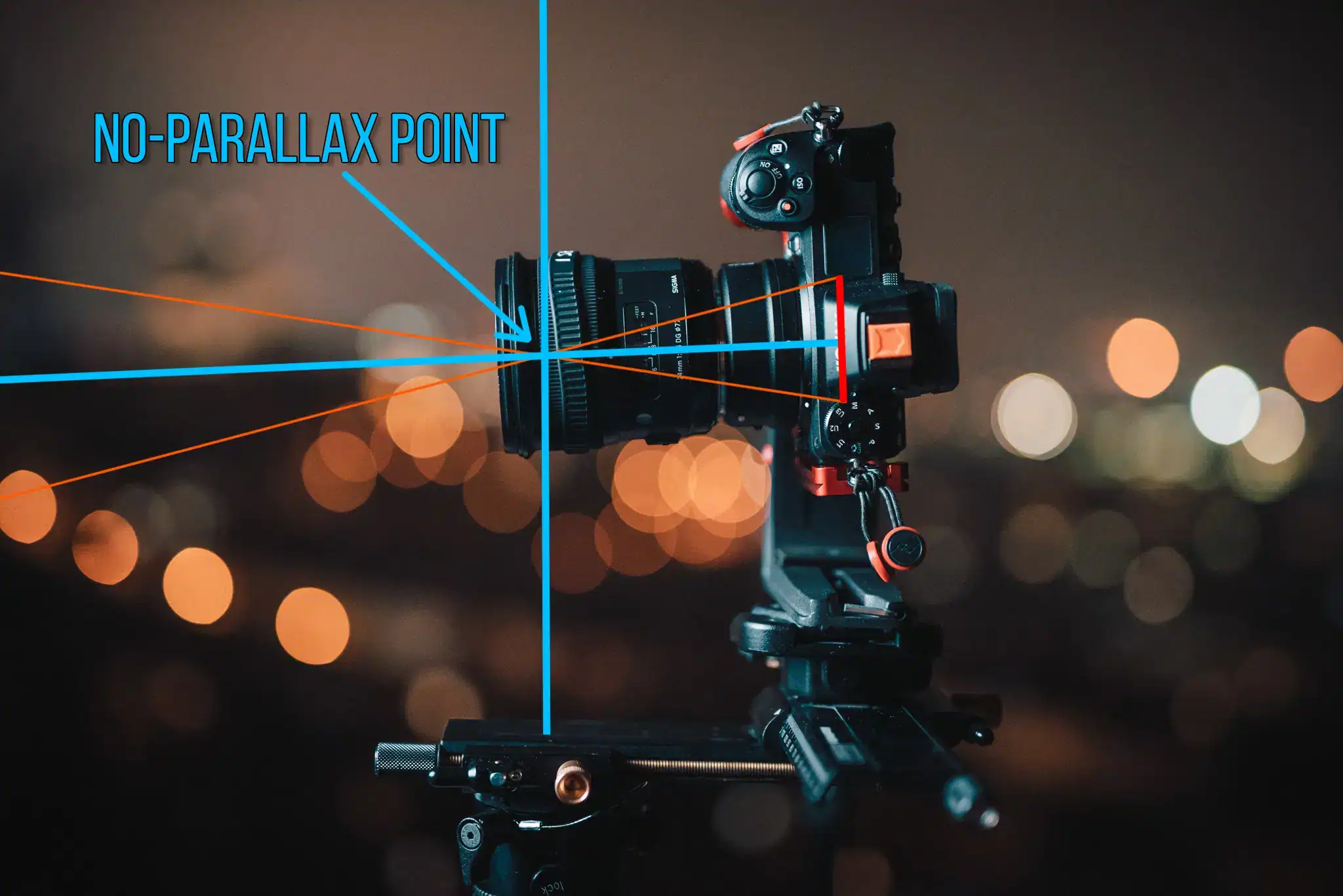
For a deeper walkthrough of panoramic head setup and best practices, see this panoramic head tutorial by 360 Rumors: Panoramic Head Tutorial.
Step-by-Step Shooting Guide
Standard Static Scenes
- Level tripod and align nodal point: Adjust the fore-aft rail until foreground/background features don’t shift relative to each other when you yaw the camera. With this 12mm fisheye on full-frame, many rigs end up around 60–70 mm from the camera’s sensor plane to the rotational axis; treat this as a starting point and fine-tune on-site.
- Manual exposure and white balance: Set M mode, meter the mid-tones, and keep ISO low (100–200). Lock white balance (Daylight outdoors, custom Kelvin indoors) to avoid color shifts during stitching.
- Capture sequence with consistent overlap:
- 6-around at 0° pitch, 60° yaw increments (or 8-around for architecture).
- 1 zenith (tilt up) and 1 nadir (tilt down or handheld nadir patch) frame.
- Nadir frame for tripod removal: Either shoot a dedicated nadir by offsetting the tripod slightly or take a handheld ground shot and patch later in post.
HDR / High Dynamic Range Interiors
- Bracket ±2 EV (3 or 5 frames) to balance bright windows and dim rooms. The A7R III’s clean base ISO files merge well.
- Lock white balance and focus to keep consistency across bracketed frames. Use a 2 or 5-second timer or remote to prevent shake.
Low-Light / Night Scenes
- Use longer exposures at ISO 100–400 when possible; the A7R III handles ISO 800–1600 cleanly if needed. Keep IBIS OFF on a tripod.
- Enable electronic front-curtain shutter (EFCS) or use a remote to minimize vibrations. Consider long exposure noise reduction off if stacking in post.
Crowded Events
- Shoot two passes: first for coverage, second waiting for gaps or cleaner positions of people.
- In post, mask moving subjects between passes to eliminate ghosts. Shorter shutter speeds (1/200s+) reduce motion blur.
Special Setups (Pole / Car / Drone)
- Secure all gear with safety tethers. Mind wind load—keep exposures short (1/250–1/500s), especially on poles.
- Rotate slower and steady. Consider higher overlap (8-around) to help the stitcher with any slight wobble.
Field Cases
- Indoor real estate: Use 8-around + zenith + nadir with ±2 EV bracketing. Flag mixed lighting or set custom Kelvin to keep tones neutral.
- Outdoor sunset: Start at ISO 100, f/8, 1/125s and adjust as the sun drops. The fisheye’s broad coverage captures the sky nicely—watch flare and shade the lens.
- Rooftop with wind: Hang a weight from the tripod’s center, keep the center column down, and add a second capture round as insurance.
Recommended Settings & Pro Tips
Exposure & Focus
| Scenario | Aperture | Shutter | ISO | Notes |
|---|---|---|---|---|
| Daylight outdoor | f/8–f/11 | 1/100–1/250 | 100–200 | Lock WB (Daylight); turn IBIS off on tripod |
| Low light/night | f/4–f/5.6 | 1/30–1/60 (or longer) | 400–800 (up to 1600) | Tripod + remote; watch light sources for flare |
| Interior HDR | f/8 | Bracket ±2 EV | 100–400 | Keep WB fixed; balance windows and lamps |
| Action / moving subjects | f/5.6–f/8 | 1/200+ | 400–800 | Two-pass method; mask in post |
Critical Tips
- Manual focus at hyperfocal distance: With 12mm on full-frame, hyperfocal at f/8 is roughly 0.6 m; focus there to keep everything sharp from ~0.3 m to infinity.
- Nodal point calibration: Start with the lens entrance pupil approximately 60–70 mm forward of the sensor plane; refine by aligning near/far objects and rotating. Mark your rails for repeatable setup.
- White balance lock: Set Daylight outdoors or custom Kelvin indoors to prevent color shifts between frames and brackets.
- RAW over JPEG: The A7R III’s 14‑bit RAW preserves highlight detail and color—key for HDR merges and clean skies.
- Stabilization: Turn IBIS off on a tripod; leave it on only for handheld tests (still expect lower stitch success handheld).
- Shutter mode: EFCS reduces vibrations on tripod; use mechanical shutter under flickering LED lighting to avoid banding.
Stitching & Post-Processing
Software Workflow
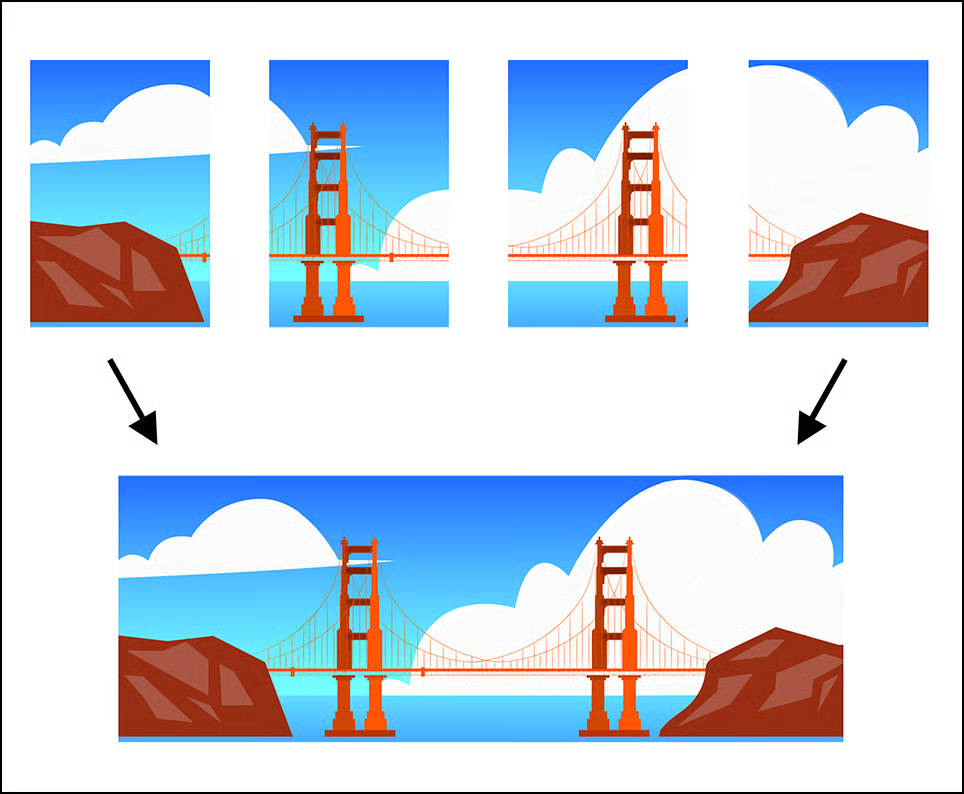
Import RAWs to Lightroom or your preferred RAW developer, apply basic corrections (lens CA, white balance, exposure), then send to a dedicated stitcher. For fisheye lenses, PTGui excels: set lens type to “Fisheye” and start with ~25–35% overlap. Fisheye shots are fast to stitch and require fewer images; rectilinear lenses demand more frames but have less edge distortion. Aim for at least 25–30% overlap for fisheye and 20–25% for rectilinear as an industry baseline. After the stitch, output an equirectangular 2:1 image sized for your delivery platform (e.g., 12k × 6k for web VR, higher for print or gigapixel). For an in-depth review of PTGui, see this overview: PTGui review on Fstoppers.
Cleanup & Enhancement
- Nadir patch: Use a dedicated nadir shot or content-aware fill/clone in Photoshop. AI tools can speed up tripod removal.
- Color and noise: Match color balance across frames, apply noise reduction conservatively (especially at ISO 1600+), and keep micro-contrast natural.
- Leveling: Set horizon and correct roll/yaw/pitch in the stitcher; use vertical control points for architecture.
- Export: Equirectangular JPEG (quality 10–12) for web or 16‑bit TIFF for archival/print. Deliver with XMP metadata if your viewer/platform supports it.
For spherical resolution planning and coverage math (number of shots vs. FOV), the PanoTools wiki is a great reference: DSLR spherical resolution.
Video: Panorama Head Setup and Stitching Basics
If you learn better visually, here’s a concise video primer relevant to setting up a panoramic head and stitching fundamentals:
Also see this practical DSLR/mirrorless guide for shooting and stitching 360 photos: Using a DSLR or mirrorless camera to shoot and stitch a 360 photo.
Useful Tools & Resources
Software
- PTGui panorama stitching
- Hugin (open source)
- Lightroom / Photoshop for RAW, masking, and retouching
- AI tripod removal tools (Content-Aware Fill, generative AI)
Hardware
- Panoramic heads (Nodal Ninja, Leofoto)
- Carbon fiber tripods with leveling bases
- Wireless remote shutters
- Pole extensions / car roof mounts with safety tethers
Disclaimer: brand names are examples; review official specs and current documentation before purchase.
For an additional perspective on lens/camera choices for virtual tours, this FAQ is a helpful resource: DSLR virtual tour camera + lens guide.
Common Mistakes & How to Avoid Them
- Parallax error: Always align the nodal point; even a few millimeters off can cause stitching seams indoors.
- Exposure flicker: Use full manual mode and fixed white balance; avoid auto-ISO and auto-WB during a pano set.
- Tripod shadows and footprints: Plan a nadir patch or move slightly and shoot a clean ground plate.
- Ghosting from movement: Use two-pass capture and mask; increase shutter speed in crowds.
- Noise at night: Keep ISO modest (100–800, up to 1600 if needed) and lengthen shutter with a stable mount.
- Flare with fisheye: Shade the lens with your hand or body; avoid direct strong lights in the frame if possible.
Frequently Asked Questions
-
Can I shoot handheld panoramas with the Sony A7R III?
You can for casual 360s, but expect lower success rates. Use high shutter speeds (1/250s+), IBIS on, and shoot extra overlap (8-around). For professional work or interiors, use a tripod and panoramic head.
-
Is the Samyang 12mm f/2.8 wide enough for single-row 360?
Yes. A single row of 6-around plus zenith and nadir reliably covers the sphere with adequate overlap. For architecture or reflective spaces, use 8-around or a two-row approach to improve edge quality.
-
Do I need HDR for interiors with bright windows?
Usually yes. Bracket ±2 EV (3–5 shots) to retain window detail and clean shadows. The A7R III’s dynamic range helps, but HDR ensures consistent results, especially in real estate and hospitality shoots.
-
How do I avoid parallax issues with this lens?
Calibrate the panoramic head to the lens’s entrance pupil. Start around 60–70 mm forward of the sensor plane, then refine by aligning near/far features while yawing. Mark your rail so you can repeat the setting quickly.
-
What ISO range is safe on the A7R III in low light?
ISO 100–400 is ideal; 800–1600 remains very clean for night panoramas. For very dark scenes, lengthen shutter rather than pushing ISO too high, and shoot a second safety round.
-
Can I set up Custom Shooting Modes for panoramas?
Yes. Use the A7R III’s memory recall (1/2/3) to store manual exposure, fixed WB, manual focus, IBIS off, EFCS on, and drive mode (2s timer) for rapid setup on site.
-
How can I reduce flare with a fisheye?
Shade the lens with your hand or body, avoid direct bright lights in the frame, and slightly reframe to push the light source away from the edges. The Samyang’s NCS helps, but technique matters most.
-
What’s the best tripod head for this setup?
A two-axis panoramic head with fore-aft and vertical adjustments (e.g., Nodal Ninja, Leofoto) is ideal. Make sure it supports your camera’s weight, allows fine nodal alignment, and has clear angle markings.
Safety, Data Integrity & Real-World Workflow
Wind and crowds are the two biggest hazards. Weight your tripod, keep the center column down, and use a strap or tether on rooftops or over water. For pole work, always use a tether and inspect clamps. In public, protect your footprint and keep people clear of the tripod legs.
For data integrity, write RAWs to both SD card slots, label your sets clearly, and back up the shoot as soon as possible. A simple workflow is: Card A (RAW master), Card B (redundant); after the shoot, clone Card A to two locations before formatting. When time allows, capture a second full pano round for safety.
Combo-Specific Notes (A7R III + Samyang 12mm f/2.8)
- Use focus magnification and peaking to nail manual focus at the hyperfocal distance.
- Stop down to f/5.6–f/8 for optimal corner sharpness and minimal CA.
- Avoid filter adapters that introduce vignetting or misalignment—fisheye coverage is very wide.
- Keep the front element clean; any dust or smudges will flare under point light sources at night.
- Consider saving a PTGui template for 6-around + Z/N with this lens to speed up your workflow on repeat jobs.
References & Further Reading
To deepen your technique beyond this guide, explore these authoritative resources placed throughout the article: