Why This Camera & Lens Are Great for Panoramas
The Sony A7 IV paired with the Sony FE 16–35mm f/2.8 GM is a powerful, flexible setup for creating both classic sweeping panoramas and full 360° photos. The A7 IV uses a 33MP full-frame Exmor R sensor (approx. 7008 × 4672 pixels), delivering excellent detail with a pixel pitch of about 5.1 µm and roughly 14+ stops of dynamic range at base ISO 100. Its 5-axis in-body stabilization (IBIS) is great for handheld stitching but can be turned off on a tripod for absolute precision. The FE 16–35mm f/2.8 GM is a rectilinear ultra-wide zoom known for sharp corners (particularly from f/5.6–f/11), well-controlled chromatic aberration, and reliable autofocus/manual focus feel. As a rectilinear lens, it preserves straight lines—vital for architectural and real estate work—at the cost of requiring more shots than a fisheye to complete a sphere.
If you’re learning how to shoot panorama with Sony A7 IV & Sony FE 16-35mm f/2.8 GM, this combo gives you reliable color, strong dynamic range for challenging interiors, and edge-to-edge sharpness when stopped down. For spherical 360s, plan on multi-row capture with careful nodal point alignment to eliminate parallax. For cylindrical or ultra-wide landscapes, the 16–35mm range provides clean results with minimal distortion when you keep a consistent overlap and a leveled tripod.
Quick Setup Overview
- Camera: Sony A7 IV — 33MP full-frame sensor (approx. 35.9 × 23.9 mm), ~14+ stops DR at ISO 100, native ISO 100–51200 (expand 50–204800), 5-axis IBIS.
- Lens: Sony FE 16–35mm f/2.8 GM — rectilinear ultra-wide zoom; excellent center-to-corner sharpness from f/5.6–f/11; mild barrel distortion at 16mm; low CA and robust flare resistance when shaded.
- Estimated shots & overlap (tested guidance):
- 16mm for full 360°: 6 shots per row × 3 rows (+45°, 0°, −45°) + 1–2 zenith + 1–2 nadir = ~20–22 frames with 30–35% overlap.
- 24mm for full 360°: 7–8 shots per row × 3 rows + zenith/nadir = ~23–26 frames with ~30% overlap.
- 35mm for “gigapixel” detail: 10–12 shots per row × 4–5 rows + zenith/nadir; expect 50–70+ images.
- Difficulty: Intermediate (easy for single-row landscapes; multi-row 360° requires nodal calibration).
Planning & On-Site Preparation
Evaluate Shooting Environment
Before setting up, assess light direction, contrast, and movement. For glass-heavy interiors or rooftops with guardrails, watch for reflections and ghosting. If shooting through glass, place the front element as close as safely possible (within a few centimeters) and shoot perpendicular to minimize reflections; use a rubber lens hood if available. In high-contrast scenes (bright windows and dark interiors), plan HDR brackets. In windy or crowded locations, consider extra stabilization and shooting multiple passes to handle moving subjects.
Match Gear to Scene Goals
The A7 IV’s dynamic range and clean low ISO performance make it ideal for interiors and dusk cityscapes. For indoor real estate, ISO 100–400 yields clean shadows; for darker spaces, ISO 800–1600 is still usable with modern noise reduction. The FE 16–35mm f/2.8 GM’s rectilinear rendering is perfect for architecture and straight lines—unlike fisheye lenses that require defishing and can exaggerate curvature. At 16mm, you’ll need fewer shots than at 24–35mm, but still more than with a fisheye. Balance your coverage needs with your available time and the subject’s complexity.
Pre-shoot Checklist
- Charge batteries; carry spares. Format fast, reliable cards (use dual-slot recording for redundancy).
- Clean lens front/rear elements and the sensor. Keep a microfiber cloth handy for dust or drizzle.
- Level the tripod; verify your panoramic head’s nodal alignment for this lens/focal length.
- Safety: confirm wind conditions, avoid edges on rooftops, and tether gear when using poles or car mounts.
- Backup workflow: shoot a second pass (especially for mission-critical jobs or moving crowds).
Essential Gear & Setup
Core Gear
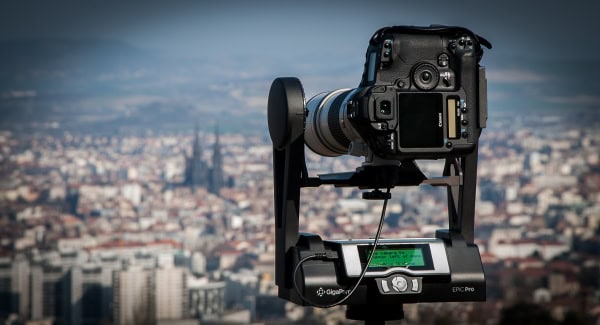
- Panoramic head: Allows precise rotation around the lens’s no-parallax (nodal) point to eliminate parallax between foreground and background. Multi-row heads enable +/− pitch control for zenith coverage.
- Stable tripod with leveling base: A leveling base speeds setup and ensures your horizontal rows stay level, reducing stitching stress.
- Remote trigger or app: Use Sony Imaging Edge Mobile/Plus or a wired remote to avoid camera shake. Enable a 2-sec self-timer if you don’t have a remote.
Optional Add-ons
- Pole or car mount: Always tether your rig, balance the center of gravity, and avoid high winds. Check local laws for rooftop or vehicle-mounted photography.
- Lighting aids: Portable LED panels or bounced flash for interiors (keep lights consistent across frames; avoid mixed color temperatures if possible).
- Weather protection: Rain covers, silica gel, and a towel. Keep the lens dry and clean to avoid contrast loss and flare.
New to dedicated panoramic heads? This short primer will help you understand alignment and workflow fundamentals. Panoramic head tutorial (360Rumors)
Step-by-Step Shooting Guide
Standard Static Scenes
- Level and align: Level your tripod, then use the panoramic head to set the camera so rotation is centered. Align the lens to its no-parallax point (see below). Use the A7 IV’s built-in level as a cross-check.
- Manual exposure and WB: Switch to Manual mode. Meter the brightest part you must retain (windows/sky), then adjust for a balanced histogram. Lock white balance (e.g., Daylight or a custom Kelvin) so frames match in color.
- Focus: Switch to manual focus. For 16mm at f/8 on full-frame, the hyperfocal distance is about 1.1 m; pre-focus there to keep everything crisp from about half that distance to infinity.
- Capture with overlap: For 16mm, shoot 6 frames around per row with 30–35% overlap. Do three rows: +45°, 0°, −45°. Then take a zenith shot pointing straight up and one or two nadir shots for cleaner tripod removal.
- Nadir shot: After your main sequence, offset the tripod or handhold a shot of the ground for easy patching.
HDR / High Dynamic Range Interiors
- Bracketed exposure: Use AEB with 3–5 frames at ±2 EV to balance bright windows and interior shadows. The A7 IV supports up to 9 frames; in extreme contrast, use 5 frames at ±2 EV for greater latitude.
- Consistent WB: Keep white balance fixed. Mixed lighting can vary across frames; if necessary, shoot a gray card and sync in post.
- Mirror workflow: Shoot all brackets at each position before rotating to maintain alignment.
Low-Light / Night Scenes
- Use a tripod and remote: Stabilize. Turn off IBIS when on a tripod to avoid sub-pixel drift. Enable EFCS or full mechanical shutter to minimize vibration.
- Exposure: Start at f/4–f/5.6, 1/30–1/60 s, ISO 400–800. The A7 IV remains clean up to ISO 1600–3200 with careful noise reduction; prefer longer shutter over extreme ISO if wind allows.
- Check for flicker: LED and signage can cause pulsing highlights. Take test frames and adjust shutter speed to avoid banding/flicker.
Crowded Events
- Two passes: Do one fast full set to lock the scene, then a slower second pass waiting for gaps in the crowd.
- Mask in post: Use PTGui’s masking to reveal clean areas from either pass, removing ghosting or duplicated people.
Special Setups (Pole / Car / Drone)
- Secure and tether: Always use safety lines. Keep your rig’s center of gravity over the pivot point; avoid strong winds with pole setups.
- Vibration control: Use faster shutter speeds on vehicles. For poles, allow the rig to fully stop moving before each exposure.
- Legal and safety: Follow local laws for rooftops, public spaces, and vehicle-mounted shooting. Prioritize safety over the shot.
A concise video primer to reinforce core panorama techniques. Pair these fundamentals with nodal alignment for flawless 360s.
Recommended Settings & Pro Tips
Exposure & Focus
| Scenario | Aperture | Shutter | ISO | Notes |
|---|---|---|---|---|
| Daylight outdoor | f/8–f/11 | 1/100–1/250 | 100–200 | Lock WB (Daylight or custom K) |
| Low light/night | f/4–f/5.6 | 1/30–1/60 | 400–800 | Tripod & remote; prefer longer exposure over ISO >1600 |
| Interior HDR | f/8 | Bracket ±2 EV | 100–400 | Expose for windows, merge brackets |
| Action / moving subjects | f/5.6–f/8 | 1/200+ | 400–800 | Freeze motion; consider multi-pass capture |
Critical Tips
- Manual focus and hyperfocal: At 16mm and f/8, set focus around 1.1 m to keep near-to-far sharpness.
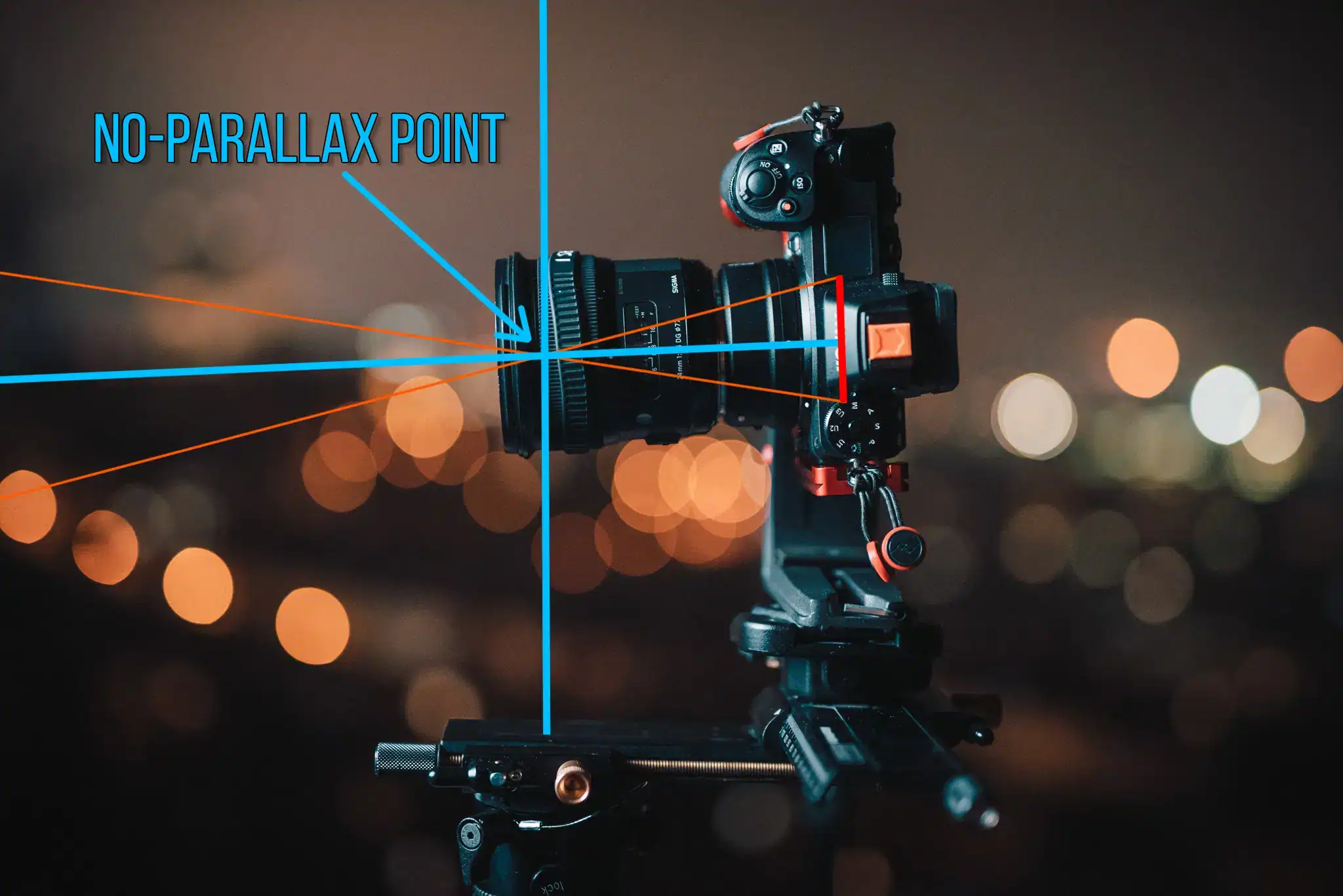
- Nodal point calibration: Mount the camera on a panoramic head. Aim at intersecting near/far objects; slide the lens over the rail until relative motion disappears while yawing. Mark your 16mm and 24mm nodal positions with a paint pen.
- White balance lock: Use a fixed WB to avoid color shifts between frames—especially crucial in HDR brackets.
- RAW over JPEG: 14-bit RAW gives you latitude for shadow/highlight recovery and consistent color mapping in post.
- IBIS and shutter mode: Turn IBIS OFF on tripods. Use EFCS to reduce micro-shake, or full mechanical to avoid potential EFCS bokeh artifacts with certain shutter speeds.
- Drive mode: Use 2-sec timer if you don’t have a remote; this alone eliminates many micro-blur issues.
Stitching & Post-Processing
Software Workflow
Import RAW files into Lightroom, Capture One, or your preferred editor to set a baseline: consistent WB, lens profile correction (vignetting/distortion), and a mild contrast curve. Export to 16-bit TIFF for stitching when quality matters. For stitching, PTGui is the industry workhorse for complex multi-row and HDR panoramas; Hugin is an excellent free alternative. Rectilinear lenses like the 16–35mm require more frames than fisheyes, but you keep straight lines—especially helpful for architecture. As a rule of thumb, aim for 25–30% overlap for fisheye and 30–35% for rectilinear. Why PTGui is a top-tier tool for complex panoramas
Cleanup & Enhancement
- Nadir patch: After stitching, use PTGui’s Viewpoint Correction, Photoshop’s Clone/Heal, or AI-based patching to remove the tripod. Capture a dedicated nadir shot to make this painless.
- Color and noise: Equalize white balance if needed, apply selective noise reduction for night scenes, and keep sharpening subtle to avoid haloing.
- Horizon and leveling: Use the optimizer to set pitch/roll; align the horizon and verticals in architectural scenes.
- Export targets: For VR, export equirectangular at 8K (7680×3840) or 12–16K for premium detail. Check hosting platform limits and JPEG quality settings (85–92 is a good balance).
New to spherical resolution planning? This reference explains how focal length and sensor resolution impact your final pano size. Panotools: DSLR spherical resolution
If you’re building 360 photos for VR or web viewers, this official guide covers end-to-end workflow considerations and publishing formats. Using a DSLR/mirrorless to shoot and stitch a 360 photo (Meta/Oculus)
Disclaimer: Always check the latest documentation for your software version; interface and features may evolve.
Useful Tools & Resources
Software
- PTGui panorama stitching
- Hugin (open source)
- Lightroom / Photoshop / Affinity Photo
- AI-based tripod removal or content-aware fill
Hardware
- Panoramic heads: Nodal Ninja, Leofoto, Sunwayfoto
- Carbon fiber tripods with a leveling base
- Arca-Swiss rails and L-brackets for repeatable nodal alignment
- Wireless remotes or tethered smartphone control
- Pole extensions and vehicle mounts with safety tethers
Disclaimer: brand names are examples only. Verify compatibility with your camera and lens and follow the manufacturer’s instructions.
Common Mistakes & How to Avoid Them
- Parallax error: Always align to the no-parallax point; even a small offset will cause ghosts in near objects.
- Exposure flicker: Shoot in Manual exposure and lock WB to keep frames consistent for seamless stitching.
- Tripod shadows: Capture a dedicated nadir and patch; move your feet and tripod between takes to minimize shadows.
- Ghosting from movement: Shoot two passes and mask in post; prioritize key directions with fewer moving subjects.
- High ISO noise: On the A7 IV, try to stay ≤ ISO 1600; use longer shutter on a tripod and careful noise reduction for night scenes.
Frequently Asked Questions
- Can I shoot handheld panoramas with the Sony A7 IV?
Yes, especially for single-row landscapes. Use faster shutter speeds (1/200+), IBIS ON, and 30–40% overlap. For full 360° or interiors, a tripod and panoramic head are strongly recommended to avoid parallax and misalignment.
- Is the Sony FE 16–35mm f/2.8 GM wide enough for a single-row 360?
No. At 16mm rectilinear, you still need multi-row capture for a complete sphere (typically three rows plus zenith and nadir). Single-row capture is fine for cylindrical or partial panoramas.
- Do I need HDR for interiors with bright windows?
Usually yes. Bracket 3–5 frames at ±2 EV so you retain window detail and interior tones. The A7 IV’s dynamic range is strong, but windows often exceed a single exposure’s latitude.
- How do I avoid parallax issues with this lens?
Calibrate the no-parallax point on a panoramic head for 16mm and 24mm and mark the rail. Keep the camera perfectly level and rotate only around the nodal axis. This is essential for close foreground objects.
- What ISO range is safe on the A7 IV in low light?
For best quality, use ISO 100–800 on a tripod. ISO 1600–3200 is usable with careful noise reduction. Prioritize longer shutter times over pushing ISO when possible.
- Can I set Custom Modes for pano shooting?
Yes. Assign C1 to Manual exposure + fixed WB + single-shot drive + IBIS OFF (tripod), and C2 for handheld pano with IBIS ON, faster shutter, and auto ISO limits. This speeds up transitions in the field.
- How do I reduce flare with the 16–35 GM?
Shade the front element with your hand or flag, avoid including the sun just outside the frame at 16mm, and keep the front glass spotless. Slightly repositioning your yaw angle can dramatically reduce veiling flare.
- What panoramic head should I choose for this setup?
Pick a multi-row head with precise fore–aft and lateral adjustments and clear scales. Ensure it supports the A7 IV’s weight and allows nodal offsets for 16–35mm. A leveling base under the head is a huge time-saver.
Field-Tested Case Studies
Indoor Real Estate (Bright Windows)
At 16mm, shoot three rows of 6 frames with ±2 EV brackets (5 frames each if the contrast is extreme). Lock WB to 4000–4500K if you’ve got mixed daylight and warm LEDs, then equalize in post. Keep ISO 100–200 to preserve shadow detail. Expect about 20 base positions with 60–100 total exposures depending on bracketing. Stitch HDR per position first, then feed the merged frames to PTGui.
Sunset Rooftop Cityscape
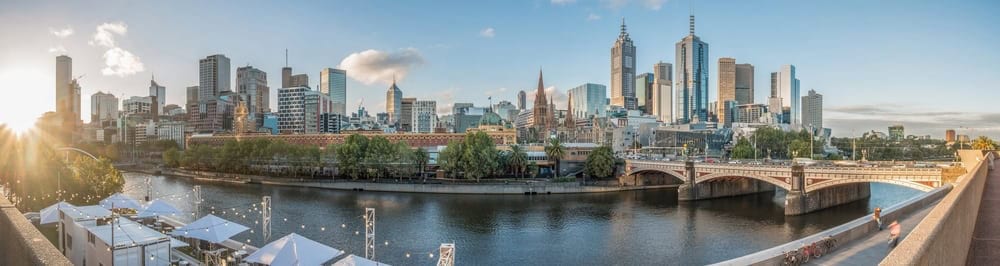
Arrive 30 minutes early. Start at ISO 100, f/8, shutter 1/125. As light drops, extend shutter down to 1/30 before increasing ISO; the A7 IV handles ISO 800–1600 cleanly. Watch for wind-induced vibration at the edge of roofs; weigh down the tripod or lower the center column.
Crowded Event Hall
Use 24mm to reduce perspective stretching of people near edges. Shoot two passes; in PTGui, use masks to keep the clean segments from each pass. Enable faster shutter (1/200+) and ISO 800–1600 to freeze motion.
Rooftop Pole Shot
Mount the A7 IV on a sturdy pole with a compact multi-row head. Keep exposures at 1/250–1/500 to counter sway. Tether to your wrist and the railing. Limit pole extension in strong winds and take brief bursts between gusts.
Safety & Gear Protection
- Always tether when working at height or over water. Use redundant straps.
- Beware of wind: lower your tripod, add weight, and avoid sail-like accessories.
- Mind the public: keep clear of walkways; don’t block exits; respect private property.
- Transport: lock down all knobs and pack the panoramic head separately to avoid damaging rails or the lens mount.
- Data safety: back up to dual cards, then copy to two drives after the shoot. Consider writing a quick shot log.
For a step-by-step on setting up a panoramic head to achieve high-end results, this resource is a solid companion. Setting up a panoramic head for high-end 360 photos (Meta/Oculus)