Why This Camera & Lens Are Great for Panoramas
If you want to learn how to shoot panorama with Sony A7 IV & Peleng 8mm f/3.5, you’re starting with a powerful, budget-friendly combo that excels for 360° capture. The Sony A7 IV is a 33MP full-frame mirrorless body with an Exmor R BSI sensor (approx. 35.9×23.9 mm) delivering around 14 stops of dynamic range at base ISO. Its pixel pitch is about 5.1 µm, which helps maintain clean detail at moderate ISOs. In-body image stabilization (IBIS) is rated around 5.5 stops, great for handheld use but easily disabled for tripod work.
The Peleng 8mm f/3.5 is a fully manual, circular fisheye. On full frame, it projects a circular image with a 180° field of view in all directions, allowing you to cover the full sphere with very few shots. This reduces total shooting time and minimizes stitching points—ideal for location work, event coverage, and pole-mounted panoramas where speed is critical. Expect some chromatic aberration and flare in extreme lighting; stopping down to f/5.6–f/8 improves sharpness across the circle. The lens is typically adapted to Sony E-mount—be sure to use a reliable adapter for proper aperture and focus operation.
In short, the A7 IV provides robust image quality and dependable ergonomics, while the Peleng 8mm drastically cuts shot count for 360 photos. That combination makes it an excellent choice for efficient 360° capture outdoors and indoors.
Quick Setup Overview
- Camera: Sony A7 IV — full-frame (35.9×23.9 mm), 33MP, ~14 stops DR at base ISO, 5.5-stop IBIS, 14-bit RAW.
- Lens: Peleng 8mm f/3.5 — circular fisheye, manual focus/aperture, ~180° FOV circular image on full frame; best sharpness f/5.6–f/8, some CA/flare.
- Estimated shots & overlap (tested):
- 3 around at 120° (level) + 1 nadir (ground). Zenith usually covered; add 1 zenith for ultra-clean ceilings.
- Alternative safety set: 4 around at 90° + nadir for extra overlap in complex scenes.
- Overlap target: ~25–30% between frames for reliable control points.
- Difficulty: Easy–Moderate. Very few shots, but nodal calibration and careful exposure/WB are essential.
Planning & On-Site Preparation
Evaluate Shooting Environment
Scan for moving subjects (people, trees in wind, traffic), reflective surfaces (glass, polished metal), and extreme light contrast (windows with direct sun). If you must shoot through glass, keep the front element as close as possible (1–3 cm) to minimize reflections, use a black cloth/hood around the lens, and shoot slightly off-axis to avoid catching yourself in the reflection. Plan your rotation path so the sun or bright lights aren’t entering the frame at the same angle in multiple shots, which reduces flare repetition.
Match Gear to Scene Goals
The Sony A7 IV’s dynamic range gives you clean shadows at ISO 100–400. With conservative processing, ISO 800–1600 remains highly usable—handy for twilight or indoor ambient. The Peleng 8mm fisheye means fewer frames, faster capture, and fewer ghosting issues from motion. The trade-off is strong fisheye distortion (handled by pano software) and greater flare risk under hard backlight. Indoors (real estate), you’ll likely use HDR brackets to balance windows; outdoors (sunset cityscapes), the fewer frames minimize changing light between shots.
Pre-shoot Checklist
- Power & storage: Full batteries and ample fast cards; the A7 IV’s 33MP RAWs plus brackets add up quickly.
- Clean optics and sensor: Dust on a circular fisheye is very visible—carry a rocket blower and microfiber cloth.
- Tripod leveling & pano head calibration: Level the base, and verify nodal alignment for the A7 IV + Peleng combo.
- Safety: In wind or on rooftops, use a weighted bag, short center column, and a safety tether. For car-mounted or pole work, use lanyards and verify all clamps.
- Backup workflow: After your main pass, shoot one extra safety round in case of missed focus or unexpected blur.
Essential Gear & Setup
Core Gear
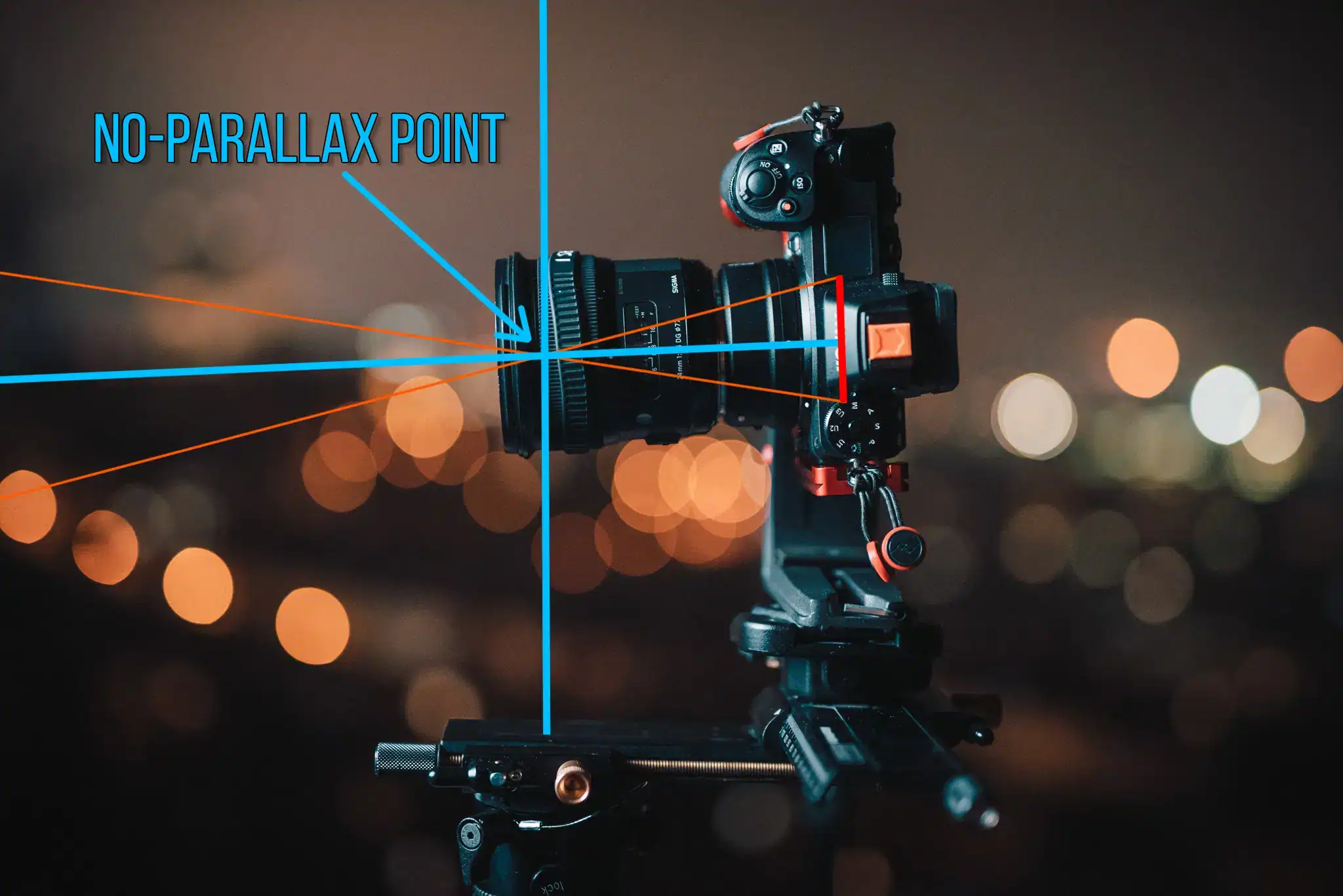
- Panoramic head: A proper pano head aligns the lens’s entrance pupil (no-parallax point) over the rotation axis. This reduces parallax between near and far objects, giving the stitcher clean control points.
- Stable tripod with leveling base: A leveling base speeds setup and maintains consistent pitch/roll during rotation.
- Remote trigger or app: Use Sony’s Imaging Edge Mobile or a wired remote to avoid touching the camera. EFCS enabled helps reduce shutter shock.
Optional Add-ons
- Pole or car mount: Great for elevated or moving shots. Secure all joints, consider wind load, and add a tether to the camera strap loop for redundancy.
- Lighting aids: Small LED panels or bounced flashes for interiors. Keep lighting consistent across frames.
- Weather protection: Rain covers and lens cloths; a single drop on a circular fisheye can ruin the frame.
Step-by-Step Shooting Guide
Standard Static Scenes
- Level and align: Level the tripod using the leveling base. Mount the pano head and camera. Slide the camera forward/back until rotating left/right shows no relative shift between near and far objects in the overlap zone. Mark your rail position for the A7 IV + Peleng so you can return to it quickly.
- Manual exposure and WB: Set M mode. Meter the brightest important area (e.g., near windows) and set exposure to preserve highlights. Lock White Balance (daylight/tungsten/custom). Disable auto-ISO; pick a stable ISO (100–400 outdoors, 400–800 indoors).
- Focus: Switch to MF and use magnified live view. For an 8mm fisheye, set focus near hyperfocal at f/8—around 0.5–0.7 m will keep near-to-infinity acceptably sharp. The Peleng’s distance scale can be optimistic; verify on the A7 IV screen.
- Capture sequence: For 3-around, shoot frames at yaw 0°, 120°, and 240° at 0° tilt. Then tilt down to capture a dedicated nadir. If ceiling features matter, add a zenith at +60° to +90°. For complex seams, use 4-around at 90° for more overlap.
- Nadir management: Either shoot a handheld nadir (remove tripod, keep camera at same nodal point) or capture a detailed ground plate to patch later in post.
HDR / High Dynamic Range Interiors
- Bracket exposures: Use ±2 EV or even ±3 EV if windows are extremely bright. The A7 IV handles 3–5 bracketed frames well; keep the same sequence for every yaw angle.
- Consistent color: Lock WB. Mixed lighting is common indoors; if possible, switch all practical lights to the same color temperature. Shoot RAW to balance later.
- Stability: Use a remote. Keep IBIS off on a tripod to prevent micro-blur across brackets.
Low-Light / Night Scenes
- Exposure: Open to f/4–f/5.6 if needed, use longer shutters (1–8 s), and keep ISO 100–800 for clean files. The A7 IV is still usable at ISO 1600–3200 with noise reduction, but dynamic range decreases.
- Minimize vibration: Turn off IBIS, use EFCS, a remote trigger, and a 2 s delay. Hang weight from the tripod if it’s windy.
- Bright lights: Shade the lens with your hand outside the FOV to reduce flare. Rotate to place streetlights away from frame edges where the fisheye stretches them.
Crowded Events
- Two passes: First, shoot a fast 3-around for coverage. Then wait for gaps in foot traffic and reshoot any frames with heavy overlap. You’ll use the second pass to mask later.
- Shutter speeds: Use 1/200 s or faster to freeze motion if you want crisp people, or go longer to blur crowds artistically—but keep camera rock-solid.
Special Setups (Pole / Car / Drone)
- Pole: Keep rotations slow; wind amplifies sway. Use a safety tether to the pole and a second one to your belt or harness. Shoot 3-around quickly at each position.
- Car-mounted: Only in controlled, safe environments. Avoid public roads unless fully permitted. Use vibration-damping mounts and increase shutter speed to 1/500 s+.
- Drone: The Peleng 8mm + A7 IV is too heavy for most drones; use dedicated 360 cams instead.
Recommended Settings & Pro Tips
Exposure & Focus
| Scenario | Aperture | Shutter | ISO | Notes |
|---|---|---|---|---|
| Daylight outdoor | f/8–f/11 | 1/100–1/250 | 100–200 | Lock WB (Daylight). Use 3-around + N. |
| Low light/night | f/4–f/5.6 | 1/30–1 s+ | 400–800 (up to 1600) | Tripod, IBIS off, EFCS on. Remote or 2 s timer. |
| Interior HDR | f/8 | Bracket ±2 to ±3 EV | 100–400 | Keep bracket count consistent at every yaw. |
| Action / moving subjects | f/5.6–f/8 | 1/200+ | 400–800 | Freeze motion or plan to mask in post. |
Critical Tips
- Manual focus at hyperfocal: With an 8mm fisheye, f/8 focused around 0.5–0.7 m keeps everything from close foreground to infinity sharp. Confirm with focus magnification.
- Nodal calibration: Use two vertical objects (one near, one far). Rotate 30–45° and adjust the fore-aft rail until they no longer shift relative to each other. Mark the rail for the A7 IV + Peleng setup.
- White balance lock: Prevent inconsistent color and banding across frames and brackets—especially under mixed indoor lighting.
- RAW capture: 14-bit RAW files give headroom for HDR merges and highlight recovery. JPEG is fine for speed, but less forgiving.
- Stabilization: Turn IBIS off on a tripod to avoid sensor “float” blur. For handheld panos, IBIS can help—just keep shutter ≥1/100 s.
- Shutter mode: Use EFCS for tripod work; avoid full electronic shutter under LED lighting to prevent rolling banding.
Stitching & Post-Processing
Software Workflow
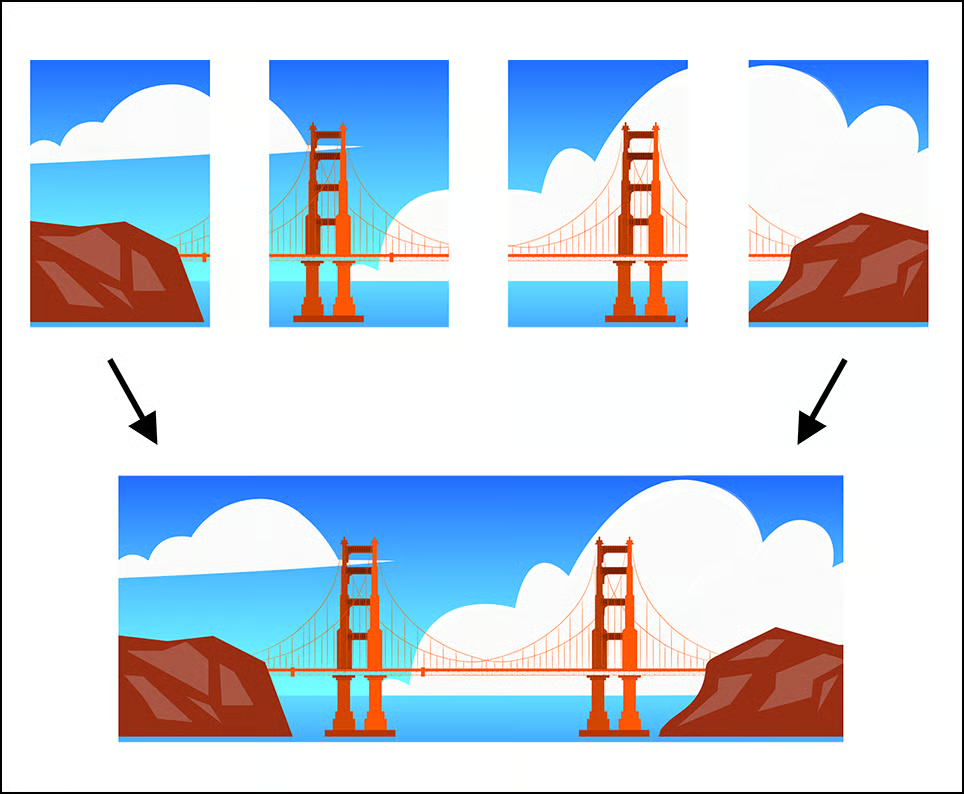
Load your frames into a dedicated stitcher. With a circular fisheye like the Peleng 8mm, set lens type to “Fisheye (circular)” and HFOV to ~180°. PTGui is the industry standard for speed and control; Hugin is an excellent open-source alternative. A typical flow is: (1) merge HDR brackets (either in LR/ACR first or directly in PTGui’s HDR workflow), (2) detect control points, (3) optimize geometry, (4) choose equirectangular projection, (5) level horizon, (6) blend, (7) output 2:1 equirectangular JPEG/TIFF (e.g., 8000×4000 px or higher). Many pros target 8K (8192×4096) for high-quality web VR. For detailed tool selection and reasoning, see a hands-on review of PTGui. Read a PTGui pro review on Fstoppers.
For panoramic head setup and best practices, this tutorial provides an excellent step-by-step grounding. Set up a panoramic head for high-end 360 photos.
Cleanup & Enhancement
- Nadir patch: Use PTGui’s Viewpoint Correction (shoot a handheld nadir) or clone in Photoshop. AI content-aware fills can speed this up.
- Color: Balance mixed lighting with WB adjustments and HSL tuning. Keep colors consistent across the sphere to avoid seams.
- Noise reduction: Apply gentle NR to shadow areas (especially ISO 1600+ or night scenes). Preserve detail in mid-tones.
- Horizon leveling: Use the stitcher’s pitch/roll/yaw controls to ensure a level horizon. Set verticals for architectural work.
- Export: Save an equirectangular 2:1 JPEG/TIFF for VR. For platform guidelines on metadata and publishing, see this reference. Oculus Creator: Shooting and stitching 360 photos.
Useful Tools & Resources
Software
- PTGui (fast, robust control points, viewpoint correction)
- Hugin (open source, powerful)
- Lightroom / Photoshop (HDR merge, color, cleanup)
- AI tools for tripod/nadir removal
Hardware
- Panoramic heads: Nodal Ninja, Leofoto, or equivalent modular rails
- Carbon fiber tripods: light but rigid; add a leveling base
- Wireless remotes: reduce vibration, maintain rhythm
- Pole extensions / car mounts: only with safety tethers and verified clamps
Disclaimer: software/hardware names provided for search reference; check official sites for details. For more theories on pano geometry and resolution with DSLRs, see the Panotools wiki. Panotools: DSLR spherical resolution.
Common Mistakes & How to Avoid Them
- Parallax error: Not aligning the entrance pupil leads to broken lines near the camera. Calibrate once, then mark your rail position.
- Exposure flicker: Auto exposure/auto WB between frames causes visible seams. Lock exposure and WB.
- Tripod shadows/footprints: Always capture a nadir or plan a clean patch method.
- Ghosting from movement: For crowds, do two passes and mask the best sections later.
- Flare and CA: Avoid hard backlight where possible; shade the lens and correct CA/fringing during RAW processing.
- IBIS on tripod: Leaving stabilization on can blur frames across a sequence—turn it off when mounted.
Frequently Asked Questions
-
Can I shoot handheld panoramas with the Sony A7 IV?
Yes—for fast-capture situations, shoot 3-around quickly at 1/100 s or faster with IBIS on. Keep your rotation as centered as possible over your body. However, handheld increases parallax and stitching errors. For critical work (architecture, interiors), use a tripod and pano head.
-
Is the Peleng 8mm f/3.5 wide enough for a single-row 360?
Yes. It’s a circular fisheye on full frame with ~180° FOV. You can cover the sphere with 3-around + nadir; add a zenith for complex ceilings. Many shooters prefer 4-around + nadir for more overlap and easier control points.
-
Do I need HDR for interiors with bright windows?
Usually yes. The A7 IV has excellent DR, but windows in midday sun can exceed it. Bracket ±2–3 EV per angle and either merge in LR/ACR or let PTGui handle HDR. Keep WB locked and bracket count consistent.
-
How do I avoid parallax issues with this combo?
Calibrate the nodal (no-parallax) point on a pano head. Use a near object and a far object in overlap; adjust the fore-aft rail until their relative position doesn’t change as you rotate. Mark that rail position for the A7 IV + Peleng and reuse it consistently.
-
What ISO range is safe on the A7 IV in low light?
For tripod-based panoramas, ISO 100–800 is ideal. ISO 1600–3200 is acceptable with careful noise reduction. Beyond that, fine detail and DR suffer.
-
Can I set up Custom Modes (C1/C2) for pano work?
Yes. Save a “Pano” mode with M exposure, fixed WB, MF, IBIS off, EFCS on, and your preferred bracketing. This speeds setup when switching between regular shooting and 360 capture.
-
How do I reduce flare with a circular fisheye?
Use your hand as a flag just outside the FOV, avoid pointing directly at the sun, and rotate slightly to place bright lights away from frame edges. Clean the front element frequently—smears amplify flare.
-
What’s the best tripod head for this setup?
A compact panoramic head with fore-aft rail adjustment (e.g., Nodal Ninja, Leofoto) is ideal. Ensure it supports the A7 IV’s weight, has precise markings, and allows quick, positive yaw clicks at 90°/120°.
For a broader primer on pano heads and technique, this overview is helpful. Panoramic head tutorial (360 Rumors)
Field-Proven Scenarios with the A7 IV + Peleng 8mm
Indoor Real Estate
Set f/8, ISO 100–200, and bracket ±2–3 EV. Shoot 4-around + nadir for robust overlap in tight rooms. Lock WB (tungsten or custom) to avoid mixed-light shifts. Use a handheld nadir with viewpoint correction in PTGui for a seamless floor.
Outdoor Sunset
Expose for highlights to retain sky color—typically ISO 100, f/8, 1/60–1/125 s. The circular fisheye minimizes total frames so changing light affects fewer images. Consider a second pass after the sun dips for richer blue-hour skies you can blend later.
Event Crowds
3-around at 1/200 s+, ISO 400–800, f/5.6–f/8. Shoot a fast coverage pass, then reshoot frames where people overlap seams. In post, mask the cleanest regions from the second pass to remove ghosts.
Rooftop/Pole Shooting
Wind becomes a serious variable. Keep the pole short, rotate slower, and use 1/250 s+ shutter. If you must increase ISO to 800–1600 to keep shutter speeds, do it—the A7 IV files handle noise reduction well. Safety tethers are non-negotiable.
Car-Mounted Capture
Only in controlled environments. Use a solid suction + strap backup. Shutter at 1/500–1/1000 s, f/5.6–f/8, ISO as needed. Shoot 4-around quickly and expect some masking for moving elements. Review each frame on the spot for sharpness.
Advanced PTGui Notes for the Peleng 8mm
- Lens type: Fisheye (circular). Start with HFOV ~180°, refine during optimization.
- Masking: Because it’s a circular fisheye, mask the black areas outside the circle to help the optimizer.
- Viewpoint correction: If you shot a handheld nadir, use Viewpoint on the nadir image to remove the tripod footprint cleanly.
- Blending: For interiors, try Exposure Fusion first for natural tones; for maximum DR, use HDR output and tone-map in post.
- Output: Equirectangular 2:1. Consider 10K–12K width if your subject warrants more resolution; 8K is a great web baseline.
If you’re exploring software choices or want a second opinion, here’s a concise discussion of pano tools and approaches. Techniques for 360 panoramas (Photo StackExchange)
Safety, Reliability & Backup Workflow
Always secure your camera and head with a tether when working at height or over crowds. In wind, lower your center column and add weight. Keep a microfiber cloth on hand—one fingerprint on a circular fisheye can render the frame unusable. For reliability, shoot one extra rotation after your main pass, and periodically check focus and exposure. Back up on-site if possible (dual cards or a portable SSD) before you tear down the setup.