Why This Camera & Lens Are Great for Panoramas
If you want to learn how to shoot panorama with Sony A1 & Peleng 8mm f/3.5, you’re combining one of the most capable full-frame mirrorless bodies with a classic circular fisheye. The Sony A1’s 50.1MP stacked CMOS sensor (36×24mm) delivers high resolution for clean equirectangular outputs, with approximately 4.17µm pixel pitch and excellent base ISO performance. It offers wide dynamic range (about 14–15 stops in practical use), a robust 5.5-stop IBIS, and fast, responsive operation—even when bracketing for HDR. The Peleng 8mm f/3.5 is a fully manual circular fisheye with a 180° field of view that dramatically reduces shot count for full 360° coverage.
In practice, a circular fisheye means you can complete a full 360×180 capture in as few as 3–4 frames around. That means less time on-site, fewer moving-subject problems, and faster stitching in software. The downsides are predictable and manageable: strong barrel distortion (expected for fisheye), potential flare from the bulbous front element, and fully manual operation (aperture and focus). On the A1, focus peaking, magnification, and precise manual exposure control make this combo far more approachable. With a calibrated panoramic head and careful technique, you’ll get professional 360 photos, HDR panoramas for real estate, and rock-solid results for virtual tours.
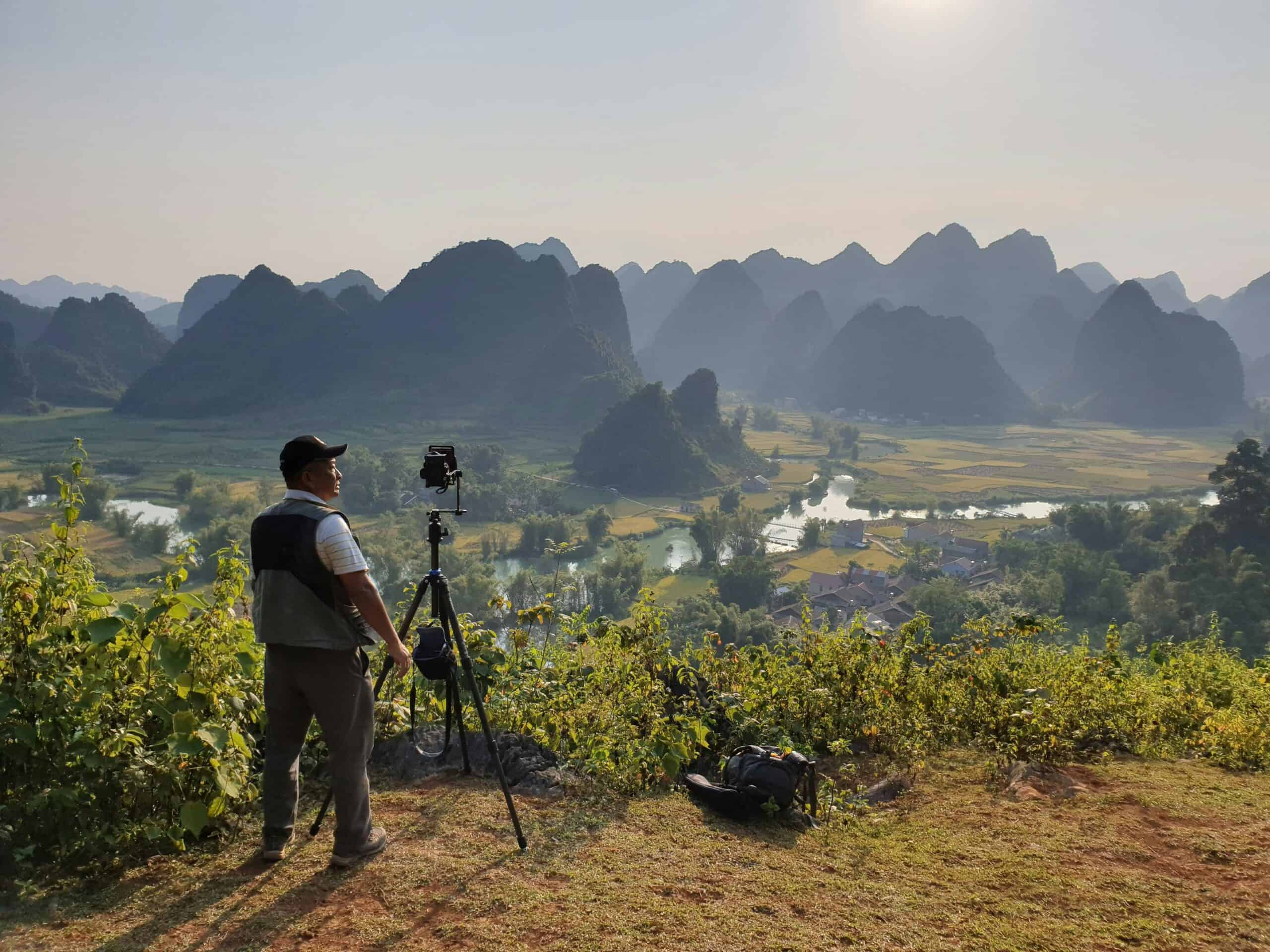
Quick Setup Overview
- Camera: Sony A1 — Full-frame 50.1MP stacked CMOS (approx. 8640×5760), ~4.17µm pixel pitch, excellent DR, native ISO 100–32,000 (expandable 50–102,400).
- Lens: Peleng 8mm f/3.5 — circular fisheye, fully manual, 180° FOV; best sharpness stopped to f/5.6–f/8; moderate CA and flare sensitivity typical of vintage fisheyes.
- Estimated shots & overlap (full-frame, circular fisheye):
- 3 around at 120° yaw — fastest field capture; requires good nodal alignment and careful overlap.
- 4 around at 90° yaw — safer overlap (30–40%), easy stitching, optional nadir patch.
- Difficulty: Intermediate — simple shot count but requires nodal calibration and careful exposure discipline.
Planning & On-Site Preparation
Evaluate Shooting Environment
Look for bright light sources, reflective surfaces (glass, polished floors), and moving elements (people, cars, leaves). Avoid placing the sun just out of frame—it can cause veiling flare with a circular fisheye. If you must shoot through glass, clean both sides and keep the lens as close as safely possible (1–3 cm) to minimize reflections. Wind can cause tripod vibration, especially during long exposures or when the panoramic head is elevated.
Match Gear to Scene Goals
The Sony A1’s strong dynamic range and clean low-ISO files support high-end real estate interior work and sunset cityscapes. Indoors, aim for ISO 100–400 with bracketing to balance windows and lamps. Outdoors at sunset, the A1 retains highlight detail well at ISO 100–200. The Peleng 8mm’s 180° coverage lets you finish quickly—fewer frames mean fewer ghosting issues when people move. The tradeoff is fisheye distortion and susceptibility to flare; careful composition and masking handle the rest.
Pre-shoot Checklist
- Power: Fully charge batteries; the A1 sips power but HDR bracketing adds cycles. Carry a spare.
- Storage: Use fast, reliable cards. Brackets multiply file count—don’t bottleneck your workflow.
- Clean optics: Wipe the Peleng’s front element and the A1 sensor (if needed) to reduce flare/dust spots.
- Tripod & head: Leveling base, calibrated panoramic head for nodal point alignment.
- Safety: Check wind loads, use a weight hook on the tripod, and employ tethers for rooftop or pole work.
- Backup workflow: Shoot an extra full rotation after your main set—insurance against movement or exposure mistakes.
Essential Gear & Setup
Core Gear
- Panoramic head: Enables rotation around the lens’s entrance pupil (no-parallax point), minimizing stitching errors around near objects.
- Leveling base + stable tripod: Leveling ensures consistent horizon and faster stitching alignment.
- Remote trigger or Imaging Edge Mobile app: Fire the shutter without touching the camera to avoid micro-blur.
Optional Add-ons
- Pole or car mount: Great for elevated or vehicle panoramas. Use guy lines, tethers, and drive slowly—wind and vibration rise rapidly with height/speed.
- Lighting: Small LED panels for dark corners in interiors; keep color temperatures consistent to ease white balance.
- Weather protection: Rain covers, silica gel, and soft cloths for sudden weather changes.
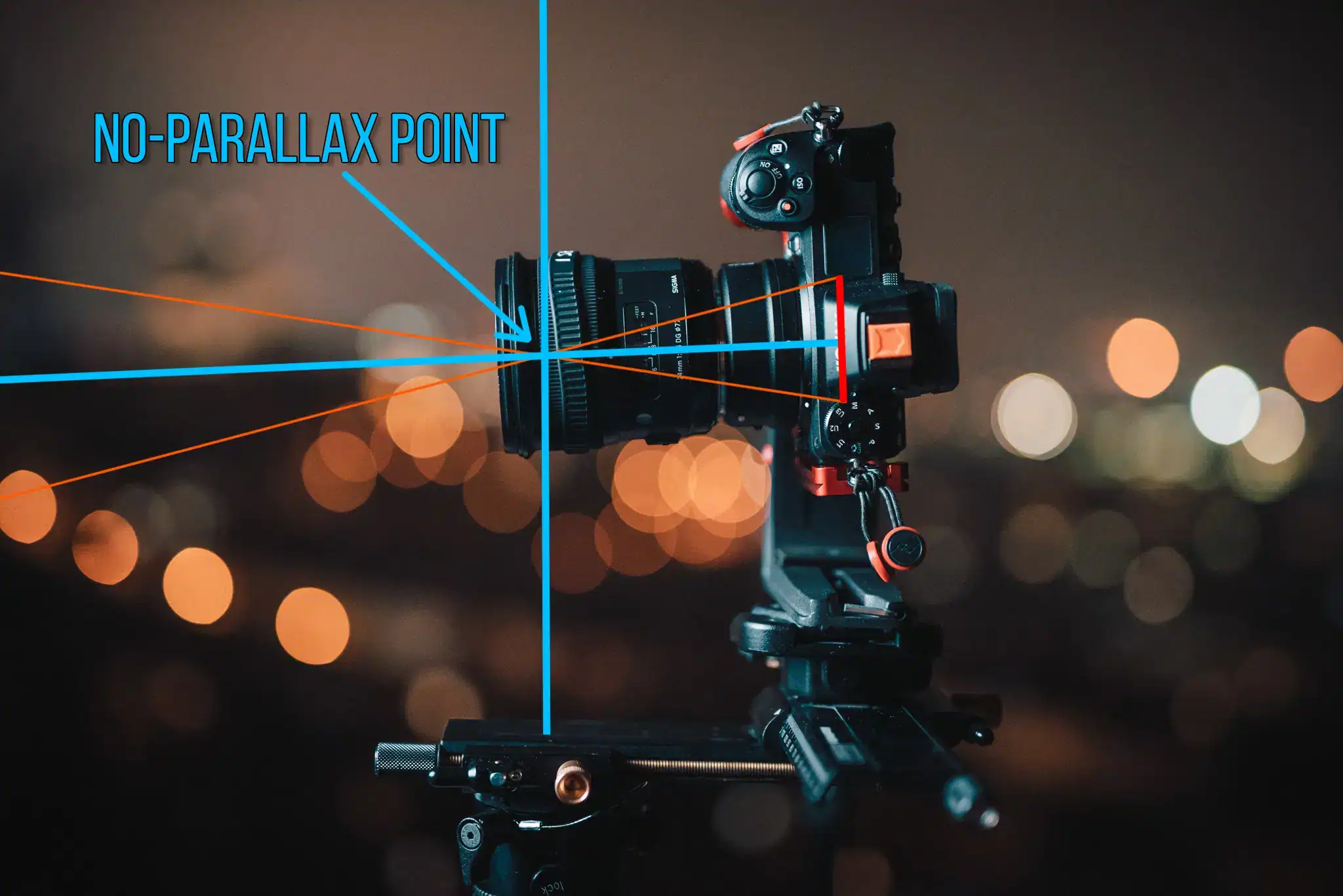
Want a quick primer on panoramic head setup? This short tutorial on panoramic head fundamentals is a solid reference at the end of your first practice session. Panoramic head tutorial
Step-by-Step Shooting Guide
Standard Static Scenes
- Level and align nodal point: Use the leveling base first. Slide the Peleng on the pano head rail until near objects (e.g., two light stands) show no relative shift when you pan left/right. Mark this rail position for the A1 + Peleng combo.
- Manual exposure & WB: Switch to Manual mode, set WB (Daylight for sun, Tungsten for indoor lamps, or a measured Kelvin). Disable Auto ISO. On a tripod, turn IBIS off to prevent sensor micro-shifts.
- Capture with overlap: With the Peleng 8mm, shoot:
- Fast set: 3 shots around at 120°, keep at least ~30% overlap between circle edges.
- Safe set: 4 shots around at 90° for generous overlap and easier stitching.
- Nadir coverage: Depending on your head height and the circular crop, you’ll likely need a nadir patch. Take a separate ground shot after moving the tripod slightly or shooting hand-held directly above the previous tripod location.
HDR / High Dynamic Range Interiors
- Bracket ±2 EV (3 or 5 frames): For bright windows and dark corners, bracket each yaw position. The A1 handles bracketing quickly—use mechanical shutter indoors to avoid LED banding.
- Lock WB and keep aperture constant: Shoot RAW, lock WB, keep aperture fixed (e.g., f/8) so only shutter speed changes across brackets.
- Sequence: For a 4-around pano with 5-frame brackets, you’ll capture 20 frames per rotation. Keep the pattern consistent to avoid skipping a frame.
Low-Light / Night Scenes
- Longer shutter, low ISO: Start at ISO 100–400 and lengthen shutter (1–8s) rather than pushing ISO. The A1 stays clean up to ~800–1600, but lower is better for stitching latitude.
- Stability: IBIS off on tripod, use a remote or 2-sec timer, and shield the lens from stray light.
- Check for flicker: Neon/LED can cause flicker. Use mechanical shutter and avoid too short exposures if lighting is cycling.
Crowded Events
- Two passes strategy: First pass for coverage, second pass waiting for gaps at problem seams.
- Mask in post: Most stitchers (PTGui, Hugin) let you paint masks to pick the cleanest version of moving subjects.
- Use 4-around: Extra overlap makes blending crowds much easier.
Special Setups (Pole / Car / Drone)
- Pole: Use a carbon pole and keep rotations slow. Tighten clamps, add a safety tether, and favor 3-around captures for speed.
- Car mount: Triple suction + safety tether; drive slowly on smooth surfaces. Plan for shorter exposures and higher ISO (400–800) to freeze vibration.
- Drone: The A1 is heavy—this is specialist territory. If you attempt it, use a heavy-lift platform and follow local aviation laws.
For a visual walk-through of panoramic head setup and capture discipline, this video provides a concise demonstration:
Recommended Settings & Pro Tips
Exposure & Focus
| Scenario | Aperture | Shutter | ISO | Notes |
|---|---|---|---|---|
| Daylight outdoor | f/8–f/11 | 1/100–1/250 | 100–200 | Lock WB (Daylight). Use 3-around for speed or 4-around for safety. |
| Low light/night | f/4–f/5.6 | 1/30–8s | 100–800 | Tripod and remote; IBIS OFF; prefer longer shutter over high ISO. |
| Interior HDR | f/8 | Bracket ±2 EV | 100–400 | Mechanical shutter indoors to avoid LED banding. |
| Action / moving subjects | f/5.6–f/8 | 1/200+ | 400–800 | Freeze motion; shoot two passes for maskable seams. |
Critical Tips
- Manual focus near hyperfocal: With 8mm at f/8, hyperfocal is roughly 0.3–0.4 m; set focus there and tape the ring. Validate on a test chart and infinity details.
- Nodal alignment: Expect the entrance pupil close to the front group on a circular fisheye. Start with the rail around mid-lens, fine-tune using the “near-far” parallax test, and mark your final rail index for the A1 body.
- White balance lock: Mixed lighting is common indoors; choose a Kelvin or a consistent preset. RAW files give you flexibility, but consistency across frames minimizes color shifts.
- RAW over JPEG: Keep maximum dynamic range and recover highlights/shadows more cleanly during stitching and blending.
- IBIS OFF on tripod: Prevents micro-jitters that can misalign stitch points. Re-enable when shooting handheld.
- Mechanical shutter indoors: Electronic shutter can show banding under LED lighting. Use mechanical for brackets inside.
- Flare control: Use your hand or a small flag just out of frame to block the sun; watch for reflections and wipe the front element frequently.
Stitching & Post-Processing
Software Workflow
With a circular fisheye, stitching is fast: import into PTGui or Hugin, set lens type to “circular fisheye,” and let the optimizer solve yaw/pitch/roll. Aim for ~30–40% overlap per adjacent frame. Rectilinear lenses usually demand more shots (~20–25% overlap) but don’t apply here. PTGui’s masking and HDR merge are excellent for real estate and mixed lighting. Many pros find PTGui the fastest way to consistent results. For a second opinion and broader panorama tips, see this review of PTGui’s strengths in complex panoramas. PTGui review and best practices
Cleanup & Enhancement
- Nadir patch: Patch the tripod area either by shooting a dedicated nadir plate or cloning in Photoshop/Affinity. Some AI tools can remove tripods rapidly.
- Color and noise: Normalize white balance across images; apply gentle noise reduction for high-ISO night caps.
- Leveling: Use the optimizer’s horizon tool to straighten roll/pitch; check verticals in interiors.
- Output: Export equirectangular 8K (8192×4096) JPEG or TIFF for VR; the A1’s 50MP files can support even larger outputs if you prefer.
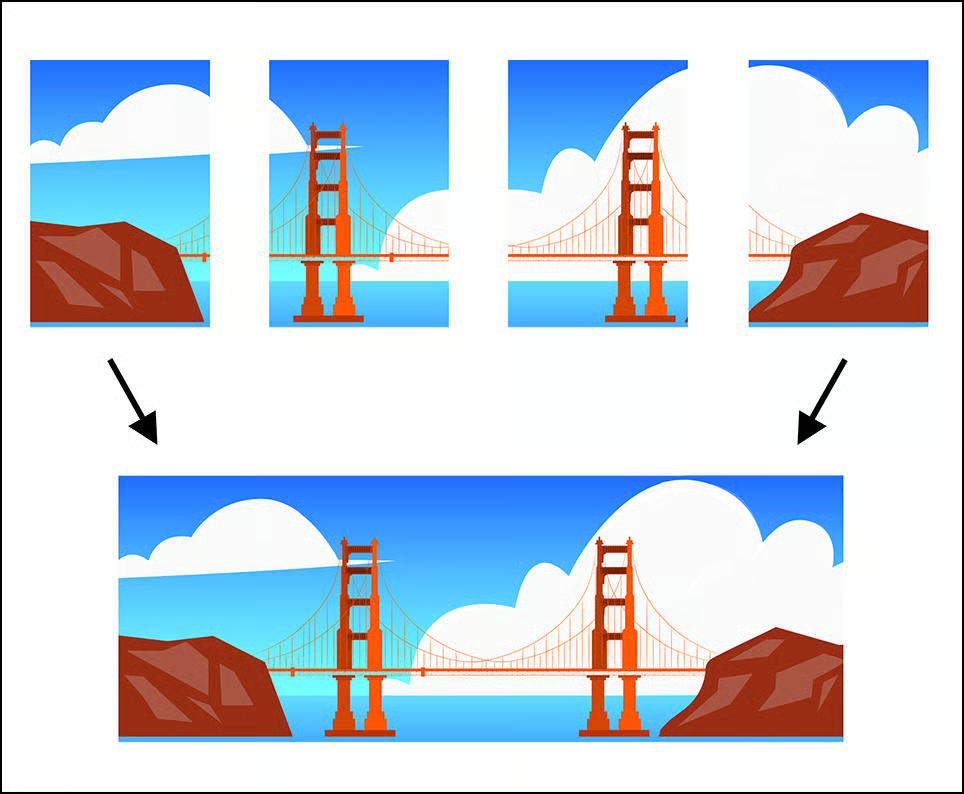
For a complete DSLR/mirrorless-to-VR overview, including export guidelines and viewer requirements, this official guide is a helpful companion. 360 photo capture and stitching for VR
Useful Tools & Resources
Software
- PTGui (fast stitching, HDR fusion, masking)
- Hugin (open-source alternative, powerful control)
- Lightroom / Photoshop / Affinity Photo (RAW prep and cleanup)
- AI tripod removal or content-aware fill tools
Hardware
- Panoramic heads: Nodal Ninja, Leofoto, and similar modular rails
- Carbon fiber tripods (with a leveling base)
- Wireless remote shutters or Sony Imaging Edge Mobile
- Pole extensions / car suction mounts with safety tethers
Disclaimer: software/hardware names are provided for search convenience; consult official sites for latest specifications and compatibility.
If you want a concise field-focused FAQ and system selection notes for DSLR 360 capture, this resource is worth bookmarking. DSLR virtual tour guide and FAQ
Common Mistakes & How to Avoid Them
- Parallax errors: Not aligning the entrance pupil. Solution: Calibrate with a near-far test and mark your rail.
- Exposure flicker: Auto exposure or Auto WB across frames. Solution: Manual exposure, fixed WB, RAW workflow.
- Tripod shadows/footprint: Neglecting nadir coverage. Solution: Shoot a nadir plate or patch in post.
- Ghosting from movement: One-pass only in crowds. Solution: Two-pass technique and masking in stitcher.
- Night noise and blur: High ISO and touching the camera. Solution: Lower ISO, longer shutter, remote trigger, IBIS off.
- LED banding indoors: Silent shutter under flicker. Solution: Mechanical shutter for interior bracketing.
Field-Tested Scenarios with the Sony A1 + Peleng 8mm
Indoor Real Estate
Mount a panoramic head and set f/8, ISO 100–200. Use 4-around with 5-frame ±2EV brackets per yaw position. Turn off electronic shutter to prevent LED banding. Keep WB fixed (e.g., 4000–4500K for mixed tungsten/LED). In PTGui, use HDR merge then tone-map gently—avoid overcooked halos. Final output at 8K equirect is ample for MLS and virtual tour platforms.
Outdoor Sunset
At golden hour, use ISO 100, f/8, and meter for highlights (protect the sun). Consider a 3-frame bracket if contrast is extreme. Use your hand as a flag to block direct sunlight at the lens edge and rotate slowly so flare doesn’t jump unpredictably between frames.
Event with Crowds
To reduce ghosting, shoot 4-around twice. During the second pass, wait for gaps in traffic at problem seams (e.g., near a busy vendor stall). In PTGui, mask in the cleaner people positions from the second pass. The Peleng’s fast shot count limits how often you miss moments.
Rooftop or Pole Capture
Use a carbon pole with a safety tether and a small stand-off to keep the camera well balanced. Favor 3-around for speed. Increase shutter speed to 1/200–1/500 if wind is significant, and bump ISO to 400–800. Always plan an escape path for sudden gusts and never leave the rig unattended.
Car-Mounted Drive-By
Use triple suction mounts with a safety line. Keep speeds low and roads smooth. Shoot 4-around with 1/250–1/500 at ISO 400–800 to combat vibration. Expect to mask moving cars and random pedestrians in post. Do not attempt on public roads without proper safety and legal permissions.
Frequently Asked Questions
-
Can I shoot handheld panoramas with the Sony A1?
Yes, for quick captures outdoors, but expect more stitching errors and parallax with near objects. Use 4-around, keep the camera rotating around your body’s pivot as consistently as possible, enable IBIS, and shoot at faster shutter speeds. A calibrated pano head still yields far more reliable results.
-
Is the Peleng 8mm f/3.5 wide enough for a single-row 360?
Absolutely. As a circular fisheye on full-frame, it covers 180° vertically and requires only 3–4 shots around to complete a full sphere. Most shooters prefer 4-around at 90° yaw for safer overlap and easier stitching.
-
Do I need HDR for interiors with bright windows?
Usually, yes. Even with the A1’s strong dynamic range, windows often exceed 15 stops. Bracket ±2EV (3 or 5 frames) at each yaw position and merge in PTGui or your HDR tool to preserve highlight detail and clean shadows.
-
How do I avoid parallax issues with this combo?
Use a panoramic head and align the lens’s entrance pupil via a near-far test. With the Peleng, start with the rail placing the rotation axis near the front optical group, then fine-tune until near objects stay stationary relative to the background while panning.
-
What ISO range is safe on the Sony A1 in low light?
For critical work, ISO 100–800 keeps the files very clean. ISO 1600 is still usable with careful noise reduction. When on a tripod, prefer longer shutter times over pushing ISO.
-
Can I set up custom modes for pano on the A1?
Yes. Save Manual exposure, fixed WB, RAW, IBIS OFF (for tripod), drive mode (self-timer or remote), and bracket settings to a custom recall for fast, consistent operation.
-
How can I reduce flare with a circular fisheye?
Avoid placing the sun just outside the circle. Use your hand or a small flag to shade the lens edge. Clean the front element often and consider slight yaw offsets to keep strong sources within the frame rather than grazing the edge.
-
What’s the best pano head for this setup?
Look for a compact, rigid head with fore-aft and lateral adjustments (e.g., Nodal Ninja/Leofoto rails). A leveling base speeds setup, and laser-etched scales help repeatability.
Want a structured, step-by-step professional workflow for perfect high-end 360s with a panoramic head? This guide covers the essential principles end-to-end. Set up a panoramic head for high-end 360 photos
Safety, Data Integrity, and Workflow Confidence
The A1 + Peleng kit is compact, but poles, rooftops, and car mounts raise risk. Always tether gear, watch wind loads, and keep bystanders clear. Indoors, protect floors and furniture with rubber feet and pads. For data integrity, back up immediately: use dual card slots with simultaneous write when speed allows, and copy to a laptop/SSD at the first opportunity. If the scene is important, shoot a second full rotation as insurance—tiny mistakes often show later at the computer.