Why This Camera & Lens Are Great for Panoramas
The Sony A1 paired with the Canon EF 8–15mm f/4L Fisheye USM (via an EF–E adapter) is a powerhouse combo for fast, high‑quality 360° panoramas. The A1’s 50.1MP full‑frame stacked CMOS sensor (approx. 35.9 × 24 mm, ~4.16 µm pixel pitch) captures immense detail with excellent dynamic range (roughly 15 stops at base ISO), so even complex interior scenes with bright windows can be balanced through bracketing without excessive noise. Its robust IBIS, electronic level, and silent shutter help you work efficiently on a tripod or in sensitive environments.
The Canon 8–15mm is a versatile fisheye zoom that gives you two useful behaviors on full frame: at 8mm it’s a circular 180° fisheye that minimizes shot count for rapid 360° capture; at 15mm it becomes a diagonal fisheye with ~180° diagonal FOV that improves edge detail and reduces stitching stress at the cost of a few more frames. The combination is ideal when you need speed (events, outdoor scouting, pole work) and reliability (real estate interiors, architectural documentation), with the A1’s resolution letting you push final output sizes significantly.
Adapter note: use a reliable EF–E adapter (e.g., Metabones V, Sigma MC‑11, or similar). Autofocus with adapted fisheyes can be hit‑or‑miss; for panoramas, manual focus with focus magnification is preferred anyway. The lens has modest lateral CA but is easily corrected in RAW; optimal sharpness generally sits around f/5.6–f/8.
Quick Setup Overview
- Camera: Sony A1 — Full-frame, 50.1MP, stacked CMOS, excellent DR; IBIS; silent electronic shutter.
- Lens: Canon EF 8–15mm f/4L Fisheye USM — fisheye zoom; circular at 8mm, diagonal at 15mm; sharp at f/5.6–f/8; mild CA; use EF–E adapter.
- Estimated shots & overlap:
- 8mm (circular fisheye): 4 around (90° apart) + optional zenith + nadir; 25–35% overlap.
- 10–12mm: 6 around + zenith + nadir; 25–30% overlap.
- 15mm (diagonal fisheye): 6–8 around + zenith + nadir; 25–30% overlap.
- Difficulty: Easy–Medium. Fisheye reduces shot count but requires good nodal alignment.
Planning & On-Site Preparation
Evaluate Shooting Environment
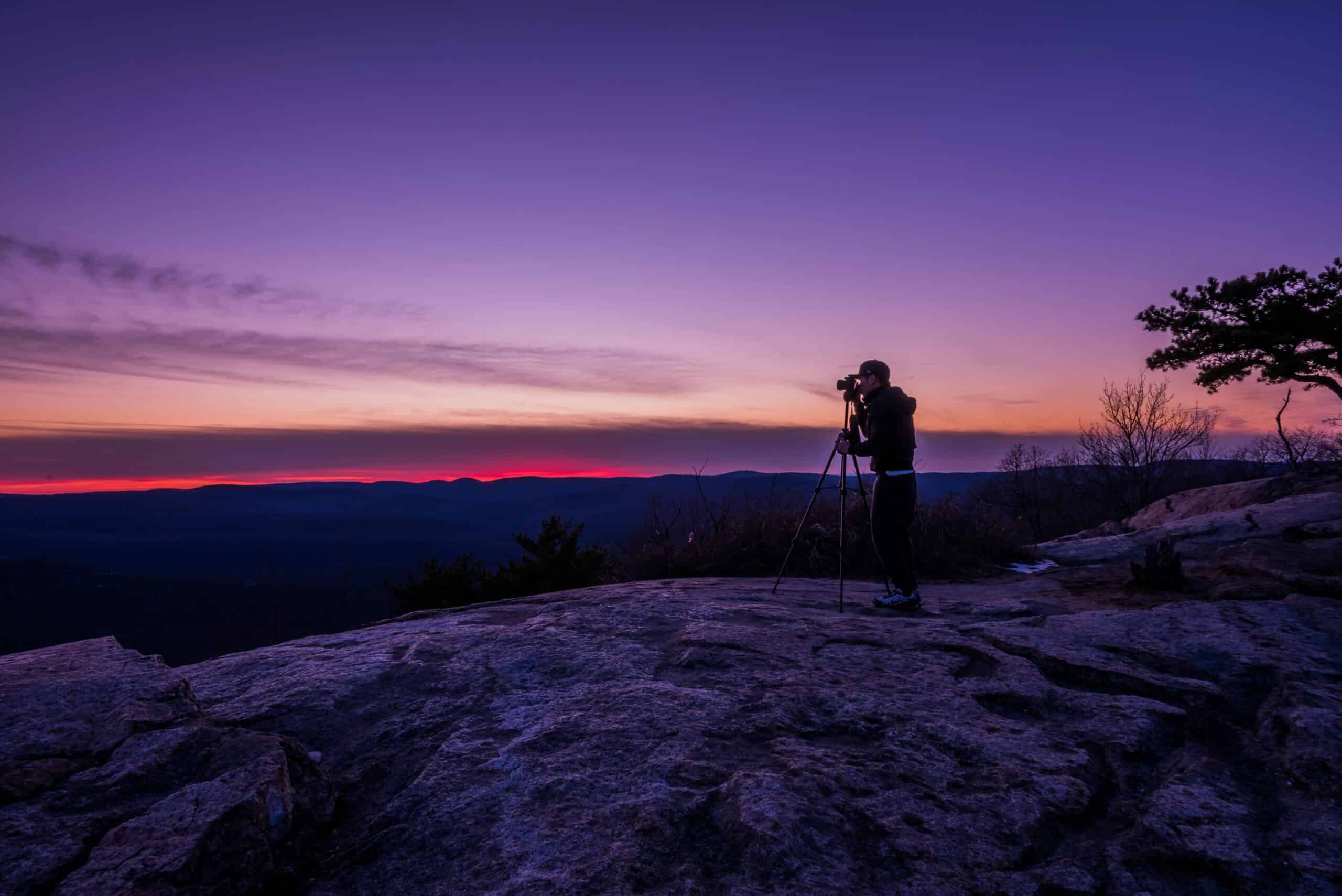
Before deploying the tripod, scan for moving elements (people, trees, vehicles), reflective or refractive surfaces (glass, polished stone, water), and high‑contrast lighting (sunset, windows). If shooting through glass, get the front element as close as possible (1–2 cm) to minimize reflections; use a rubber lens hood if available. Avoid strong oblique backlight at 8mm—circular fisheye captures the sun easily and can flare; plan your rotation so the sun is framed toward an overlap region for easier masking.
Match Gear to Scene Goals
The A1’s dynamic range and low‑noise RAW files let you bracket interiors cleanly; safe ISO ranges for critical quality are ISO 100–400 for interiors with tripod, and up to ISO 800–1600 for hand‑held or fast outdoor work. The fisheye drastically cuts shot count—great for event crowds, roof poles, or windy conditions—but you must mind parallax by aligning the entrance pupil. For real estate and architecture, 10–12mm or 15mm often yields cleaner edges and straighter perceived lines after remapping to equirectangular.
Pre-shoot Checklist
- Power & storage: full batteries, large/fast cards; consider dual card backup.
- Optics clean: lens front/rear and sensor checked for dust (tiny specks are very obvious at 8–15mm).
- Tripod & head: level base; pano head calibrated for no‑parallax; bubble or electronic level verified.
- Safety: wind assessment; rooftop and pole tethering; car mount double safety straps; no people below your rig.
- Backup workflow: for critical scenes, shoot one full safety round with identical settings before you change anything.
Essential Gear & Setup
Core Gear
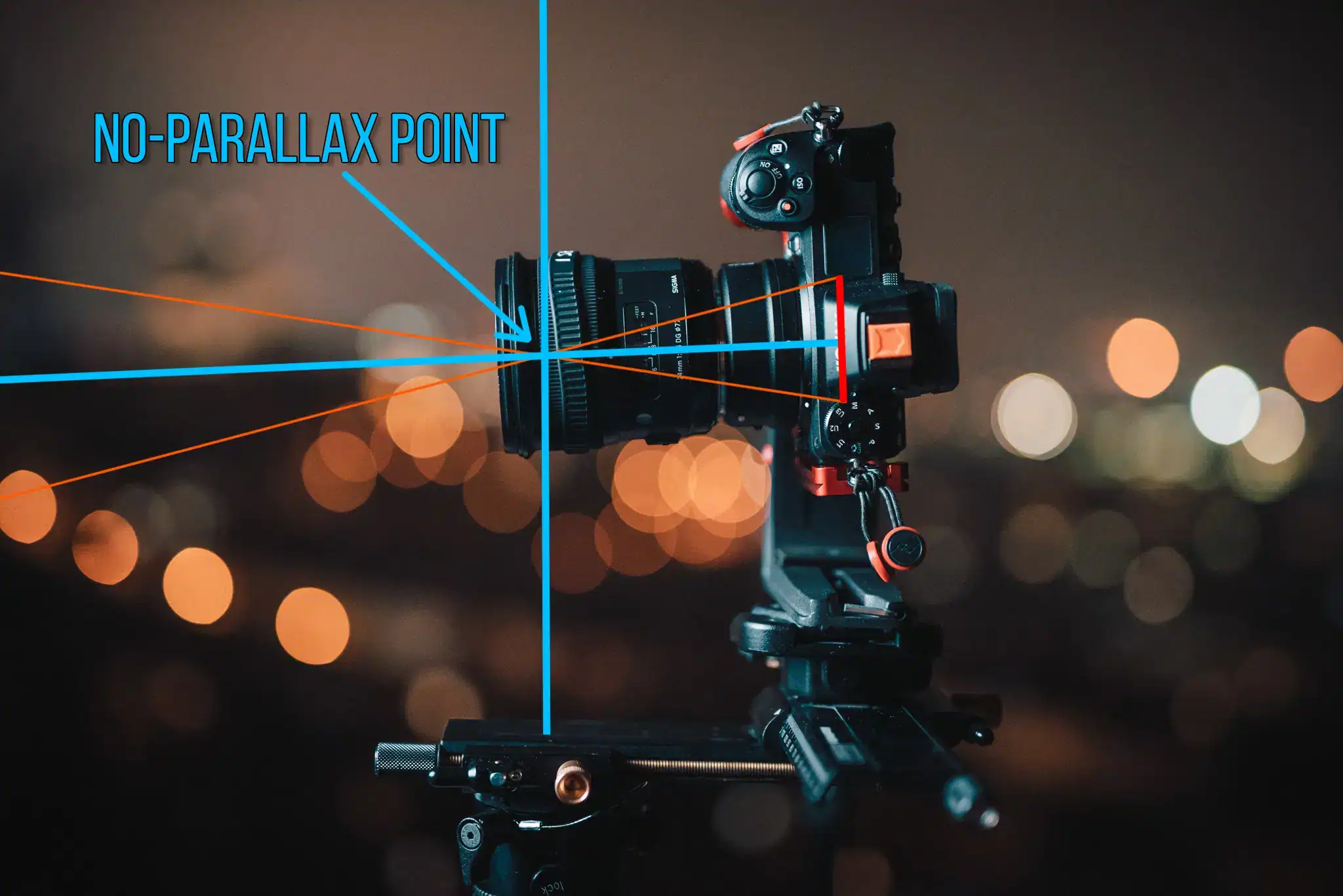
- Panoramic head: A rotator and fore‑aft rail allow aligning the lens’s entrance pupil (commonly called nodal point) over the rotation axis. This eliminates parallax when foreground and background overlap, which is crucial for clean stitches.
- Stable tripod with leveling base: A leveling base speeds setup and keeps your rotation true, reducing yaw/pitch errors.
- Remote trigger or app: Use a wired remote, Bluetooth trigger, or Sony’s Imaging Edge app for vibration‑free exposures.
Optional Add-ons
- Pole or car mount: Use high‑strength clamps and safety tethers. Watch wind load—fisheyes catch everything, including the sky; shoot shorter exposures and rotate slower to mitigate vibration.
- Lighting aids: Small LED panels or bounced speedlights for low‑light interiors. Keep lighting consistent between frames.
- Weather protection: Rain covers, silica gel, and gaffer tape for unexpected drizzle or dust.
Want a visual walk‑through of panoramic head setup? See Meta’s comprehensive guide on panoramic heads for high‑end 360 photos. Set up a panoramic head to shoot perfect high‑end 360 photos
Step-by-Step Shooting Guide
Standard Static Scenes
- Level and align: Level the tripod using the leveling base or camera’s electronic level. Slide the camera along the pano head’s rail until foreground and background objects maintain relative position as you pan—this indicates the entrance pupil is over the rotation axis.
- Manual exposure and WB: Set Manual mode. Choose aperture first (f/5.6–f/8 for maximum sharpness across the fisheye). Dial shutter for mid‑tone exposure; keep ISO low (100–200). Set a fixed white balance (Daylight, Tungsten, or Custom). This prevents color and exposure flicker across frames.
- Focus: Switch to manual focus. For 8mm at f/8, a focus distance of about 0.3–0.5 m keeps everything from ~0.15 m to infinity acceptably sharp. For 15mm at f/8, set ~1 m for hyperfocal coverage. Use focus magnification to confirm.
- Capture sequence:
- 8mm: 4 around (90° increments), slight downward tilt (–5° to –10°) to secure nadir coverage; add a dedicated zenith if needed.
- 10–12mm: 6 around (60° increments), level row; add zenith (+60° to +90°) and nadir shots.
- 15mm: 6–8 around depending on scene complexity; always capture zenith and nadir.
- Nadir shot: After the around shots, tilt down and shoot the ground for tripod removal. For a clean patch, shoot a handheld nadir with the tripod moved aside while keeping the camera position roughly above the rotation point.
HDR / High Dynamic Range Interiors
- Bracket ±2 EV (3 or 5 frames): Windows vs interior shadows demand bracketing to preserve detail. The A1’s DR lets you compress to natural tonality in post without haloing.
- Lock WB and keep constant aperture: Changing f‑stop across brackets shifts vignetting and sharpness; keep aperture fixed.
- Use self‑timer or remote: Prevent micro‑shake across bracket sets; enable exposure delay if needed.
Low-Light / Night Scenes
- Longer exposures on tripod: Use f/4–f/5.6 and 1/15–1/60 s as a starting point. Keep ISO 100–400 for best quality; the A1 handles up to ISO 800–1600 if wind or vibration forces faster shutter.
- Turn off IBIS on tripod: Sensor stabilization can introduce blur when the camera is locked down. Use the electronic first curtain or silent shutter if you prefer vibration‑free capture.
- Use a wind shield: Your body or a jacket can shield the lens from gusts during each exposure.
Crowded Events
- Two passes strategy: First, shoot the full sequence quickly for coverage. Second, reshoot frames with fewer people when gaps appear.
- Mask in post: Use PTGui’s masking to remove duplicates or ghosting. Faster shutter (1/200–1/500) reduces blur on moving subjects.
Special Setups (Pole / Car / Drone)
- Pole: Use a rigid carbon pole, anchor your feet, and tether the camera. Short exposures (1/250–1/500) and a lower ISO gain (ISO 400–800) help freeze sway. Rotate slowly and allow settle time before each frame.
- Car mount: Only on private/controlled roads. Double safety lines, inspect suction mounts, and limit speed. Use faster shutter speeds and capture at stops whenever possible.
- Drone: The A1 is heavy; unless using specialized rigs, prefer a dedicated 360 camera for aerials.
For more fundamentals and field‑tested pano techniques, this panoramic head tutorial offers practical visuals and troubleshooting. Panoramic head tutorial by 360 Rumors
Recommended Settings & Pro Tips
Exposure & Focus
| Scenario | Aperture | Shutter | ISO | Notes |
|---|---|---|---|---|
| Daylight outdoor | f/8–f/11 | 1/100–1/250 | 100–200 | Lock WB to Daylight; slight underexposure protects highlights |
| Low light/night | f/4–f/5.6 | 1/15–1/60 | 100–800 | Tripod + remote; disable IBIS on tripod; consider multiple passes |
| Interior HDR | f/8 | Bracket ±2 EV | 100–400 | Expose for mid‑tones; blend to retain window detail |
| Action/moving subjects | f/5.6–f/8 | 1/200+ | 400–800 | Two passes; mask motion in post |
Critical Tips
- Manual focus at hyperfocal: At 8mm f/8, set ~0.3–0.5 m; at 15mm f/8, ~1 m. Confirm with focus magnification.
- Nodal calibration: Use two vertical objects at different distances. Pan left/right—if their relative position shifts, adjust the camera forward/back on the rail until the shift disappears.
- White balance lock: Avoid mixed WB across frames. Use a custom preset if light is mixed.
- RAW workflow: Shoot RAW for maximum latitude (CA removal, defringe, tone mapping). JPEG is fine for quick work but limits dynamic range.
- IBIS and tripod: Disable stabilization on tripod to prevent sensor drift blur. Use the A1’s electronic level for perfect horizons.
- Adapter behavior: With the EF 8–15mm, AF may be inconsistent via adapters—manual focus is more reliable for panoramas.
Case Studies (What Works in the Field)
Indoor Real Estate
At 10–12mm, shoot 6 around + zenith + nadir. Bracket ±2 EV. Keep WB fixed (e.g., 3200–4000K under warm LEDs). The A1’s DR preserves window highlights, reducing the need for aggressive HDR. Keep the camera centered in doorways to minimize vertical line bending when remapped.
Outdoor Sunset
At 8mm circular, 4 around + zenith + nadir, underexpose 1/3–2/3 stop to protect the sun rim. Consider shooting two sequences: one for sky detail, one for shadows, then blend in post.
Event Crowds
At 15mm, shoot 8 around for more overlap and control. Increase shutter to 1/250–1/500 and ISO 400–800. Mask moving people in PTGui later.
Rooftop Pole
At 8mm, use 4 around to finish quickly. Short exposures (1/250–1/500) reduce sway. Always tether the camera and check wind gusts; safety first.
Car-Mounted Capture
Only on closed/controlled environments. At 8–10mm, shoot at stops or crawl speeds with fast shutter. Expect vibrations; overshoot frames to ensure you have clean pairs for masking.
Stitching & Post-Processing
Software Workflow
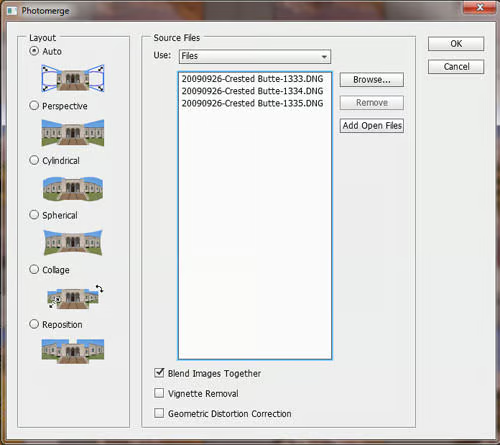
Import RAWs into Lightroom or Capture One for basic corrections (WB, exposure, CA/defringe). Export 16‑bit TIFFs to PTGui or Hugin for stitching. Fisheyes are actually easier to stitch because each frame covers a lot and the projection is predictable; aim for ~25–30% overlap. Rectilinear lenses require more frames and careful overlap but can present straighter local geometry. For a deep dive on PTGui’s capabilities and why many pros rely on it, see this review. PTGui: Fstoppers review
Cleanup & Enhancement
- Nadir patch: Use PTGui’s Viewpoint correction or export to Photoshop/Affinity for manual clone/patch. AI tools can accelerate tripod removal.
- Color consistency: Sync WB and tone curves across all frames before stitching; apply subtle global contrast after stitching to avoid seams.
- Noise reduction: Apply mild NR on interior shadows; the A1 tolerates modest NR without smearing details.
- Level & horizon: Use the panorama editor to set horizon and verticals accurately; verify pitch/yaw/roll.
- Export: For VR platforms, export 2:1 equirectangular JPEG/TIFF (e.g., 12000×6000 or higher). If targeting virtual tour platforms, ensure metadata compatibility.
Resolution vs shot count is explained in detail by the Panotools community—handy when planning your capture grid. DSLR spherical resolution resources
Video: See the Process in Action
Watch a thorough walkthrough on high‑end 360 photo creation with DSLRs/mirrorless, from setup to stitch.
If you’re new to 360 pipelines using interchangeable‑lens cameras, Meta’s guide is another reliable reference from capture through stitching. Using a DSLR/Mirrorless to shoot and stitch a 360 photo
Useful Tools & Resources
Software
- PTGui panorama stitching
- Hugin (open source)
- Lightroom / Photoshop / Affinity Photo
- AI tripod removal and inpainting tools
Hardware
- Panoramic heads: Nodal Ninja, Leofoto, Really Right Stuff
- Carbon fiber tripods with leveling bases
- Wireless remotes (Sony Bluetooth or wired)
- Pole extensions / car mounts with safety tethers
Disclaimer: software/hardware names are provided for search reference; verify official documentation for specifications and compatibility.
Common Mistakes & How to Avoid Them
- Parallax error: Always align the entrance pupil on a pano head, especially with nearby objects.
- Exposure flicker: Use full manual exposure and fixed white balance.
- Tripod shadows and footprints: Capture a dedicated nadir and patch during post‑processing.
- Ghosting from movement: Shoot two passes and mask people/vehicles in your stitcher.
- High ISO noise: Keep ISO low when possible; the A1 is clean up to ISO 800–1600 but base ISO yields the best gradients.
- IBIS on tripod: Disable stabilization to prevent subtle blur from sensor drift.
Frequently Asked Questions
-
Can I shoot handheld panoramas with the Sony A1?
Yes for partial panoramas and quick 360s outdoors, but expect stitching challenges from parallax. Use high shutter speeds (1/250+), lock exposure/WB, and maintain consistent rotation around the camera. For critical 360s or interiors, use a pano head and tripod.
-
Is the Canon EF 8–15mm f/4L wide enough for a single-row 360 on full frame?
Absolutely. At 8mm (circular) you can cover a full sphere with 4 around plus zenith/nadir. At 15mm (diagonal), use 6–8 around plus zenith/nadir for robust overlaps and cleaner edges.
-
Do I need HDR for interiors with bright windows?
Often, yes. Bracket ±2 EV (3–5 frames) to retain highlights outdoors while preserving interior detail. The A1’s DR helps, but HDR bracketing keeps noise lower in shadow areas and avoids blown windows.
-
How do I avoid parallax issues with this lens and an EF–E adapter?
Mount the A1 on a panoramic head with a fore‑aft rail. Perform a no‑parallax test with near/far verticals and adjust the camera position until relative alignment is stable while panning. Mark the rail positions for 8mm and 15mm on your quick‑release plate for repeatability.
-
What ISO range is safe on the A1 in low light?
For tripod‑based HDR panoramas, aim for ISO 100–400. For hand‑held or windy scenes, ISO 800–1600 is workable, especially when downsampling the final equirectangular. Always prioritize aperture and shutter first; raise ISO only as needed.
-
Can I set up Custom Modes for panoramas on the A1?
Yes. Assign a custom mode with manual exposure, fixed WB, manual focus, drive mode single shot, IBIS off (for tripod), and electronic level display. Store separate presets for “HDR tripod” and “fast outdoor” workflows.
-
How can I reduce lens flare with a fisheye?
Plan your rotation to place the sun near overlap seams, use your hand/body to flag the sun just outside the frame, clean the front element, and avoid unnecessary filters. Slightly underexpose to protect highlights.
-
What panoramic head should I choose for this setup?
Any solid 2‑axis head with a precise rotator works well (Nodal Ninja, Leofoto, RRS). Ensure it supports fore‑aft adjustment for the entrance pupil and offers click‑stops at common increments (60°/90°). A compact ring clamp solution is also excellent for the 8–15mm.