Why This Camera & Lens Are Great for Panoramas
The Olympus OM-1 paired with a diagonal fisheye like the Sigma 15mm f/1.4 DG DN Diagonal Fisheye Art gives you a fast, bright optic and a rugged, stabilized camera body — an appealing combo for 360 photo and panoramic work. The OM-1 features a 20.4 MP stacked BSI Micro Four Thirds sensor (approx. 17.3 × 13 mm, ~3.3 µm pixel pitch), superb weather sealing (IP53-rated body when paired with sealed lenses), and class-leading in-body stabilization (IBIS) up to 7–8 stops with Sync-IS lenses. The Sigma 15mm f/1.4 DG DN is a modern Art-series fisheye with excellent sharpness wide open, robust build, and a 180° diagonal field on full-frame.
Important mount note: the Sigma 15mm f/1.4 DG DN Diagonal Fisheye Art is available for Sony E and L-Mount, not Micro Four Thirds. Directly mounting this lens on the OM-1 is not natively supported; there is no mainstream mechanical adapter from E/L to MFT that preserves infinity focus without optics. If you plan to use this exact lens with the OM-1, you would need a specialty optical adapter (not commonly available) and must accept potential vignetting and quality trade-offs. Practically speaking, most OM-1 panoramic shooters use an 8 mm class fisheye (e.g., Olympus M.Zuiko 8mm f/1.8 PRO, 7.5 mm manual fisheyes) to achieve similar coverage. This guide focuses on technique for “diagonal fisheye on OM-1,” and where relevant, calls out differences specific to the Sigma 15mm f/1.4 DG DN.
Why a diagonal fisheye? Fisheyes dramatically reduce the number of shots required for a seamless 360 photo. While rectilinear lenses need many frames, a diagonal fisheye can often complete a sphere in one or two rows plus zenith/nadir, speeding capture and improving stitching reliability around moving elements.
Quick Setup Overview
- Camera: Olympus OM-1 — Micro Four Thirds, 20.4 MP stacked BSI sensor, base ISO ~200 (LOW setting available), ~12 stops usable RAW dynamic range, IP53 weather sealing, IBIS up to 7–8 stops with compatible lenses.
- Lens: Sigma 15mm f/1.4 DG DN Diagonal Fisheye Art — diagonal fisheye projection, extremely sharp from f/2–f/5.6, good control of lateral CA, robust weather resistance. Note: native mounts are Sony E and L-Mount; not natively compatible with OM-1 (MFT).
- Estimated shots & overlap:
- If you adapt/use a true diagonal fisheye on OM-1 with similar FOV to an 8 mm MFT fisheye: 6 shots around (60° steps) + zenith + nadir (total 8). 25–30% overlap.
- If you somehow use the Sigma 15mm on OM-1 with limited coverage (due to crop): plan 10–12 shots around + zenith + nadir; 30% overlap to be safe.
- Difficulty: Moderate. Easy if using a calibrated panoramic head; more challenging if handholding or adapting lenses.
Planning & On-Site Preparation
Evaluate Shooting Environment
Look for moving objects, reflective surfaces, wind, and tight spaces. Glass walls and polished floors can reflect your tripod; keep the lens 30–60 cm away from glass to reduce reflections, and shade the lens to avoid flare. In busy scenes, plan two passes to help manage people movement in post. For rooftops and poles, check wind gusts and structure safety before raising gear.
Match Gear to Scene Goals
The OM-1’s stacked sensor and IBIS are excellent for low-light static scenes, but to maximize image quality, prefer ISO 200–800. Indoors, the bright f/1.4 fisheye (or an 8 mm f/1.8 MFT fisheye) lets you stop down modestly (f/4–f/5.6) for sharpness while keeping shutter times reasonable. A diagonal fisheye reduces shot count — vital for interiors with people or outdoor sunset light that changes quickly. However, fisheye projection exaggerates curvature; avoid placing straight architectural lines near frame edges or plan for careful de-fishing/correction in post.
Pre-shoot Checklist
- Charge batteries; bring spares. The OM-1’s battery is good, but long HDR brackets and night scenes drain faster.
- Large, fast cards; enable sequential file numbering. Clean lens and sensor (OM-1 has a dust-reduction system, but check anyway).
- Leveling base and calibrated panoramic head to align the nodal point and eliminate parallax.
- Safety: secure tripod on rooftops, avoid edges, and tether the camera when using poles or car mounts.
- Backup workflow: shoot a second safety round in case of stitching hiccups or motion ghosts.
Essential Gear & Setup
Core Gear
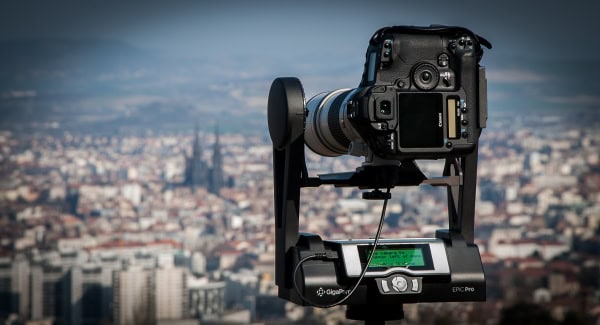
- Panoramic head: This is critical to place the lens’s entrance pupil (nodal point) over the rotation axis to eliminate parallax. Parallax causes stitching mismatches, especially near objects like furniture or railings.
- Stable tripod with leveling base: Leveling the head ensures roll stability and consistent overlap.
- Remote trigger or camera app: Use the OM Image Share app or a remote release to avoid touching the camera.
Optional Add-ons
- Pole or car mount: Use a safety tether; beware of wind-induced vibration. Keep speeds low and rotations slow.
- Lighting aids: Small LED panels for dark interiors; keep color temperature consistent for easier white balance.
- Weather gear: Rain covers and a microfiber cloth. The OM-1 is weather-sealed; still protect the lens front element.
Step-by-Step Shooting Guide
Standard Static Scenes
- Level the tripod: Use a leveling base or the OM-1’s level indicator. A small bubble level on the head helps too.
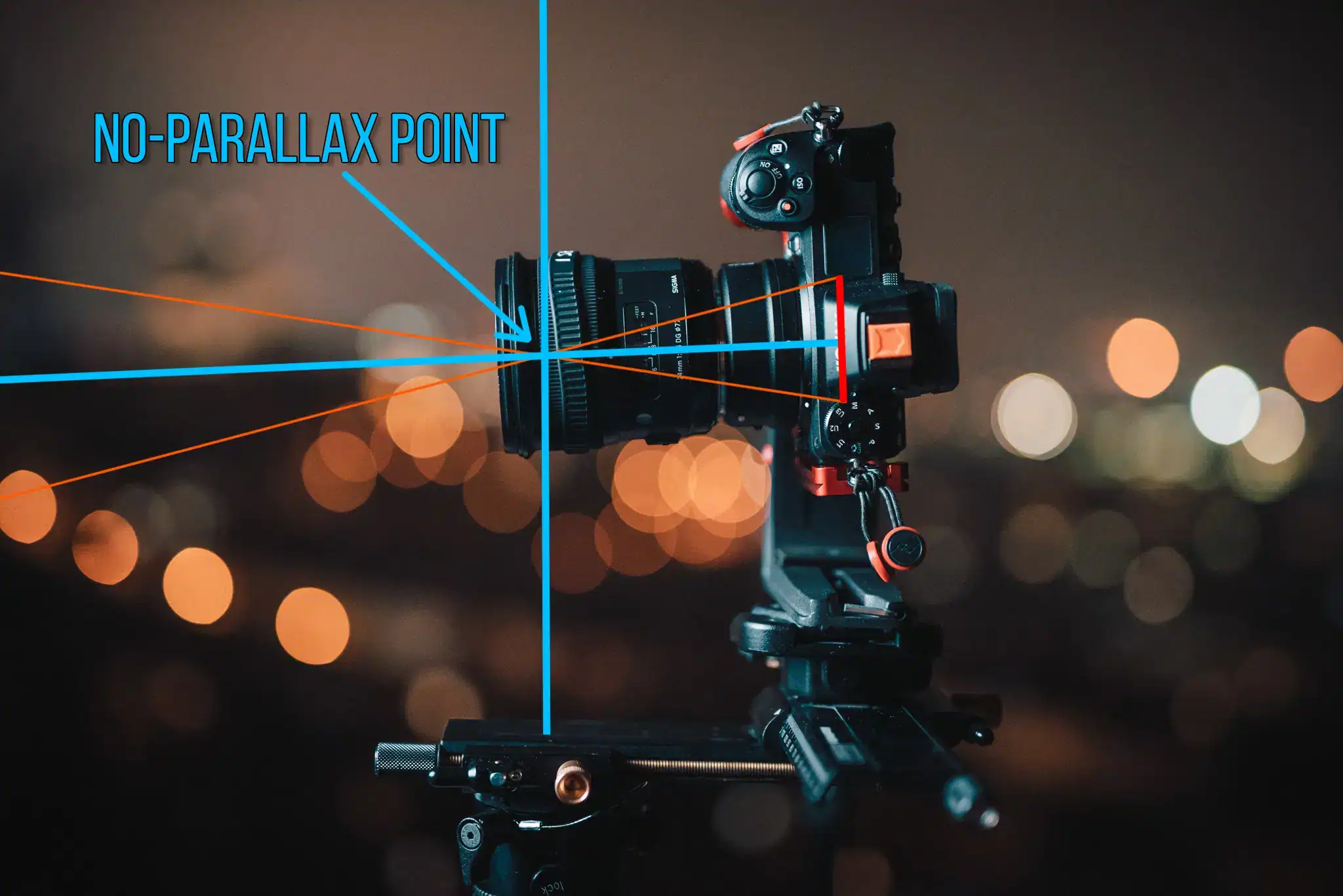
- Align the nodal point: Mount your panoramic head and slide the camera so the lens’s entrance pupil sits precisely above the rotation axis. Start with a rough guess, then refine with a near/far object alignment test (explained below).
- Set manual exposure, manual white balance, and manual focus: Avoid any auto mode that changes frame-to-frame. Pick a WB preset (Daylight, Tungsten) or set Kelvin values and keep it locked.
- Capture the round: With a true diagonal fisheye on OM-1 (e.g., 8 mm MFT), shoot 6 frames at 60° increments. Then shoot zenith (straight up) and a nadir (angled down) for tripod patching. If using the Sigma 15mm adapted with reduced FOV, shoot 10–12 around to ensure overlap.
- Take the nadir: After the main sequence, offset the tripod or use a handheld nadir shot to simplify tripod removal in post.
HDR / High Dynamic Range Interiors
- Bracket ±2 EV (3 or 5 frames): The OM-1 bracketing is reliable; use a 2 EV spacing to cover bright windows and dark corners.
- Lock white balance across brackets: AWB shifts create color inconsistencies; use a fixed Kelvin setting.
- Use a 2-second self-timer or remote: Prevent vibration, especially at slower shutters.
Low-Light / Night Scenes
- Open to f/2.8–f/4 if needed, but prefer f/4–f/5.6 for corner sharpness. The Sigma 15mm is sharp even wide; stop down slightly for uniformity.
- Target ISO 200–800 on the OM-1. ISO 1600 is usable but will need more noise reduction. Base ISO 200 gives best DR.
- Use long exposures on tripod; turn IBIS off when locked on a solid head to avoid micro-jitters.
Crowded Events
- Shoot two passes: one standard, one timed when people shift. You’ll mask frames later for clean seams.
- Prefer faster shutters (1/200+) and a bit more ISO (400–800) to freeze movement; keep exposure consistent.
Special Setups (Pole / Car / Drone)
- Pole: Use a carbon pole, guy lines, and a safety tether. Rotate slowly. Take extra overlap (30–40%).
- Car: Mount on a rigid suction platform; confirm clean rotation, avoid high speeds, and plan two passes for moving traffic.
- Drone: If using a separate platform for reference, lock exposure and use high overlap; watch prop shadows.
Recommended Settings & Pro Tips
Exposure & Focus
| Scenario | Aperture | Shutter | ISO | Notes |
|---|---|---|---|---|
| Daylight outdoor | f/8–f/11 | 1/100–1/250 | 100–200 (LOW/200) | Lock WB (Daylight). Turn IBIS off on tripod. |
| Low light/night | f/4–f/5.6 | 1/30–multi-sec | 200–800 | Tripod + remote; avoid ISO >1600 unless necessary. |
| Interior HDR | f/8 | Bracket ±2 EV | 200–400 | Balance windows with interior lamps; keep WB fixed. |
| Action / moving subjects | f/5.6–f/8 | 1/200+ | 400–800 | Freeze motion; consider two-pass strategy. |
Critical Tips
- Manual focus near the hyperfocal distance. On a 15 mm fisheye (FF) or 8 mm (MFT), focusing at ~1–1.5 m with f/8 keeps everything from ~0.6 m to infinity sharp.
- Nodal calibration: Start with the camera plate so that the lens’s entrance pupil sits roughly 55–65 mm forward of the sensor plane for a 15 mm fisheye, then refine using near/far alignment. Record your rail values.
- White balance lock: Pick Kelvin and keep it fixed. Mixed lighting? Consider a gray card capture for reference.
- RAW over JPEG: The OM-1’s 12-bit RAW latitude helps recover highlights/shadows and fix WB globally.
- IBIS: On tripod, disable. Handheld panos (emergency only) can keep IBIS on, but stitching will be less consistent.
Stitching & Post-Processing
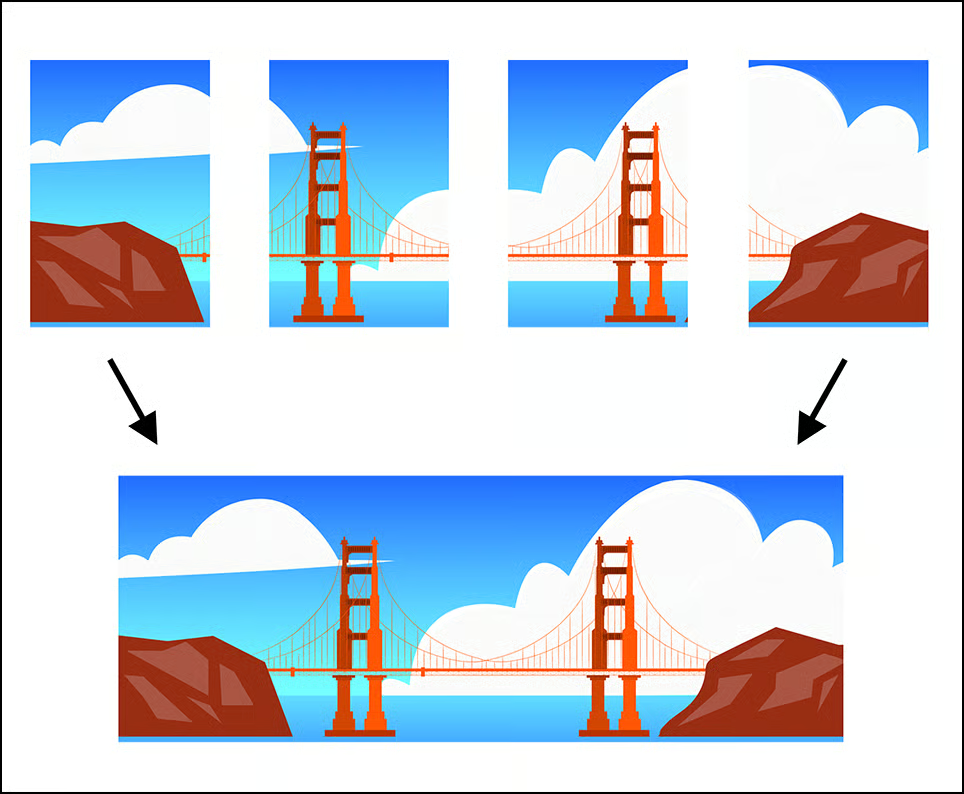
A diagonal fisheye is usually easier to stitch because you need fewer images and have strong control point density. In PTGui or Hugin, set fisheye lens type and ensure at least 25–30% overlap for fisheyes and 20–25% for rectilinear. Correct the lens projection, optimize control points, and set horizon using vertical lines.
Software Workflow
PTGui is a gold standard for spherical panoramas, with reliable fisheye support, masking, and HDR merge workflows. Hugin is an excellent open-source alternative. For global color and sharpening, finish in Lightroom or Photoshop. For VR delivery, export an equirectangular TIFF/JPEG at 8K–16K depending on your needs and the OM-1’s capture resolution. A practical starting point is 10000 × 5000 px for web tours, scaling higher for gigapixel work. For an industry overview of pano head setup and best practices, see the panoramic head tutorial on 360 Rumors, and for a pro review of PTGui’s capabilities, check Fstoppers’ in-depth review. Panoramic head tutorial PTGui review and workflow tips
Cleanup & Enhancement
- Nadir patch: Shoot a clean plate or use AI/clone tools to remove the tripod. Many virtual tour platforms accept nadir logos.
- Color and WB: Normalize mixed lighting with HSL and local adjustments. Keep skin tones natural in event panos.
- Noise reduction: Apply moderate NR for ISO 800–1600 night scenes. Preserve detail with masking.
- Level horizon: Use verticals and horizon tools in the stitcher to correct roll/pitch/yaw.
- Export: Save layered project files; export equirectangular masters and web-optimized JPEGs.
For platform-specific guidance on preparing DSLR/mirrorless 360 photos, Oculus provides a concise best-practices guide. DSLR/mirrorless 360 capture and stitching principles
Useful Tools & Resources
Software
- PTGui panorama stitching and HDR merge
- Hugin open-source panorama stitcher
- Lightroom / Photoshop for tone, color, and retouching
- AI tools for tripod/nadir removal and people cleanup
Hardware
- Panoramic heads: Nodal Ninja, Leofoto, Bushman Panoramic
- Carbon fiber tripods with leveling base
- Wireless remote shutters and smartphone apps
- Pole extensions and vehicle mounts (with safety tethers)
Disclaimer: product names are for search/reference; always check official documentation for your exact model and firmware.
Common Mistakes & How to Avoid Them
- Parallax errors: Always align to the lens’s entrance pupil using a calibrated panoramic head.
- Exposure flicker: Use full manual exposure and locked white balance; avoid auto ISO and AWB.
- Tripod shadows and footprints: Shoot a dedicated nadir frame and patch it in post.
- Ghosting from moving people/cars: Do a second pass and mask in PTGui/Hugin.
- High ISO noise at night: Keep ISO ≤800 where possible, lengthen shutter, and use a remote release.
- IBIS conflicts on tripod: Disable stabilization when mounted on a rigid head.
Real-World Case Studies
Indoor Real Estate
Set f/8, ISO 200, and bracket ±2 EV in 5 frames to handle bright windows. Shoot 6 around + Z + N with an 8 mm-class MFT fisheye or increase to 10–12 around if your adapted coverage is narrower. Use a gray card shot for WB. In PTGui, use HDR Merge and mask people or pets.
Outdoor Sunset
Light changes fast at sunset. With a fisheye, you can finish a full sphere in under a minute: 6 around at f/8, 1/100 s, ISO 200, plus Z+N. Consider a second pass at a slightly darker exposure to retain sky color, then blend.
Event Crowds
Raise shutter to 1/200–1/320 and ISO 400–800. Do two rotations; in post, pick frames with fewer people near seams and mask the rest. Keep the camera in one spot to prevent parallax issues.
Rooftop/Pole Shooting
Check wind and balance. Use a guy line and a safety tether. Increase overlap to 30–40% and shoot a clean nadir if possible after lowering the pole. Keep the OM-1 IBIS off and use a 2–5 s self-timer to minimize vibrations.
Car-Mounted Capture
Use a rigid suction mount and safety line. Park the car for static shots; moving capture is advanced and can introduce motion blur and parallax. Lock exposure and WB, and avoid direct sun into the fisheye to reduce flare.
Fast Nodal Point Calibration (Entrance Pupil)
Place a light stand (near object) ~0.5–1 m from the camera and a distant object (e.g., building edge). Rotate the head and watch their relative movement. Slide the camera forward/backward on the rail until the near and far objects stay aligned as you pan. For a 15 mm fisheye, a starting estimate is positioning the entrance pupil roughly 55–65 mm forward of the camera’s sensor plane, but always verify with the near/far test. For deeper reading on panoramic rig setup and core principles used by pros, see Oculus’s guide to panoramic heads. Set up a panoramic head for high-end 360 photos
Compatibility & Practical Alternatives
Because the Sigma 15mm f/1.4 DG DN Diagonal Fisheye Art is not made for Micro Four Thirds, using it on the Olympus OM-1 requires a rare optical adapter (if any) that may degrade image quality and reduce FOV. In practice, to keep the same streamlined workflow described above, use a native MFT fisheye around 7.5–8 mm. You’ll get similar capture patterns (6 around + Z + N) and excellent stitching reliability, with the OM-1’s IBIS and weather sealing still giving you top-tier usability.
Frequently Asked Questions
- Can I shoot handheld panoramas with the Olympus OM-1?
In a pinch, yes. Keep IBIS on, use fast shutter speeds (1/250+), and overlap generously (50%). However, for high-quality 360 photos, a leveled tripod and panoramic head are strongly recommended to prevent parallax and stitching errors.
- Is the Sigma 15mm f/1.4 DG DN Diagonal Fisheye Art wide enough for single-row 360 on OM-1?
As mounted natively, this lens is not compatible with MFT, and adapted coverage will likely be narrower than a native 8 mm MFT fisheye. For a single-row 360 on OM-1, a native 7.5–8 mm fisheye is ideal with 6 shots around + Z + N.
- Do I need HDR for interiors with bright windows?
Usually yes. Bracket ±2 EV in 3–5 frames to retain window detail and interior shadows. Merge HDR in PTGui or HDR software before stitching if your stitcher requires it.
- How do I avoid parallax issues?
Use a panoramic head and align the lens’s entrance pupil to the rotation axis. Calibrate using a near/far object test and record your rail positions for repeatability. Avoid moving the tripod between frames.
- What ISO range is safe on the OM-1 in low light?
Aim for ISO 200–800 for best balance of noise and dynamic range. ISO 1600 can work with careful noise reduction; prioritize longer shutter times on a tripod instead of pushing ISO.
- Can I create custom presets to speed up pano shooting?
Yes. Save a custom mode with manual exposure, fixed WB, RAW, IBIS off, and MF at the hyperfocal distance. This cuts setup time and reduces the chance of auto settings drifting mid-sequence.
- How do I reduce flare with a fisheye?
Avoid direct strong light sources near the edge of the frame. Use your hand or a flag to shade the lens when the sun is just outside the frame, and clean the front element carefully to avoid micro-ghosting.
- What’s the best tripod head for this setup?
A dedicated panoramic head with fore/aft and lateral adjustment (e.g., Nodal Ninja, Leofoto) is ideal. Look for clear rail scales, rigid construction, and locking knobs that won’t drift under load.
Safety, Reliability, and Backup Workflow
Always tether your camera when shooting from height, avoid overhanging edges, and check wind conditions for poles. On location, shoot a second safety round and, if possible, a quick handheld backup around in case unexpected movement ruins a frame. Keep redundant cards, verify critical frames on-site, and store a duplicate copy before leaving.
Takeaways: How to shoot panorama with Olympus OM-1 & Sigma 15mm f/1.4 DG DN Diagonal Fisheye Art
The OM-1 is a superb panoramic body thanks to its rugged build, excellent stabilization (disable on tripod), and clean 20 MP files. The Sigma 15mm f/1.4 DG DN Diagonal Fisheye Art is a stellar fisheye; however, it’s not natively compatible with MFT. If you require a seamless workflow on OM-1, choose a native 7.5–8 mm fisheye to replicate the diagonal-fisheye advantages described here. Either way, the core principles remain: level the rig, calibrate the entrance pupil, lock exposure and WB, capture with adequate overlap, and stitch with pro software. With these practices, you’ll produce crisp, immersive 360 photos consistently.
For further study on DSLR/mirrorless pano technique and lens choices across systems, see this comprehensive FAQ by 360 Rumors. DSLR/mirrorless virtual tour camera & lens guide