Why This Camera & Lens Are Great for Panoramas
If you want to know how to shoot panorama with Olympus OM-1 & Laowa 8-15mm f/2.8 FF Zoom Fisheye, you’ve picked a compact, rugged combo that delivers fast capture and excellent control. The Olympus OM-1 uses a 20.4MP stacked BSI Micro Four Thirds sensor (17.3×13.0mm) with a pixel pitch around ~3.3µm, offering quick readout, reliable autofocus, and class-leading weather sealing (IP53) that’s perfect for outdoor 360 photo work. Its in-body stabilization is superb for handheld shooting, while the camera’s bracketing and customizable controls make it friendly for HDR panorama workflows and repeatable shooting routines.
The Laowa 8–15mm f/2.8 FF Zoom Fisheye is a manual-focus, manual-aperture fisheye lens designed for full-frame, but it adapts well to the OM-1 via a passive mount adapter (for example, an EF–MFT adapter). On Micro Four Thirds, this lens behaves as a diagonal fisheye across the range, with a very wide field of view at 8–10mm that keeps shot counts low for full 360° coverage. Fisheye rendering is actually a benefit for stitching: it reduces the number of frames you need, keeps corners sharp at practical apertures (f/5.6–f/8), and makes multi-exposure HDR brackets manageable without complex multi-row rigs.
Do note a few considerations. Because the lens is adapted, EXIF may not transmit focal length or aperture; you’ll set lens type/FOV manually in your stitcher. The front element is bulbous; use care with lens caps and avoid impact or sand. Finally, turn off IBIS on a locked-down tripod to prevent micro-blur from correction drift.
Quick Setup Overview
- Camera: Olympus OM-1 — Micro Four Thirds, 20.4MP stacked BSI sensor, excellent weather sealing (IP53), strong bracketing/Custom Modes.
- Lens: Laowa 8–15mm f/2.8 FF Zoom Fisheye — diagonal fisheye on MFT, manual focus/aperture, sharp by f/5.6–f/8, mild lateral CA easily corrected.
- Estimated shots & overlap (portrait camera orientation on a pano head):
- 8mm: 6 shots around (every 60°) + 1 zenith + 1 nadir (25–30% overlap).
- 10–12mm: 8 around (every 45°) + zenith + nadir.
- 15mm: 10–12 around (30–36° increments) + zenith + nadir.
These counts are conservative to ensure clean stitching on Micro Four Thirds.
- Difficulty: Easy–Moderate (manual fisheye is forgiving, but nodal alignment is essential).
Planning & On-Site Preparation
Evaluate Shooting Environment
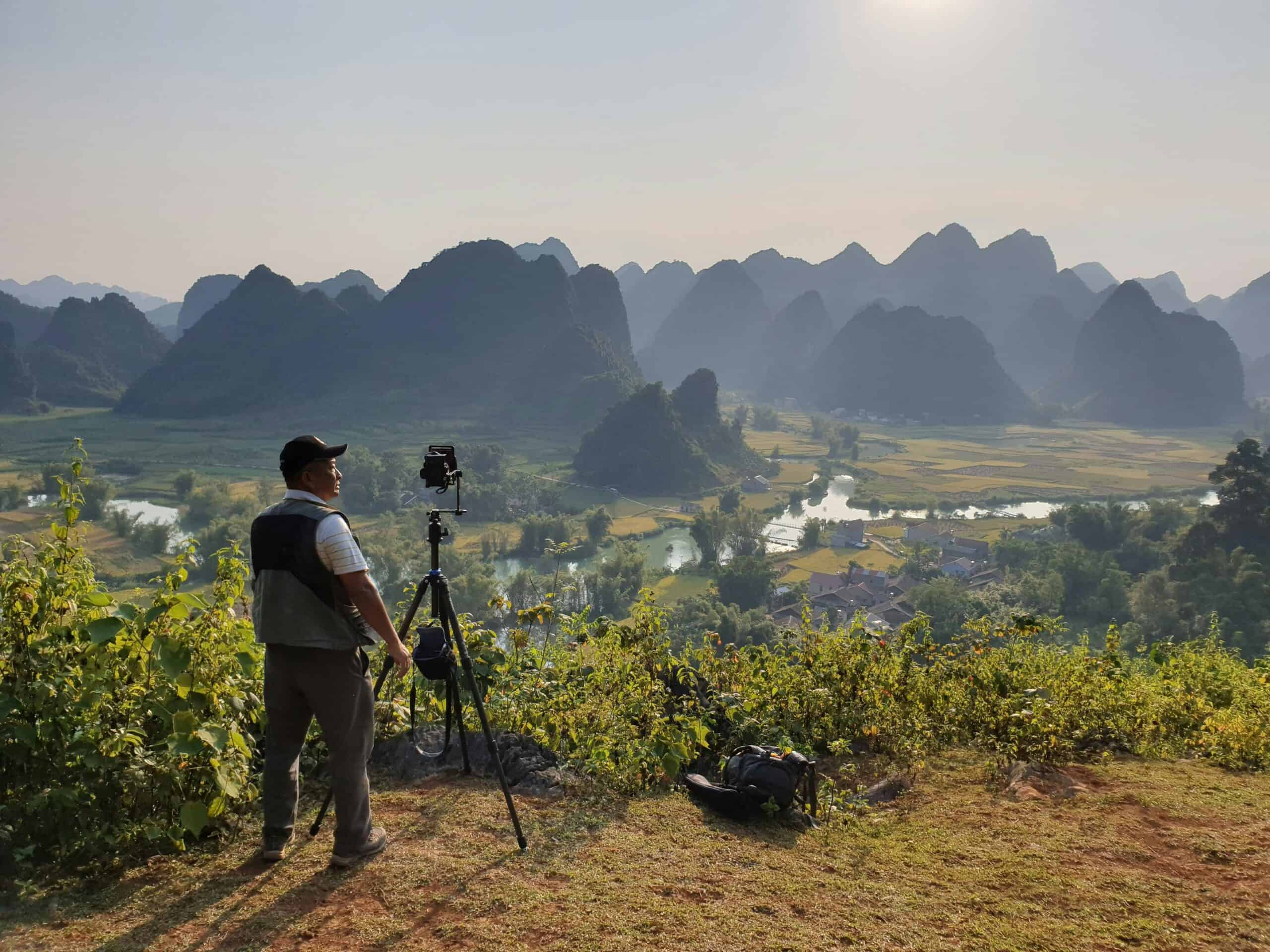
Before you set up, scan the space for moving subjects, reflective surfaces (glass, polished floors), and light sources that may flare a fisheye. If shooting through glass, get the front element as close as safely possible (1–2 cm) to minimize reflections; shade with your hand or a black cloth off-frame. For outdoor panoramas, consider sun angle to reduce flare and ghosting; a slight camera rotation to keep the sun near a seam can help blending in post.
Match Gear to Scene Goals
Why the OM-1 and Laowa 8–15mm work: the OM-1’s stacked sensor has solid dynamic range at base ISO (roughly ~12 EV at ISO 200) and clean files up to ISO 800–1600 with careful exposure. The Laowa fisheye reduces shot count, which speeds up sequences in changing light and helps avoid ghosting in crowds. If you need fewer frames and reliable stitching—especially indoors—this combo is highly efficient. For interiors with windows, HDR bracketing with the OM-1 keeps highlight detail, while the fisheye’s sharpness at f/5.6–f/8 makes edges consistent across frames.
Pre-shoot Checklist
- Charge batteries, format fast UHS-II cards, clean lens and sensor.
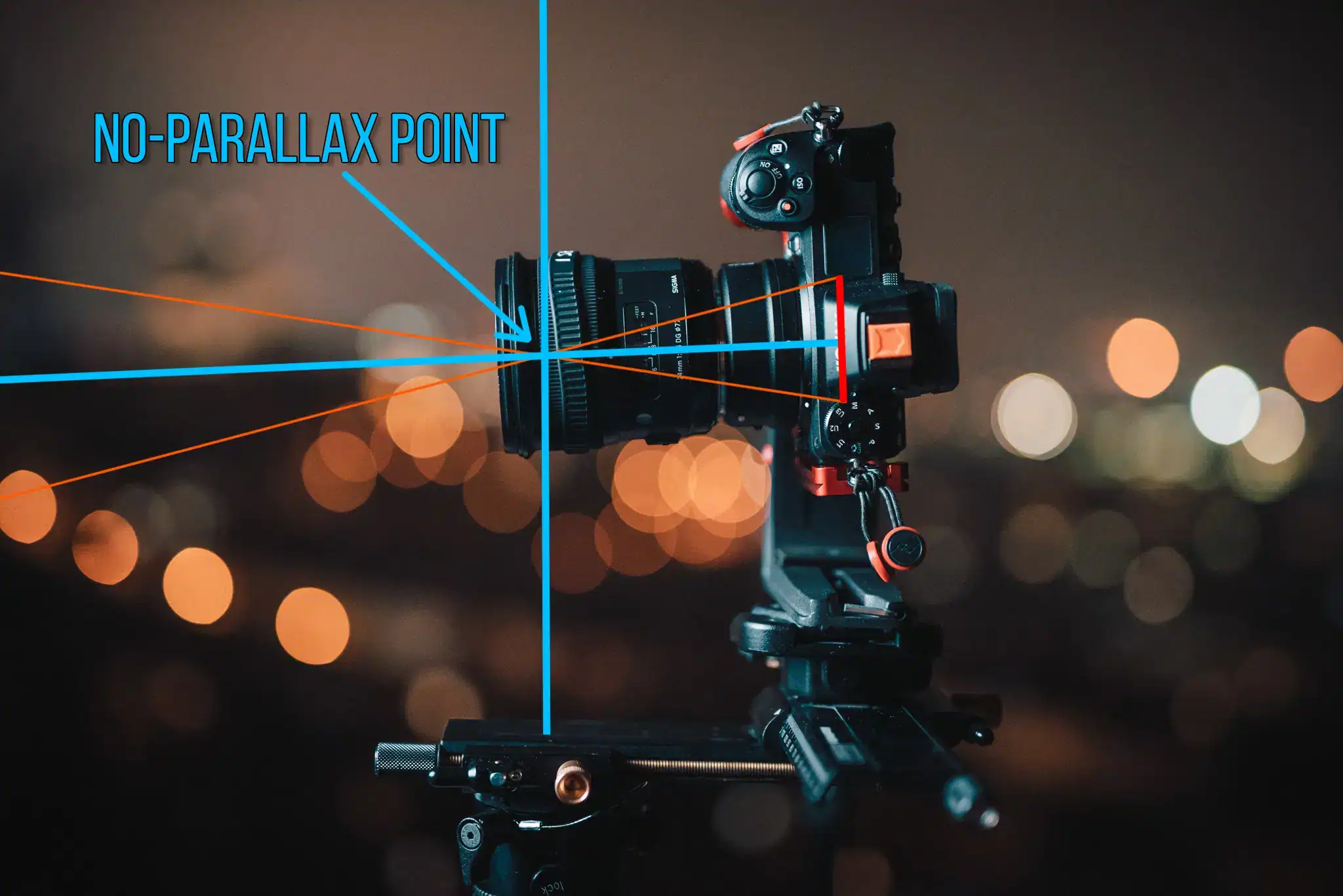
- Mount and level tripod; calibrate the panoramic head for nodal (no-parallax) alignment.
- Safety: assess wind, rooftop edges, crowds; tether the camera for pole or car-mount work.
- Backup workflow: shoot a second pass at the same yaw angles in case of motion/ghosting issues.
Essential Gear & Setup
Core Gear
- Panoramic head with fore-aft and lateral adjustments. Align the lens’s entrance pupil (nodal point) exactly over the yaw axis to eliminate parallax between foreground and background.
- Stable tripod with a leveling base or half-ball. Leveling reduces horizon correction later.
- Remote release or the OM-1 app. Use a 2s timer or anti-shock to eliminate vibrations.
Optional Add-ons
- Pole or car mount for elevated or moving perspectives. Always use a safety tether and avoid high winds; the fisheye’s bulbous front is vulnerable.
- LED panels for dim interiors; keep light positions consistent across frames.
- Rain cover and microfiber cloths. The OM-1 is well sealed, but water on a fisheye front element ruins frames fast.
Step-by-Step Shooting Guide
Standard Static Scenes
- Level tripod and align nodal point. Start with the lens foot about 35–40 mm forward of the sensor plane at 8mm as a baseline, then fine-tune: place two vertical objects at different distances and rotate; adjust until there’s no relative shift.
- Switch to Manual exposure. Meter mid-tones, then lock shutter, aperture, ISO, and white balance. Consistency is vital for clean stitching.
- Capture your around shots with generous overlap:
- 8mm: 6 shots around at 60° intervals.
- 10–12mm: 8 around at 45°.
- 15mm: 10–12 around at 30–36°.
- Then add 1 zenith and 1 nadir frame.
- For the nadir, either lean the rig and shoot the ground plate, or use a handheld viewpoint-corrected shot; you’ll patch the tripod later.
HDR / High Dynamic Range Interiors
- Bracket ±2 EV (3 or 5 frames) to balance bright windows and deep shadows. The OM-1’s AEB makes this fast; keep aperture fixed at f/8.
- Lock white balance and focus so brackets stitch seamlessly across yaw angles.
- Use the same bracket pattern at every yaw position before rotating to the next.
Low-Light / Night Scenes
- Use a tripod, IBIS off, and a remote. Set the shutter 1/30–1/60s minimum for moving subjects; longer for static cityscapes.
- Keep ISO in the 200–800 range on the OM-1 for best detail. ISO 1600 is usable with careful noise reduction; avoid pushing beyond ISO 3200 for critical 360 work.
- Enable anti-shock or a 2s timer if not using a remote to minimize shake.
Crowded Events
- Shoot two full passes: one for the environment and one timed for gaps in the crowd.
- In post, mask or blend frames to remove duplicates and ghosting.
- Faster rotation and fewer frames at 8–10mm reduce the chance of moving people crossing seams.
Special Setups (Pole / Car / Elevated)
- Secure the camera with a clamp and safety tether; check fasteners before each spin.
- Reduce rotation speed and increase overlap. Wind buffeting is magnified on poles; use faster shutter speeds.
- If car-mounted, plan routes to avoid harsh vibration; shoot at stops if possible.
Recommended Settings & Pro Tips
Exposure & Focus
| Scenario | Aperture | Shutter | ISO | Notes |
|---|---|---|---|---|
| Daylight outdoor | f/8–f/11 | 1/100–1/250 | 100–200 | Lock WB (Daylight); avoid pointing directly at sun if possible |
| Low light/night | f/4–f/5.6 | 1/30–1/60 | 200–800 | Tripod, IBIS off, remote/timer; expose to the right without clipping |
| Interior HDR | f/8 | Bracket ±2 EV | 100–400 | Use consistent bracket count at each yaw position |
| Action / moving subjects | f/5.6–f/8 | 1/200+ | 400–800 | Short sequence; do a second pass for clean plates |
Critical Tips
- Manual focus: set the Laowa to near infinity, then fine-tune with magnified live view. At 8–10mm, f/8 provides deep depth of field.
- Nodal calibration: mark your rail settings for 8mm and 12mm on tape. Reuse these marks for speed and consistency.
- White balance lock: choose a fixed WB to avoid color shifts across frames (especially under mixed lighting).
- Shoot RAW: fisheye stitching and HDR benefit from 14-bit RAW latitude for highlight recovery and color consistency.
- IBIS off on a tripod: stabilization can introduce blur during long exposures when the camera is fixed.
Stitching & Post-Processing
Software Workflow
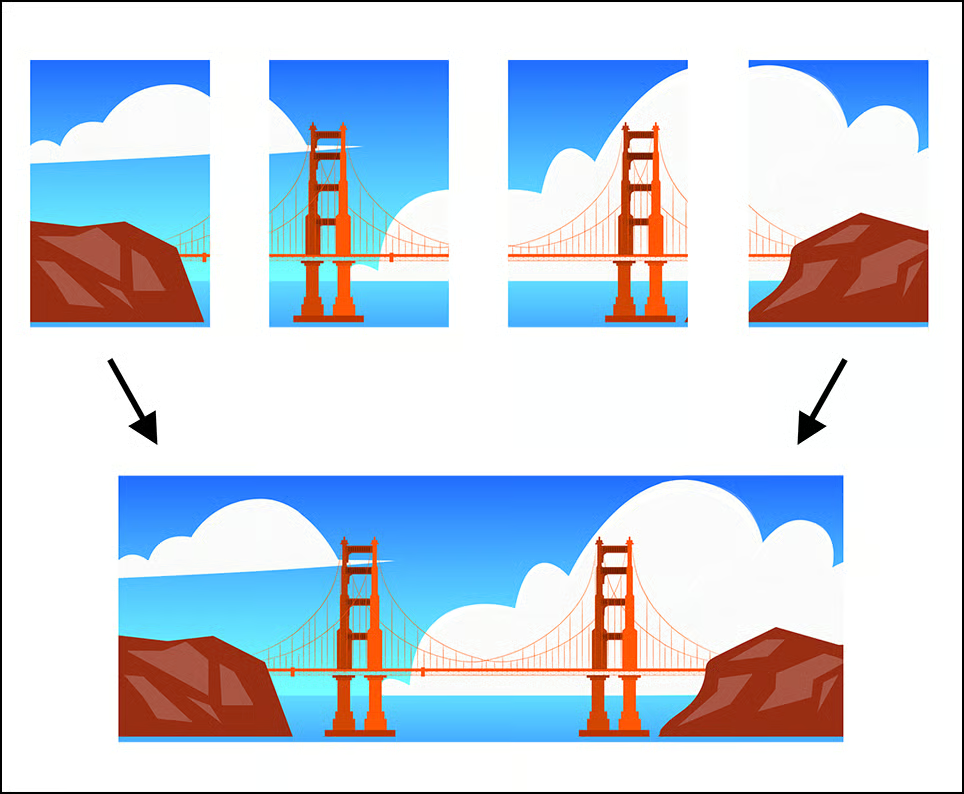
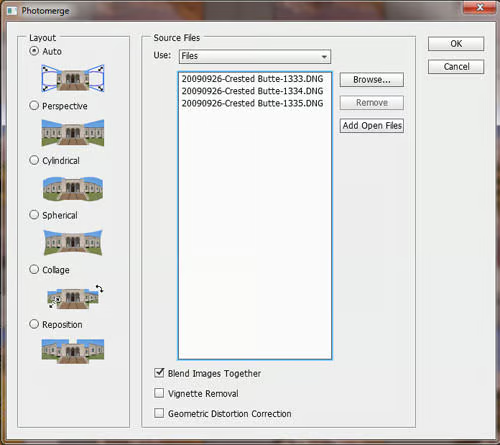
Import your RAW files into Lightroom or your preferred RAW converter, sync a neutral profile and consistent WB, then export 16-bit TIFFs to your stitcher. In PTGui or Hugin, set the lens type to “Fisheye” and enter the focal length you used (note: adapted lenses may lack EXIF). For fisheye, industry practice is 25–30% overlap; rectilinear lenses can use 20–25%. Optimize control points, check for parallax misalignment, and use viewpoint correction for the nadir patch if you shot it handheld. PTGui’s masking and exposure fusion tools are extremely effective for HDR panorama work.
If you prefer direct RAW stitching, PTGui supports it and can save time, but preprocessed TIFFs offer more control over noise and color. Once stitched to equirectangular, fix horizon tilt, correct color casts, and apply selective noise reduction to shadow areas. Export a 16k or 8k equirectangular JPEG/PNG depending on your delivery platform.
Learn more about panoramic head setup and control point best practices here: panoramic head tutorial (360 Rumors).
For a deep dive into PTGui’s power and why it’s a top-tier stitcher, see this review: Fstoppers on PTGui.
Useful Tools & Resources
Software
- PTGui panorama stitching
- Hugin (open-source alternative)
- Lightroom / Photoshop for RAW and retouching
- AI tripod/nadir removal tools
Hardware
- Panoramic heads (Nodal Ninja, Leofoto)
- Carbon fiber tripods + leveling base
- Wireless remotes or camera apps
- Pole extensions / vehicle mounts (with safety tether)
For VR delivery guidelines and equirectangular exports, see: Oculus Creator: DSLR/Mirrorless 360 workflow.
Recommended Video
Watch this short panoramic head setup primer to reinforce alignment fundamentals:
Common Mistakes & How to Avoid Them
- Parallax error: recalibrate the nodal point whenever you change focal length.
- Exposure flicker: use full Manual mode and locked WB; avoid Auto ISO for 360 sequences.
- IBIS blur on tripod: disable stabilization when the camera is fixed.
- Insufficient overlap: stick to 25–30% for fisheye; more if shooting handheld.
- Tripod in frame: shoot a nadir patch or plan for a clean clone stamp area.
- Lens flare: shade the front element; avoid placing the sun mid-frame.
Field-Proven Scenarios with the OM-1 + Laowa 8–15mm
Indoor Real Estate HDR
At 8mm f/8, shoot 6 around + Z + N, each at -2/0/+2 EV. Keep WB fixed (Tungsten or a custom reading) across frames. In PTGui, enable exposure fusion or merge brackets to HDR first, then stitch. You’ll get bright windows and noise-free shadows, even at ISO 200–400.
Outdoor Sunset Overlook
Use a base ISO (200), f/8, 1/125s, and meter slightly to the right to preserve shadow color. Rotate quickly as light changes; do a second pass if the sky is evolving. The OM-1’s weather sealing lets you stay out when mist or wind would scare off a lesser rig.
Event Crowds
At 10–12mm, 8 around + Z + N is a good balance between overlap and speed. Take a “clean plate” pass early, then another when people spread out. In post, mask the least busy regions per seam.
Rooftop or Pole Shooting
Keep the pole as vertical as possible and shoot fast frames at 8mm. Increase shutter speed to 1/250s+ to counter sway. Safety tethers are non-negotiable; the fisheye’s front element is exposed and wind will fight you.
Car-Mounted Capture
Stop the vehicle for each set if you need perfect seams. If you must shoot rolling, use higher shutter speeds (1/500s), increase overlap, and be prepared for more masking.
For a deeper understanding of how many pixels you’ll get in your final sphere given lens and sensor, this reference is helpful: Panotools: DSLR spherical resolution.
Frequently Asked Questions
-
Can I shoot handheld panoramas with the Olympus OM-1?
Yes, but expect more stitching work. Use 8–10mm for fewer frames, increase overlap (35%+), keep shutter 1/250s or faster, and lock exposure/WB. Handheld 360s are fine for casual sharing, but a leveled tripod and pano head still win for pro results.
-
Is the Laowa 8–15mm f/2.8 wide enough for single-row 360 on Micro Four Thirds?
At 8mm on MFT, it’s a diagonal fisheye with very wide coverage. A single row of 6 around plus zenith and nadir is reliable. If you need higher resolution or safer overlap, go to 8 around.
-
Do I need HDR for interiors with bright windows?
Usually yes. Bracketing ±2 EV (3 or 5 frames) preserves highlights outside and keeps indoor shadows clean. Merge the brackets consistently across yaw positions before or during stitching for smooth tonality.
-
How do I avoid parallax issues with this fisheye?
Calibrate the entrance pupil at your chosen focal length. Use a pano rail to align the lens so near/far objects do not shift relative to each other when you pan. Mark your rail positions for 8mm and 12mm and reuse those marks.
-
What ISO range is safe on the OM-1 in low light?
For 360s where pixel-level detail matters, ISO 200–800 is the sweet spot. ISO 1600 is workable with good exposure and noise reduction. Avoid 3200+ unless absolutely necessary.
Final Safety & Workflow Notes
Use a high-quality metal adapter for the Laowa lens; confirm infinity focus and check for play. Always secure your rig in wind and around people, especially with pole or vehicle mounts. Keep spare microfiber cloths for the fisheye front element and a rocket blower for dust—any smear or speck is visible across huge angle-of-view frames.
Create a repeatable workflow: custom mode on the OM-1 with Manual exposure, fixed WB, IBIS off, 2s timer, and RAW enabled. Save yaw-angle notes or use a click-stop rotator for consistency. Back up your files immediately and keep a second stitched version with conservative settings for safety delivery.
For broad technique discussions and community wisdom, this Q&A thread is a goldmine: Best techniques to take 360 panoramas (StackExchange).