Why This Camera & Lens Are Great for Panoramas
This guide shows you how to shoot panorama with Olympus OM-1 & Fujifilm XF 8-16mm f/2.8 R LM WR—what works, what doesn’t, and how to get professional 360° results with this concept. Important note up front: the Fujifilm XF 8–16mm is a rectilinear ultra‑wide zoom built for Fujifilm X‑mount APS‑C bodies. It does not natively mount or electronically adapt to the Micro Four Thirds mount of the Olympus OM‑1. There is no practical adapter that preserves infinity focus and aperture control from X‑mount to MFT. So if your goal is to use this particular lens, you should pair it with a Fuji X body. If your goal is to achieve the same field of view on the OM‑1, use an equivalent MFT ultra‑wide such as the M.Zuiko 7–14mm f/2.8 PRO, Laowa 7.5mm f/2, or the M.Zuiko 8mm f/1.8 fisheye PRO (for fewer shots and faster 360 capture).
Why the OM‑1 is still an excellent panorama platform: it’s a rugged, weather‑sealed (IP53) mirrorless body with a 20.4MP stacked BSI Micro Four Thirds sensor (17.3 × 13.0 mm) and pixel pitch around 3.3 µm. The camera delivers roughly ~12 stops of usable dynamic range at base ISO, fast readout, and highly effective in‑body stabilization (IBIS). For panoramas on a tripod, IBIS should be turned off; for pole or handheld capture, IBIS can help. The Fujifilm XF 8–16mm f/2.8 (when used on a Fuji body) is one of the sharpest rectilinear ultra‑wides on the market (approx. 122° diagonal FOV at 8mm on APS‑C), with excellent contrast and low distortion for a zoom. Its constant f/2.8 helps indoors and at blue hour, though it is heavy and cannot accept front filters due to a built‑in hood.
In this tutorial, we’ll cover two practical paths so you can follow along no matter your exact hardware: (1) using the OM‑1 with an equivalent MFT ultra‑wide (7–14mm, 7.5mm prime, or 8mm fisheye) and (2) using the XF 8–16mm on a Fuji X body—the shot counts and stitching logic are the same. Wherever you see “8mm rectilinear,” you can substitute OM‑1 + 7mm on the M.Zuiko 7–14mm for near‑identical coverage.
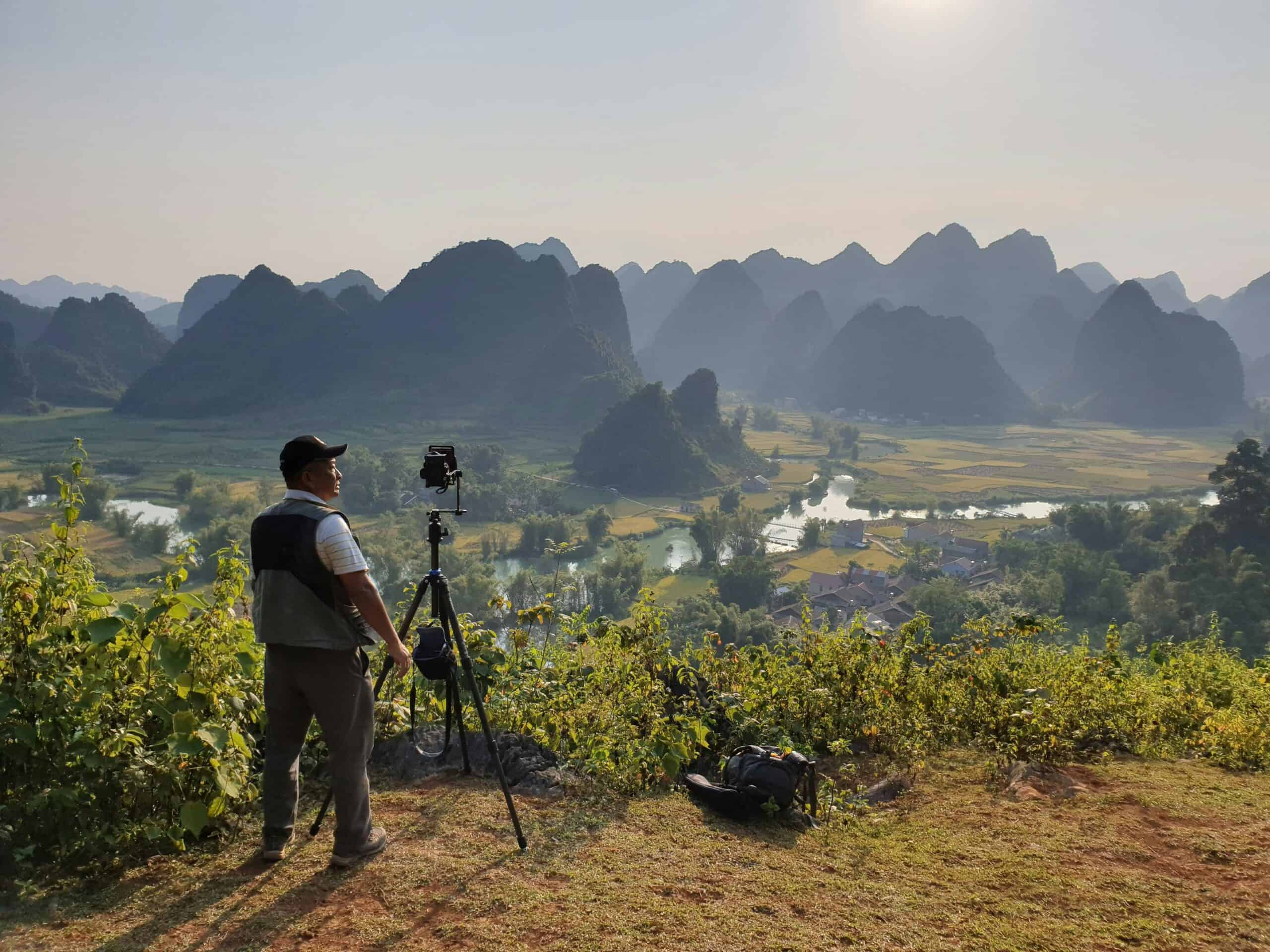
Quick Setup Overview
- Camera: Olympus OM‑1 — Micro Four Thirds (17.3 × 13.0 mm), 20.4MP stacked BSI sensor, ~12 EV dynamic range, weather‑sealed.
- Lens: Fujifilm XF 8–16mm f/2.8 R LM WR — Rectilinear ultra‑wide zoom for Fuji X mount; sharp at f/5.6–f/8, minor lateral CA at edges, built‑in hood (no front filters). Not mountable to OM‑1; use a MFT equivalent like M.Zuiko 7–14mm f/2.8 PRO or fisheye 8mm on OM‑1.
- Estimated shots & overlap (rectilinear ultra‑wide at ~7–8mm equivalent on MFT or 8mm on APS‑C):
- 360° multi‑row: 6 around × 3 rows (−50°, 0°, +50°) + zenith + nadir = ~20 frames (30–40% overlap).
- Or higher precision: 8 around × 3 rows + zenith + nadir = ~26 frames (safer stitching in complex spaces).
- Fisheye option (MFT 8mm): 4 around + zenith + nadir = 6–8 frames total (fastest field workflow).
- Difficulty: Intermediate (easy with a calibrated panoramic head; advanced if doing pole or car‑mounted work).
Planning & On-Site Preparation
Evaluate Shooting Environment
Start by reading the light and movement. For outdoors, note sun position and wind (vibration risk). Indoors, look for reflective surfaces (glass, metal, polished floors), mixed lighting, and moving objects. If shooting through glass, move the front element as close as possible (1–2 cm) and shoot at a slight angle to reduce flare and ghost reflections; use a black cloth or hood to block stray light.
Match Gear to Scene Goals
For low‑light interiors or twilight cityscapes, the OM‑1’s sensor does well at ISO 200–800 with long exposures; push to 1600 if you must, but tripod stability and bracketing are preferable. Rectilinear ultra‑wides (like XF 8–16 or M.Zuiko 7–14) preserve straight lines—great for architecture and real estate—but need more frames for full 360° coverage. A fisheye on MFT (e.g., M.Zuiko 8mm f/1.8) reduces your shot count dramatically, which helps with crowds and wind but requires precise no‑parallax alignment and careful defishing/stitch control.
Pre-shoot Checklist
- Battery topped up (bring a spare), cleared cards, microfiber cloth for lens and sensor check.
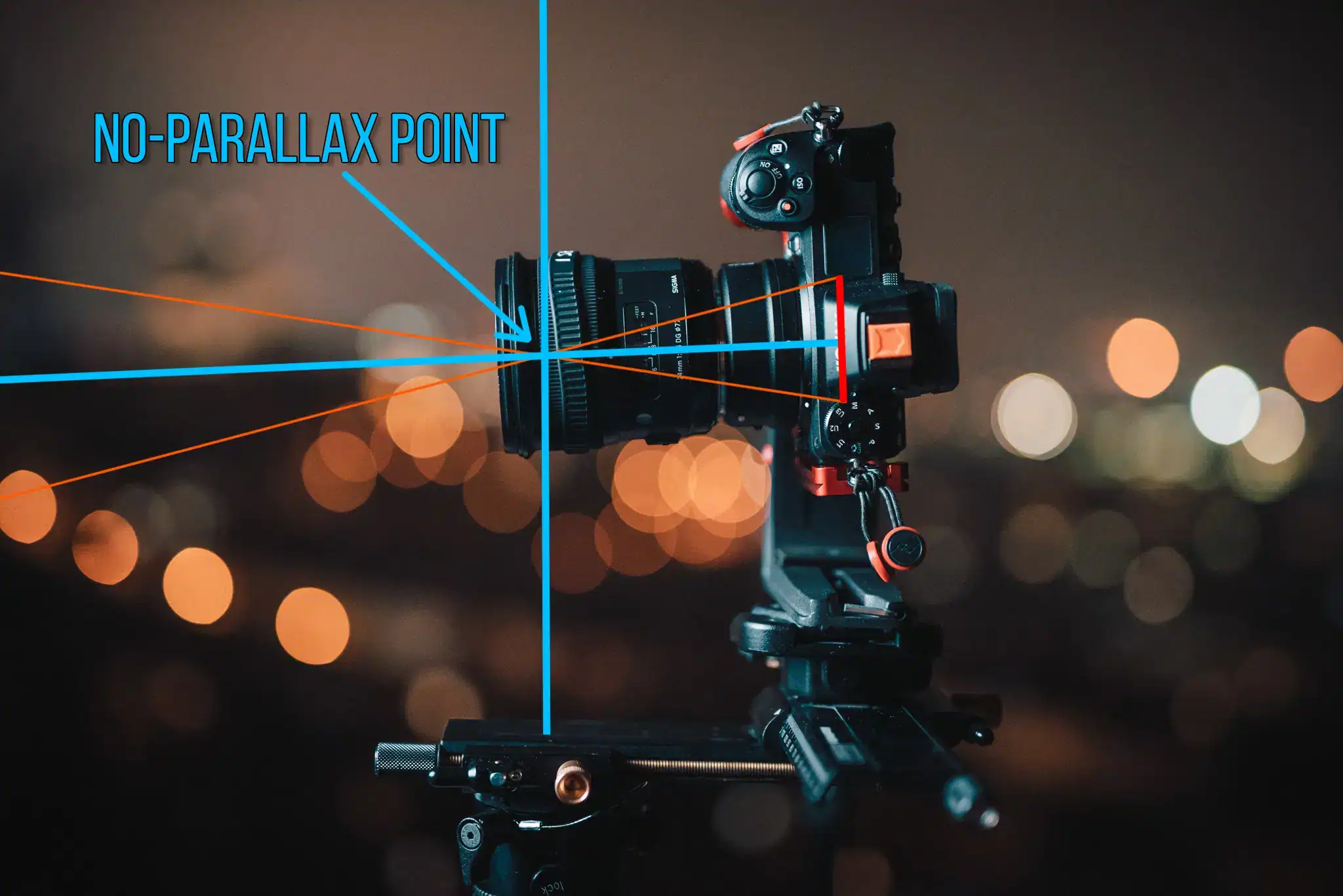
- Tripod leveled, panoramic head calibrated to the lens’s no‑parallax (nodal) point.
- Safety: on rooftops and poles, use a secondary tether; avoid strong wind gusts; watch for overhead lines.
- Backup workflow: shoot a second full rotation if time allows; this saves edits when someone walks through a frame or a gust shakes the setup.
Essential Gear & Setup
Core Gear
- Panoramic head with rail adjustment: Align the lens entrance pupil over the yaw axis to eliminate parallax. This is critical if foreground objects are within a few meters.
- Stable tripod with a leveling base: Level once at the base so you can rotate without horizon drift.
- Remote trigger or app: Use a cable release or OM Image Share app to avoid touching the camera.
Optional Add-ons
- Pole or car mount: Keep the rotation slow; enable electronic shutter to minimize vibration blur; always tether gear and avoid high winds.
- Lighting for interiors: Small LED panels to fill deep shadows if HDR bracketing is not allowed.
- Weather protection: Rain cover for the camera and a towel to dry after mist or sea spray.
If you’re new to panoramic heads, this short primer on setting one up is worth a look at the end of this section: Panoramic head setup tutorial and tips.
Step-by-Step Shooting Guide
Standard Static Scenes
- Level tripod and align nodal point: On your panoramic head, slide the camera forward/back until rotating the rig doesn’t shift the relative position of a near object against a distant object. Mark this rail position for your lens at 8mm (or 7mm on MFT).
- Manual exposure and locked white balance: Set M mode. Meter the mid‑tones, then use a single exposure across all frames. Lock WB (Daylight, Cloudy, Tungsten) to avoid color shifts that complicate stitching.
- Capture with tested overlap:
- Rectilinear ~8mm equivalent (OM‑1 + 7–14 at 7–8mm, or XF 8–16 on Fuji at 8mm): 6 around × 3 rows (−50°, 0°, +50°), then zenith and nadir. Aim for 30–40% overlap.
- Fisheye (OM‑1 + 8mm): 4 around at 0° + zenith + nadir; if tight indoors, consider 6 around to reduce stitching stress.
- Take a nadir (ground) shot: After the main set, tilt down and shoot the tripod area. You’ll patch this later to remove the tripod from the final 360°.
HDR / High Dynamic Range Interiors
- Bracket exposures: Use ±2 EV (3 or 5 frames) to balance bright windows and interior shadows. Keep the same bracket across the entire rotation.
- Lock white balance: Prevent shifts across brackets—manual WB makes HDR merges and stitching more reliable.
- Tripod discipline: Use 2‑sec shutter delay or remote; turn off IBIS on a tripod to avoid micro‑drift.
Low-Light / Night Scenes
- Use long shutter times and low ISO: On OM‑1, ISO 200–800 is the sweet spot; prefer longer exposures (1–8 s) at f/5.6–f/8 over pushing ISO past 1600 unless motion requires it.
- Remote trigger or app: Prevent any contact vibration. Electronic shutter helps (beware LED banding; enable anti‑flicker if needed).
- Wind strategy: Hang a small weight from the tripod center, use the lowest leg sections, and shield the setup with your body.
Crowded Events
- Two passes: First pass for composition, second pass waiting for gaps in moving people. Shoot extra coverage around busy sectors.
- Mask in post: Later, blend the cleanest people‑free patches in your stitcher or Photoshop.
- Fisheye advantage: In dense crowds, a fisheye’s minimal shot count reduces people movement between frames.
Special Setups (Pole / Car / Drone)
- Pole: Use a compact body/lens, tensioned guy lines if possible, and a safety tether. Keep IBIS on for small shakes. Rotate slowly and take multiple passes.
- Car mount: Park on stable ground; avoid traffic; secure suction mounts and safety lines; disable IBIS for static captures on a rigid mount, enable for rolling shots.
- Drone: If you export a bracketed pano from a drone, match exposure/WB policy and overlap to your ground rig for consistency. Follow local regulations.
Recommended Settings & Pro Tips
Exposure & Focus
| Scenario | Aperture | Shutter | ISO | Notes |
|---|---|---|---|---|
| Daylight outdoor | f/8–f/11 | 1/100–1/250 | 200 | Lock WB to Daylight; enable e-shutter if wind is low |
| Low light/night | f/4–f/5.6 | 0.5–8 s | 200–800 | Tripod and remote; IBIS off on tripod; anti-flicker for LED lighting |
| Interior HDR | f/8 | Bracket ±2 EV | 200–400 | 3–5 frames per angle to hold window highlights |
| Action / moving subjects | f/5.6–f/8 | 1/200+ | 400–800 | Freeze motion; shoot a second clean pass for background plates |
Critical Tips
- Manual focus at hyperfocal: At 7–8mm on MFT, f/8 hyperfocal is roughly 0.5–0.7 m; focus once, then disable AF. Everything from ~0.35 m to infinity will be sharp.
- Mark your nodal rail: For each focal length you use (7mm, 8mm, 10mm…), mark the rail position. This saves time and errors.
- White balance lock: Mixed lighting is common indoors—pick a WB that looks neutral overall. You can fine‑tune in RAW later, but keep it consistent.
- Shoot RAW: You’ll need the latitude for HDR merging, color correction, and stitching seams.
- IBIS behavior: Turn off IBIS when the camera is on a tripod or panoramic head; turn it on when handheld or on a pole to counter small shakes.
For a concise visual refresher on pano fundamentals, the video above provides a useful walkthrough you can apply directly with the OM‑1 and an ultra‑wide lens.
Stitching & Post-Processing
Software Workflow
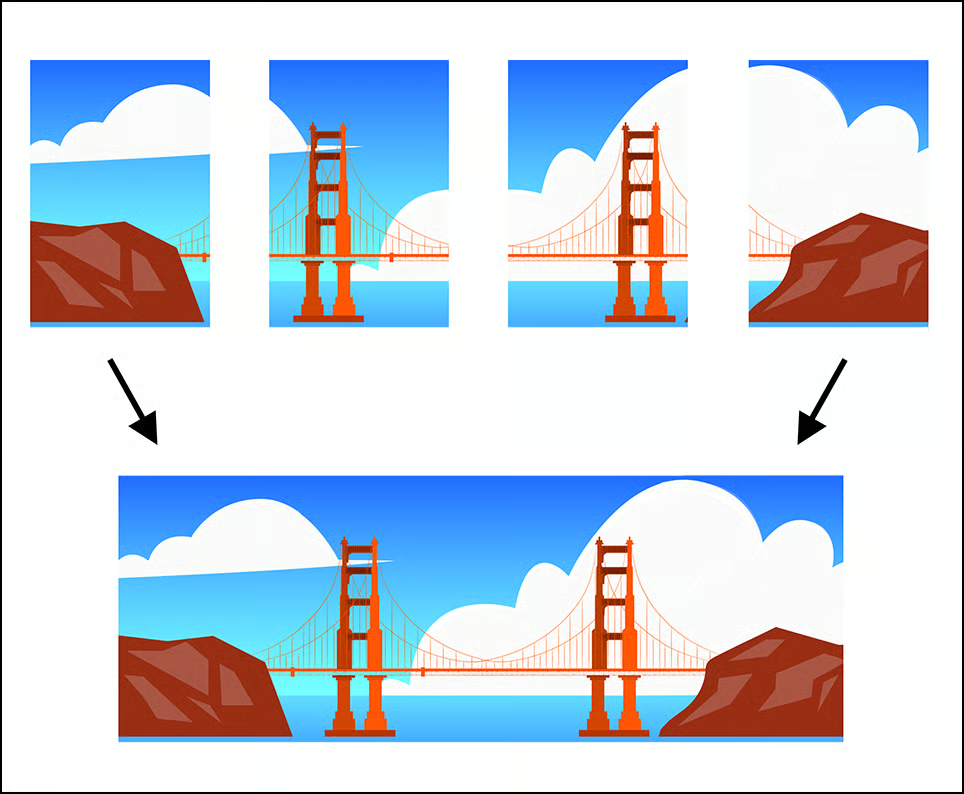
Import RAWs and apply basic lens corrections (if available for your lens/body in your RAW processor). For rectilinear ultra‑wides, keep distortion corrections consistent across the set. Next, feed the aligned frames into a stitcher like PTGui or Hugin. Rectilinear lenses usually need more shots and careful control points, but yield clean straight lines. Fisheye lenses are often faster to stitch because of fewer frames, but you must nail the no‑parallax alignment. Aim for ~25–30% overlap with fisheye, and 30–40% overlap with rectilinear for complex scenes. Consider reading this review to understand why PTGui is favored for pro work: PTGui review and workflow strengths.
Cleanup & Enhancement
- Nadir patch: Use PTGui Viewpoint correction, a dedicated nadir shot, or clone/AI tools to remove the tripod.
- Color harmonization: Balance color temperature across the sphere; tweak saturation selectively to avoid neon hues in mixed lighting.
- Noise reduction: For night shots, apply modest luminance NR to shadows; preserve detail on edges to prevent seam artifacts.
- Level and orientation: Ensure horizon level; set the initial view (yaw/pitch/roll) for a pleasing starting direction in VR.
- Export: Save an equirectangular 2:1 image (e.g., 12000 × 6000 px JPEG or TIFF) for VR platforms, or a large TIFF if further retouching is planned.
If you’re new to high‑end 360 stitching, Oculus’ production notes for DSLR/mirrorless 360s are a solid reference to complement this guide: Using a mirrorless/DSLR to shoot and stitch a 360 photo.
Useful Tools & Resources
Software
- PTGui panorama stitching (fast control points, masking, viewpoint correction)
- Hugin (open‑source alternative with robust control point tools)
- Lightroom / Photoshop (RAW processing and final cleanup)
- AI tripod removal / sky replacement tools (optional polish)
Hardware
- Panoramic heads (Nodal Ninja, Leofoto, Fanotec)
- Carbon fiber tripods with leveling bases
- Wireless remote shutters / smartphone apps
- Pole extensions / car suction mounts (with safety tethers)
Disclaimer: product names are for reference; consult official documentation for the latest specs and compatibility. For deeper technique, this FAQ is handy: Best techniques for 360 panoramas.
Common Mistakes & How to Avoid Them
- Parallax error: Always calibrate the no‑parallax point for the exact focal length you use.
- Exposure/WB flicker: Manual mode and locked white balance throughout the entire sequence.
- Tripod shadows in the nadir: Capture an extra nadir shot; be ready to patch in post.
- Ghosting from movement: Shoot two passes; mask clean regions during stitching.
- Noise at night: Favor low ISO and longer shutter times on a stable tripod over high ISO.
- Forgetting to disable IBIS on tripod: Can introduce micro‑blur across frames; turn it off when mounted.
- Using the wrong lens/body pairing: The XF 8–16mm does not mount on OM‑1; use an MFT ultra‑wide or a Fuji X body for this lens.
Real Field Advice & Case Studies
Indoor Real Estate
Rectilinear ultra‑wides keep lines straight—ideal for property tours. Use the OM‑1 with the M.Zuiko 7–14mm at 7–9mm, f/8, ISO 200–400, and bracket ±2 EV for bright windows. 8 around × 3 rows plus zenith/nadir (~26 frames) yields robust control points and minimal seam stress. Keep the camera height consistent (1.2–1.5 m) for a comfortable viewing perspective.
Outdoor Sunset
At golden hour, lock exposure mid‑scene (don’t meter the sun directly). Shoot a second safety rotation as the light changes quickly. On the OM‑1, ISO 200, f/8, 1/60–1/125 is a good start. Consider a fisheye to reduce the time between the first and last frame and avoid changing sky color across the set.
Event Crowds
Use a fisheye for speed when people are moving. If using rectilinear at 8mm, increase overlap (six or eight shots around per row) and shoot two fast passes. In post, mask to keep the cleanest subject positions from each pass.
Rooftop / Pole Shooting
Limit your rig’s profile and use a safety tether. Shoot at faster shutter speeds and consider ISO 400–800 to minimize motion blur. Rotate smoothly and pause between frames to let oscillations settle. Avoid strong gusts—safety first.
Car-Mounted Capture
Static scenes yield best results. Turn off engine vibrations, use multiple suction cups plus a tether, and shoot a multi‑row sequence at lower ISO. If the car must be on, use higher shutter speeds and accept a slight ISO bump.
Frequently Asked Questions
- Can I actually use the Fujifilm XF 8–16mm on the Olympus OM‑1?
No. The XF 8–16mm is an X‑mount lens and does not have a practical adapter for Micro Four Thirds that preserves infinity focus and aperture control. To get similar coverage on OM‑1, use the M.Zuiko 7–14mm f/2.8 PRO at 7–8mm, or consider the M.Zuiko 8mm fisheye PRO.
- Is an ultra‑wide rectilinear lens wide enough for single‑row 360°?
Usually not. At ~7–8mm rectilinear on MFT (or XF 8mm on APS‑C), you’ll typically need 3 rows (−50°, 0°, +50°) at 6–8 shots per row, plus zenith and nadir—about 20–26 frames. A fisheye can do 360° with as few as 6–8 frames.
- Do I need HDR for interiors with bright windows?
Yes, in most cases. Bracket ±2 EV (3–5 frames) at each position to preserve window detail without crushing shadows. Keep WB locked across all brackets.
- How do I avoid parallax problems?
Use a panoramic head and align the entrance pupil (no‑parallax point) over the rotation axis. Calibrate once for each focal length and mark the rail. This is critical when nearby objects are within a few meters.
- What ISO range is safe on the OM‑1 for panoramas?
Base ISO 200 is best for quality; 200–800 is a safe working range. 1600 is usable in a pinch, but prefer longer exposures on a stable tripod for cleaner results.
- Can I set up Custom Modes on the OM‑1 for pano work?
Yes—use C1/C2 for “Tripod Pano” (M mode, IBIS off, WB locked, 2‑sec delay) and “Pole/Handheld Pano” (faster shutter, IBIS on, e‑shutter). This saves time on location.
- How do I reduce flare with ultra‑wide lenses?
Avoid shooting directly into intense light sources; shade the lens with your hand or body; clean the front element; and slightly adjust angle to move flare artifacts into overlapping regions that you can mask out.
- What’s the best panoramic head for this setup?
Look for a compact 2‑axis head with precise rails (e.g., Nodal Ninja/Fanotec or Leofoto). It must support your camera’s weight and allow easy, repeatable entrance pupil positioning.
Pro Notes, Standards, and References
If you’d like to dive deeper into DSLR/mirrorless 360 production standards and nodal alignment practice, see these authoritative references placed throughout this article. In particular, the panoramic head setup guidance here is considered industry‑standard: Set up a panoramic head for perfect high‑end 360 photos. For estimating shot counts and resolution by lens type and sensor, Panotools maintains a useful reference: DSLR spherical resolution.
Safety & Gear Protection
Rooftops, poles, and car mounts raise risk. Always tether your camera, wear a harness where appropriate, and avoid high winds and busy roads. Keep a rain cover handy, and never leave a rig unattended. When shooting crowds, be mindful of privacy and local laws. Back up your card before leaving the location; redundancy is part of a trustworthy workflow.