
Why This Camera & Lens Are Great for Panoramas
The Olympus OM-D E‑M1 Mark III is a compact, rugged Micro Four Thirds (MFT) mirrorless body with a 20.4MP Live MOS sensor, superb 5‑axis in‑body stabilization (IBIS), and class‑leading weather sealing—everything you want for pano work in the field. Its 20MP sensor (approximate pixel pitch ~3.3 µm) offers around 12 EV of dynamic range at base ISO, with clean files from ISO 200–800 and usable results to ISO 1600 if you expose carefully. The body’s precise manual controls, customizable buttons, and reliable Olympus OI.Share app support a stable, repeatable pano workflow.
The Sony FE 16–35mm f/2.8 GM is a high‑end rectilinear ultra‑wide zoom renowned for edge‑to‑edge sharpness, low coma, and excellent flare resistance for its class. It delivers a diagonal field of view of ~107° at 16mm on full frame with well‑controlled chromatic aberration and great micro‑contrast when stopped down to f/5.6–f/8—excellent for stitching panoramas with crisp overlap.
Important compatibility note: The Sony FE 16–35mm f/2.8 GM is a Sony E‑mount lens. The Olympus E‑M1 Mark III is a Micro Four Thirds mount camera. Due to flange distance constraints, there is no mainstream adapter that maintains infinity focus from Sony E‑mount lenses to Micro Four Thirds bodies. Practically, you cannot mount the 16–35mm GM on the E‑M1 Mark III. To follow the techniques in this guide on the E‑M1 Mark III, use an equivalent MFT rectilinear ultra‑wide (for example: Olympus M.Zuiko 8–25mm f/4 PRO, 7–14mm f/2.8 PRO, Panasonic 8–18mm f/2.8–4, or Laowa 7.5mm f/2). All field settings and shot counts below map 1:1 by matching the equivalent field of view. If you plan to actually use the Sony 16–35mm GM, pair it with a compatible Sony E‑mount body; the pano technique remains the same.
Quick Setup Overview
- Camera: Olympus OM‑D E‑M1 Mark III — Micro Four Thirds sensor (17.4 × 13.0 mm), 20.4MP; base ISO 200 (extended LOW), ~12 EV DR at base; 5‑axis IBIS up to ~7 stops with compatible lenses; weather‑sealed.
- Lens: Sony FE 16–35mm f/2.8 GM — rectilinear ultra‑wide; excellent corner performance when stopped down; low CA and flare for its class. Note: not physically compatible with MFT; use an MFT ultra‑wide that matches the field of view (e.g., 8–18mm on MFT ≈ 16–35mm on full frame).
- Estimated shots & overlap (rectilinear, field‑tested):
- 16mm FF equivalent (≈8mm MFT): 8 shots around (0° pitch) + 1 zenith + 1 nadir; 30% overlap; very reliable outdoors.
- 20mm FF equivalent (≈10mm MFT): 10–12 around + zenith + nadir; 25–30% overlap.
- 24mm FF equivalent (≈12mm MFT): 12 around × 2 rows (+30° and −30°) + zenith + nadir; 25% overlap.
- Difficulty: Moderate. With a calibrated panoramic head, results are highly repeatable.
Planning & On-Site Preparation
Evaluate Shooting Environment
Look for the brightest source (sun, bright windows), reflective surfaces (glass, polished floors), and moving elements (people, trees, cars). In interiors with glass, shoot at an angle to reduce reflections and keep the lens front element 5–10 cm from the glass if possible. For sunsets, plan for bracketing; shadow recovery on the E‑M1 Mark III is good to ~2 stops at base ISO before noise becomes intrusive.
Match Gear to Scene Goals
The E‑M1 Mark III’s sensor is excellent for daytime and blue‑hour panos. Indoors, it handles ISO 400–800 well; ISO 1600 remains usable with careful noise reduction. A rectilinear ultra‑wide (16–35mm FF equivalent) offers natural lines—ideal for real estate and architecture—but requires more frames than a fisheye. If your priority is speed (fewer shots), consider a fisheye on MFT (e.g., 7.5–8mm); just remember fisheye corners can complicate straight lines.
Pre-shoot Checklist
- Charge batteries (bring at least 2); carry high‑speed, high‑capacity UHS‑II SD cards.
- Clean lens front/rear elements; if changing lenses, use a rocket blower to reduce sensor dust—dust becomes very noticeable in skies across multiple frames.
- Level your tripod; verify panoramic head nodal alignment is stored/marked for your lens focal lengths.
- Safety first: weigh down tripod in wind; on rooftops or poles, use tethers and safety lines; on car mounts, double‑check all clamps.
- Backup workflow: after a clean pass, take a second safety round or a different overlap pattern in case of stitching issues.
Essential Gear & Setup
Core Gear
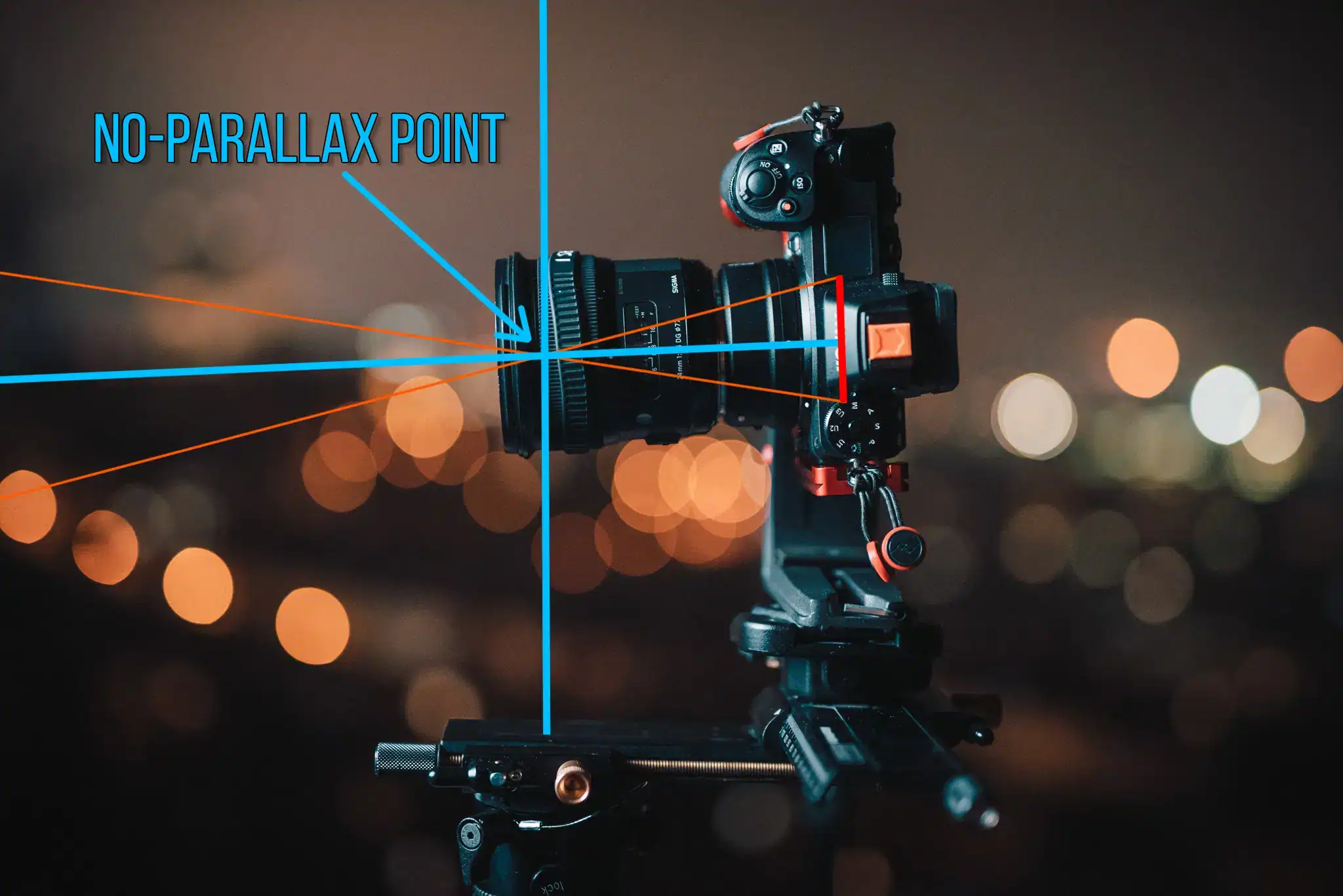
- Panoramic head: A proper pano head lets you rotate around the lens’s no‑parallax (entrance pupil) point to remove parallax and align frames more precisely. This is essential when foreground objects are close (interiors, city scenes).
- Stable tripod with leveling base: The leveling base speeds setup and keeps your “horizon” consistent across rows, minimizing post‑processing corrections.
- Remote trigger or app: Use a cable release or Olympus OI.Share app to avoid shake. A 2‑second self‑timer works in a pinch.
Optional Add-ons
- Pole or car mount: Great for overhead or moving perspectives. Always tether the camera, avoid high winds, and keep speeds low to reduce vibrations.
- Lighting aids: Small LED panels for interior fill; they can reduce dynamic range and minimize ghosting around windows.
- Weather protection: Rain covers, lens hoods, and microfiber cloths for drizzle and sea spray.
Step-by-Step Shooting Guide
Standard Static Scenes
- Level and nodal alignment: Level the tripod with the leveling base. Set your panoramic head to the pre‑calibrated fore/aft position for your focal length (e.g., 8mm MFT ≈ 16mm FF). To calibrate, align two vertical objects (one near, one far) and adjust fore/aft until relative positions don’t shift as you pan.
- Manual exposure and WB: Switch to Manual exposure. Meter the brightest zone you want to retain detail in (e.g., sky or window highlights), then set a shutter speed that keeps highlights below clipping. Lock white balance (Daylight outdoors, a custom Kelvin indoors) to avoid color shifts between frames.
- Focus: Use manual focus. For 8mm MFT at f/8, a hyperfocal distance is around 0.5–0.6 m; focus there to keep the scene sharp from ~0.3 m to infinity. Confirm with magnified live view.
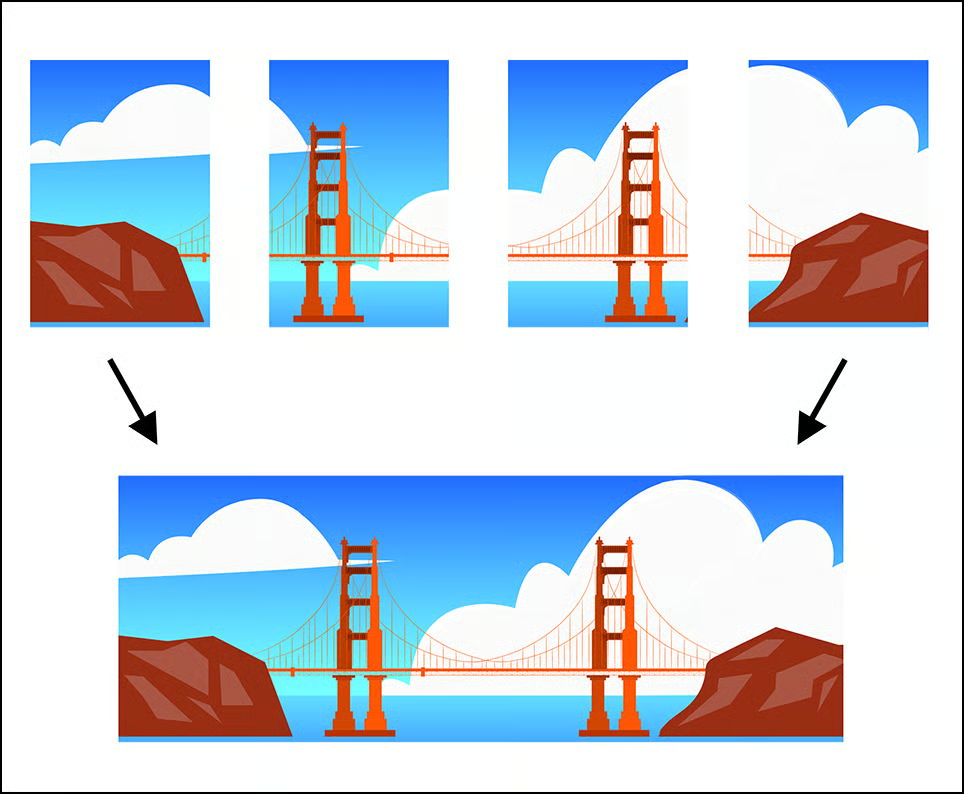
- Capture sequence with overlap: At 8mm MFT (≈16mm FF), shoot 8 frames around at 45° intervals. Then take one zenith (tilt up) and one nadir (tilt down). Use 25–30% overlap horizontally and at least 20% vertically if doing multi‑row.
- Nadir (ground) shot: If your head supports it, offset the camera laterally and shoot a clean ground plate to patch the tripod in post.
HDR / High Dynamic Range Interiors
- Bracket exposures: Use ±2 EV bracketing; three frames (−2/0/+2) works, five frames (−4/−2/0/+2/+4) is safer for bright windows. Keep WB locked and focus fixed.
- Timing: Shoot all brackets quickly for each position before rotating to the next. Stop IBIS on the tripod to avoid any micro‑corrections between brackets.
- File management: Keep a consistent naming scheme or use folders per pano to simplify merging in PTGui or Hugin later.
Low-Light / Night Scenes
- Stability first: Turn IBIS off on a locked tripod to prevent sensor drift. Use a remote or 2‑sec timer.
- Exposure: Favor low ISO (200–400). Use f/5.6–f/8 for best edge sharpness and stop down only as needed. Let the shutter lengthen (1–10 s) depending on wind and subject movement.
- Noise: Slightly expose to the right (without clipping highlights) to keep shadows cleaner on the E‑M1 Mark III.
Crowded Events
- Two passes: First, a quick “anchor” pass for composition; second, a patient pass, waiting for gaps in foot traffic at each camera position.
- High shutter: Use 1/200 s or faster at f/5.6–f/8 and ISO 400–800 to reduce subject blur. Mask moving people during stitching.
Special Setups (Pole / Car / Drone)
- Pole: Keep the pole vertical; use a lightweight nodal head and safety tether. Rotate slowly to avoid vibrations. Short exposures (1/250 s+) help.
- Car mount: Only at very low speed in controlled areas; stabilize with suction + safety straps; shoot at burst with fast shutter and fixed WB.
- Drone: If using drones with MFT payloads, lock exposure, shoot sufficient overlap, and try to keep the drone hovering as stable as possible.
Recommended Settings & Pro Tips
Exposure & Focus
| Scenario | Aperture | Shutter | ISO | Notes |
|---|---|---|---|---|
| Daylight outdoor | f/8–f/11 | 1/100–1/250 | 200 | Lock WB (Daylight); IBIS off on tripod |
| Low light/night | f/4–f/5.6 | 1/30–10 s | 200–400 | Tripod + remote; expose to protect highlights |
| Interior HDR | f/8 | Bracket ±2 EV (3–5 frames) | 200–400 | Lock WB; consistent timing across brackets |
| Action / moving subjects | f/5.6–f/8 | 1/200+ | 400–800 | Two-pass strategy for clean masks |
Critical Tips
- Manual focus at hyperfocal: For 8mm MFT at f/8, focus ~0.5–0.6 m; for 12mm MFT at f/8, focus ~1.0 m. Verify with magnified live view.
- Nodal point calibration: Mark your pano rail positions for 8mm, 10mm, 12mm MFT equivalents. Keep a small tape mark and note on your head.
- White balance lock: Mixed lighting? Set a custom Kelvin (e.g., 3500–4000 K under LEDs) to keep all frames consistent.
- RAW over JPEG: Shoot RAW for better highlight recovery and noise control. 12‑bit files are fine; consistency matters most.
- IBIS: Off on tripod. On if you must handhold a quick pano, but keep shutter fast and overlap generous.
Stitching & Post-Processing
Software Workflow
Import and cull your sequence, then stitch in PTGui or Hugin. Rectilinear lenses require more images than fisheyes but yield straight lines that clients love. For rectilinear sets, 20–25% overlap is acceptable; if you’re new, 25–30% makes control point detection more reliable. After stitching and optimizing, level the horizon, set the projection to equirectangular for 360 output, and render a 2:1 image (e.g., 12000×6000 px). For a clear PTGui overview and why many pros prefer it, see this review at Fstoppers. PTGui overview and review
Cleanup & Enhancement
- Nadir patch: Use viewpoint correction in PTGui or content‑aware fill/clone in Photoshop to remove the tripod. Dedicated AI tools can help for repetitive floors.
- Color and noise: Apply a consistent camera profile, correct white balance, then perform gentle noise reduction on shadow brackets (especially ISO 800–1600).
- Geometry: Correct yaw/pitch/roll and re‑center the pano for your chosen horizon point.
- Export: Create a high‑quality JPEG (quality 90–95%) or 16‑bit TIFF master. For VR publishing, export equirectangular at 8K–12K width depending on your multi‑row resolution.
For a step‑by‑step panoramic head setup guide from a VR platform perspective, the Oculus articles are practical and concise. Set up a panoramic head for high‑end 360 photos
Useful Tools & Resources
Software
- PTGui (fast, robust control point solver, HDR and masking support)
- Hugin (open‑source, flexible, great for learning the fundamentals)
- Lightroom / Photoshop (global color, local retouching, nadir patching)
- AI tripod removal tools (speed up nadir cleanup)
Hardware
- Panoramic heads (Nodal Ninja, Leofoto, SeaguLL): calibrated rails, rotators with click‑stops
- Carbon fiber tripods: strong and light for rooftop or outdoor hikes
- Leveling bases: rapid leveling for multi‑row panos
- Wireless remote shutters or app control
- Pole extensions / car mounts with safety tethers
Disclaimer: software/hardware names provided for search reference; check official sites for details.
Recommended video
Want a visual walkthrough of the panoramic head concept and shooting flow? This concise tutorial complements the steps above:
Common Mistakes & How to Avoid Them
- Parallax error: Always align the entrance pupil on a pano head; even small errors cause stair‑stepped edges on close objects.
- Exposure flicker: Manual exposure and locked white balance across the entire sequence—never mix auto modes mid‑pano.
- Tripod shadows and footprints: Capture a proper nadir tile for patching later.
- Ghosting from motion: Shoot a second pass during lulls in movement and mask selectively in PTGui.
- High ISO noise: On the E‑M1 Mark III, keep ISO at 200–800 whenever possible; prefer longer shutter speeds if the scene allows.
Field Case Studies
Indoor Real Estate
Use a rectilinear 8–12mm MFT lens for minimal distortion. Shoot 8–12 frames around with ±2 EV brackets. Keep WB fixed at ~4000 K for mixed daylight/LED. Turn off IBIS on the tripod. Capture a clean nadir for fast tripod removal.
Outdoor Sunset
Expose for highlights at base ISO 200, shoot 8 around + zenith + nadir at 8mm MFT, then a safety pass at +0.7 EV. If clouds move quickly, reduce the number of frames by slightly widening your focal length (e.g., 7mm) to prevent cloud tearing.
Event Crowds
Go for 1/250 s, f/6.3, ISO 400–800. Execute two passes: one fast for structure, one slower timing each shot between moving people. Use masks to clean ghosting during stitching.
Rooftop / Pole Shooting
Attach a safety line. Limit exposure time (1/250 s or faster) to beat micro‑vibrations. Shoot a slightly higher overlap (30–35%) to help the stitcher handle small pole flex.
Car-Mounted Capture
Only in controlled areas at walking speed. Lock focus and exposure. Use fast shutter (1/500 s) and increased overlap. Expect to mask moving elements in post.
Frequently Asked Questions
- Can I shoot handheld panoramas with the E‑M1 Mark III?
Yes, for quick partial panos or when a tripod isn’t allowed. Use fast shutter (1/250 s+), IBIS on, and generous overlap (40–50%). For full 360×180° panos with nearby foreground, a pano head and tripod are strongly recommended to avoid parallax.
- Is the Sony FE 16–35mm f/2.8 GM wide enough for single‑row 360°?
At 16mm on full frame (≈8mm on MFT), you can often do one row of 8 around plus zenith and nadir. Indoors with tight ceilings or very near foreground, consider two rows to avoid coverage gaps at the zenith and improve stitching margins.
- Do I need HDR for interiors with bright windows?
Usually yes. Bracket ±2 EV (3 or 5 frames) to preserve window detail and lift shadows cleanly. Merge the brackets per camera position first (or let PTGui handle HDR), then stitch.
- How do I avoid parallax issues?
Use a panoramic head and calibrate the entrance pupil for your exact focal length. Mark the rail positions and reuse them. Keep foreground objects from touching the camera if possible—greater subject distance reduces the impact of small alignment errors. For a visual primer on pano heads, this tutorial is helpful. Panoramic head fundamentals
- What ISO range is safe on the E‑M1 Mark III for low light?
ISO 200–800 is the sweet spot. ISO 1600 is workable with careful exposure and noise reduction. Prefer longer shutter times over raising ISO when on a tripod.
- Can I save a Custom Mode for pano?
Yes. Program a Custom Mode (C1/C2) with Manual exposure, Manual focus, IBIS off, RAW, fixed WB, self‑timer/remote, and your preferred bracketing settings. This speeds up location work and ensures consistency.
- Which tripod head should I choose?
Pick a dedicated panoramic head with calibrated rails and a detented rotator (e.g., Nodal Ninja, Leofoto). Ensure it supports your camera’s weight, offers repeatable click‑stops (e.g., 30°, 45°), and has clear scale markings for multi‑row work.
Compatibility Clarification and Practical Alternatives
Because Sony E‑mount lenses cannot be adapted to Micro Four Thirds bodies while retaining infinity focus, use the E‑M1 Mark III with a native MFT ultra‑wide to match the 16–35mm FF FOV. For example:
- 16mm FF ≈ 8mm on MFT (try Olympus 8–25mm f/4 PRO at 8mm or Panasonic 8–18mm at 8mm)
- 20mm FF ≈ 10mm on MFT
- 24mm FF ≈ 12mm on MFT
If you own the Sony FE 16–35mm f/2.8 GM and want identical results, use a Sony E‑mount camera. The capture technique, overlaps, bracketing strategy, and post‑processing pipeline in this article remain exactly the same across systems.
Safety, Data Integrity & Trust
- Always tether gear on rooftops, poles, and car rigs. Wind gusts can topple even heavy tripods.
- Weather‑seal awareness: The E‑M1 Mark III and many PRO lenses are weather‑sealed, but keep rain covers handy; water on the front element ruins panos fast.
- Redundancy: Shoot a second pass and back up to dual SD cards in camera when possible. After the session, duplicate files to two separate drives immediately.
- Stitching sanity checks: Before leaving, stitch a quick preview on a laptop or tablet to confirm coverage and overlap.
For broader pano best practices and FAQs from the virtual‑tour community, this guide is a solid reference. DSLR/Mirrorless virtual tour FAQ and lens guide