Why This Camera & Lens Are Great for Panoramas
If you’re learning how to shoot panorama with Olympus E-M1 Mark III & Samyang 8mm f/3.5 UMC Fish-Eye CS II, you’ve chosen a compact, rugged, and highly capable combo. The E‑M1 Mark III uses a 20.4MP Micro Four Thirds Live MOS sensor (approx. 17.4 × 13.0 mm) with a pixel pitch around 3.3 µm and a real-world dynamic range in the ~12.5 EV class at base ISO. Its in-body image stabilization (IBIS) is among the best for handheld work and fine framing, yet it can be disabled for tripod shooting. The camera’s magnesium alloy build and weather sealing make it reliable outdoors and on rooftops or poles.
The Samyang 8mm f/3.5 UMC Fish-Eye CS II is a manual, diagonal fisheye with a removable hood, known for solid sharpness stopped down and predictable geometric projection that stitches well. On Micro Four Thirds, the 2× crop means this 8mm is not a 180° diagonal fisheye; expect an effective diagonal field of view around ~135–140° (horizontal roughly ~105–110°). That means you’ll need more frames than with a 7.5mm MFT fisheye, but you gain low distortion consistency and good corner sharpness at f/8. The lens has a manual aperture ring and manual focus, which is great for locking exposure and focus across a panorama.
Together, this setup gives you a lightweight, travel-ready rig that excels in single- and multi-row panoramas, 360 photos, and HDR interiors. The fisheye projection reduces shot count compared to rectilinear lenses and tends to produce reliable control points in PTGui or Hugin during stitching.
Quick Setup Overview
- Camera: Olympus OM-D E‑M1 Mark III — Micro Four Thirds (20.4 MP), ~3.3 µm pixel pitch, robust weather sealing, strong IBIS (disable on tripod).
- Lens: Samyang 8mm f/3.5 UMC Fish-Eye CS II — diagonal fisheye, manual aperture/focus, generally sharp by f/8, moderate CA easy to correct.
- Estimated shots & overlap (MFT crop, ~140° diagonal FOV):
- Efficient 360: 6 around (60° steps) + zenith + nadir (total 8). Overlap ~25–30%.
- Safe 360: 8 around (45° steps) + zenith + nadir (total 10). Overlap ~35%.
- Gigapixel/multi-row: 2 rows (e.g., 6 around at +15°, 6 around at −15°) + zenith + nadir.
- Difficulty: Moderate (manual focus lens + nodal alignment). With a calibrated panoramic head: easy–moderate.
Planning & On-Site Preparation
Evaluate Shooting Environment
Walk the scene before setting up. Note moving subjects (people, leaves, waves), reflective surfaces (glass, polished floors), and strong point light sources that could flare on a fisheye. In interiors with glass, keep 30–60 cm away and shoot at a slight angle to avoid self-reflections. Outdoor sunsets demand bracketing or careful exposure against the bright sky; avoid placing the sun right at the fisheye’s edge where flare is strongest. Check wind conditions for rooftop or pole work—gusts cause micro-shake and can topple lightweight tripods.
Match Gear to Scene Goals
The E‑M1 Mark III’s dynamic range (~12.5 EV) and low noise up to ISO 800 make it a dependable 360 camera for real estate and architecture. For twilight cityscapes, plan for ISO 200–400 with longer shutter speeds on a tripod. The Samyang 8mm fisheye requires fewer frames than a rectilinear lens and delivers strong stitching reliability. Its distortion is part of the projection and is handled during stitching; just maintain consistent overlap and precise nodal alignment to minimize parallax.
Pre-shoot Checklist
- Battery topped up, spare battery/SD card ready; clean front element and sensor.
- Level the tripod; verify panoramic head calibration (nodal point marked).
- Safety: weigh down tripod on windy rooftops; use tethers on poles and car mounts.
- Workflow: shoot one complete safety round at the end; verify histogram at each orientation.
Essential Gear & Setup
Core Gear
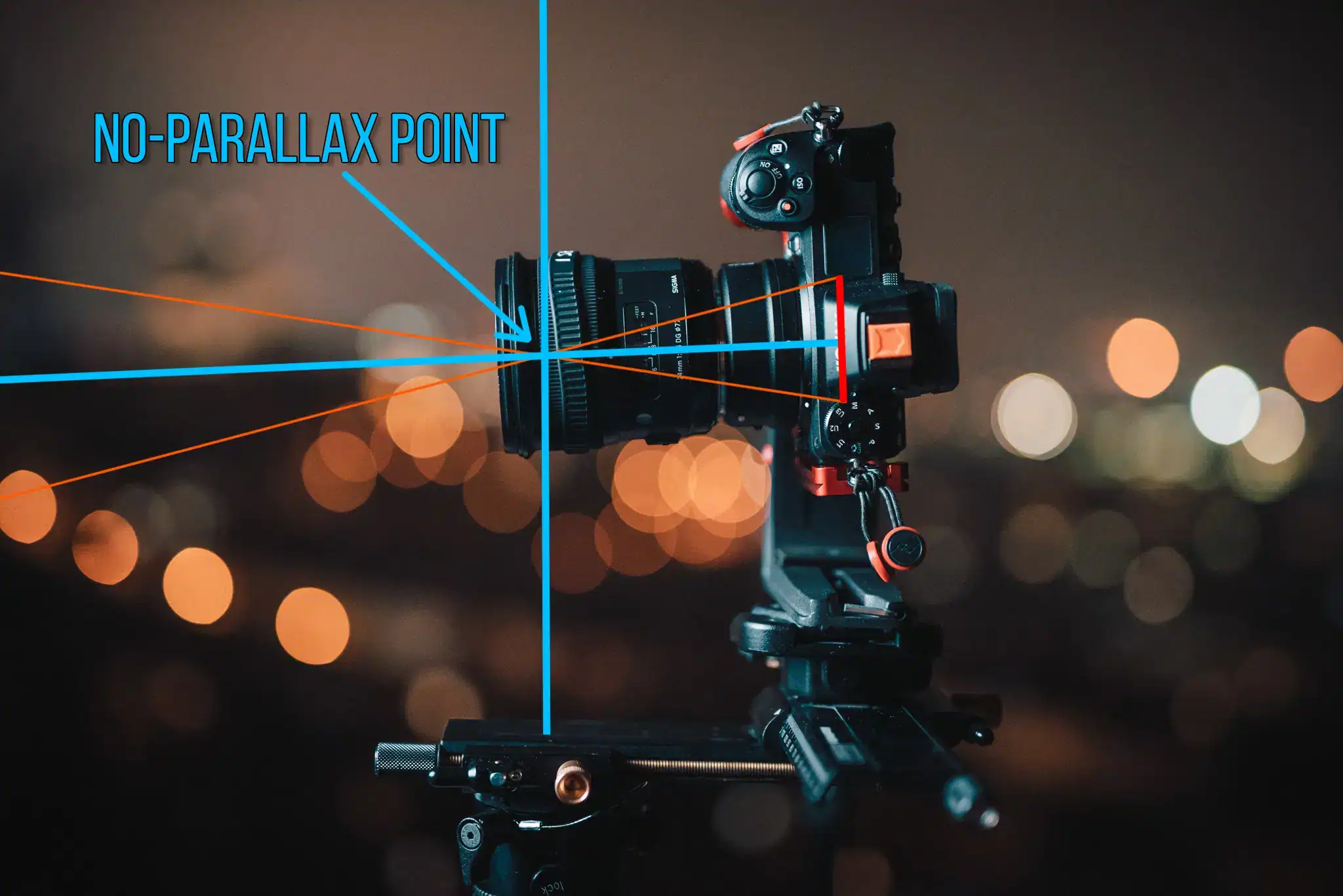
- Panoramic head: Enables rotation around the lens’s entrance pupil (nodal point) to eliminate parallax. Calibrate once for this lens and mark the rails.
- Stable tripod with leveling base: A half-ball or leveling bowl helps you set the rotator perfectly level in seconds.
- Remote trigger or app: Use the Olympus app or a cable release. Prefer electronic shutter or Anti-Shock to avoid vibrations.
Optional Add-ons
- Pole or car mount: Always use a safety tether. Avoid excessive speed/wind; stabilize rotation and keep shutter speeds sufficiently fast for any vibration.
- Lighting aids: Small LED panels or bounced flash for dim interiors (keep it consistent frame-to-frame).
- Weather protection: Rain cover, microfiber cloths, and a lens hood (the CS II’s removable hood can reduce flare; keep it on unless it intrudes).
Step-by-Step Shooting Guide
Standard Static Scenes
- Level and align the nodal point: Mount the E‑M1 Mark III on your panoramic head with the Samyang 8mm positioned so the rotation happens around the lens’s entrance pupil. For this lens on MFT, the entrance pupil tends to sit roughly 40–45 mm forward of the sensor plane mark (Σ). Fine-tune by aligning near/far objects while rotating. Mark your rail settings for future speed.
- Manual exposure and white balance: Set M mode, meter for the mid-tones, and lock WB (Daylight or a custom K value). Shoot RAW for maximum latitude. Disable IBIS on tripod (to prevent sensor drift).
- Capture sequence with overlap: With this combo, start with 6 around at 60° increments for efficiency (tilt +5° if you need more sky), then add 1 zenith (tilt +90°) and 1 nadir (tilt −90°). If you see difficult textures or tight spaces, switch to 8 around at 45° for extra overlap and an easier stitch.
- Nadir shot for tripod removal: Either shoot a dedicated nadir after offsetting the tripod or capture a handheld nadir from the same entrance pupil position and patch later.
HDR / High Dynamic Range Interiors
- Bracket exposures: Use 3 frames at ±2 EV or 5 frames at ±1 EV depending on window brightness. The E‑M1 Mark III’s AEB makes this easy; prefer AEB over “HDR mode” for consistent RAW files.
- Lock white balance and focus: Keep WB fixed and focus manual to avoid inconsistencies. Verify no clipping in highlights via histogram/overexposure warning.
Low-Light / Night Scenes
- Use longer shutter speeds on a tripod: ISO 200–400 if possible; up to ISO 800 remains clean on this sensor. Turn off IBIS, enable electronic shutter or Anti-Shock, and use the timer/remote.
- Wind awareness: If the tripod vibrates, increase shutter speed by raising ISO modestly (to 400–800) or shield the rig from wind.
Crowded Events
- Two passes: First, capture a full set rapidly. Second, wait for gaps in traffic and reshoot problem panels. You’ll mask the best frames during stitching.
- Keep overlap generous (30–40%): This gives the stitcher more control points despite movement.
Special Setups (Pole / Car / Drone)
- Secure everything: Safety tether the camera and head. On poles, spin slowly and keep shutter speeds higher (1/200–1/500) to counter sway.
- Vibration strategy: For car rigs, pick smooth surfaces, avoid high speed, and shoot bursts to cherry-pick the sharpest frame per view.
Recommended Settings & Pro Tips
Exposure & Focus
| Scenario | Aperture | Shutter | ISO | Notes |
|---|---|---|---|---|
| Daylight outdoor | f/8–f/11 | 1/100–1/250 | 200 | Lock WB (Daylight); aim for ETTR without clipping |
| Low light/night | f/4–f/5.6 | 1/30–1/60 (tripod) or 1/125+ (handheld) | 200–800 | Remote trigger; IBIS off on tripod |
| Interior HDR | f/8 | Bracket ±2 EV (3) or ±1 EV (5) | 200–400 | Balance windows and lamps; keep WB fixed |
| Action / moving subjects | f/5.6–f/8 | 1/200+ | 400–800 | Freeze motion; consider two-pass method |
Critical Tips
- Manual focus: Set the Samyang to near-infinity and stop down to f/8; confirm with magnification/peaking. On MFT, f/8 yields excellent depth-of-field for 360 scenes.
- Nodal point calibration: Expect the entrance pupil ~40–45 mm in front of the sensor plane. Fine-tune against near/far reference lines and mark your rail to repeat.
- White balance lock: Use Kelvin or a custom preset. Mixed lighting? Shoot a grey card and unify in post.
- RAW over JPEG: Preserve dynamic range and color fidelity for blending and stitching.
- IBIS usage: Handheld pano tests benefit from IBIS if you set the focal length to 8 mm in the IS menu. On tripod, disable IBIS to avoid motion artifacts.
Stitching & Post-Processing
Software Workflow
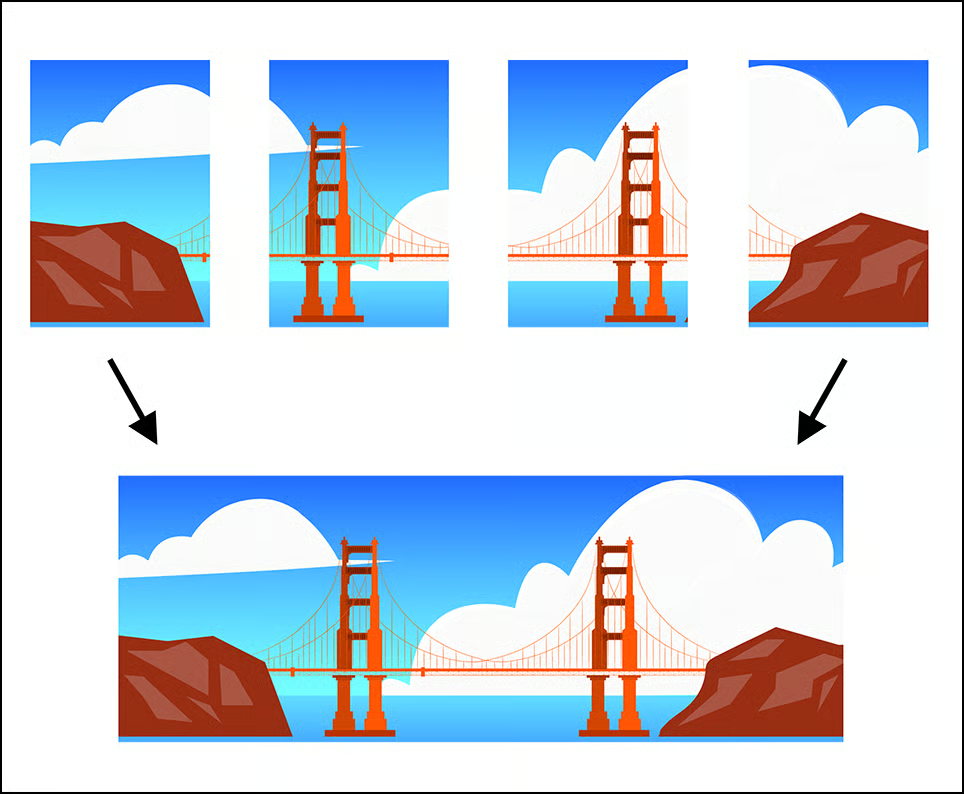
Import RAW files to Lightroom or your preferred editor, make synchronized base adjustments (white balance, lens CA correction off if using a dedicated fisheye profile later), and export 16-bit TIFFs. In PTGui or Hugin, set lens type to fisheye and let the optimizer estimate field of view (expect ~135–140° on MFT with this 8mm). Use at least 25–35% overlap for reliable control points. Fisheyes stitch faster with fewer images; rectilinear lenses may need more shots but show less stretching near edges. For best results, aim for 25–30% overlap with fisheye and 20–25% with rectilinear lenses at similar coverage. For software choices and rationale, see this hands-on PTGui review by Fstoppers at the end of this section. Read a detailed PTGui review and workflow tips.
Cleanup & Enhancement
- Nadir patch: Use a dedicated nadir shot to replace the tripod area, or clone/heal in Photoshop. AI-based content fill can speed this up.
- Color and noise: Apply consistent color correction. For low-light panos, gentle noise reduction preserves detail—start in RAW, finish after stitching.
- Leveling: Use the optimizer in PTGui or the horizon tool in Hugin to neutralize roll/pitch. Ensure verticals are truly vertical for interiors.
- Export: Deliver 8,192 px or 10,000+ px wide equirectangular JPEG/TIFF for web/VR players. Keep metadata (XMP) intact when possible.
For a broader primer on DSLR/mirrorless 360 workflows and best practices, Meta’s creator docs provide an excellent overview. See DSLR/mirrorless 360 photo guidance.
Video: A concise walk-through on practical panorama technique and stitching fundamentals.
Useful Tools & Resources
Software
- PTGui panorama stitching
- Hugin open source stitcher
- Lightroom / Photoshop for RAW and retouching
- AI tripod removal and content-aware fill tools
Hardware
- Panoramic heads (Nodal Ninja, Leofoto, Sunwayfoto)
- Carbon fiber tripods for weight vs stability
- Leveling bases/half-balls to speed setup
- Wireless remote shutters or smartphone app control
- Pole extensions / car mounts with safety tethers
For a deep dive on panoramic head setup and theory, this tutorial is a solid reference. Panoramic head alignment tutorial
Disclaimer: software/hardware names provided for search reference; check official sites for details.
Common Mistakes & How to Avoid Them
- Parallax error → Always rotate around the entrance pupil; calibrate and mark your panoramic head.
- Exposure flicker → Shoot manual exposure and lock white balance. Avoid auto-ISO and auto-WB.
- Tripod shadows / footprints → Capture a dedicated nadir shot and patch it cleanly.
- Ghosting from moving subjects → Shoot two passes and mask the best frames in post.
- Night noise → Keep ISO in the 200–800 range and use longer shutter speeds on a stable tripod.
- IBIS drift on tripod → Turn off IBIS when locked on a tripod to prevent micro-blur.
Field-Proven Scenarios with This Combo
Indoor Real Estate
For bright windows and dim rooms, use 3× ±2 EV or 5× ±1 EV brackets at f/8, ISO 200–400. Shoot 6 around + Z + N. The E‑M1 Mark III’s low base ISO noise produces clean shadows after HDR merging. Keep lamps on for ambiance but avoid mixing multiple WB types; fix WB in Kelvin to minimize color cast.
Outdoor Sunset
Meter for mid-tones and avoid clipping the sun. Consider 5× ±1 EV to retain sky gradients. Wind? Raise ISO to 400 and aim for 1/125–1/200 s to ensure micro-sharp frames. The Samyang’s detachable hood helps reduce flare—use it unless it intrudes in the frame.
Crowded Events
Use 8 around for more overlap and control points. Shoot a fast sequence at 1/200–1/250 s, ISO 400–800. Capture a second pass during lulls to easily mask out heavy motion in PTGui.
Rooftop or Pole Shooting
Keep the rig as light as possible; add a counterweight to the lower pole segment for balance. Safety tether the camera. Shoot 6 around + Z + N with a slightly faster shutter (1/200+). If the pole sways, overshoot with 8 around and keep multiple frames per angle, choosing the sharpest in post.
Frequently Asked Questions
- Can I shoot handheld panoramas with the E‑M1 Mark III?
Yes, especially with IBIS. Set focal length to 8 mm in the IS menu, use 1/250 s or faster, and maintain consistent overlap. Expect more stitching cleanup than tripod shots, and avoid close foregrounds to reduce parallax.
- Is the Samyang 8mm f/3.5 wide enough for single-row 360 on Micro Four Thirds?
Yes, but you’ll need more frames than a 7.5mm MFT fisheye. Plan on 6–8 shots around plus zenith and nadir. For tight interiors or to ensure sky coverage, tilt the row slightly upward or add a second row.
- Do I need HDR for interiors with bright windows?
Usually. Bracket 3× ±2 EV or 5× ±1 EV to retain window detail and clean shadows. Merge exposure stacks before stitching or use PTGui’s HDR workflow for consistent tone mapping across the panorama.
- How do I avoid parallax issues with this lens?
Use a panoramic head and align the entrance pupil. For this combo, start with the lens about 40–45 mm forward of the sensor plane, then refine with near/far alignment tests. Mark your rail for repeatability.
- What ISO range is safe on the E‑M1 Mark III in low light?
ISO 200–800 is a reliable working range. ISO 1600 is usable with careful noise reduction, but for 360s intended for close inspection, keep ISO as low as the shutter and stability allow.
- Can I set up Custom Modes for pano?
Yes. Assign a Custom Mode with M exposure, fixed WB, IBIS off (tripod use), electronic shutter, 2 s timer, and your preferred bracketing. It saves minutes on location.
- How can I reduce flare with a fisheye?
Avoid placing the sun at the frame edge, keep the hood on (CS II’s removable hood helps), and clean the front element frequently. Shield the lens with your hand just outside the frame when necessary.
- What panoramic head should I choose?
Look for an Arca-type two-rail system with precise scales, a click-stop rotator (e.g., 45° and 60° detents), and a leveling base. Popular options include Nodal Ninja and Leofoto—ensure the vertical arm adjusts to place the lens entrance pupil over the rotation axis.
Safety, Limitations, and Trustworthy Workflow
Even with robust weather sealing, avoid rain droplets on the fisheye—tiny drops become large smears after stitching. Weigh or stake down the tripod in wind. On rooftops and poles, use tethers and never stand under the rig. Accept that the Samyang 8mm on MFT has a narrower field of view than a native 7.5mm fisheye—budget a few extra frames and you’ll still enjoy fast, reliable stitching.
For deeper planning and technique, see this panoramic shooting Q&A with practical community advice. Panorama techniques from experienced photographers
Final Thoughts
Mastering how to shoot panorama with Olympus E-M1 Mark III & Samyang 8mm f/3.5 UMC Fish-Eye CS II is about repeatable technique: precise nodal alignment, locked exposure and WB, sufficient overlap, and careful bracketing when needed. Once your panoramic head is calibrated and your custom settings are saved, you can build consistent 360° results in minutes, whether it’s a real-estate interior, a windswept rooftop, or a bustling event. Keep it safe, keep it steady, and let software like PTGui or Hugin do the heavy lifting.