
Why This Camera & Lens Are Great for Panoramas
If you want to learn how to shoot panorama with Nikon Zf & Tokina ATX-i 11-20mm f/2.8, you’re starting with a very capable combo. The Nikon Zf is a 24.5 MP full-frame mirrorless body with a BSI sensor, excellent low-light performance, and IBIS that’s helpful when you’re not on a tripod. When you mount the Tokina ATX-i 11–20mm f/2.8 (DX) via an FTZ/FTZ II adapter, the Zf automatically switches to DX crop. That means each frame is roughly 10.3 MP, but the camera’s strong dynamic range (around 14+ EV at base ISO) and clean higher-ISO files let you capture sharp, low-noise source images for seamless stitching.
The Tokina 11–20mm f/2.8 is a rectilinear ultra-wide zoom designed for APS-C. At 11mm it delivers an approx. 104° diagonal field of view on DX—wide enough to reduce the number of shots for a 360, with straight lines that architectural shooters prefer. It has a constant f/2.8 for low-light work, decent control of lateral chromatic aberration, and good central sharpness stopped down (f/5.6–f/8). Being rectilinear (not fisheye), you’ll need more frames than a fisheye would, but you’ll get more natural-looking walls and horizons—great for real estate and interiors.
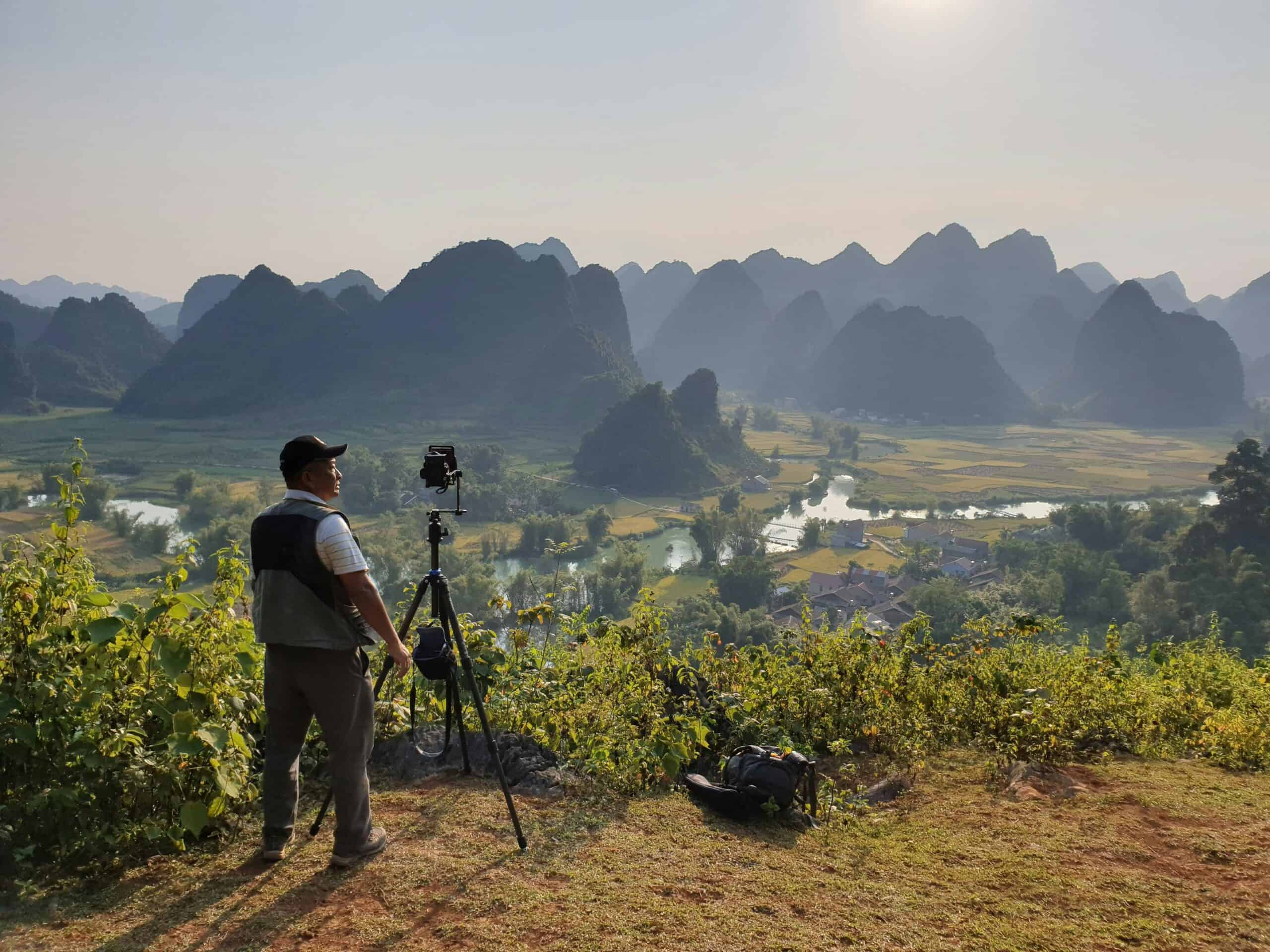
Quick Setup Overview
- Camera: Nikon Zf — Full-frame (FX) 24.5 MP BSI CMOS; DX crop output ~10.3 MP per frame; pixel pitch ~5.9 μm; excellent base-ISO dynamic range (~14 EV).
- Lens: Tokina ATX-i 11–20mm f/2.8 (DX, rectilinear) — sharpest around f/5.6–f/8; some lateral CA at edges; constant f/2.8 for low light. Use via FTZ/FTZ II adapter.
- Estimated shots & overlap (spherical 360):
- At 11mm DX (~16.5mm FF equiv): 8 around at 0° + 4 at +60° + 1 zenith + 1 nadir (≈14 frames) with ~25–30% overlap.
- At 14mm DX (~21mm FF equiv): 10 around + 5 at +60° + 1 zenith + 1 nadir (≈17 frames).
- At 20mm DX (~30mm FF equiv): 12 around + 6 at +60° + 1 zenith + 1 nadir (≈20 frames).
- Difficulty: Intermediate (rectilinear UWA requires accurate nodal alignment; stitching is straightforward with good overlap).
Planning & On-Site Preparation
Evaluate Shooting Environment
For 360 photos, look at the light, moving subjects, and reflective surfaces. Interiors with windows typically need HDR bracketing to balance bright exteriors and interior shadows. If shooting near glass, angle your camera slightly or keep the lens 5–10 cm away from the surface to reduce reflections and ghosting. Watch for moving crowds, vehicles, trees in the wind, and waves—these cause ghosting and require timing or masking in post.
Match Gear to Scene Goals
The Nikon Zf’s low-noise performance and strong dynamic range make it a great pano body—expose at ISO 100–400 for maximum DR, and don’t be afraid to go to ISO 800–1600 at night if needed. The Tokina 11–20’s rectilinear rendering keeps architecture straight and natural, though you’ll take more shots than with a fisheye. For real estate or architectural 360s, rectilinear is often preferred because “fisheye look” can curve lines. Outdoors at sunset, the Zf’s latitude helps preserve highlight color while holding shadow detail, especially if you bracket.
Pre-shoot Checklist
- Charge batteries, clear fast UHS-II cards, clean lens front and rear elements (and sensor).
- Level the tripod before you mount a panoramic head; verify nodal/entrance pupil alignment.
- Safety first: secure on rooftops; tether when over edges; avoid shooting under heavy wind with a pole.
- Backup workflow: shoot a second full pass, especially in busy scenes. If something moved, you’ll have options for clean masks.
Essential Gear & Setup
Core Gear
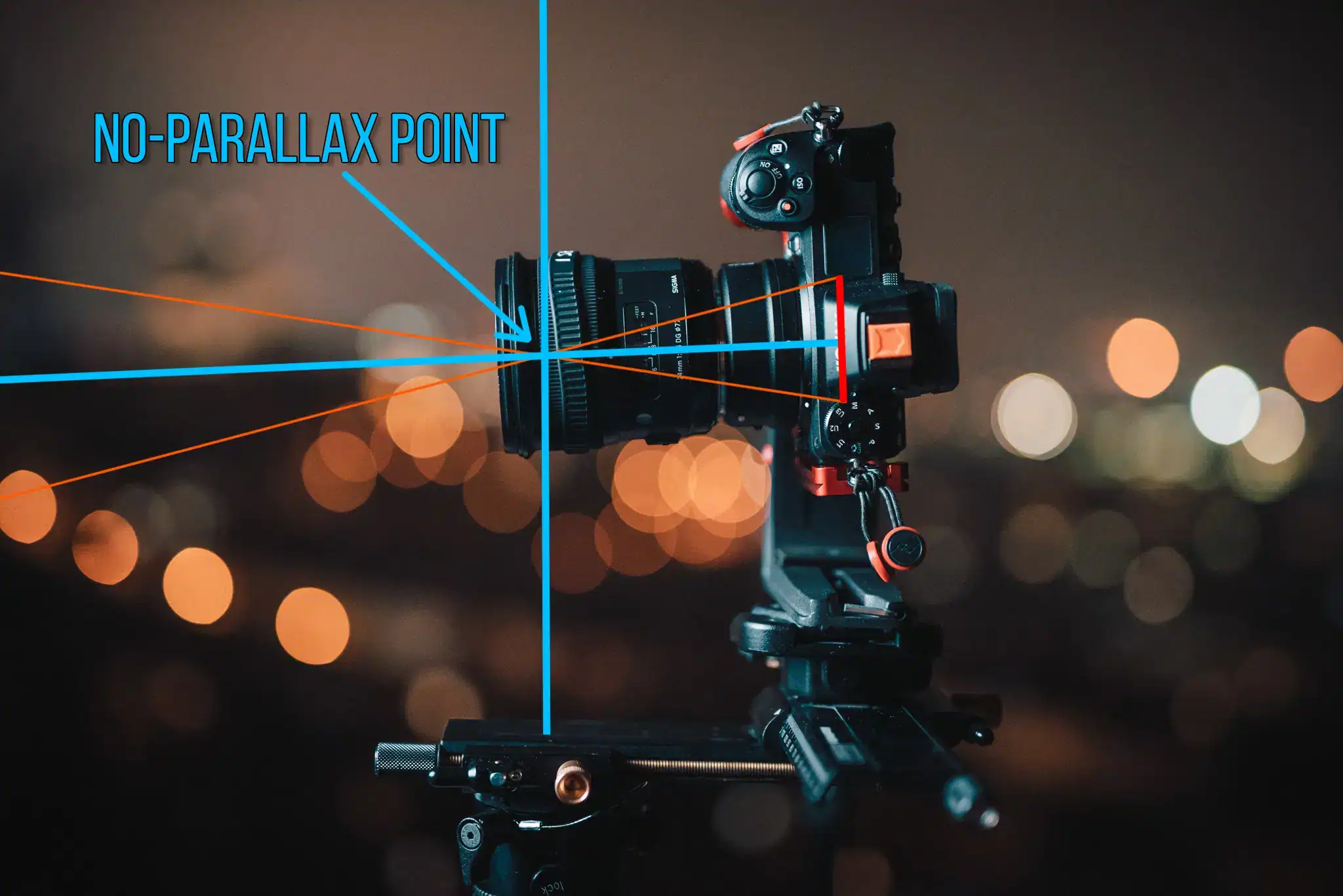
- Panoramic head: Lets you rotate around the lens’s entrance pupil (nodal point) to eliminate parallax. This is critical with rectilinear lenses and near objects.
- Stable tripod with a leveling base: A leveling base speeds setup and keeps your horizon true across rows.
- Remote trigger or SnapBridge app: Fire without touching the camera. Use a 2–5 second timer or exposure delay to kill shutter shock.
Optional Add-ons
- Pole or car mount: Great for crowds or above obstacles. Always tether gear, watch wind loading, and use faster shutter speeds to fight vibration.
- Small LED panels or flash for interiors: Fill dark corners so you can use lower ISO and smaller apertures.
- Weather protection: Rain cover, microfiber towels, and silica packs for humid or rainy shoots.
Step-by-Step Shooting Guide
Standard Static Scenes
- Level the tripod and align the nodal point. Mount your Nikon Zf + Tokina 11–20mm on a panoramic head with an FTZ adapter. Slide the camera on the nodal rail so foreground and background features don’t shift as you pan. Test with two vertical objects (one close, one far). Adjust until there’s no relative motion.
- Switch to Manual exposure and lock white balance. Set WB to Daylight (outdoors), or custom Kelvin (e.g., 3200–3800K for tungsten interiors). Shoot RAW for maximum flexibility.
- Capture your sequence with consistent overlap. At 11mm DX, a reliable pattern is 8 shots around at 0°, 4 shots at +60°, then 1 zenith (+90°) and 1 nadir (−90° or tilt down to the floor). Keep overlap around 25–30%.
- Take a clean nadir. After the main set, lift the tripod, shoot a handheld nadir frame, or take an extra down shot with the tripod moved slightly. This will make tripod removal easier.
HDR / High Dynamic Range Interiors
- Enable exposure bracketing ±2 EV (3 or 5 frames). The Zf handles AEB well; set to Manual mode so shutter speed changes while aperture and ISO remain fixed.
- Lock WB and use a constant aperture (often f/8). Merge HDR per angle first, then stitch, or stitch bracketed sets directly in PTGui to preserve consistent alignment.
Low-Light / Night Scenes
- Use a tripod, exposure delay, and a remote. Start around f/4–f/5.6, ISO 400–1600, and shutter 1/15–4 s depending on ambient light. Turn IBIS off on a tripod to avoid micro-wobble.
- Watch for moving lights, people, and cars. When practical, shoot a second pass to capture “clean” regions for masking.
Crowded Events
- Shoot two full passes: one fast pass to capture geometry, another timed for gaps in crowds. Use faster shutter (1/200–1/500) at higher ISO if needed.
- In post, mask between passes to remove ghosts and duplicate limbs.
Special Setups (Pole / Car / Drone)
- Secure everything. Use safety tethers, tighten all clamps, and mind wind. On a pole, rotate more slowly and use 1/250–1/500 shutter to fight vibration.
- Car-mounted captures require stiff suction mounts and very fast shutters. Confirm local regulations before shooting from moving vehicles.
Want to see a complete panoramic head setup in action? Watch this concise walkthrough:
Recommended Settings & Pro Tips
Exposure & Focus
| Scenario | Aperture | Shutter | ISO | Notes |
|---|---|---|---|---|
| Daylight outdoor | f/8–f/11 | 1/100–1/250 | 100–200 | Lock WB (daylight), shoot RAW |
| Low light/night | f/4–f/5.6 | 1/15–1/60 (tripod) or 1/125–1/250 (handheld) | 400–1600 | Use remote or timer; IBIS off on tripod |
| Interior HDR | f/8 | Bracket ±2 EV | 100–400 | Merge HDR then stitch, or stitch bracketed sets in PTGui |
| Action / moving subjects | f/5.6–f/8 | 1/200+ | 400–800 | Freeze motion; consider double pass for clean masks |
Critical Tips
- Manual focus at the hyperfocal distance. At 11mm on DX, f/8’s hyperfocal is roughly 0.8 m; focus there and you’ll have near-to-infinity sharpness.
- Nodal point calibration: Place one object ~0.5 m in front of the lens and another several meters away. Pan left/right and slide the camera on the rail until the objects don’t shift relative to each other. Mark that position for 11mm, and another for 14mm/20mm—zooms shift the entrance pupil.
- White balance lock: Use Kelvin (e.g., 3200K for tungsten) to avoid color shifts between frames and across HDR brackets.
- RAW over JPEG: The Zf’s 14-bit RAW gives you extra headroom for stitching, color correction, and highlight recovery.
- IBIS/VR: Turn off in-body and lens stabilization on a tripod. For pole or handheld panos, stabilization can help—test for consistency.
- Shutter mode: Use exposure delay or a 2s timer to reduce shutter shock. Mechanical or EFCS is safest on a tripod; avoid full electronic if artificial lights cause banding.
- Feature note: The Zf’s Pixel Shift is great for static single-frame scenes but not practical for multi-frame 360s—avoid it for pano capture.
Stitching & Post-Processing
Software Workflow
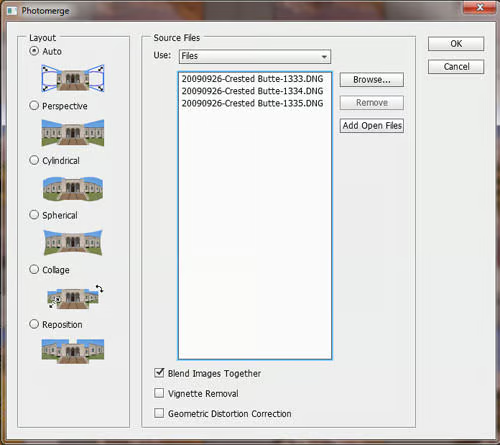
Import all RAWs, apply base corrections (lens profile off if your stitcher handles it better), and sync exposure/WB settings. Stitch in PTGui or Hugin using the rectilinear lens model. Rectilinear lenses typically stitch best with 20–25% overlap, but with ultra-wide zooms like the 11–20mm, 25–30% is safer to ensure robust control points—especially indoors with lots of parallel lines. PTGui’s optimizer will handle small misalignments, but good input overlap makes a huge difference. For a deep dive into PTGui’s strengths, see this review from Fstoppers at the end of the paragraph. Why PTGui is a top choice for complex panoramas.
Cleanup & Enhancement
- Nadir patch: Add a handheld down-shot in PTGui or export a layered panorama and clone/AI-fill the tripod area.
- Color and noise: Apply gentle noise reduction for ISO 800–1600 night frames. Match color between rows for a seamless look.
- Horizon leveling: Use the stitching software’s auto-level or place vertical control points on door frames and pillars.
- Export equirectangular: 2:1 ratio JPEG/TIFF for virtual tour platforms. With 10.3 MP DX frames and ~14–18 shots, expect ~12k–16k px wide equirectangulars depending on overlap and sharpening.
Want fundamental theory on pano resolution and coverage? This classic reference explains spherical resolution and coverage math. Panotools: DSLR spherical resolution guide.
If you’re new to panoramic heads and control points, this step-by-step tutorial is a great visual primer. Panoramic head setup and shooting tips.
Disclaimer: Software features evolve; always check current documentation for the latest workflow recommendations.
Useful Tools & Resources
Software
- PTGui panorama stitching
- Hugin (open source)
- Lightroom / Photoshop for RAW and retouch
- AI tripod removal tools (Content-Aware Fill, Generative Fill)
Hardware
- Panoramic heads (Nodal Ninja, Leofoto, Sunwayfoto)
- Carbon fiber tripods with leveling bases
- Wireless remotes or SnapBridge
- Pole extensions and car mounts (with safety tethers)
Disclaimer: Names provided for search reference; verify specs and compatibility with the FTZ adapter and your Nikon Zf.
Real-World Case Studies
Indoor Real Estate (Rectilinear Advantage)
At 11mm DX, shoot at f/8, ISO 100–200, bracket ±2 EV for windows. Use 8 around at 0°, 4 at +60°, and a nadir. The rectilinear rendering keeps walls straight—ideal for listing photos and tours. Expect a ~14–16k wide equirectangular after stitching and light sharpening.
Outdoor Sunset 360
Sunset skies push dynamic range. On the Zf, base ISO 100 and a mid-aperture (f/8) are safe. Bracket your sky-facing frames (±2 EV) or time your sequence to finish on the brightest area. Use a soft grad in post to keep the horizon natural.
Event Crowds
Use 1/200–1/500 s and ISO 400–800. Shoot two passes: the first to lock geometry, the second to capture better positions of moving people. Mask in PTGui to remove ghosts and duplicates.
Rooftop or Pole
Mount the pano head firmly, use a safety line, and keep the center of gravity low. On a pole, raise shutter to 1/250–1/500 and consider a lighter nodal rail. Rotate slower; let vibrations settle between shots.
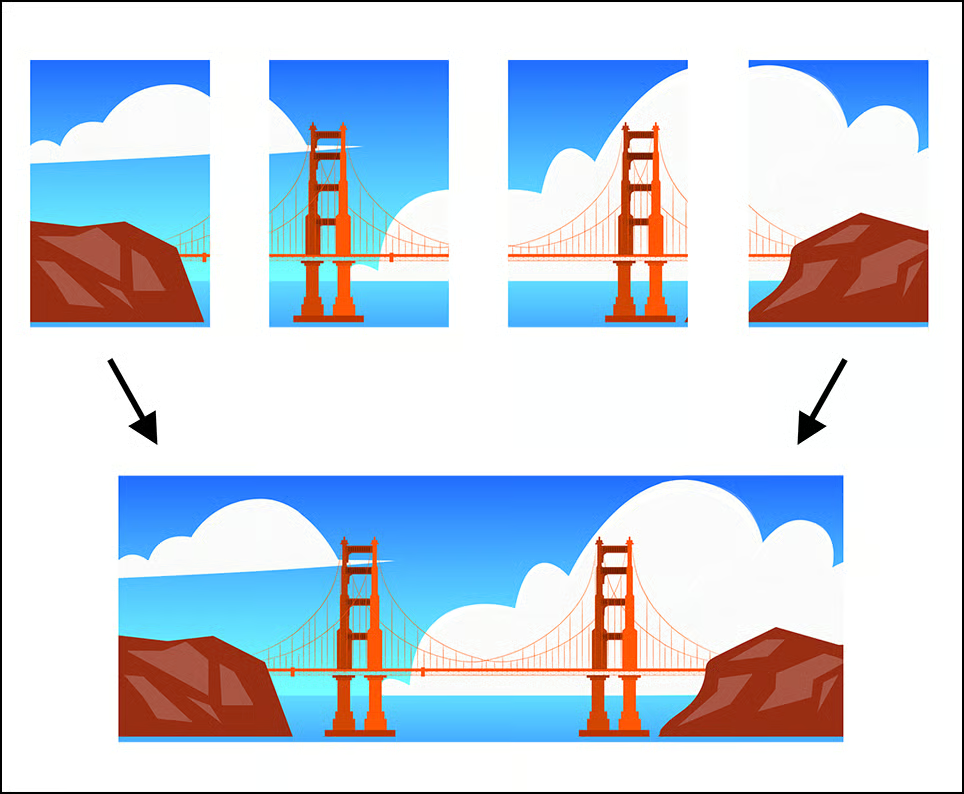
Visual Aids
Common Mistakes & How to Avoid Them
- Parallax error → Use a panoramic head and align the entrance pupil precisely.
- Exposure flicker → Shoot Manual exposure, lock WB, and keep ISO fixed unless you must adapt.
- Tripod shadows and clutter → Capture a clean nadir or patch in post.
- Ghosting from movement → Shoot multiple passes and mask in post or time shots for gaps.
- High-ISO noise at night → Keep ISO as low as practical, use longer exposures on a stable tripod.
- Inconsistent overlap → Use a click-stop rotator or mark angles on your head for repeatability.
Frequently Asked Questions
- Can I shoot handheld panoramas with the Nikon Zf?
Yes, for quick cylindrical panos or 180° views. Use 1/250+ shutter, IBIS on, and generous overlap (40%+). For full 360s with near objects, a tripod and panoramic head are strongly recommended to avoid parallax errors.
- Is the Tokina ATX-i 11–20mm wide enough for a single-row 360?
Not for a complete spherical 360. It’s a rectilinear UWA on DX (approx. 16.5–30mm FF equiv). You’ll need multi-row capture: for example, 8 around at 0°, 4 at +60°, plus zenith and nadir.
- Do I need HDR for interiors with bright windows?
Usually yes. Bracket ±2 EV (3 or 5 frames) at each position. Merge to HDR first or let PTGui handle bracketed sets. Lock WB and aperture for consistent color and DoF.
- How do I avoid parallax issues with this lens?
Use a panoramic head with a nodal rail. Calibrate at 11mm and mark the rail position. Recalibrate at 14mm and 20mm since the entrance pupil shifts as you zoom. Keep near objects at least 0.5–1 m away whenever possible.
- What ISO range is safe on the Nikon Zf in low light?
ISO 100–400 yields maximum dynamic range. ISO 800–1600 remains very usable for night panos on a tripod. ISO 3200 is workable, but expect more noise and a DR drop; expose to the right without clipping highlights.
- Can I set up Custom Shooting Modes for pano?
Yes—use U1/U2/U3 on the Nikon Zf to store Manual mode, WB preset (e.g., 5600K), RAW, single-shot with exposure delay, and IBIS off. It speeds up field work.
- What’s the best tripod head for this setup?
A two-axis panoramic head with fore-aft and lateral adjustment (e.g., Nodal Ninja or a comparable Leofoto/Sunwayfoto kit) lets you align the entrance pupil precisely for the Tokina 11–20. Add a click-stop rotator for consistent angles.
Safety, Workflow, and Trusted References
Always tether gear on rooftops or poles, avoid shooting in strong gusts, and keep pedestrians clear of your tripod. Back up cards immediately after the shoot; a second full pass can save a panorama if a frame is soft or blocked. For further reading on panoramic head technique and VR-ready workflows, these curated resources are excellent: