
Why This Camera & Lens Are Great for Panoramas
If you’re figuring out how to shoot panorama with Nikon Zf & Sony FE 16-35mm f/2.8 GM, you’re pairing a modern, low-noise full-frame body with a pro-grade ultra-wide zoom. The Nikon Zf uses a 24.5MP full-frame BSI CMOS sensor (approx. 36×24 mm) with large 5.9 µm pixels, excellent base ISO dynamic range of around 14 stops, and in-body stabilization (IBIS). Those traits translate into cleaner shadows, better highlight recovery, and flexibility for low-light interiors—all crucial for panoramic and 360 photo capture.
The Sony FE 16–35mm f/2.8 GM is a rectilinear ultra-wide zoom: straight lines stay straight, making architectural and real estate panoramas look natural. At 16mm you get a very wide field of view (~96° horizontal), which helps reduce the number of shots needed compared to longer focal lengths. Stopped down to f/5.6–f/8, the lens delivers high central sharpness and very usable corners. Expect mild barrel distortion at 16mm and vignetting wide open; both are easy to correct during stitching or raw processing.
Compatibility note: the Sony FE 16–35mm is a Sony E-mount lens. To use it on the Nikon Zf (Z mount), you’ll need an E-to-Z adapter (for example, Techart TZE-01 or Megadap ETZ21). AF and EXIF pass-through may work but can be inconsistent; for panoramas, manual focus is recommended anyway. Also, turn off in-body stabilization on a tripod to prevent micro-shake during multi-shot sequences.
Quick Setup Overview
- Camera: Nikon Zf — Full Frame, 24.5MP BSI sensor, approx. 5.9 µm pixel pitch, ~14 EV DR at ISO 100, excellent ISO 100–1600 performance.
- Lens: Sony FE 16–35mm f/2.8 GM — rectilinear ultra-wide zoom; sharpest around f/5.6–f/8; mild barrel distortion at 16mm; manageable CA and vignetting.
- Estimated shots & overlap (full spherical 360×180):
- At 16mm: 3 rows × 6–8 around (18–24) + zenith + nadir ≈ 20–26 shots total.
- At 20–24mm: 3 rows × 8 around (24) + zenith + nadir ≈ 26–30 shots total.
- At 35mm: 3–4 rows × 10–12 around; not recommended unless you need maximum resolution.
- Overlap targets: 25–30% horizontal; 25–40% vertical (more overlap makes stitching easier).
- Difficulty: Intermediate (rectilinear ultra-wide on tripod with panoramic head).
Planning & On-Site Preparation
Evaluate Shooting Environment
Every panorama lives or dies by scene management. Outdoors, watch the sun angle: strong backlight can reduce contrast and reveal flare. Indoors, glass and reflective surfaces can double your time in post—position carefully to avoid reflections, and if you must shoot through glass, get as close as possible (1–2 cm) and use a rubber lens hood to minimize reflections and ghosting. Consider moving elements—trees, clouds, people, cars—and decide if you’ll mask them later or time your shots during lulls.
Match Gear to Scene Goals
The Nikon Zf’s clean files at ISO 100–800 are perfect for high-detail panoramas, while ISO 1600–3200 remains usable with modest noise reduction. The rectilinear Sony 16–35mm at 16mm keeps straight lines straight—great for architecture, interiors, and cityscapes. Compared to a fisheye, you’ll shoot more frames, but you’ll also have more natural geometry and higher stitched resolution.
Pre-shoot Checklist
- Charge batteries; bring spares. High-shot-count sequences drain batteries faster.
- Use large, fast cards; shoot RAW + optional bracketing for HDR.
- Clean lens front/rear elements and the sensor; dust becomes a nightmare across dozens of frames.
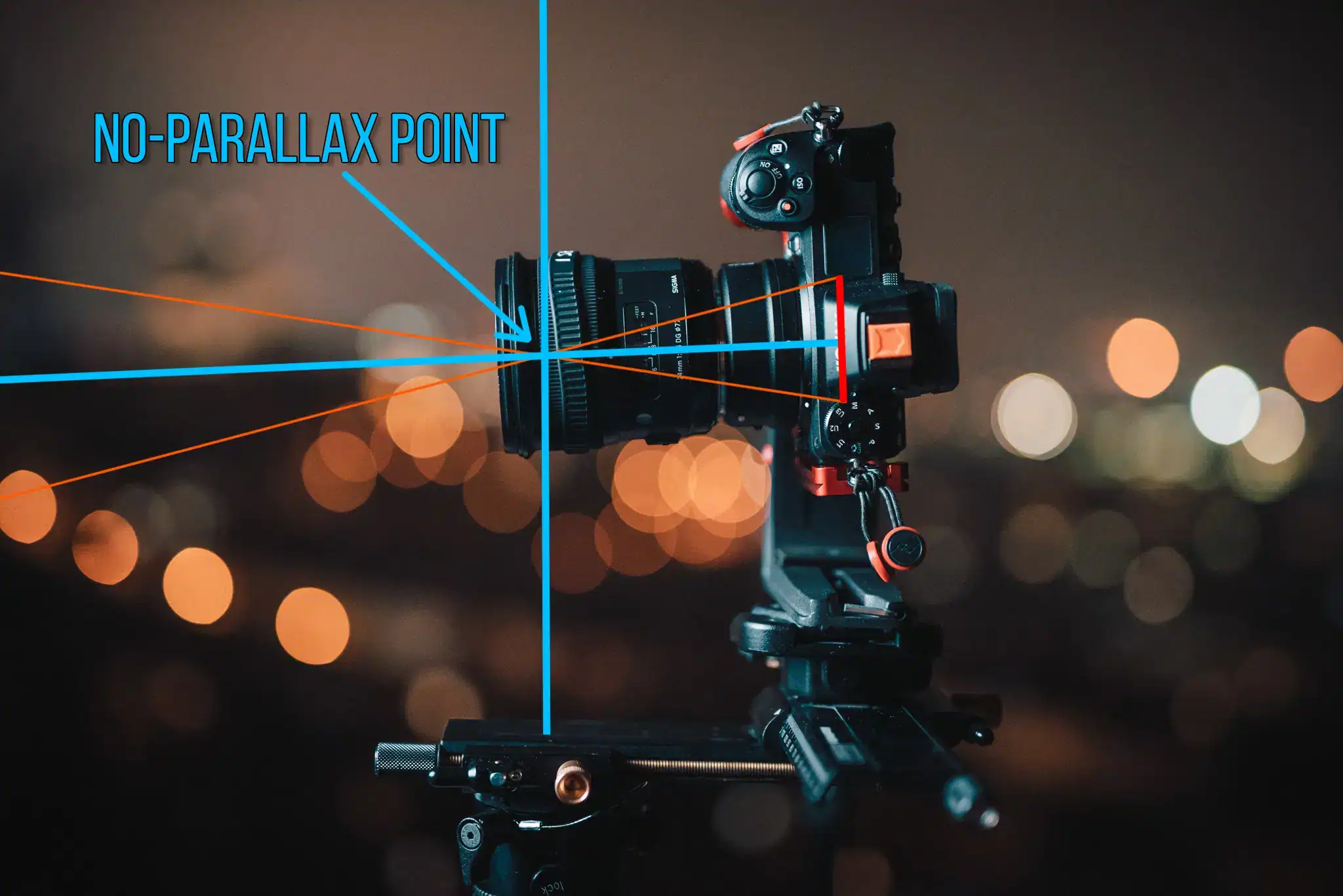
- Level your tripod and pre-calibrate your panoramic head for the entrance pupil (no-parallax point) at 16mm.
- Adapter check: verify fit, AF/MF and aperture control before you’re on location.
- Safety: weigh down your tripod in wind; use a tether/leash on rooftops and poles; avoid car mount use in traffic or on unsafe surfaces.
- Backup capture: shoot a second full pass if the scene allows—insurance against motion ghosts or stitching glitches.
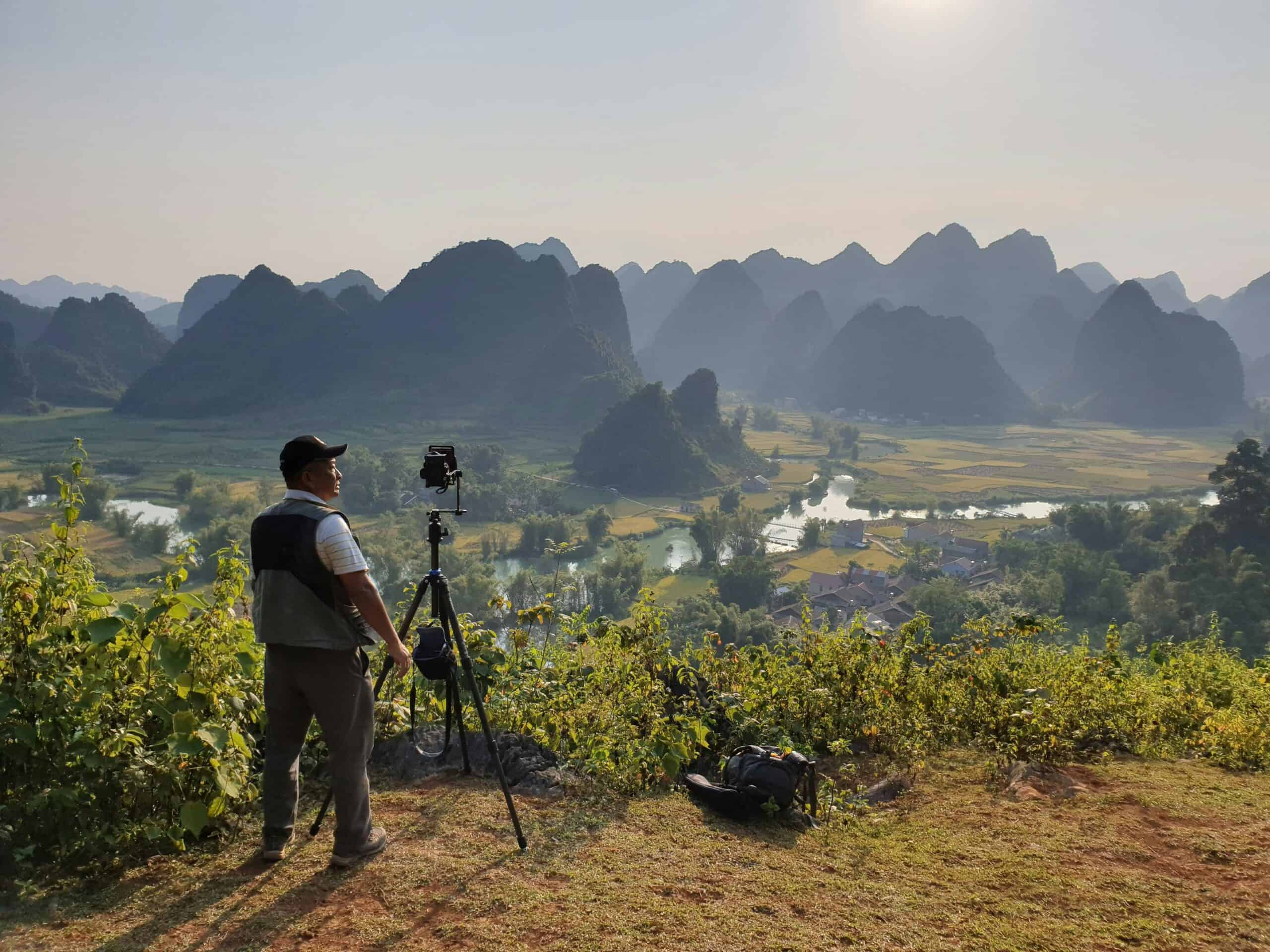
Essential Gear & Setup
Core Gear
- Panoramic head: Allows rotating around the entrance pupil (nodal point) to eliminate parallax. For a zoom like the 16–35, mark your rail for 16mm and stick to it for consistency.
- Stable tripod with leveling base: A bowl or leveling base drastically speeds up setup and keeps your horizon true.
- Remote trigger or app: Use a release cable or Nikon SnapBridge to prevent vibrations and accidental body movement.
Optional Add-ons
- Pole or car mount: Use only with safety tethers and in light winds; beware of flex and vibration that can misalign frames.
- Lighting aids: Small LED panels help balance dark corners in interiors without changing color temperature drastically.
- Weather protection: Rain covers and microfiber cloths; moisture on the front element ruins stitching consistency.
Step-by-Step Shooting Guide
Standard Static Scenes
- Level and center: Level the tripod using the base, not the head. Ensure the panoramic head’s rotator is level so yaw rotations don’t tilt the horizon.
- Nodal alignment: Position the camera so the lens rotates around the entrance pupil. Use a simple test—align a close object with a distant line, pan left/right, and adjust the rail until there’s no relative shift. Mark this setting for 16mm.
- Manual exposure and white balance: Meter the brightest part you need to hold detail (e.g., sky near sun), then set manual exposure. Lock white balance (e.g., Daylight 5200–5600K outdoors; a fixed Kelvin indoors). Disable Auto ISO.
- Manual focus at hyperfocal: At 16mm and f/8, the hyperfocal distance is roughly 1.1 m; focus slightly beyond 1 m to keep near-to-far sharp. Use focus magnification to confirm, then switch AF off.
- Sequence and overlap: For a full 360×180 at 16mm, shoot 3 rows (e.g., +45°, 0°, −45° pitch) with 6–8 images around each row at ~60–70° yaw increments. Capture a dedicated zenith (up) and nadir (down) frame.
- Lens settings: Use f/5.6–f/8 for best edge-to-edge sharpness; keep ISO 100–200 outdoors to maximize dynamic range.
- Nadir patching: Shoot an extra handheld nadir after moving the tripod slightly or use a nadir adapter to get a clean floor tile for patching.
HDR / High Dynamic Range Interiors
- Bracket 3–5 frames: Use ±2 EV (or more if windows are extremely bright). Keep WB locked and aperture constant.
- Speed vs quality: 3 shots (−2/0/+2) works for most rooms; 5 shots (−4/−2/0/+2/+4) handles strong sunlit windows.
- Merge before or after stitch: Many prefer merging HDR stacks per view first (in Lightroom or PTGui’s exposure fusion), then stitch to reduce motion artifacts.
Low-Light / Night Scenes
- Use longer exposures: Keep ISO 100–800 if on tripod; let shutter lengthen (1–10 s) rather than raising ISO. The Zf’s 24MP sensor handles long exposures well.
- Disable IBIS on tripod: Prevent sensor drift and micro-jitter. Use a 2s delay or remote trigger.
- Watch light pollution and flare: Shield the front element from bright point sources; stop down to f/5.6–f/8 for corner performance.
Crowded Events
- Two passes: First pass for structure and background; second pass when people move so you can mask cleaner frames in post.
- Short shutter: Use 1/125–1/250 and ISO 400–800 to freeze motion. You’ll sacrifice some DR but gain cleaner edges for stitching.
Special Setups (Pole / Car / Drone)
- Pole: Keep it under safe wind limits; use a guy-line if tall. Rotate more slowly to prevent flex; shoot extra overlap (35–40%).
- Car mount: Only on private lots or controlled conditions. Secure with multiple suction cups, safety lines, and shoot when stationary.
- Drone: Not applicable with this body, but you can do elevated vantage from a pole. Always consider safety and local regulations.
Recommended Settings & Pro Tips
Exposure & Focus
| Scenario | Aperture | Shutter | ISO | Notes |
|---|---|---|---|---|
| Daylight outdoor | f/8–f/11 | 1/100–1/250 | 100–200 | Lock WB (Daylight 5200–5600K) |
| Low light/night | f/4–f/5.6 | 1/2–10 s | 100–800 | Tripod & remote; longer shutter beats high ISO |
| Interior HDR | f/8 | Bracket ±2 EV (3–5 frames) | 100–400 | Keep aperture and WB locked across brackets |
| Action / moving subjects | f/5.6–f/8 | 1/200+ | 400–800 | Freeze motion; do a double pass for masking |
Critical Tips
- Manual focus at hyperfocal: At 16mm, f/8, set ~1.1 m for front-to-back sharpness; confirm via magnified live view.
- Nodal calibration: Zooms shift the entrance pupil with focal length—lock the lens at 16mm and mark the rail position. Re-check if you change zoom.
- White balance: Use a fixed Kelvin or a custom WB target. Mixed lighting? Choose a neutral target and correct balance uniformly in post.
- RAW over JPEG: RAW preserves highlight detail and enables consistent color/contrast across the set.
- Stabilization: Turn IBIS off on tripod. Enable it only for handheld/pole captures where unavoidable.
- Lens corrections: Because you’re adapting a Sony lens, in-camera corrections may be limited. Apply lens profile in your RAW converter or in PTGui during stitch.
Stitching & Post-Processing
Software Workflow
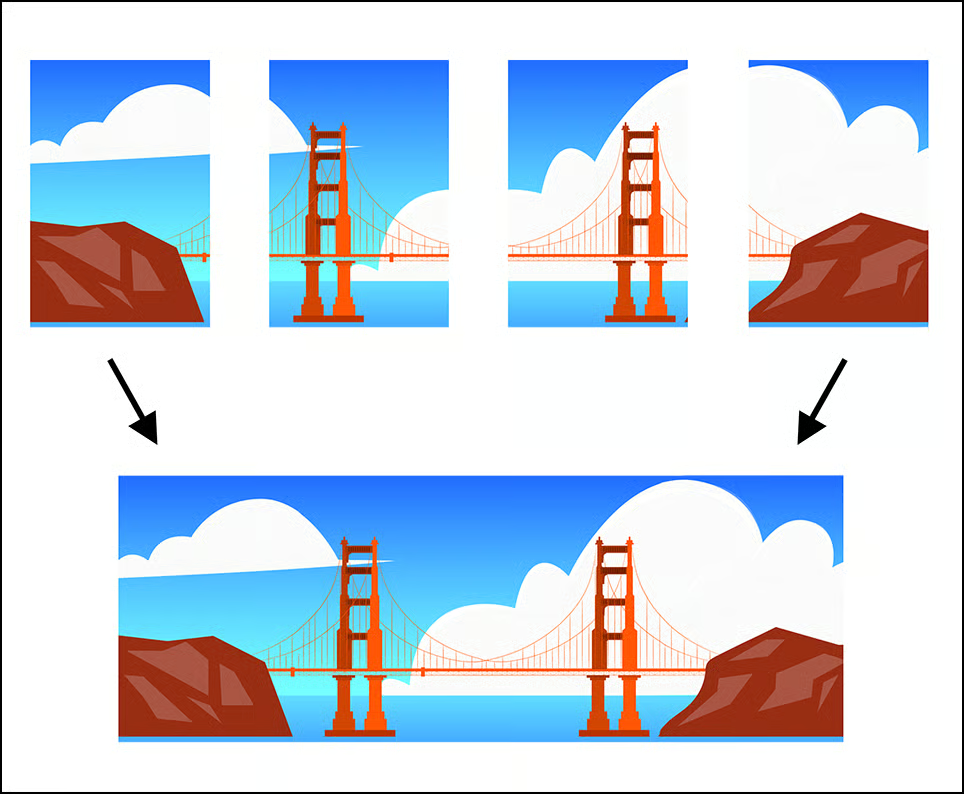
PTGui is a workhorse for spherical panoramas, especially with HDR brackets and mixed exposures. Hugin is a powerful open-source alternative. Lightroom/Photoshop can stitch single-row panos but are less reliable for full 360×180 with multiple rows. With rectilinear ultra-wide lenses, aim for 20–30% overlap and keep exposure/WB consistent to reduce control-point errors. Many pros merge HDR first per angle, then stitch the merged set for a cleaner control-point layout. To learn more about why PTGui is favored for complex panoramas, see this overview at Fstoppers. PTGui review: pro-grade stitching and HDR blending
Cleanup & Enhancement
- Nadir patch: Use a dedicated nadir shot or an AI patching tool for a seamless floor.
- Color and noise: Sync color corrections across the whole set; apply modest noise reduction for ISO 1600+ captures.
- Horizon leveling: Use yaw/pitch/roll tools in PTGui or Hugin to straighten the horizon and set level anchor points.
- Export formats: For VR players, export equirectangular JPEG/TIFF (2:1), commonly 8K–16K on a 24MP base depending on overlap and rows.
For a structured guide on high-end DSLR/mirrorless 360 workflows, the Meta/Oculus creator docs are concise and practical. Using a mirrorless camera to shoot and stitch a 360 photo
Field-Proven Scenarios
Indoor Real Estate (Mixed Lighting)
Mount the Zf on a leveling base in the center of the room. Lock the lens at 16mm and set f/8. Use 3–5 bracketed exposures (±2 EV), WB locked to a custom Kelvin (e.g., 4000–4500K for warm interiors). Shoot 3 rows × 8 around for robust overlap. Merge HDR stacks first, then stitch. Patch the nadir with a handheld shot. This yields a clean, bright room with controlled windows.
Outdoor Sunset (High DR, Moving Clouds)
Time around golden hour and shoot a faster sequence to minimize cloud movement. Consider 3 brackets (−2/0/+2) if the sun is in frame. Use f/8, ISO 100, and adjust shutter from 1/250 down to maintain highlight detail. If clouds move quickly, reduce to single exposure and lift shadows in RAW to avoid ghosting.
Event Crowd (Motion Management)
Set 1/200–1/250, f/5.6–f/8, ISO 400–800. Do two full passes: (1) structural pass capturing the venue; (2) people pass waiting for gaps. In post, mask people from the second pass selectively. This keeps the space coherent and removes duplicate limbs/heads across seams.
Rooftop or Pole (Safety First)
Attach a safety tether to the camera or pole. Keep the pole height moderate if wind is present and use 35–40% overlap. Use faster shutter speeds (1/250+) to mitigate sway. If the structure vibrates, shoot multiple frames per angle and pick the sharpest for stitching.
Car-Mounted Capture (Controlled Environment)
Use a multi-cup suction mount, secondary leash, and park the vehicle to shoot; do not shoot while moving in public spaces. Turn off IBIS on tripod-style mounts and use a faster shutter (1/250+). Expect to patch the nadir and remove the mount in post.
Watch: Panoramic Head Setup Basics
Seeing a panoramic head in action makes nodal alignment far easier to understand. The video below covers the fundamentals you’ll use with the Nikon Zf and a panoramic rail when shooting at 16mm.
If you’re new to panoramic heads, this illustrated guide is also helpful. Panoramic head tutorial (entrance pupil alignment)
Useful Tools & Resources
Software
- PTGui panorama stitching (robust control points, HDR/Masking)
- Hugin open-source stitcher
- Lightroom / Photoshop for RAW and cylindrical panos
- AI tripod/nadir removal tools for faster cleanup
Hardware
- Panoramic heads: Nodal Ninja, Leofoto, or similar with fore-aft rail
- Carbon fiber tripod with leveling base (or bowl)
- Wireless remote shutters and L-brackets
- Pole extensions / vehicle mounts with safety tethers
Disclaimer: product names for research; check official sources for specs. For deeper technical background on resolution tradeoffs by focal length and shot count, see the PanoTools Wiki. Spherical resolution and shot planning
Common Mistakes & How to Avoid Them
- Parallax errors: Always rotate around the entrance pupil; re-check nodal alignment after moving the tripod.
- Exposure flicker: Don’t use auto modes; lock exposure, WB, and ISO for the entire sequence.
- Tripod shadows and footprints: Shoot a clean nadir or plan to patch in post.
- Motion ghosts: Time your shots, shoot extra overlaps, or do double passes for masking.
- High ISO noise: On the Zf, keep ISO ≤1600 when possible and lengthen shutter with a stable tripod.
- Adapter surprises: Test your E-to-Z adapter at home. For panoramas, prefer manual focus and manual aperture control.
Frequently Asked Questions
- Can I shoot handheld panoramas with the Nikon Zf?
Yes for single-row or partial panos. Use high shutter speeds (1/250+), IBIS on, and generous overlap (40%+). For full 360×180 with multi-rows, a tripod and panoramic head dramatically improves alignment and stitch quality.
- Is the Sony FE 16–35mm f/2.8 GM wide enough for a single-row 360?
No. At 16mm (rectilinear), a single row won’t cover zenith and nadir. Plan on 3 rows (e.g., +45°, 0°, −45°) plus dedicated zenith/nadir frames. Expect 20–26 shots total at 16mm.
- Do I need HDR for interiors with bright windows?
Usually, yes. Bracket 3–5 frames at ±2 EV to protect window highlights and lift shadows cleanly. Merge HDR stacks before stitching for better control points and fewer ghosts.
- How do I avoid parallax issues with this lens?
Use a panoramic head and align rotation around the entrance pupil. With a zoom, the entrance pupil changes with focal length—lock the lens at 16mm, calibrate once, and mark the rail so you can repeat the setting.
- What ISO range is safe on the Nikon Zf for low light panoramas?
ISO 100–800 is ideal on a tripod; ISO 1600–3200 is workable with careful noise reduction. It’s better to lengthen shutter than to push ISO when the camera is solidly mounted.
Pro Notes on This Specific Combo
Because the Sony lens is adapted to the Nikon body, expect the following: in-camera distortion/vignetting corrections may not apply; therefore, shoot RAW and apply a Sony 16–35GM profile in post. AF through adapters can hunt—switch to manual focus and use magnification to nail hyperfocal. The Zf’s IBIS is excellent, but switch it off on a tripod. If your Zf firmware supports high-res pixel-shift, keep it disabled for panoramas; the micro-shifts aren’t helpful across multi-angle sequences.
Behind the Scenes Visuals
Safety, Care, and Workflow Trust Tips
- Wind management: Hang a bag on the tripod hook; keep center column down for stability.
- Rooftops and poles: Always tether the camera; never work near edges without proper safety measures.
- Moisture: Keep a microfiber on hand and a rain cover ready. A wet front element will ruin multiple frames before you notice.
- Redundancy: If time allows, shoot a second full set. Corrupted files or stitching hiccups happen.
- Documentation: Save a custom preset for panorama shooting on your Zf (user mode if available) to avoid missing a setting like Auto WB or Auto ISO.
For broader camera and lens selection advice for 360 capture, this reference offers practical buying and workflow guidance. DSLR/mirrorless 360 camera and lens guide