Why This Camera & Lens Are Great for Panoramas
If you’re searching for how to shoot panorama with Nikon Z9 & Olympus 8mm f/1.8 PRO Fisheye, you’re probably aiming for fast, high‑quality 360 photos with minimal frames. The Nikon Z9 brings a 45.7MP full-frame stacked CMOS sensor with excellent dynamic range (around 14+ stops at base ISO 64), deep bit-depth (14-bit NEF), and in-body image stabilization, making it superb for controlled, low-noise panoramic captures. The Olympus 8mm f/1.8 PRO Fisheye is a pro-grade diagonal fisheye with a 180° field of view on Micro Four Thirds, known for strong central sharpness, fast aperture for low light, and relatively well-controlled chromatic aberration.
Important compatibility note: The Olympus 8mm f/1.8 PRO is a Micro Four Thirds mount lens. There is no mainstream electronic adapter that allows full aperture and focus control on a Nikon Z9, and the lens’s image circle is too small to cover the Z9’s full-frame sensor (even in DX crop, vignetting is likely). Practically, you have two solid paths:
- Use the Nikon Z9 with a native or adapted full-frame fisheye (for example, Nikon 8–15mm Fisheye or a circular fisheye for Z-mount) and apply the shooting steps below—the technique and overlap for an 8mm-class fisheye are the same.
- Or use the Olympus 8mm f/1.8 PRO on a Micro Four Thirds body for capture and apply the same pano workflow; the Z9 can remain your editing workstation and main stills body.
Either way, the guide below focuses on fisheye-based 360 capture—fewer shots, faster capture, and reliable stitching when your nodal point is dialed in.
Quick Setup Overview
- Camera: Nikon Z9 — Full Frame (35.9×23.9 mm), 45.7MP; stacked CMOS, base ISO 64, excellent DR (~14+ stops), pixel pitch ~4.35 µm.
- Lens: Olympus 8mm f/1.8 PRO Fisheye — diagonal fisheye; on MFT it covers 180° diagonal; very sharp stopped down around f/4–f/5.6; good CA control; fast aperture for low light.
- Estimated shots & overlap (fisheye on full-frame):
- 8mm circular fisheye: 3 around (120° apart) + optional zenith + nadir; 30–35% overlap.
- 8–9mm diagonal fisheye (full-frame equivalent): 4 around (90° apart) + zenith + nadir; 25–30% overlap.
- 12–15mm fisheye: 6 around + zenith + nadir; 25–30% overlap.
- Difficulty: Moderate. With a calibrated panoramic head, consistent results become easy.
Planning & On-Site Preparation
Evaluate Shooting Environment
Look for mixed lighting, reflections, and movement. Glass and polished metal can double or triple highlights—shoot slightly off-axis to avoid hot spot reflections. If you must shoot through glass, press a rubber lens hood against the pane and keep the lens as perpendicular as possible; distance yourself from bright internal lights to reduce flare and ghosting. For wind, put a weight on the tripod hook and minimize sail area.
Match Gear to Scene Goals
The Z9’s ISO performance is excellent. For critical, low-noise virtual tours, stay around ISO 64–400 when on a tripod. ISO 800–1600 remains very usable with careful noise reduction and is fine for event coverage. The fisheye advantage: you need far fewer frames to cover 360°, which speeds up capture (vital at sunset or in crowds). The trade-off: pronounced distortion that you must manage in stitching and post. The Olympus 8mm f/1.8 PRO has very strong central sharpness; for panoramas, you’ll typically stop down to f/5.6–f/8 for consistent edge-to-edge sharpness and cleaner stitching seams.
Pre-shoot Checklist
- Charge batteries and carry a spare; the Z9’s power draw is higher when reviewing or bracketing.
- Format fast memory cards; shoot RAW or 14-bit NEF for maximum dynamic range.
- Clean front/rear elements and the sensor; fisheyes see everything—dust turns into big smudges.
- Level the tripod and confirm your panoramic head’s nodal point settings for this lens setup.
- Safety checks: Secure straps, consider a tether on rooftops or poles; assess wind and foot traffic.
- Backup workflow: If time allows, shoot a second full round as insurance; minor changes can save a stitch.
Essential Gear & Setup
Core Gear
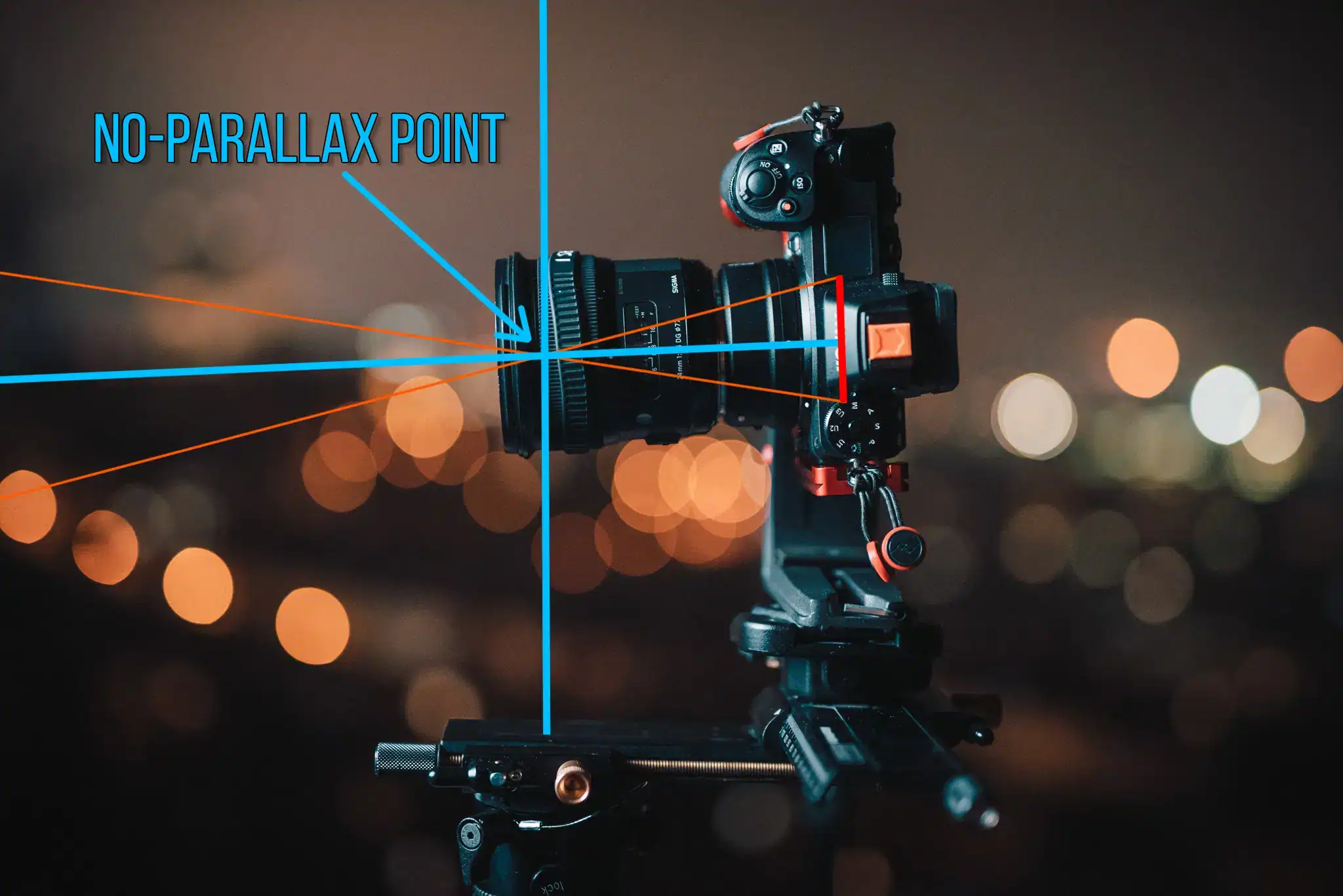
- Panoramic head: Lets you rotate around the lens’s entrance pupil (nodal point) to avoid parallax. Without this, foreground/background alignment breaks when stitching.
- Stable tripod with leveling base: A leveling base cuts setup time and keeps rotations flat, minimizing pitch/roll corrections later.
- Remote trigger or app: Minimizes vibration. The Z9 also supports self-timer; 2s delay works if you don’t have a remote.
If you’re new to pano heads, this is the single best upgrade for consistency. A short learning session will pay off for years. For a primer on panoramic head fundamentals, see this panoramic head tutorial by 360 Rumors at the end of this section.
Optional Add-ons
- Pole or car mount: Great for crowds or over-views. Always use safety tethers, and watch wind gusts—fisheyes are light but poles act like levers.
- Portable lighting for interiors: Small LED panels or bounced flash can fill dark corners in real estate without creating harsh hotspots.
- Weather protection: A compact rain cover and microfiber cloth are priceless in drizzle or sea spray.
Learn more about pano head alignment and best practices in this concise tutorial. Panoramic head basics and alignment tips
Step-by-Step Shooting Guide
Standard Static Scenes
- Level the tripod and align the nodal point. Mount your camera so the rotation axis passes through the lens’s entrance pupil. Start with your rail roughly set so the rotation pivot is about in line with the front element’s center, then fine-tune by observing a near/far alignment test (details below).
- Set manual exposure and lock white balance. Meter for the mid-tones or slightly protect highlights (histogram just touching the right without clipping). Lock a fixed WB (Daylight or custom Kelvin); changing WB between frames creates color seams.
- Capture with reliable overlap. For an 8mm circular fisheye: 3 shots at 120° spacing around the horizon often cover it; add zenith and nadir if needed. For an 8–9mm diagonal fisheye on full-frame: 4 around at 90° works well; add zenith and nadir for perfect coverage.
- Nadir shot for tripod removal. Tilt down and shoot the ground with the tripod moved aside, or shoot a handheld nadir and patch later.
HDR / High Dynamic Range Interiors
- Bracket ±2 EV or ±3 EV depending on window brightness. The Z9’s base ISO 64 gives big highlight headroom; combine 3–5 exposure brackets per view.
- Keep WB locked across brackets and frames. This keeps tonality consistent for the stitcher and simplifies batch processing.
- Use electronic shutter and a remote/self-timer to avoid micro-shake between brackets.
Low-Light / Night Scenes
- Use a tripod, IBIS on or off depending on your head stability. On very rigid tripod/pano heads, turn IBIS off to prevent micro-corrections; handheld or on flexible mounts, IBIS can help.
- Shoot at f/4–f/5.6 and lengthen shutter to keep ISO low (100–800). The Z9 stays clean through ISO 1600–3200 with proper noise reduction; for premium virtual tours, try to stay ≤800.
- Trigger remotely or use a 2s delay, and consider Long Exposure NR for exposures ≥1s.
Crowded Events
- Shoot two passes. First pass quickly for safety; second pass wait for moving people to clear key seams.
- Keep the camera height consistent; mark your tripod leg extension for fast resets.
- In post, mask moving people between passes for clean seams.
Special Setups (Pole / Car / Drone)
- Secure gear with tethers and clamp redundancies; check all knobs twice.
- Plan slower, smoother rotations to reduce motion blur; use higher shutter speeds (1/250s+) if the platform vibrates.
- For car rigs, avoid strong crosswinds and watch reflections from car paint and windows; consider a matte cloth on reflective surfaces.
Recommended Settings & Pro Tips
Exposure & Focus
| Scenario | Aperture | Shutter | ISO | Notes |
|---|---|---|---|---|
| Daylight outdoor | f/8–f/11 | 1/100–1/250 | 100–200 | Lock WB (Daylight). Expose to protect highlights. |
| Low light/night | f/4–f/5.6 | 1/30–1/60 (or longer on tripod) | 400–800 | Tripod + remote; turn IBIS off on very rigid heads. |
| Interior HDR | f/8 | Bracket ±2 EV (3–5 frames) | 100–400 | Windows vs. lamps balanced in merge; keep WB fixed. |
| Action / moving subjects | f/5.6–f/8 | 1/200+ | 400–800 | Freeze motion; do two passes for masking. |
Critical Tips
- Manual focus: Set focus once and switch to MF. With fisheyes, focusing near the hyperfocal at f/5.6–f/8 keeps everything sharp; check at 100% before shooting a set.
- Nodal calibration: Place a light stand 1 m in front and a vertical object 5–10 m behind. Rotate left/right; adjust the rail until their relative alignment doesn’t shift. Mark the rail with tape for this combo.
- White balance lock: Mixed lighting (tungsten + daylight) can vary frame to frame; lock WB and fix color in post globally.
- RAW over JPEG: RAW/NEF preserves highlight detail and color depth critical for HDR panoramas and aggressive color grading.
- IBIS and tripod: On stable pano heads, disable IBIS to avoid micro-drift. On poles or flexy setups, IBIS can help at 1/30–1/60s.
Compatibility reality check
Mounting the Olympus 8mm f/1.8 PRO (MFT) to a Nikon Z9 (full-frame) is not straightforward: the flange distances and electronics are incompatible, and the lens doesn’t cover the full-frame image circle. If you must use this lens, capture on a Micro Four Thirds body and follow this workflow. On the Z9, use an 8–9mm full-frame fisheye for identical shooting steps and overlap. It’s better to use the right tool than fight adapters that don’t exist or require optical compromises.
Stitching & Post-Processing
Software Workflow
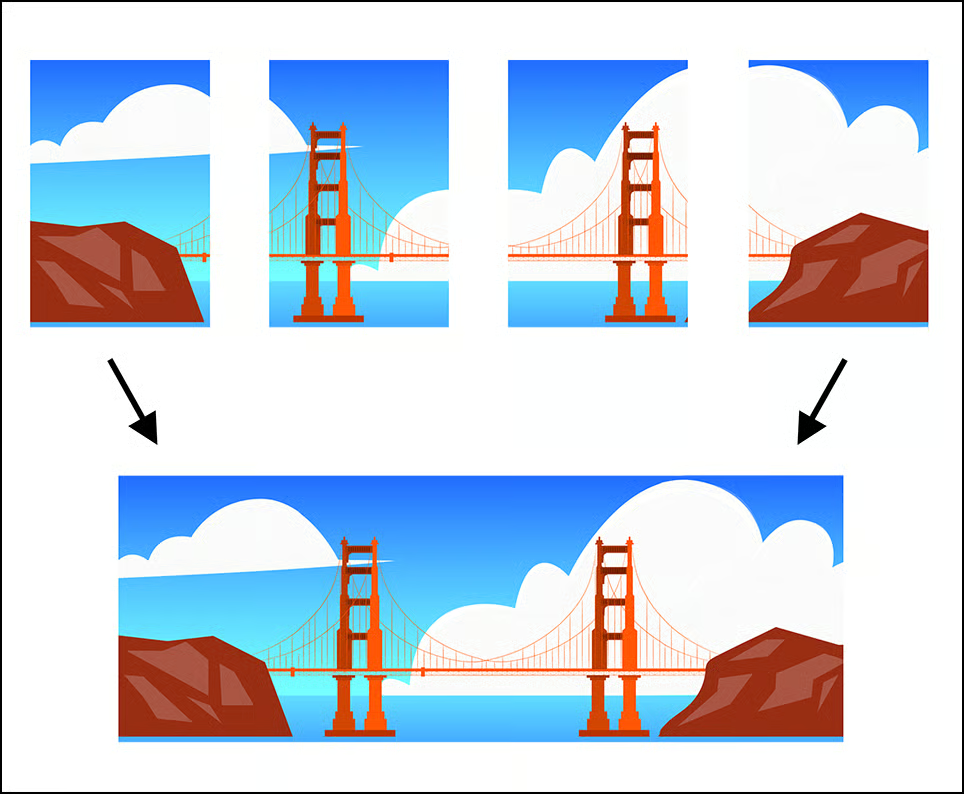
Import your frames into a dedicated stitcher. PTGui is the industry workhorse for fisheye-based 360s, offering automatic control point generation, lens model detection, and powerful masking for moving subjects. Hugin is a capable open-source alternative. Fisheyes are actually easier to stitch when you’ve shot with sufficient overlap and correct nodal alignment. Aim for ~25–35% overlap around and capture zenith/nadir coverage to avoid gaps. After stitching to an equirectangular projection (2:1), finish in Lightroom/Photoshop for color, denoise, and sharpening. For references and reviews, see the PTGui overview at the end of this section.
Cleanup & Enhancement
- Tripod/nadir patch: Use a dedicated nadir shot, PTGui Viewpoint correction, or retouch in Photoshop. There are also AI-based tools for fast tripod removal.
- Color and noise: Apply global WB and tone curves first, then local adjustments. The Z9 files tolerate modest denoise without smearing detail.
- Horizon leveling: If the pano feels tilted, correct roll/pitch/yaw in the stitcher or a viewer tool.
- Export formats: Save a 16-bit TIFF master and an 8-bit JPEG equirectangular (2:1, e.g., 12000×6000 px) for web/VR. Keep a layered project file for revisions.
Learn more about stitching strategies and software choices in this practical review. PTGui: A top-tier panorama stitching tool
Useful Tools & Resources
Software
- PTGui panorama stitching
- Hugin (open-source)
- Lightroom / Photoshop for color and retouch
- AI tripod removal and object cleanup tools
Hardware
- Panoramic heads (Nodal Ninja, Leofoto, Sunwayfoto)
- Carbon fiber tripods with leveling base
- Wireless remote shutters or app control
- Pole extensions and car mounts with safety tethers
For a deeper dive into full 360 panorama workflows for VR, Meta’s creator guide is a good high-level overview. Using a mirrorless/DSLR to shoot and stitch 360 photos
Disclaimer: software/hardware names provided for search reference; check official sites for latest features and compatibility.
Common Mistakes & How to Avoid Them
- Parallax error: Always rotate around the entrance pupil. Recheck calibration if you move the camera plate or swap lenses.
- Exposure flicker: Manual mode and fixed WB. Don’t let auto-ISO or auto-WB vary across frames.
- Tripod shadows or missing floor: Capture a nadir frame and patch later.
- Ghosting from moving subjects: Take multiple passes, then mask in PTGui or Photoshop.
- Night noise: Keep ISO modest (ideally ≤800) and use longer shutter with a stable tripod.
- Lens flare with fisheye: Shield the lens from direct sun and avoid strong backlight when possible; use your hand or a flag just outside the frame if needed.
Frequently Asked Questions
-
Can I shoot handheld panoramas with the Nikon Z9?
Yes, for quick 360 captures in good light, you can handhold and rotate carefully around your body’s center. However, parallax and horizon drift are common. For professional results, use a tripod and panoramic head—especially indoors with foreground elements.
-
Is the Olympus 8mm f/1.8 PRO wide enough for single-row 360?
On Micro Four Thirds, yes—its 180° diagonal FoV means you can cover a full sphere with 4–6 frames around plus zenith/nadir. On the Z9 specifically, this lens is not natively usable due to mount and image circle limits. Use a full-frame fisheye of similar FoV to achieve the same shot count.
-
Do I need HDR for interiors with bright windows?
Usually yes. Bracket ±2 EV (3–5 frames) so you can hold window detail and clean shadows. The Z9’s base ISO DR is excellent, but multi-exposure merging still yields cleaner results in high-contrast rooms.
-
How do I avoid parallax issues with a fisheye?
Mount your camera on a panoramic head and calibrate the entrance pupil. Align a near object with a far object, rotate the camera, and adjust fore/aft rails until there’s no relative shift. Mark the setting for fast repeatability.
-
What ISO range is safe on the Z9 in low light?
For premium virtual tours and prints, stick to ISO 64–800 on a tripod. ISO 1600–3200 is workable for events or when you need faster shutter speeds; apply careful denoise in post.
-
Can I set custom modes on the Z9 for panoramas?
Yes. Save a “Pano” bank with Manual exposure, fixed WB, RAW, IBIS off (for rigid tripod work), and your bracket settings. This reduces setup time and mistakes on location.
-
How do I reduce flare with a fisheye?
Keep the sun just out of frame, use your hand/flag to block direct light, and clean the front element often. Slightly change your yaw for shots with flare and mask the clean frame in the stitcher.
Field-Proven Scenarios and Settings
Indoor Real Estate (Bright Windows)
Tripod + pano head, f/8, ISO 100–200, HDR bracketing ±2 EV (5 frames). Four shots around at 90° with a diagonal fisheye; add zenith/nadir. Lock WB to 5000–5600K or use a custom Kelvin that neutralizes mixed lighting. Use masks in PTGui to avoid ghosting from swaying plants or curtains.
Outdoor Sunset Overlook
Four around + zenith at f/8, 1/100s, ISO 100–200. Meter just to the right of the histogram (ETTR) to preserve shadow detail but avoid clipping the sun. Shoot a second pass a minute later for safety—light changes quickly.
Crowded Event Floor
Raise the camera to eye or above-head height; 1/250s, f/5.6–f/8, ISO 800–1600. Do two quick rotations: first for coverage, second waiting for gaps at critical seams. In post, use masks to remove duplicates and blur streaks.
Rooftop or Pole Capture
Keep the pole vertical (use a bubble level). 1/250–1/500s, f/5.6–f/8, ISO 400–800. Rotate slower and stop breathing movement between frames. Watch for wind; if gusty, lower the pole and shoot more frames to be safe.
Nodal Point: Fast Calibration Method
- Mount the camera on your panoramic head and level everything.
- Place a light stand or tripod about 1 meter in front of the camera and align it with a vertical background edge 5–10 meters away.
- Rotate 30–45° left and right. If the foreground pole shifts relative to the background edge, move the camera front/back on the rail.
- Repeat until the shift disappears. Mark the rail with tape and note the lens, focus distance, and aperture used.
Pro tip: Fisheyes can have slightly different entrance pupil positions at different focus distances and apertures. Calibrate at your typical f-stop (f/5.6–f/8) and focus distance (hyperfocal or ∞) for repeatable results.
For a broader discussion of panoramic techniques and pitfalls, this Q&A thread offers extra perspectives. Best techniques to take 360 panoramas
Deliverables & Hosting
Export a 2:1 equirectangular JPEG (8–12K width) for web viewing and a 16-bit TIFF master for archival. Most virtual tour platforms accept 8000×4000 px or larger. Keep a layered stitch file (PTGui project) so you can reopen and adjust control points, masks, or horizon if a client requests changes later.
Safety, Weather, and Gear Care
- Wind: Add weight to the tripod, lower your center column, and avoid extending thin leg sections.
- Rooftops and poles: Use safety tethers and never lean over edges. Avoid conductive poles near power lines.
- Rain and sea spray: Carry a compact rain cover and wipe the fisheye frequently—drops near the edge can look huge in the stitch.
- Data safety: Use dual-card recording if possible and back up after each shoot; consider a second pass of frames as a capture backup.
Further Reading
When you need a refresher on VR-oriented capture beyond stills, this high-level guide is helpful. Setting up a panoramic head for high-end 360 photos