
Why This Camera & Lens Are Great for Panoramas
If you’re wondering how to shoot panorama with Nikon Z9 & Canon RF 15-35mm f/2.8L IS USM, you’ve picked a powerhouse camera and a world-class ultra‑wide zoom. The Z9’s 45.7MP full-frame stacked CMOS sensor delivers a detailed equirectangular output with excellent dynamic range, and the RF 15–35 provides crisp, rectilinear coverage from ultra-wide to wide, ideal for single- and multi-row panoramas. Important note up front: Canon RF lenses are not natively compatible with Nikon Z cameras, and as of this writing there’s no fully functional RF→Z adapter that provides electronic aperture control and AF. In practice, shooters pair the Z9 with a comparable Z‑mount lens (e.g., NIKKOR Z 14–24mm f/2.8 S or Z 14–30mm f/4 S), or use a Canon EF 16–35mm (via EF→Z adapter) to replicate the 15–35mm field of view. The shooting method, nodal alignment, exposure strategy, and shot counts below remain valid for any rectilinear lens in this range.
Why the combo works conceptually: the Z9’s base ISO of 64 offers class-leading highlight headroom (~14+ stops of DR at base), low read noise, and zero shutter shock (all‑electronic shutter) for vibration‑free multi-shot sequences. The Canon RF 15–35mm is an optically excellent, stabilized rectilinear zoom (constant f/2.8, 82mm filter thread) with strong corner sharpness stopped down (f/5.6–f/8) and manageable distortion that stitches well. Even if you can’t mount the RF lens directly on the Z9, the field-tested guidance here targets this focal range so you can apply it with a Z‑mount equivalent.
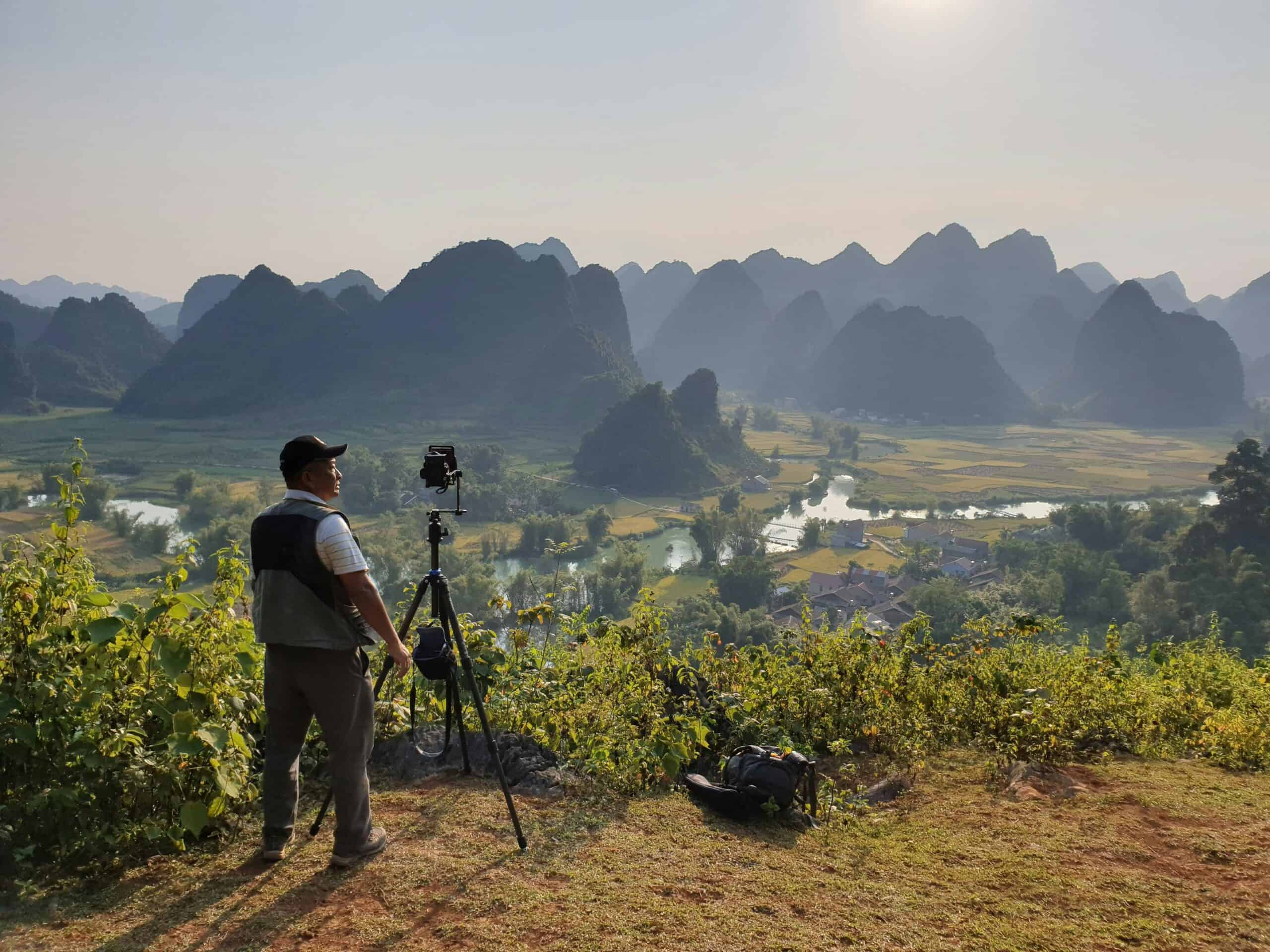
Quick Setup Overview
- Camera: Nikon Z9 — Full-frame 45.7MP stacked CMOS (8256×5504), ~4.36µm pixel pitch, base ISO 64, excellent DR, 5‑axis IBIS (disable on tripod).
- Lens: Canon RF 15–35mm f/2.8L IS USM — rectilinear UWA zoom, strong sharpness at f/5.6–f/8, moderate barrel distortion at 15mm, good CA control. Note: RF lens cannot be natively mounted to Z9; use a Z‑mount equivalent or EF lens + EF→Z adapter.
- Estimated shots & overlap (full-frame, rectilinear):
- 15mm: Two rows × 8 around (≈45° yaw steps) + zenith + nadir = ~18 shots at ~30% overlap.
- 24mm: Three rows × 12 around (≈30° yaw steps) + Z + N = ~38 shots at ~30% overlap.
- 35mm (for detail/gigapixel): Four rows × 14 around + Z + N = 58–60 shots at ~30% overlap.
- Difficulty: Moderate (easy outdoors on tripod, intermediate for interiors and HDR multi-row work).
Field of view guide: a 15mm rectilinear on full frame gives ~100° horizontal FOV and ~77° vertical, which typically requires multi-row capture to cover zenith and nadir cleanly.
Planning & On-Site Preparation
Evaluate Shooting Environment
Look for direct sun flare, reflective surfaces (glass, polished floors), and moving elements (people, trees, flags). If shooting through glass, keep the front element 5–10 cm away and place a lens cloth or flexible hood against the pane to reduce reflections. Switch off any variable interior lights (flicker) and aim for consistent ambient lighting during the set.
Match Gear to Scene Goals
The Nikon Z9’s DR and low read noise make it superb for high-contrast scenes like sunset sky + shadowed foreground. For interiors, ISO 64–400 yields clean files; ISO 800–1600 remains workable with modern denoise. The Canon RF 15–35’s 15mm end (or a Z‑mount equivalent at 14–15mm) minimizes shot count at the expense of a little edge stretching; for real estate, that balance is perfect. Stop down to f/8 for consistent corner-to-corner sharpness and match rows carefully to avoid coverage gaps.
Pre-shoot Checklist
- Charge batteries; bring spares. The Z9 is power hungry during long HDR sequences.
- Format cards; shoot RAW (HE* or NEF lossless compressed).
- Clean lens and sensor; UWA flare doubles dust visibility.
- Level tripod; verify panoramic head calibration (nodal/entrance pupil alignment).
- Safety: use a weight bag in wind; tether gear on rooftops; secure car mounts with secondary lines.
- Backup workflow: after a full round, shoot a second safety pass, especially in crowds or changeable light.
Essential Gear & Setup
Core Gear
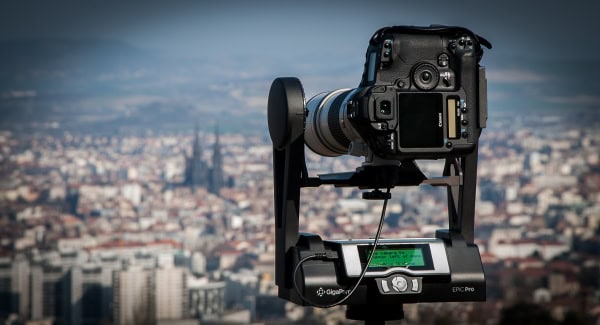
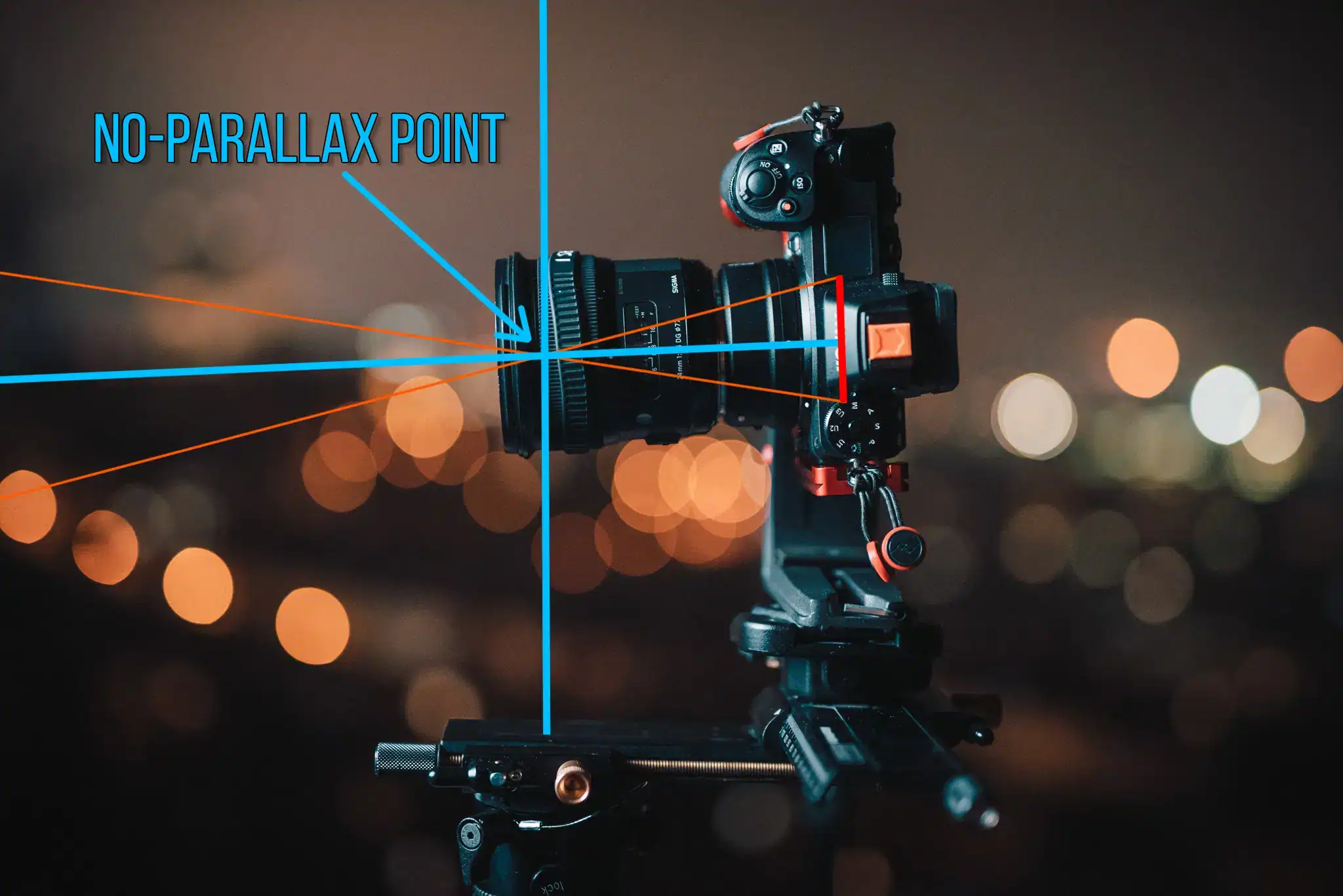
- Panoramic head: Enables rotation around the lens’s no‑parallax point (NPP), eliminating parallax between near/far objects for seamless stitching.
- Stable tripod with a leveling base: Level once, then rotate in yaw without introducing pitch/roll errors.
- Remote trigger or SnapBridge app: Fire without touching the camera; use exposure delay if needed.
Optional Add-ons
- Pole or car mount: Use safety tethers, check wind. Avoid IBIS/IS on rigid mounts; vibrations can worsen blur if stabilization hunts.
- LED panels or flashes for interiors: Keep lighting consistent across frames or bracket for HDR.
- Weather protection: Rain covers, microfiber cloths, and silica packs for humid nights.
If you cannot mount the RF 15–35 on your Z9, use a NIKKOR Z 14–24/2.8 S or Z 14–30/4 S at similar focal lengths—the rest of this workflow is unchanged.
Step-by-Step Shooting Guide
Standard Static Scenes
- Level and align the nodal point: On the panoramic head, slide the camera forward/back until foreground and background objects stay aligned during rotation. Mark this setting on the rail for your focal lengths (15mm, 24mm, 35mm) so you can repeat it quickly.
- Manual exposure and locked white balance: Set M mode. Meter a mid-tone, then lock shutter, aperture, ISO across all shots. Set WB to Daylight/Custom (don’t use Auto WB) for consistent color during stitching.
- Capture with tested overlap:
- At 15mm: Two rows (pitch +45°, −45°), 8 shots per row (yaw 45° steps). Then take a zenith (point up) and a nadir (point down).
- At 24mm: Three rows (pitch +45°, 0°, −45°), 12 shots per row (≈30° steps), plus Z & N.
- Nadir shot: After the main set, lift the rig and shoot the ground from the same spot (or offset a little and note it), to patch out the tripod later.
HDR / High Dynamic Range Interiors
- Bracket ±2 EV (3–5 frames): The Z9 supports up to 9‑frame bracketing. For bright windows, 5 frames at 2 EV spacing is robust.
- Keep WB locked and aperture fixed (e.g., f/8). Vary shutter only. Use a remote or 2–5 sec exposure delay to avoid micro‑shake.
- Shoot fewer rows at 15mm to reduce total exposures; HDR × multi-row grows exponentially—plan your time.
Low-Light / Night Scenes
- Use tripod, IBIS OFF, lens IS OFF. Long exposures remove noise better than pushing ISO.
- Settings starting point: f/4–f/5.6, 4–15 s, ISO 64–400. Move ISO to 800–1600 only if wind or motion forces shorter times.
- Use Long Exposure NR off (do dark frames later) to keep cadence fast across rows.
Crowded Events
- Shoot two passes: first for complete coverage, second waiting for gaps to reduce ghosting. Mark a fixed rotation cadence so both passes align.
- Later, mask moving subjects in PTGui/Photoshop. Keep overlap generous (30–40%) to give the stitcher options.
Special Setups (Pole / Car / Drone)
- Secure everything with tethers and a safety line. Check bolts before lifting a pole; avoid overhead lines and strong gusts.
- Use faster shutter (1/250–1/500) and slightly higher ISO to fight vibration. Rotate slower and pause longer between frames.
Recommended Settings & Pro Tips
Exposure & Focus
| Scenario | Aperture | Shutter | ISO | Notes |
|---|---|---|---|---|
| Daylight outdoor | f/8–f/11 | 1/100–1/250 | 64–200 | Lock WB to Daylight; disable IBIS/IS on tripod |
| Low light/night | f/4–f/5.6 | 1–15 s | 64–800 | Remote trigger; use exposure delay; avoid high ISO if scene is static |
| Interior HDR | f/8 | Bracket ±2 EV | 64–400 | Balance windows vs room lights; keep aperture fixed |
| Action / moving subjects | f/5.6–f/8 | 1/200+ | 400–1600 | Freeze motion; consider double-pass capture |
Critical Tips
- Manual focus at hyperfocal: At 15mm and f/8 on full frame, hyperfocal is ~0.95 m; set focus there and switch AF off.
- Nodal calibration: Find the NPP for 15mm, 24mm, and 35mm and mark your rail. This saves minutes every shoot.
- White balance lock: Avoid Auto WB. Mixed lighting? Create a custom Kelvin value (e.g., 3800–4200K for warm interiors) and stick with it.
- RAW over JPEG: You’ll want the Z9’s 14‑bit tonal data for HDR merges and sky recovery.
- Stabilization off on tripod: Turn off the Z9’s IBIS and the lens’s IS to avoid sensor/element drift during long exposures.
Stitching & Post-Processing
Software Workflow
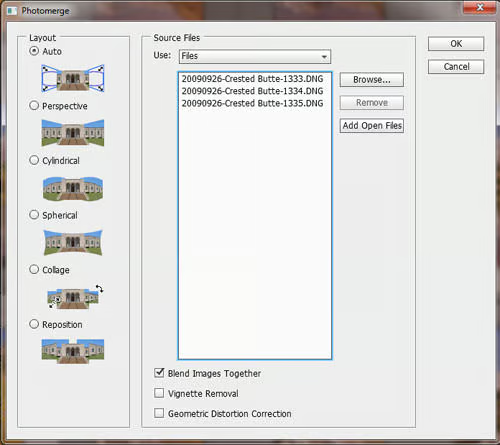
Import RAWs into Lightroom or your RAW processor, apply lens corrections (distortion, vignetting) consistently, and sync settings across the set. Stitch with PTGui for the most control over multi-row HDR panos, or try Hugin for a free alternative. Rectilinear lenses need more shots than fisheyes but deliver natural edges and architecturally faithful lines. Aim for 25–30% overlap at 15–24mm and 30%+ at 35mm to ensure robust control point generation. For publishing to VR, export an equirectangular 2:1 image (e.g., 16000×8000) as a 16‑bit TIFF or high-quality JPEG. See a thorough PTGui review for more advanced masking and HDR workflows at the end of this section. PTGui overview and review
Cleanup & Enhancement
- Nadir patch: Use PTGui’s Viewpoint correction or clone/heal in Photoshop; AI remove tools can speed this up.
- Color and noise: Match color balance across rows; apply gentle noise reduction in shadows, especially at ISO 800–1600.
- Horizon and leveling: Adjust yaw/pitch/roll; set verticals upright for architecture.
- Export for platforms: Save as 8K–16K equirectangular JPEG for web/VR; keep a 16‑bit master TIFF for archival.
For a concise industry perspective on setting up panoramic heads and best practices, the Oculus creator guides are excellent references. Set up a panoramic head for high‑end 360 photos
Real-World Scenarios & Field Notes
Indoor Real Estate
Use 15–18mm to minimize shot count and keep lines straight. Shoot 5‑frame HDR brackets at f/8, ISO 64–200. Turn off ceiling fans and wait out people movement. Watch for mirrors—step aside and shoot a patch frame if needed.
Outdoor Sunset
Meter for the highlights and bracket ±2 EV to rescue shadows. The Z9’s base ISO 64 and 14‑bit RAW files retain cloud texture and color gradients beautifully.
Event Crowds
Go 24mm to reduce extreme edge stretch on faces. Use 1/200 s minimum and ISO 800–1600. Two passes let you remove ghosting in post.
Rooftop / Pole Shooting
Secure the pole with a harness and tether the camera. Shorter shutter speeds (1/250–1/500) prevent motion blur. Overlap more generously (35–40%) to help the stitcher with micro‑motion.
Car-Mounted Capture
Only on closed roads or with proper permits. Rigid mounts, safety cables, and high shutter speeds (1/1000) are essential. Expect to fix rolling subjects and parallax via selective masking.
For more background and techniques vetted by the pano community, this Q&A thread is a good starting point. Best techniques to take 360 panoramas
Watch: Panorama Shooting Basics
This short video reinforces nodal alignment, exposure locking, and overlap strategy before you head out.
If you’re building virtual tours, this long-form explainer is also helpful. Virtual tour camera and lens guide
Useful Tools & Resources
Software
- PTGui panorama stitching
- Hugin (open source panorama tool)
- Lightroom / Photoshop for RAW and retouching
- AI tripod removal and sky replacement tools
Hardware
- Panoramic heads: Nodal Ninja, Leofoto, Really Right Stuff
- Carbon fiber tripods with leveling bases
- Wireless remotes / intervalometers
- Pole extensions and car mounts with safety tethers
Disclaimer: brand names are for reference. Check official sites for compatibility and current specs.
For formulas and resolution planning, the community-maintained PanoTools wiki is invaluable. DSLR spherical resolution (PanoTools Wiki)
Common Mistakes & How to Avoid Them
- Parallax error: Calibrate the nodal point and lock it for each focal length you use.
- Exposure flicker: Manual mode only; fixed WB; no auto ISO.
- Tripod shadows and footprints: Shoot a clean nadir for patching.
- Ghosting from moving subjects: Capture a second pass and mask in post.
- High ISO noise at night: Prefer long exposures at low ISO; stabilize well.
- IBIS/IS left on: Turn off stabilization on a tripod to avoid drift and blur.
Frequently Asked Questions
- Can I mount the Canon RF 15–35mm f/2.8L IS USM on the Nikon Z9?
Not natively. There is currently no fully functional RF→Z adapter with electronic aperture/AF. Use a Z‑mount ultra‑wide (e.g., Z 14–24/2.8 S) or a Canon EF 16–35mm via an EF→Z adapter.
- Can I shoot handheld panoramas with the Z9?
Yes for simple partial panos; for 360×180, a leveled tripod and panoramic head are strongly recommended. Handheld, keep shutter at 1/250+, lock exposure/WB, and overshoot overlap (40%+).
- Is 15mm wide enough for a single-row 360?
Not for full 360×180 on full frame. A single row at 15mm leaves gaps at zenith and nadir. Plan on two rows at 15mm plus dedicated zenith and nadir shots.
- What ISO range is safe on the Z9 in low light?
ISO 64–400 is pristine; ISO 800–1600 is still very workable with modern denoise. Above ISO 3200, expect noticeable shadow noise—use longer exposures when possible.
- How do I avoid parallax issues with a rectilinear zoom?
Mount on a panoramic head and find the no‑parallax point for each focal length you’ll use (15, 24, 35mm). Slide the rail until near/far features stay aligned while panning; mark those positions.
- Should I enable IBIS or lens IS for panoramas?
On a tripod: turn both off. On a pole or car mount with vibration: consider IS/IBIS ON only if it demonstrably reduces blur; test, as stabilization can also introduce micro‑jitter.
- Can I save a custom panorama setup on the Z9?
Yes. Assign a User Mode with manual exposure, fixed WB, single AF (then MF), bracketing settings, and exposure delay. This speeds up repeatable pano setups.
- Which tripod head is best for this setup?
A multi-row panoramic head (e.g., Nodal Ninja/RSS/Leofoto) with precise fore‑aft and lateral adjustments. For gigapixel at 35mm, a robust two‑axis head with click stops and an indexed rotator helps.
Limitations, Safety, and Data Management
Compatibility: The Nikon Z9 cannot directly control Canon RF lenses. Use native Z‑mount glass or EF glass via an EF→Z adapter. If you must use the RF 15–35, pair it with a Canon RF‑mount body instead; adapt the workflow here accordingly.
Weather/wind: UWA fronts are large; always use a weighted tripod. On rooftops or poles, tether the camera. In traffic or public spaces, follow local regulations and safety best practices.
Backup: The Z9’s dual card slots are ideal—write RAW to both. After a full 360 set, do a quick review for coverage, then shoot a second safety pass. Keep a shot log of row/pitch angles if working manually.
Additional Inspiration
Want more on head setup and shot planning? This practical tutorial breaks down principles and pitfalls with visuals. Panoramic head tutorial and best practices