Why This Camera & Lens Are Great for Panoramas
If you’re wondering how to shoot panorama with Nikon Z9 & 7Artisans 10mm f/2.8 II Fish-Eye, this guide distills expert field practice for this exact combo. The Nikon Z9’s 45.7MP stacked full-frame BSI CMOS sensor (approx. 36×24mm, ~4.35µm pixel pitch) delivers superb detail and excellent dynamic range (notably strong at base ISO 64), while its robust 5-axis in-body stabilization (IBIS) is helpful for handheld scouting and low-light framing. The 7Artisans 10mm f/2.8 II is a full-frame diagonal fisheye providing a massive angle of view (diagonal ~178°), enabling fewer shots per 360° pan and faster captures—ideal for interiors, busy streets, and fast-changing light.
Because the 7Artisans is manual focus and manual aperture, it’s consistent and predictable for panoramic work: set-and-forget focus at hyperfocal distance and lock exposure and white balance for seamless stitching. Distortion is expected with fisheye projection, but panorama software understands this well. On a calibrated panoramic head (to align the lens’s entrance pupil), you’ll minimize parallax and get clean stitches with fewer frames than a rectilinear lens would require.
Quick Setup Overview
- Camera: Nikon Z9 — full-frame 45.7MP stacked CMOS; base ISO 64; excellent DR; strong low-light performance to ISO 1600–3200 for pano use.
- Lens: 7Artisans 10mm f/2.8 II Fish-Eye — diagonal fisheye; manual focus/aperture; best overall sharpness around f/5.6–f/8; some purple fringing/CA possible around high-contrast edges.
- Estimated shots & overlap (tested guidance):
- Quality-first: 6 around at 60° yaw + 1 zenith + 1 nadir (≈8 shots total; ~30–35% overlap).
- Speed run: 4 around at 90° yaw + 1 zenith + 1 nadir (≈6 shots; ~25–30% overlap; more demanding on stitch).
- Handheld safety: 8 around at 45° yaw (no Z/N) for heavy overlap; patching may be needed.
- Difficulty: Moderate — fast to capture, but nodal alignment and consistent exposure are critical.
Planning & On-Site Preparation
Evaluate Shooting Environment
Survey your scene for moving elements (people, trees, cars), reflective surfaces (glass, polished floors), and light direction. For glass viewpoints, place the lens as close as safely possible (1–3 cm) to minimize reflections, and shade the front element with your body or a flexible flag. Watch for direct sun hitting the fisheye’s dome; severe flare can destroy contrast. In interiors, note mixed lighting (tungsten + daylight) and plan a fixed white balance to avoid color inconsistency.
Match Gear to Scene Goals
The Z9’s strong base ISO 64 dynamic range lets you protect highlights at sunrise/sunset and lift shadows later. Indoors, the sensor remains clean up to ISO 800–1600; for 360 photo work, we suggest staying at ISO 64–200 in daylight and ISO 400–800 indoors, pushing to ISO 1600 only if motion demands faster shutter speeds. The 10mm fisheye keeps frames to a minimum, which reduces stitch seams in moving scenes—excellent for event halls, busy streets, and tight interiors—though straight architectural lines near the frame edge will bow (normal for fisheye), so compose carefully if you output non-360 crops.
Pre-shoot Checklist
- Power & media: Fully charge batteries; the Z9 is power-hungry. Bring large, fast CFexpress cards and back up to a second card in-camera.
- Clean optics: Gently clean the 7Artisans’ front dome; fisheye flare/ghosting amplifies dust and smudges.
- Pano head calibration: Verify entrance pupil alignment before the job (mark your rails for this combo).
- Tripod leveling: Use a leveling base or the Z9’s virtual horizon; level saves time in post.
- Safety: On rooftops or windy locations, tether your gear and keep the center column down. For car mounts, use rated suction mounts and safety lanyards.
- Backup workflow: Shoot a second full pass (especially for paid gigs) to hedge against stitching surprises.
Essential Gear & Setup
Core Gear
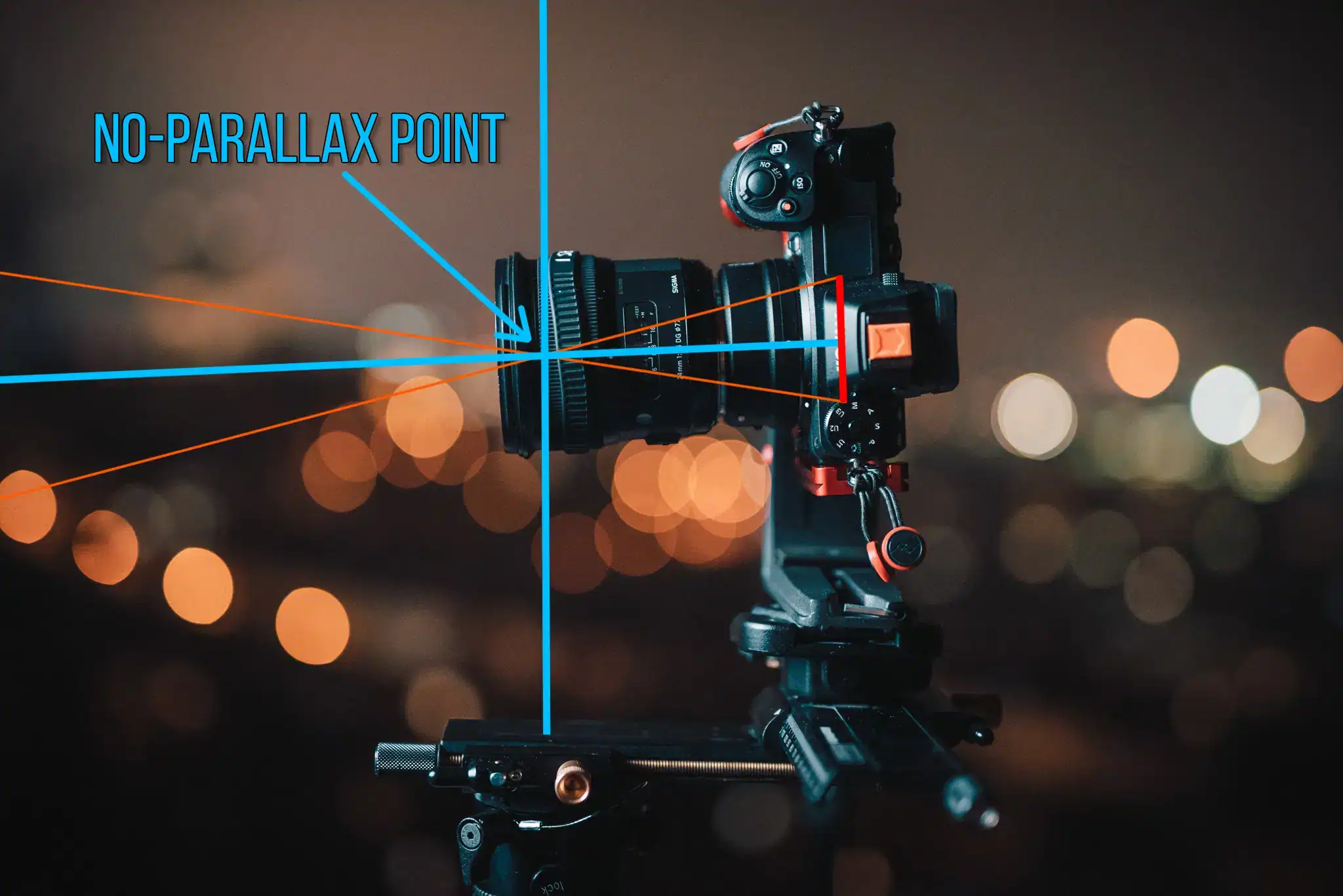
- Panoramic head: A proper pano head lets you rotate around the lens’s entrance pupil (nodal point), minimizing parallax between near/far objects. This is the single most important component after your camera and lens.
- Stable tripod with leveling base: A leveling base speeds setup and keeps your rotation plane true, which simplifies stitching and horizon leveling.
- Remote trigger or SnapBridge app: Trigger without touching the camera. Even with the Z9’s electronic shutter, physical contact can nudge alignment, especially on lighter tripods.
Optional Add-ons
- Pole or car mount: For elevated or car-top captures, use a rigid pole and guy lines. Add a safety tether. Avoid high winds; vibration destroys stitch alignment.
- Lighting aids: Small LEDs can help brighten shadowy interiors. Avoid mixed color temperatures, or gel lights to match ambient.
- Weather protection: A rain cover and microfiber cloth for the fisheye dome are essential in drizzle, sea spray, or snowfall.
For a deeper dive into setting up a panoramic head, see this practical overview. Read the panoramic head setup tutorial
Video: Panoramic Head Setup Basics
Visual learners can benefit from a quick demonstration before heading out to shoot.
Step-by-Step Shooting Guide
Standard Static Scenes
- Level and align nodal point: Level the tripod, then set your pano head so the rotation is perfectly horizontal. Adjust fore-aft and left-right rails until near/far objects don’t shift relative to each other when you yaw the camera. Mark the final positions on the rails for the Z9 + 7Artisans 10mm for repeatability.
- Manual exposure and WB: Set the Z9 to M mode. Meter for the brightest area you must preserve (often windows/sky), expose to protect highlights, and lock settings. Fix white balance (e.g., Daylight or custom Kelvin like 5600K). Avoid Auto WB or Auto ISO—consistency beats convenience for stitching.
- Focus once, then lock: Since the lens is manual focus, use magnified live view and peaking. At f/8, set near hyperfocal (~0.5 m) to keep everything from roughly 0.25 m to infinity acceptably sharp.
- Capture order: For the 10mm fisheye, shoot 6 around at 60° increments at 0° tilt. Add a zenith shot by tilting up ~60–90°, and a nadir by tilting down. Use a consistent rotation order (e.g., clockwise) to keep your workflow predictable.
- Nadir capture: For a clean floor, take an extra nadir with the tripod moved slightly and the camera held over the tripod position on a boom or offset plate to make later patching easy.
HDR / High Dynamic Range Interiors
- Bracketing: Use AEB at ±2 EV (3 or 5 frames if needed). The Z9 handles bracket sequences quickly with the electronic shutter.
- Lock WB: Keep a fixed Kelvin value across brackets to avoid seam-toned shifts.
- ISO and aperture: For real estate, f/8, ISO 100–200 is ideal; let shutter speed lengthen on a solid tripod. If people move through the frame, consider ISO 400 to tighten shutter speed.
- Workflow: Either pre-merge each bracket set to 32-bit HDR before stitching or let PTGui/Hugin handle exposure fusion after stitching. Test both—some interiors benefit from pre-merged consistency.
Low-Light / Night Scenes
- Exposure: Use f/4–f/5.6, ISO 400–800 (up to 1600 if necessary) with 1/10–1/30s on a tripod. Turn off IBIS (Vibration Reduction) to prevent micro-drift on tripod.
- Remote triggering: Use a remote or the self-timer to avoid shake. Enable exposure delay if you’re on a lighter tripod.
- Flare control: Shield the fisheye from direct streetlights; a hand or flag just outside the frame can help. Shoot a second frame for that position without the flag and blend if needed.
Crowded Events
- Two-pass strategy: First pass quickly with 6 around; second pass wait for gaps or better positioning of people. You’ll mask later between passes to remove duplicates.
- Higher overlap: If the crowd is dense, add frames (e.g., 8 around at 45° yaw) to give the stitcher more choices.
- Shutter speed: Aim for 1/125–1/250s at f/5.6–f/8 and ISO 400–800 to freeze moderate motion.
Special Setups (Pole / Car / Drone)
- Pole work: Use a rigid pole and guy lines. Keep shutter speeds faster (1/250s+) and overlap higher (8 around) to survive micro-movements.
- Car mounts: Drive slowly in safe, controlled environments; consider multi-pass stops rather than rolling capture to avoid motion blur and parallax shifts.
- Safety and legality: Always tether gear. Mind local regulations for vehicle or aerial capture.
Recommended Settings & Pro Tips
Exposure & Focus
| Scenario | Aperture | Shutter | ISO | Notes |
|---|---|---|---|---|
| Daylight outdoor | f/8–f/11 | 1/100–1/250 | 64–200 | Lock WB (Daylight or 5600K); protect highlights |
| Low light/night | f/4–f/5.6 | 1/10–1/60 | 400–800 (1600 max) | Tripod + remote; turn off IBIS on tripod |
| Interior HDR | f/8 | Bracket ±2 EV | 100–400 | Balance windows vs lamps; keep WB fixed |
| Action / crowds | f/5.6–f/8 | 1/200+ | 400–800 | Two-pass shooting; mask in post |
Critical Tips
- Manual focus at hyperfocal: At 10mm and f/8, focus around ~0.5 m to keep near-to-far sharp.
- Nodal calibration: For fisheyes, the entrance pupil sits closer to the front element. Use a near/far object test, yaw the camera, and adjust rails until relative motion vanishes. Mark your rail positions.
- White balance lock: Avoid Auto WB. Choose a Kelvin value or custom preset to prevent stitched seams from differing hues.
- RAW capture: Shoot 14-bit RAW to leverage the Z9’s dynamic range, especially at ISO 64–200. It gives you headroom for shadow recovery and color grading.
- IBIS/Vibration Reduction: On tripod, turn VR off. Handheld scouting or pole work can benefit from VR on.
- Lens handling: The 7Artisans’ dome is exposed; always use a cap when moving, and avoid touching or laying it down facing surfaces.
Stitching & Post-Processing
Software Workflow
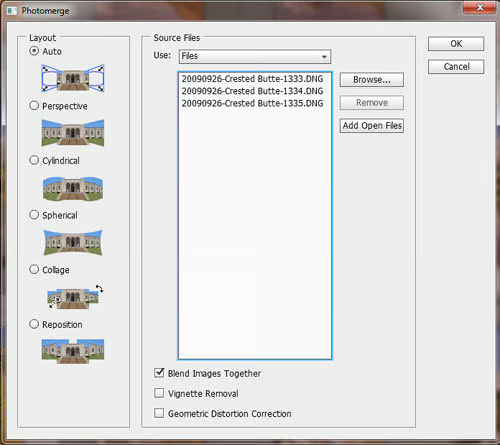
Import RAWs to Lightroom/Camera Raw, apply a neutral profile, and synchronize exposure/WB across the set. Then stitch in PTGui or Hugin. With a fisheye, mark your lens type as “Full-Frame Fisheye” 10mm, and let the optimizer refine lens parameters. Industry overlap recommendations: ~25–35% for fisheye, ~20–25% for rectilinear. For this lens, 6-around + Z/N provides robust control points and minimal seam stress. PTGui’s control point generator is excellent; Hugin is free and very capable if you’re comfortable with manual control point editing.
For large projects or commercial tours, PTGui’s template workflow and masking tools are a time-saver. Many pros consider PTGui a reference tool for spherical work. Why PTGui is favored for complex panoramas
Cleanup & Enhancement
- Nadir patch: Export a layered output or use a tripod removal workflow (content-aware fill, AI patchers, or manual clone). Many virtual tour pros keep a branded floor patch ready.
- Color and noise: Harmonize color temperature if mixed lighting slipped through; apply targeted noise reduction to shadows for night scenes.
- Leveling: Use the panorama editor to set horizon and correct roll/yaw/pitch. Auto horizon can get you close; refine manually for architectural accuracy.
- Export formats: For VR platforms, export 8K–12K equirectangular JPEGs or TIFFs depending on your delivery needs.
If you’re new to 360 outputs for VR, the Oculus/Meta creator guidelines are a concise reference. Read DSLR/mirrorless 360 photo guidance
Note: Always consult the latest documentation for your software; features evolve and can streamline your workflow substantially.
Useful Tools & Resources
Software
- PTGui panorama stitching
- Hugin (open-source stitching)
- Lightroom / Photoshop for RAW and retouching
- AI tripod removal tools (content-aware, generative fill)
Hardware
- Panoramic heads (e.g., Nodal Ninja, Leofoto, Sunwayfoto)
- Carbon fiber tripods with a leveling base
- Wireless remote shutters or camera apps
- Pole extensions / car mounts with tethers
Disclaimer: brand names are examples for search; check official specs and compatibility for your exact setup.
For a broader context on DSLR/mirrorless choices for virtual tours, this overview is a helpful read. Explore camera/lens guidelines for virtual tours
Common Mistakes & How to Avoid Them
- Parallax error: Always align the entrance pupil. If you see near/far objects shifting when you yaw, recalibrate the rails.
- Exposure flicker: Use full manual exposure and fixed WB. Avoid Auto ISO/WB between frames.
- Tripod shadows and footprint: Capture a nadir shot offset from the tripod or plan a patch in post.
- Ghosting from moving people: Shoot a second pass and mask; increase overlap to give the stitcher options.
- Night noise and blur: Keep ISO moderate (≤1600), use longer exposure on a sturdy tripod, and turn off IBIS.
- Flare on fisheye dome: Shade the lens and avoid direct intense light angles when possible.
Field-Proven Scenarios With This Combo
Indoor Real Estate
At f/8, ISO 100–200, and bracketed ±2 EV, the Z9 maintains crisp highlight detail through windows while the 10mm fisheye reduces the total shots per room. Shoot 6 around plus Z/N for dependable stitches, and keep the camera height consistent (typically 1.4–1.6 m) for a natural perspective across rooms.
Outdoor Sunset Cityscape
Expose for sky highlights at ISO 64–100, f/8, letting shadows lift in post. A single exposure per position often suffices thanks to the Z9’s dynamic range. Use a lens hood shadow or body flag to avoid direct sun striking the dome on edge frames.
Event Crowd
Use ISO 400–800 and 1/200s+ to freeze motion. Run two passes (fast/slow), then blend. With the fisheye’s few frames, you’ll have fewer moving seams to retouch.
Rooftop Pole
Elevate for a cleaner skyline with 8-around coverage to overcome micro-sway. Shorten exposures or raise ISO slightly to reduce motion blur from wind. Always tether the pole and never operate near edges without proper safety procedures.
Frequently Asked Questions
-
Can I shoot handheld panoramas with the Nikon Z9?
Yes, but expect more stitching challenges. Use higher overlap (8 around at 45° increments), faster shutter speeds (1/250s+), and enable IBIS. Handheld is fine for scouting or casual 360 photos; for professional work, use a tripod and pano head.
-
Is the 7Artisans 10mm f/2.8 II wide enough for a single-row 360?
Yes. On full-frame, 6 shots around plus a zenith and nadir is reliable. In a rush, 4 around plus Z/N can work, but it’s more sensitive to nodal alignment and may need manual control point tweaking.
-
Do I need HDR for interiors with bright windows?
Often yes. Bracket ±2 EV and either pre-merge HDR or let PTGui/Hugin exposure-fuse after stitching. The Z9’s DR helps, but bright windows generally require bracketing for the cleanest results.
-
How do I avoid parallax issues with this lens?
Calibrate the panoramic head so rotation occurs around the lens’s entrance pupil. With fisheyes, this point is close to the front element. Use near/far alignment tests and mark your rail positions for the Z9 + 10mm combo so you can repeat it precisely.
-
What ISO range is safe on the Z9 for low light panoramas?
For high-quality panos, ISO 64–200 in daylight and ISO 400–800 indoors are sweet spots. ISO 1600 remains usable when shutter speed must be higher, but try to stabilize and use longer exposures first.
-
Can I assign a custom mode for panoramas?
The Z9 lets you store shooting banks. Save a “Pano” bank with manual exposure, fixed WB, RAW, single shot, self-timer or remote, and VR off. This speeds setup and ensures consistency.
-
How can I reduce fisheye flare?
Avoid placing strong light sources near the frame edge; shade the lens with a hand/flag (shoot a clean version without the flag and blend), and keep the dome spotless. Slight reframing of individual positions can dramatically reduce artifacts.
-
Which pano head works best for this setup?
A compact, precise two-rail panoramic head (e.g., Nodal Ninja, Leofoto) with a leveling base is ideal. Ensure it supports the Z9’s weight and allows easy fore-aft/left-right entrance pupil alignment.
For additional reading on panorama technique basics and community tips, this Q&A thread is a solid reference. Best techniques to take 360 panoramas
Safety, Limitations, and Data Protection
The Z9 is rugged and weather-sealed, but always shield the 7Artisans’ dome lens in rain or dusty wind. Use wrist straps and tethers on rooftops or poles. The front element is easily scratched—never place the camera face-down. In crowds, keep a compact footprint and be mindful of trip hazards. For data, enable dual-card recording for redundancy, and back up to a laptop or SSD after each location. Keep at least one full, untouched RAW set until the final delivery is approved.