
Why This Camera & Lens Are Great for Panoramas
Learning how to shoot panorama with Nikon Z8 & Sony FE 12-24mm f/4 G gives you a pro-grade, high-resolution workflow that’s flexible indoors and outdoors. The Nikon Z8’s 45.7MP full-frame stacked BSI sensor (approx. 36×24mm, ~4.35µm pixel pitch) delivers class-leading dynamic range at base ISO 64 and robust high-ISO performance for dim interiors. Its 5-axis IBIS, precise manual controls, and excellent live view make it a joy to dial in consistent exposures and nail nodal alignment on a panoramic head.
The Sony FE 12-24mm f/4 G is a full-frame rectilinear ultra-wide zoom. At 12mm it offers an extremely wide angle of view (approx. 122° diagonal), minimizing shot count for multi-row 360° work while maintaining straight lines—a big win for architecture and real estate where fisheye distortion is undesirable. Sharpness is strong across the frame by f/5.6–f/8 with well-controlled chromatic aberration. Note that it features a bulbous front element and integrated hood (no front filter threads), which matters for flare control and protective handling.
Mount compatibility: because the lens is Sony E-mount, you’ll need an autofocus-capable adapter to use it on the Nikon Z8. Popular choices include the Megadap ETZ21 Pro or Techart TZE-01. Both support electronic aperture and AF on many Sony lenses, though performance and compatibility can vary. For panoramic work where you’ll shoot stopped-down and often manual focus, these adapters are a practical solution—just test your specific combo for corner performance and ensure tight tolerances to avoid tilt or decentering artifacts.
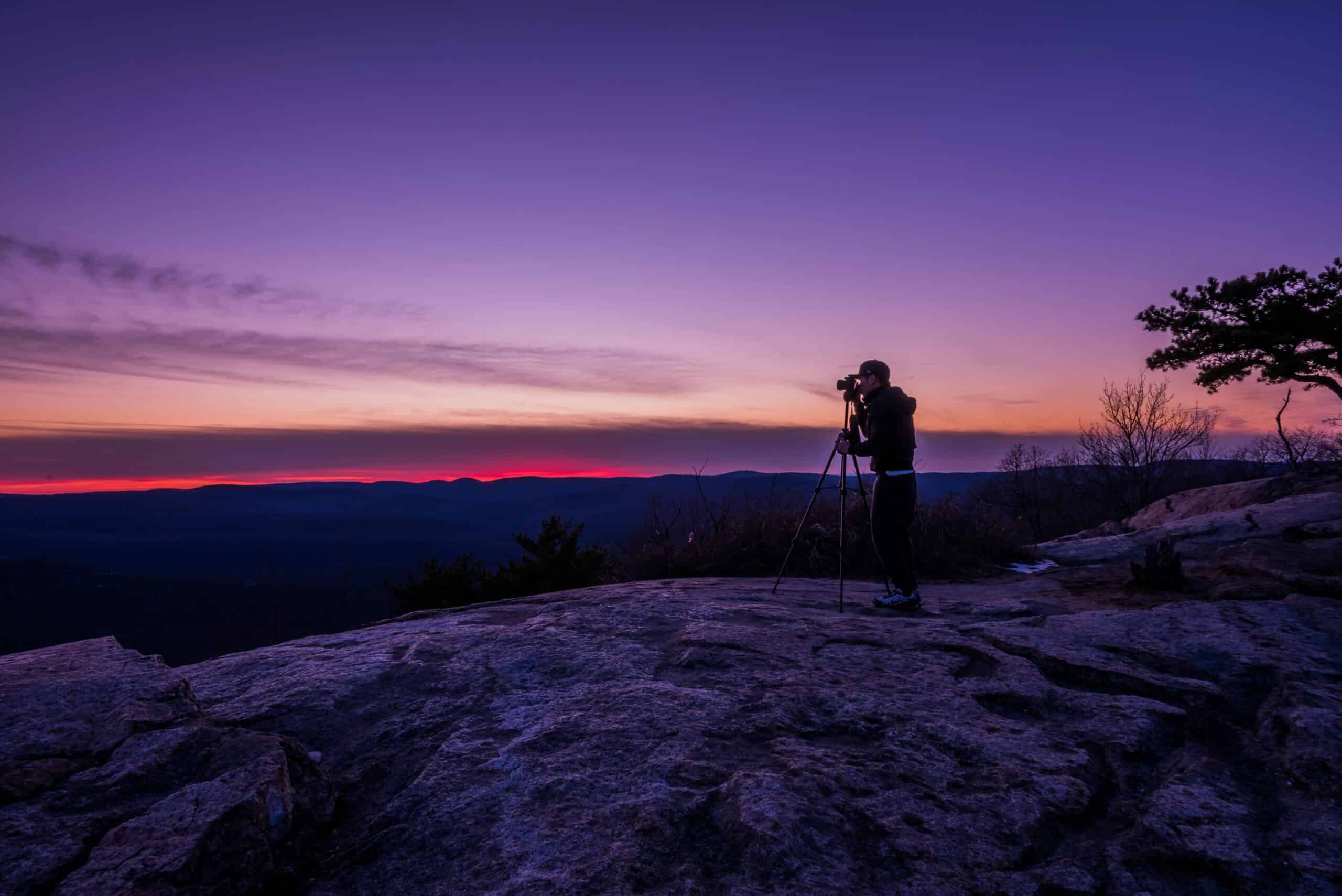
Quick Setup Overview
- Camera: Nikon Z8 — full-frame (FX) 45.7MP stacked BSI CMOS; base ISO 64; ~14+ stops DR at base; 5-axis IBIS.
- Lens: Sony FE 12-24mm f/4 G — rectilinear ultra-wide zoom, internal focus, integrated hood, strong center-to-edge sharpness by f/5.6–f/8; moderate CA well-corrected in post.
- Estimated shots & overlap (field-tested, rectilinear on full-frame):
- At 12mm: two-row 8+8 around (30–35% overlap) at approx. +30° and −30° pitch, plus zenith and nadir (≈18 shots total). For extremely detailed skies or floors, add one extra for safety.
- At 16mm: 8 around at 0° + 8 around at +45° (or −45°) + zenith/nadir (≈18 shots). Single-row is possible for cylindrical panoramas but won’t cover full 180° vertical.
- At 24mm: 12–16 around per row; plan multi-row for full spherical. Use ≥30% overlap.
- Difficulty: Intermediate. Rectilinear ultra-wide requires good nodal alignment and disciplined overlap, but stitching is highly predictable for architecture.
Planning & On-Site Preparation
Evaluate Shooting Environment
Scan for moving people, rippling foliage, traffic, and reflective surfaces (glass, polished stone, glossy wood). Ultra-wides can catch stray light—shield the lens from strong backlight and flare sources. If shooting through windows, keep the front element at least 5–10 cm away and shoot as perpendicular as possible to reduce ghosting; turn off room lights to avoid double reflections. In tight interiors, note that rectilinear lenses stretch corners—keep strong lines away from the extreme periphery when possible.
Match Gear to Scene Goals
The Z8’s base ISO 64 and broad dynamic range make it terrific for high-contrast scenes like sunset cityscapes or interiors with bright windows—perfect for an HDR panorama. Its AF is overkill for static tripod work, but convenient; you’ll typically switch to manual focus once composed. The Sony 12-24mm f/4 G, being rectilinear, preserves straight lines (ideal for real estate), though it needs more shots than a fisheye to cover a full sphere. For indoor daylight, ISO 100–400 is typically “clean.” Outdoors at sunset, ISO 64–200 preserves maximum highlight detail. At night, ISO 800–1600 on the Z8 remains very usable with tripod support.
Pre-shoot Checklist
- Charge batteries and carry spares; high-res bracketed panoramas consume power. Bring ample, fast storage (UHS-II/CFexpress).
- Clean the lens and sensor; ultra-wide rectilinears make dust and flare more obvious.
- Level the tripod; calibrate your panoramic head to the no-parallax point for this lens and adapter.
- Safety checks: for rooftops, poles, or car mounts, tether the camera, confirm wind conditions, and secure loose straps.
- Backup workflow: shoot a second safety pass, especially for client work or changing light.
Real-World Scenarios
- Indoor real estate: 12–16mm range works best to keep lines straight; bracket ±2 EV to tame windows; ISO 100–200; f/8; 2-row capture for full ceilings and floors.
- Outdoor sunset: base ISO 64–100; f/8; manual WB; consider a two-pass capture—one close to sunset, one shortly after—for easier sky blending.
- Crowded events: shoot two quick rotations; one faster for ambient context, a second waiting for gaps to minimize ghosting. Mask in post.
- Rooftop or pole shooting: IBIS ON can help micro-vibrations on a pole; use higher shutter speeds (1/200+). Tether and keep a safety lanyard attached.
Essential Gear & Setup
Core Gear
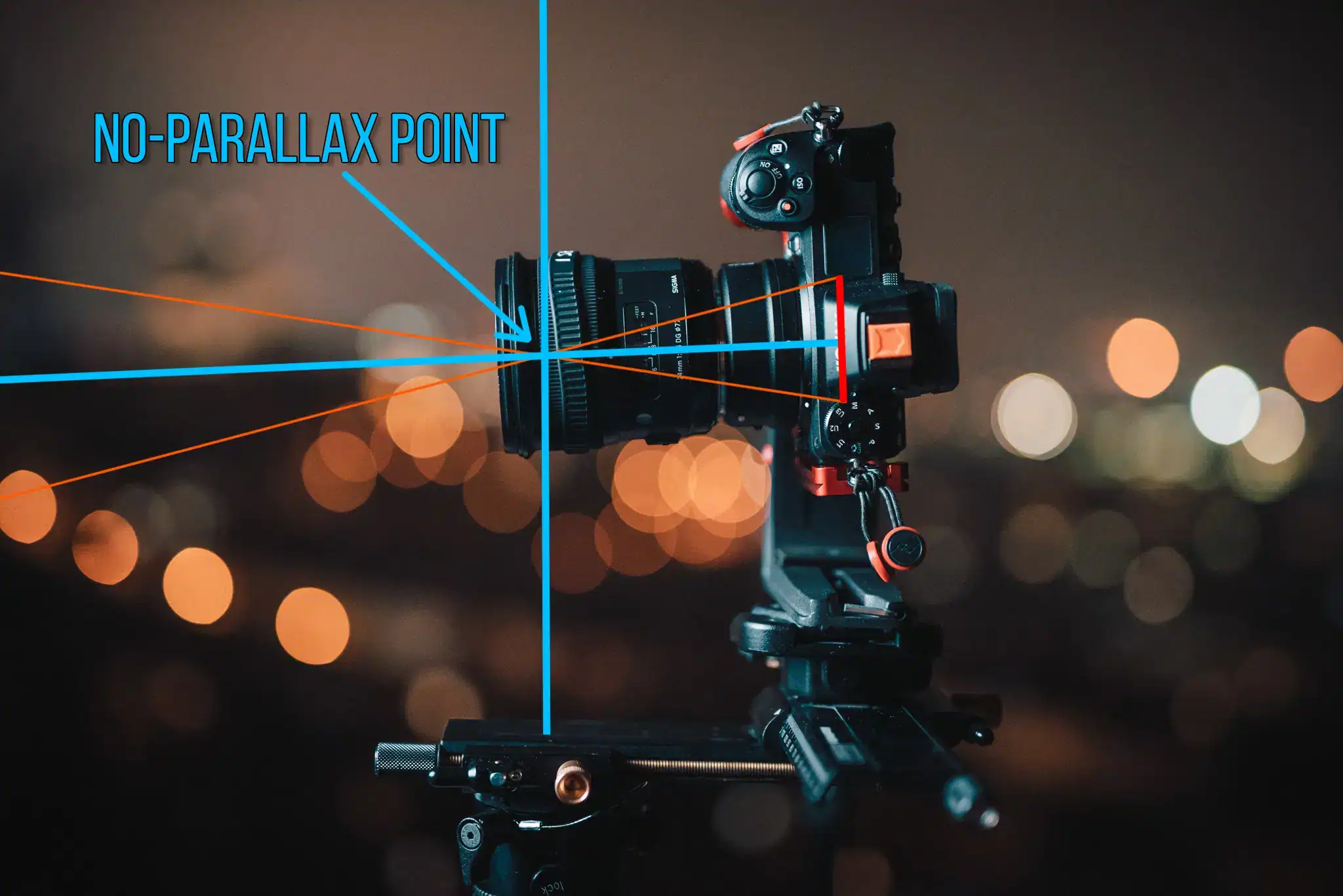
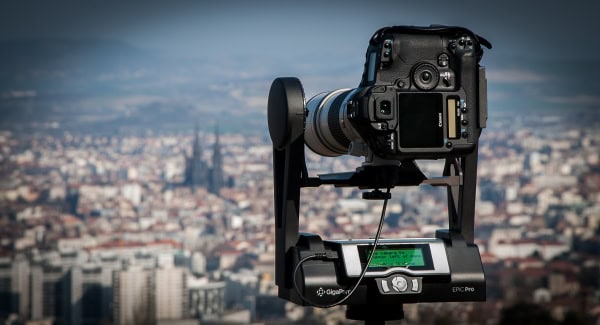
- Panoramic head: Allows you to rotate around the lens’s entrance pupil (nodal point) to eliminate parallax between near and far subjects. Mark your fore-aft and vertical rail positions for 12mm and 16mm; record them for quick setup.
- Stable tripod with leveling base: A leveling base speeds up setup and keeps rows aligned across rotations.
- Remote trigger or app: Use SnapBridge or a wired remote to avoid vibration and keep your hands off the camera during long exposures.
Optional Add-ons
- Pole or car mount: Always tether the camera. Monitor wind and vibration; avoid overextending poles in gusty conditions.
- Lighting aids: Small LED panels or bounced speedlights for low-light interiors (ensure consistent WB across frames).
- Weather protection: Rain covers, microfiber cloths, lens hood shading; the 12-24’s front element needs extra care.
Further reading on panoramic head setup and best practices can accelerate your learning curve. See this practical panoramic head guide for a foundational overview. Panoramic head tutorial (360Rumors)
Step-by-Step Shooting Guide
Standard Static Scenes
- Level tripod & align the nodal point: On your pano head, slide the camera forward/back until nearby and distant objects remain aligned when panning. With the Z8 + adapter + 12-24mm at 12mm, expect the entrance pupil to sit slightly behind the front element; note your exact rail marks for repeatability.
- Manual exposure & white balance: Set M mode, fix ISO, aperture, and shutter. For daylight, try ISO 64–100, f/8, 1/100–1/250. Lock WB (Daylight/Cloudy or custom Kelvin). This prevents exposure flicker and color shifts between frames.
- Capture sequence with reliable overlap: At 12mm, use two rows of 8 shots each at ±30° pitch with 45° yaw increments (≈30–35% overlap). Then add a zenith shot (~+90°) and a nadir shot (~−90°). Rotate consistently and keep horizon centered for the zero-pitch row.
- Nadir shot for tripod removal: After the main sequence, tilt down and shoot the floor. If possible, move the tripod slightly and shoot a handheld clean plate for an easier patch.
HDR / High Dynamic Range Interiors
- Bracket ±2 EV: Use AEB to capture 3–5 exposures per view (e.g., −2/0/+2 EV). The Z8’s electronic shutter is silent and avoids vibrations; just ensure flicker reduction if under LED lighting.
- Lock white balance and focus: Any shift across brackets will complicate stitching and tonemapping. Consider “High Frequency Flicker Reduction” on the Z8 to avoid banding with certain LEDs.
Low-Light / Night Scenes
- Use longer exposures and keep ISO moderate: Start at f/4–f/5.6, 1/30–1/60, ISO 400–800. The Z8 handles 800–1600 well; favor longer shutter before raising ISO too high.
- Remote trigger and IBIS off on a locked tripod: Turn IBIS off on solid tripod shots to avoid sensor micro-corrections. If on a pole or in light wind where micro-vibrations occur, IBIS ON can help.
Crowded Events
- Two-pass capture: First rotation for coverage, second rotation when people clear key areas. Record more overlap (35–40%) to give the stitcher room to mask movement.
- Masking later: Use PTGui’s masking to choose which people remain. A little patience on location saves hours in post.
Special Setups (Pole / Car / Drone)
- Secure gear and tether: On poles or car rigs, use safety lines and check fasteners twice. Balance the setup to reduce oscillation.
- Compensate for vibration: Raise shutter speed (1/200–1/500), increase ISO if needed (800–1600 on Z8 is very usable), and rotate slower between frames to let vibrations settle.
Recommended Settings & Pro Tips
Exposure & Focus
| Scenario | Aperture | Shutter | ISO | Notes |
|---|---|---|---|---|
| Daylight outdoor | f/8–f/11 | 1/100–1/250 | 64–200 | Lock WB (Daylight/Cloudy); maximize DR at ISO 64 |
| Low light/night | f/4–f/5.6 | 1/30–1/60 | 400–800 | Tripod & remote; if needed ISO 1600 remains clean on Z8 |
| Interior HDR | f/8 | Bracket ±2 EV | 100–400 | Balance windows & lamps; fix WB and focus |
| Action / moving subjects | f/5.6–f/8 | 1/200+ | 400–800 | Freeze motion; consider two-pass capture |
Critical Tips
- Manual focus at hyperfocal: At 12mm f/8 on full frame, hyperfocal distance is roughly ~0.6 m; focus there to keep 0.3 m to infinity sharp.
- Nodal point calibration: Place a near object against a far object; pan left/right and adjust the fore-aft rail until their relative position doesn’t shift. Mark positions for 12, 16, and 24mm.
- White balance lock: Avoid Auto WB when shooting multi-image panoramas; mixed lighting can shift hue frame to frame.
- RAW workflow: Shoot 14-bit RAW to preserve highlight detail, especially at ISO 64–100. This helps when merging HDR or balancing tricky interior lighting.
- IBIS usage: Off on a rock-solid tripod; ON for pole or vehicle-mounted captures where micro-vibrations exist.
Stitching & Post-Processing
Software Workflow
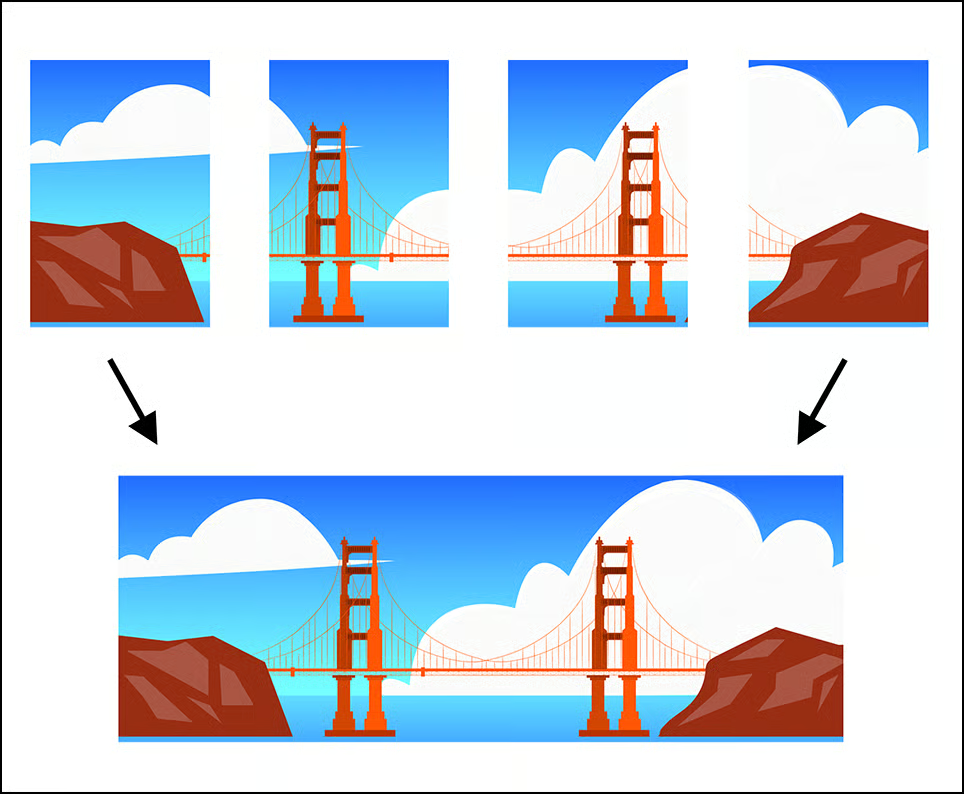
For rectilinear ultra-wide panoramas, PTGui is a benchmark tool thanks to its control point editor, masking, and HDR merging. Hugin is a capable open-source alternative. Lightroom/Photoshop can work for simpler, single-row stitches, but for multi-row 360 photos, PTGui/Hugin are preferred. Industry guidance suggests 20–25% overlap for rectilinear lenses and 25–30% for fisheye—when in doubt, add a bit more overlap for robust control point generation. Why PTGui is favored for complex panoramas (Fstoppers review)
Cleanup & Enhancement
- Tripod/nadir patch: Patch with a clean plate or use AI fill after exporting. Many virtual tour platforms include nadir patch tools.
- Color and noise: Balance exposure across frames, apply lens profiles, and use careful noise reduction (Z8 files tolerate moderate NR well).
- Level & straighten: Use “straighten horizon” tools and adjust yaw/pitch/roll until verticals are true and horizons level.
- Export: For VR, export a 2:1 equirectangular JPEG/TIFF at the highest needed resolution. The Z8’s 45.7MP, when multiplied across 16–24 frames, can reach multi-hundred-megapixel outputs—great for zoomable tours. For more on spherical resolution math, see the PanoTools wiki. Understanding spherical resolution (PanoTools)
Want a step-by-step primer on setting up a panoramic head and capturing pro-grade 360s? This guide from Meta’s Creator resources covers fundamentals for DSLR/mirrorless workflows. Set up a panoramic head for high-end 360 photos
Useful Tools & Resources
Software
- PTGui panorama stitching
- Hugin (open source)
- Lightroom / Photoshop for RAW and finishing
- AI tools for tripod/nadir removal
Hardware
- Panoramic heads (e.g., Nodal Ninja, Leofoto)
- Carbon fiber tripods and leveling bases
- Wireless remote shutters
- Pole extensions / vehicle mounts with safety tethers
Disclaimer: software/hardware names are for reference; verify compatibility and current documentation.
Common Mistakes & How to Avoid Them
- Parallax error: Always align to the lens’s entrance pupil; recheck after zoom changes.
- Exposure flicker: Use full manual mode and a locked white balance.
- Tripod shadows or missing floor: Capture a dedicated nadir frame or bring a clean plate.
- Ghosting from movement: Increase overlap and use masking in the stitcher.
- Night noise: Keep ISO moderate and extend shutter with a stable mount.
- Adapter oversight: Verify your E-to-Z adapter fit; play-free mounting prevents tilted planes or decentering that complicate stitching.
Frequently Asked Questions
- Can I shoot handheld panoramas with the Nikon Z8?
Yes, for simple single-row sweeps outdoors, handheld is possible. Use higher shutter speeds (1/200+), IBIS ON, and generous overlap (40%+). For full 360×180 coverage and interior work, a tripod and panoramic head dramatically improve stitch quality and alignment.
- Is the Sony FE 12-24mm f/4 G wide enough for a single-row 360?
For a full spherical 360×180, a single row at 12mm will not cover zenith and nadir completely. Plan on two rows (e.g., +30° and −30°) plus dedicated zenith and nadir shots. For cylindrical panoramas (no top/bottom), a single row can work.
- Do I need HDR for interiors with bright windows?
Often yes. Bracket ±2 EV (3–5 frames) to capture both window highlights and interior shadows. Merge to HDR in PTGui or pre-merge in Lightroom, then stitch. The Z8’s base ISO 64 and high DR help, but extreme scenes still benefit from bracketing.
- How do I avoid parallax issues with this setup?
Use a calibrated panoramic head and rotate around the entrance pupil. For the 12-24mm, mark rail positions at 12mm and 16mm since the entrance pupil shifts with focal length. Recheck alignment anytime you change zoom or add filters/adapters.
- What ISO range is safe on the Z8 in low light?
For tripod-based panoramas, target ISO 64–400 whenever possible. At night, ISO 800–1600 remains very usable; allow longer exposures rather than pushing beyond ISO 1600 unless needed for wind or vibration control.
- Can I store pano settings on the Z8 for speed?
Yes. Use the Z8’s custom user settings (U1/U2/U3) to store manual exposure, manual focus, IBIS off (tripod), fixed WB, and your preferred drive/bracketing settings. This reduces setup time on location.
- Will the E-to-Z adapter affect image quality?
A quality adapter (Megadap ETZ21 Pro or Techart TZE-01) should maintain optical integrity. Ensure secure, play-free mounting. Check corners at your working apertures; stop to f/8 for best uniformity. For panoramas, minor AF speed differences are irrelevant since you’ll often shoot manual focus.
- What’s the best panoramic head for this combo?
Choose a head with fore-aft and vertical adjustments, rigid clamps, and clear degree markings (e.g., Nodal Ninja, Leofoto). A leveling base saves time. For multi-row 360s with a rectilinear lens, a gimbal-style or two-rail head is ideal.
For a concise, high-quality walkthrough on DSLR/mirrorless 360 photos and stitching approaches, this guide is worth a read. Using a DSLR or mirrorless camera to shoot and stitch a 360 photo
Safety, Limitations & Honest Advice
Bulbous-front lenses like the 12-24mm f/4 G are vulnerable: always use the integrated hood as protection, keep the cap on until you’re ready, and avoid dusty or sandy rotations that could scratch the element. On rooftops and poles, tether everything—including your remote—to avoid dropped gear. The Z8’s electronic shutter can show banding under certain LED lighting frequencies; test flicker reduction options and consider longer exposures to average fluctuations. Finally, because this is an adapted lens, always test your adapter and lens on your specific pano head for tilt/shift consistency before critical shoots.