Why This Camera & Lens Are Great for Panoramas
If you want a practical, field-tested guide on how to shoot panorama with Nikon Z7 II & AstrHori 12mm f/2.8 Fisheye, you’re in the right place. This combo is a powerhouse for 360° photography: the Z7 II’s 45.7MP full-frame BSI sensor (36×24 mm) delivers huge detail, excellent dynamic range at base ISO (roughly 14+ stops around ISO 64), and clean files up through ISO 1600 with careful exposure. The AstrHori 12mm f/2.8 is a compact, manual-focus, full-frame fisheye that covers an extremely wide diagonal field of view (fisheye projection) to minimize the number of shots for a full sphere—ideal for fast, consistent stitching.
The Z7 II’s 5-axis in-body stabilization (IBIS) helps on handheld or pole work; dual card slots add reliability. Its precise manual focus aids and magnified live view make it easy to nail hyperfocal focus with a fisheye. The AstrHori 12mm’s strengths are simplicity, speed (f/2.8 for darker environments), and a big field of view, while the trade-offs are typical of fisheyes: strong distortion (expected and handled in stitching) and some lateral CA that improves when stopped to f/5.6–f/8. With a calibrated panoramic head, this kit is capable of professional-level 360 photos and virtual tours indoors and out.
Quick Setup Overview
- Camera: Nikon Z7 II — Full-frame (FX) 36×24 mm, 45.7MP, base ISO 64, dual slots (CFexpress/XQD + UHS-II SD), 5-axis IBIS.
- Lens: AstrHori 12mm f/2.8 Fisheye — manual focus, full-frame fisheye projection, very wide diagonal FOV; sharpest around f/5.6–f/8; moderate CA wide open.
- Estimated shots & overlap (tested): 6 shots around at 60° yaw increments + 1 zenith + 1 nadir for safe coverage; experienced users can sometimes get away with 4 around + zenith/nadir outdoors with clean skies. Aim for 30–35% overlap.
- Difficulty: Easy–Moderate (easy if you use a panoramic head and lock exposure/white balance; moderate if working with crowds or on a pole).
Planning & On-Site Preparation
Evaluate Shooting Environment
Before you extend legs on the tripod, scan for moving subjects (people, cars, leaves), reflective surfaces (glass, polished floors), and light sources that can flare a fisheye. If shooting through glass, keep the front element as close as safely possible (1–3 cm) to reduce reflections and ghosting. Note any strong backlight (sun or spotlights) and plan your rotation so you capture those frames last to limit flare contaminating adjacent shots.
Match Gear to Scene Goals
The Z7 II’s dynamic range and low base ISO let you hold sky highlights while lifting shadows later. Indoors, ISO 400–800 is typically safe; ISO 1600 is still clean with basic noise reduction if you expose carefully. The AstrHori 12mm fisheye minimizes the total number of shots (great for crowds or wind) but introduces characteristic fisheye distortion—which is exactly what stitching software expects from a fisheye lens profile.
Pre-shoot Checklist
- Charge batteries, format fast cards; carry spares. Clean front element and sensor (dust shows up on skies and flat walls).
- Level tripod; verify panoramic head rails and camera plate are tight; confirm nodal (no-parallax) alignment for this camera/lens.
- Safety: On rooftops or windy locations, add a weight bag, keep a tether to railing/anchor, and never leave a pole unattended.
- Backup workflow: Shoot a spare full rotation—especially if people or vehicles are moving—so you have extra frames to mask later.
Essential Gear & Setup
Core Gear
- Panoramic head: A rotator with click-stops and fore-aft and left-right rails to place the lens’s entrance pupil on the rotation axis. Proper nodal alignment eliminates parallax so edges stitch cleanly.
- Stable tripod with leveling base: A leveling base is faster and more precise than adjusting tripod legs at each site.
- Remote trigger or SnapBridge app: Prevent vibration; on the Z7 II, consider Exposure Delay mode as well.
Want a deeper dive into panoramic head setup and alignment? See this practitioner-focused panoramic head tutorial for additional diagrams and methods. Comprehensive panoramic head setup tutorial
Optional Add-ons
- Pole or car mount: Use a safety tether. For pole shots, keep exposures short (1/200 s or faster) and be mindful of wind-induced sway.
- Lighting aids: Small LED panels or bounced flash help interiors with dark corners; keep lighting consistent across frames.
- Weather protection: Rain covers and lens hoods/shades can reduce flare and protect in drizzle or blowing sand.
Step-by-Step Shooting Guide
Standard Static Scenes
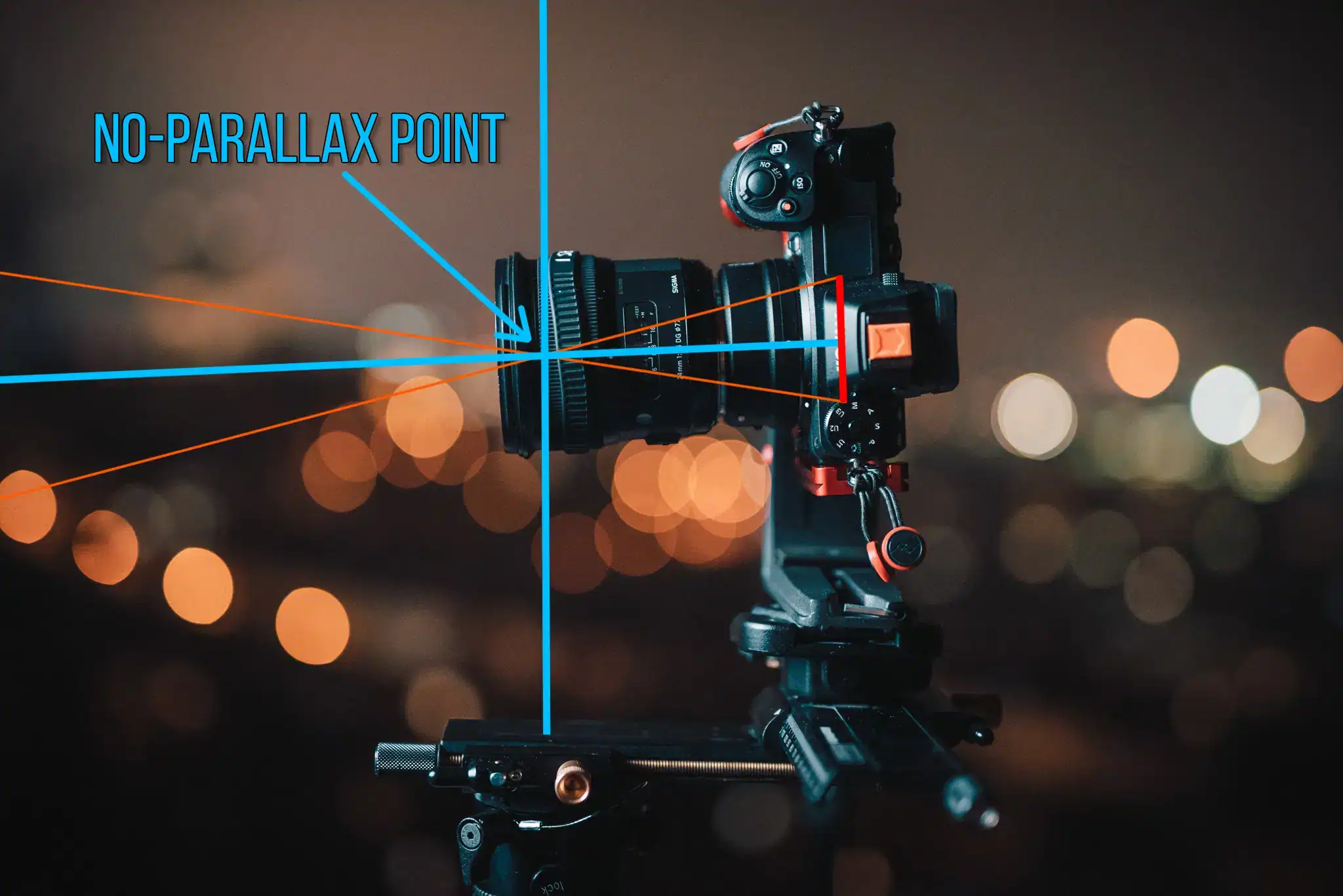
- Level the tripod and align the nodal point. Center the lens’s entrance pupil over the rotator’s axis. Start with a rough offset (for many 12mm fisheyes this is often several centimeters forward of the camera mount) and fine-tune using two nearby vertical objects (one close, one distant) while panning. Adjust until there’s no relative shift between them.
- Set manual exposure and lock white balance. On the Z7 II, switch to M mode; pick a fixed WB (Daylight, Cloudy, or a custom Kelvin). Consistent exposure and WB across frames make stitching seamless.
- Focus: Use manual focus with magnified live view. For a 12mm on full frame, at f/8, hyperfocal distance is around 0.6–0.7 m; set focus just beyond this to keep everything from roughly 0.3 m to infinity acceptably sharp.
- Capture with overlap: With the AstrHori 12mm, shoot 6 around at 60° increments (tilt 0°). Add a zenith (tilt +60° to +90°, depending on your head) and a nadir (tilt −60° to −90°, or shoot a handheld nadir for tripod removal).
- Use exposure delay or a remote. Enable Exposure Delay Mode (e.g., 0.2–1 s) or use a 2 s self-timer. For tripod work, turn IBIS (Vibration Reduction) OFF to prevent corrective drift.
HDR / High Dynamic Range Interiors
- Bracket exposures: 3 frames at ±2 EV usually balances bright windows and interior shadows. The Z7 II supports up to 9-shot bracketing; for most interiors, 3–5 shots are plenty.
- Keep WB fixed and shoot the entire rotation for the 0 EV exposure first if you want to minimize motion artifacts, then repeat for +2 and −2 EV passes. Alternatively, bracket each angle in sequence if the scene is static.
- Watch for ghosting: If curtains or foliage move between brackets, capture an extra “clean” frame to mask later.
Low-Light / Night Scenes
- Use a tripod, remote, and Exposure Delay. Start around f/4–f/5.6, 1/30–1/60 s, ISO 400–800. The Z7 II is clean at ISO 800–1600; ISO 3200 is usable with good exposure and moderate noise reduction.
- Turn VR (IBIS) OFF on a tripod; it can introduce micro-blur during long exposures. Consider EFCS (Electronic Front-Curtain Shutter) to reduce shutter shock.
- Check for star trailing if doing astrophotography—shorten shutter speeds accordingly and consider stacking later.
Crowded Events
- Shoot two passes: First a quick reference round, then a deliberate pass waiting for gaps. This provides clean patches for masking people who walked through seams.
- Use faster shutter speeds (1/200 s or faster) and slightly higher ISO (800–1600) to freeze motion. You can denoise in post; you can’t fix motion blur easily.
Special Setups (Pole / Car / Drone)
- Pole work: Use a lightweight rotator; tether the pole; keep shutter speeds high (≥1/250 s) and consider turning VR ON for handheld/pole to mitigate micro-shake.
- Car mount: Use strong suction mounts, safety cables, and very fast shutter speeds (1/1000 s+). Avoid traffic and shake. Plan the route and shoot multiple rotations to ensure usable frames.
- Drone: If you’re adapting the Z7 II (hefty), verify payload and local regulations. Typically, a smaller camera is better suited for drones; otherwise, use ground-based pole techniques for elevation.
Recommended watch: A clear, step-by-step walkthrough to reinforce panoramic shooting fundamentals.
Recommended Settings & Pro Tips
Exposure & Focus
| Scenario | Aperture | Shutter | ISO | Notes |
|---|---|---|---|---|
| Daylight outdoor | f/8–f/11 | 1/100–1/250 | ISO 64–200 | Lock WB (Daylight); aim for 30–35% overlap |
| Low light / night | f/4–f/5.6 | 1/30–1/60 | ISO 400–800 (up to 1600 if needed) | Tripod, remote, VR OFF; consider EFCS |
| Interior HDR | f/8 | Bracket ±2 EV | ISO 64–400 | Balance windows and lamps; keep WB fixed |
| Action / public events | f/5.6–f/8 | 1/200+ | ISO 400–1600 | Freeze motion; shoot two passes for masking |
Critical Tips
- Manual focus at hyperfocal: For 12mm, f/8 puts hyperfocal around 0.6–0.7 m. Mark your focus ring for speed.
- Nodal calibration: Slide the camera forward/back on the rail while panning past a near object and a far object. Adjust until there’s no relative shift. Tape a reference mark on your rail for the AstrHori 12mm once dialed in.
- White balance lock: Avoid Auto WB to prevent color shifts across frames, especially under mixed lighting.
- RAW over JPEG: The Z7 II’s 14-bit RAW files carry headroom for highlights and shadow recovery—vital for HDR panoramas.
- IBIS/VR: Off on tripod; On when handholding or using a pole. Also consider Exposure Delay Mode or a 2 s self-timer to reduce vibrations.
Stitching & Post-Processing
Software Workflow
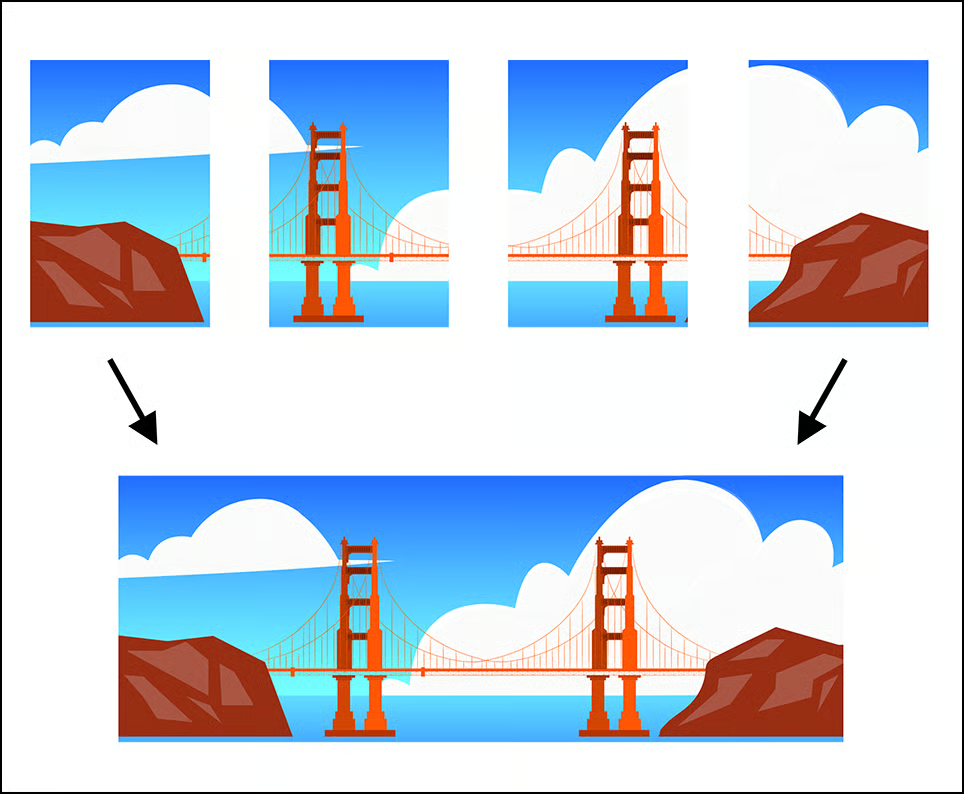
Import RAWs into Lightroom or your preferred converter. Apply identical basic settings to the whole set (lens profile off if not recognized; we’ll handle lens type in the stitcher). Export 16-bit TIFFs for best quality, then stitch in PTGui or Hugin. For fisheyes, select lens type “Full-Frame Fisheye” and let the optimizer refine parameters. With a 12mm fisheye you can work with fewer images than rectilinear lenses, and modern stitchers handle the projection natively. Industry overlap guidelines: about 25–35% for fisheye and 20–25% for rectilinear. PTGui’s control point generator and “Viewpoint” correction are excellent for difficult nadir/zenith patches. For an overview of why many pros choose PTGui, see this practical review. Why PTGui is often the fastest path to clean stitches
Cleanup & Enhancement
- Tripod/nadir patch: Shoot a handheld nadir or use viewpoint correction and clone tools. AI content-aware fill works well on uniform floors.
- Color balance: Fix any mixed lighting. Apply noise reduction sparingly—Z7 II files tolerate moderate NR without smearing detail.
- Level horizon: In equirectangular view, adjust roll/yaw/pitch until verticals are straight and the horizon is flat.
- Export: For web/VR, export equirectangular JPEG at 8–16k width depending on platform limits; keep a 16-bit master TIFF archived.
If you’re new to end-to-end 360 workflows with mirrorless/DSLR, this short guide from Meta’s Creator resources is a straightforward reference. Complete DSLR/mirrorless 360 photo overview
Useful Tools & Resources
Software
- PTGui for fast, robust stitching, viewpoint correction, and masking.
- Hugin (open source) for cost-free stitching with advanced controls.
- Lightroom / Photoshop for RAW processing and retouching.
- AI tools (content-aware fill) for tripod/nadir cleanup.
Hardware
- Panoramic heads: Nodal Ninja, Leofoto, or equivalent multi-row heads.
- Carbon fiber tripod with a leveling base for speed and stability.
- Wireless remote shutters or phone app (Nikon SnapBridge).
- Pole extensions and vehicle mounts with safety tethers.
Disclaimer: product and brand names are for reference; always confirm compatibility and current specs with the manufacturer.
Common Mistakes & How to Avoid Them
- Parallax error: Always align the entrance pupil over the rotation axis; re-check after transport or lens changes.
- Exposure/WB flicker: Use manual exposure and fixed white balance—never auto modes for panoramas.
- Tripod shadows or reflections: Capture a dedicated nadir, then patch or clone. In reflective floors, take extra clean plates.
- Ghosting from motion: Shoot multiple passes and mask moving subjects in post.
- High ISO noise: Keep ISO as low as practical; use a sturdy tripod and longer exposures where possible.
- VR/IBIS on tripod: Turn it OFF to avoid micro-blur and drifting during long exposures.
Field Case Studies
Indoor Real Estate (Bright Windows)
Place the tripod about 1.35–1.6 m high to keep verticals natural. Lock exposure based on a mid-tone interior; bracket ±2 EV. Shoot 6 around + zenith + nadir. In PTGui, blend the brackets (either HDR merge first or let PTGui’s exposure fusion handle it). Watch for color casts from mixed lighting; set WB to a consistent Kelvin (e.g., 4000–5000K) and correct per room later.
Sunset Rooftop
Base ISO (64–100) for maximum DR; expose slightly to the right without clipping the sunlit clouds. To control flare with the fisheye, angle the lens so the sun is captured in as few frames as possible. Shoot a second pass a minute later in case a flare spot appears—use the cleaner duplicate in post. Add a safety tether for wind gusts.
Crowded Event Hall
Use 1/250 s at ISO 800–1600 and f/5.6–f/8. Do two full rotations; on the second pass, wait for gaps in traffic. In PTGui, mask moving people to keep critical seams clean. The Z7 II’s high resolution allows gentle cropping if you need to shift seams in the panorama editor.
Pole Shooting Over a Courtyard
Keep the pole as vertical as possible. Use 1/250–1/500 s with ISO 400–800 and VR ON (since it’s handheld). Minimize the number of frames (4 around + zenith, then a handheld nadir if safe) to reduce time aloft. If winds are strong, don’t fly the pole—safety first.
Frequently Asked Questions
-
Can I shoot handheld panoramas with the Nikon Z7 II?
Yes, especially outdoors with good light. Use high shutter speeds (1/250 s+), VR ON, and keep overlap generous (35–40%). However, for professional 360s or interiors, a tripod and panoramic head are strongly recommended for consistent alignment and cleaner stitches.
-
Is the AstrHori 12mm f/2.8 wide enough for a single-row 360?
Yes. On full frame it’s a full-frame fisheye with a very wide diagonal FOV. In practice, 6 shots around + zenith + nadir is reliable for full 360×180 coverage. In simple exteriors, experienced shooters can sometimes use 4 around + Z + N.
-
Do I need HDR for interiors with bright windows?
Usually. Bracketing ±2 EV (3 frames) handles most window-to-room ranges. The Z7 II’s base ISO DR is excellent, but very bright windows will still benefit from bracketing to keep highlights clean without crushing shadows.
-
How do I avoid parallax issues with this combo?
Use a panoramic head and align the entrance pupil. With the AstrHori 12mm, you’ll slide the camera forward on the rail until near/far objects don’t shift relative to each other when panning. Mark the rail position so you can return to it quickly next time. For more on best practices, this setup guide is helpful. Set up a panoramic head for perfect 360s
-
What ISO range is safe on the Z7 II in low light?
ISO 64–400 is pristine; ISO 800–1600 is still very clean with careful exposure and light NR; ISO 3200 is usable for events if you expose to the right. For tripod work, prefer longer shutter times at lower ISO.
-
Can I save a panorama preset on the Z7 II?
Yes. Assign a Custom Shooting Mode (U1/U2/U3 on Nikon Z) with manual exposure, fixed WB, RAW, VR OFF (tripod), EFCS ON, exposure delay enabled, and manual focus. This speeds up your workflow on location.
-
How do I reduce flare with a fisheye?
Avoid pointing directly at strong light sources when possible; capture them in as few frames as you can. Shade the lens between frames if needed and clean the front element frequently. Consider an extra pass for flare-prone frames to swap in post.
-
What panoramic head should I choose?
Look for a sturdy head with precise click-stops and dual rails (fore-aft and lateral) so you can perfectly center the lens over the rotation axis. Popular options include Nodal Ninja and Leofoto multi-row heads.
Safety, Reliability & Data Management
Rooftops, poles, and car rigs are inherently risky—always use safety tethers and get permission where required. In wind, lower your center column and add weight to the tripod. Protect your files: use both card slots (RAW to CFexpress/XQD, backup to SD), and back up to a laptop or SSD as soon as possible. Keep a second full rotation as an on-site redundancy if a frame turns out soft or obstructed.
Final Thoughts
The Nikon Z7 II and AstrHori 12mm f/2.8 Fisheye form a fast, dependable 360° workflow: precise manual focus, huge resolution, and a fisheye field of view that minimizes shot count without sacrificing quality. Combine a careful nodal calibration, locked exposure and WB, and disciplined overlap with a robust stitcher like PTGui or Hugin, and you’ll consistently deliver professional panoramas—whether that’s real estate interiors, golden-hour rooftops, or dynamic events. For more background on practical DSLR/ML 360 capture techniques, this FAQ is a useful companion. DSLR/Mirrorless 360 Virtual Tour FAQ