
Why This Camera & Lens Are Great for Panoramas
If you’re wondering how to shoot panorama with Nikon Z6 II & Sony FE 14mm f/1.8 GM, you’re looking at a surprisingly capable ultra‑wide, high‑dynamic‑range combo—provided you use a smart adapter. The Nikon Z6 II is a 24.5MP full‑frame mirrorless camera with a BSI CMOS sensor, dual EXPEED 6 processors, and excellent 5‑axis IBIS. At base ISO 100, it offers roughly 14 stops of usable dynamic range with clean shadows and solid highlight retention—perfect for architectural interiors and sunset cityscapes where HDR panorama work is common. Its pixel pitch is about 5.9µm, which handles low light gracefully and keeps noise well-controlled up through ISO 1600–3200 when exposures are managed on a tripod.
The Sony FE 14mm f/1.8 GM is a rectilinear ultra‑wide prime known for extreme sharpness, low coma, and minimal distortion for such a wide FOV. Its diagonal FOV is ~114° (approx. 104° horizontal, 81° vertical), which is generous for single‑row panoramas and multi‑row 360 photos. While it’s not a fisheye (so you won’t do 360° with just 4–6 shots), it yields cleaner lines and more natural-looking architecture than a fisheye. The fast f/1.8 aperture is great for night scenes and astro foregrounds, although for panoramas you’ll usually stop down to f/8–f/11 for depth and uniform sharpness.
Compatibility note: to mount the Sony FE 14mm GM on a Nikon Z6 II, use a Sony E-to-Nikon Z autofocus adapter such as the Megadap ETZ21 Pro or Techart TZE‑02. These maintain infinity focus and AF functions. For panorama work, you’ll typically focus manually and lock settings anyway, so even a manual adapter can work—just ensure solid, play-free mounting to keep nodal alignment consistent.
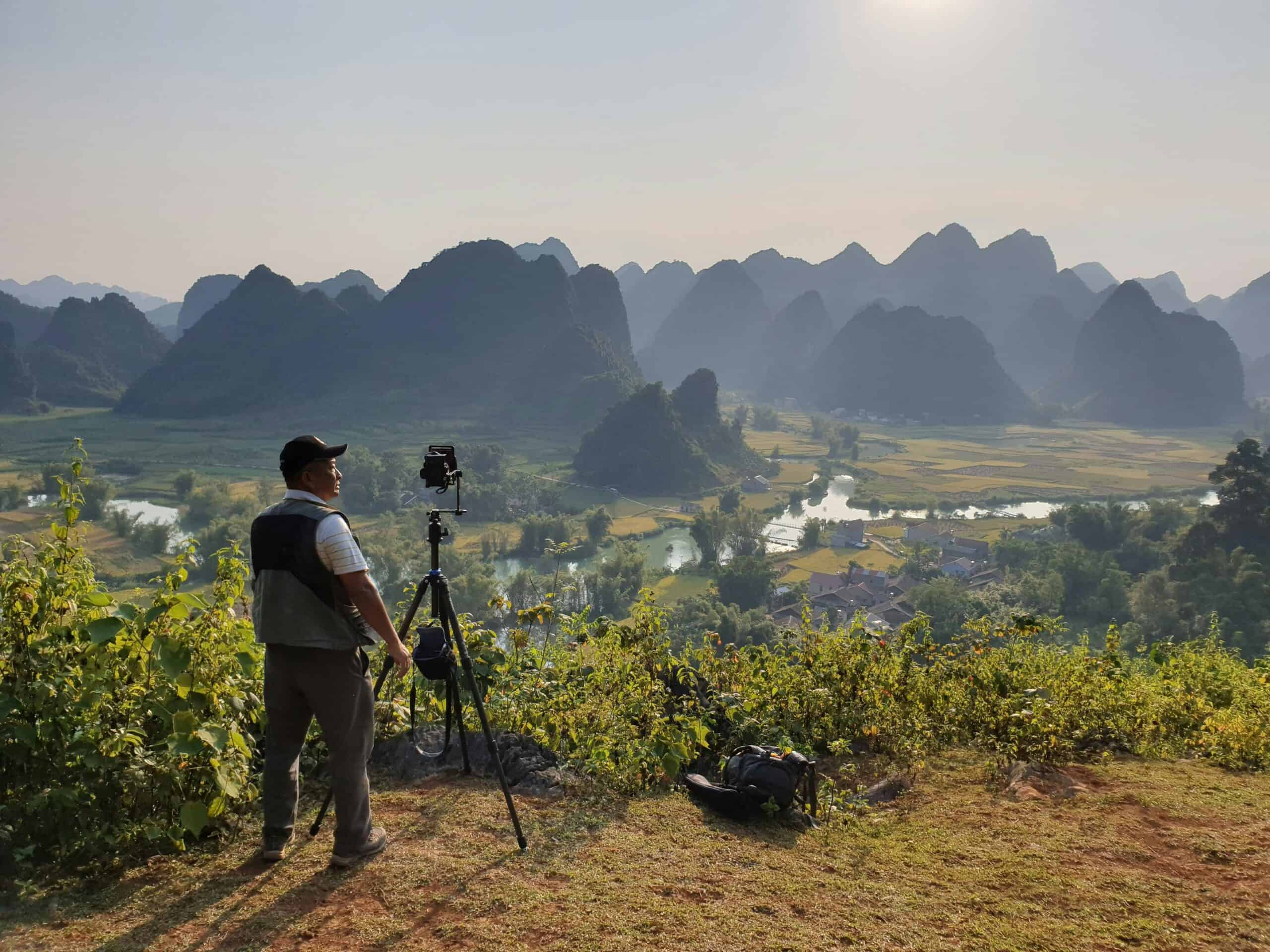
Quick Setup Overview
- Camera: Nikon Z6 II — Full‑Frame (36×24mm), 24.5MP BSI CMOS, ~5.9µm pixel pitch, excellent DR at ISO 100.
- Lens: Sony FE 14mm f/1.8 GM — Rectilinear ultra‑wide; razor sharp center-to-corner by f/5.6–f/8; low coma/CA for night scenes; built-in petal hood; rear filter slot.
- Estimated shots & overlap (field-tested baselines, 30% overlap):
- Single-row pano (cylindrical, landscapes): 8–10 shots around at 0° pitch.
- Full 360° spherical: 3 rows of 8 around at +45°, 0°, −45° = 24 shots + zenith + nadir (2–3 shots) ≈ 26–27 images.
- Alternative spherical: 10 around × 3 rows (tighter overlap) + Z/N ≈ 32 shots for complex interiors.
- Difficulty: Intermediate (rectilinear UWA requires careful overlap and nodal alignment).
Planning & On-Site Preparation
Evaluate Shooting Environment
Assess your scene for dynamic range, reflections, and motion. Interiors with windows will likely need HDR bracketing. Highly reflective surfaces (glass, glossy floors, cars) amplify parallax errors—give yourself extra overlap and keep the camera exactly at the no‑parallax point. If shooting through glass, press the lens hood gently to the surface or shoot at a slight angle and stand 30–50 cm back to avoid flare rings and double reflections from laminated panes.
Match Gear to Scene Goals
The Nikon Z6 II’s dynamic range and clean ISO 100–800 output are ideal for real estate and daylight panoramas. At night, the Z6 II handles ISO 1600–3200 well with tripod support, though longer exposures at ISO 100–400 will always produce cleaner stitches. The Sony 14mm GM reduces the number of frames vs. longer focal lengths while keeping straight lines straight—a win for architecture compared to fisheyes that bend lines and require de‑fishing. If your priority is the fewest shots for a 360, a fisheye is faster; if your priority is natural geometry and edge-to-edge resolution, this 14mm rectilinear is the better choice.
Pre-shoot Checklist
- Charge batteries, format dual cards, clean lens and sensor.
- Verify your panoramic head calibration for the 14mm position; bring a hex key and a silver marker to mark rails.
- Level your tripod with a leveling base; check leg locks and spikes or rubber feet based on surface.
- Safety: evaluate wind on rooftops; use a tether line if mounting on a pole or vehicle. Keep bystanders away from swinging gear.
- Backup workflow: shoot a second pass if time allows, especially for commercial jobs or crowds.
Essential Gear & Setup
Core Gear
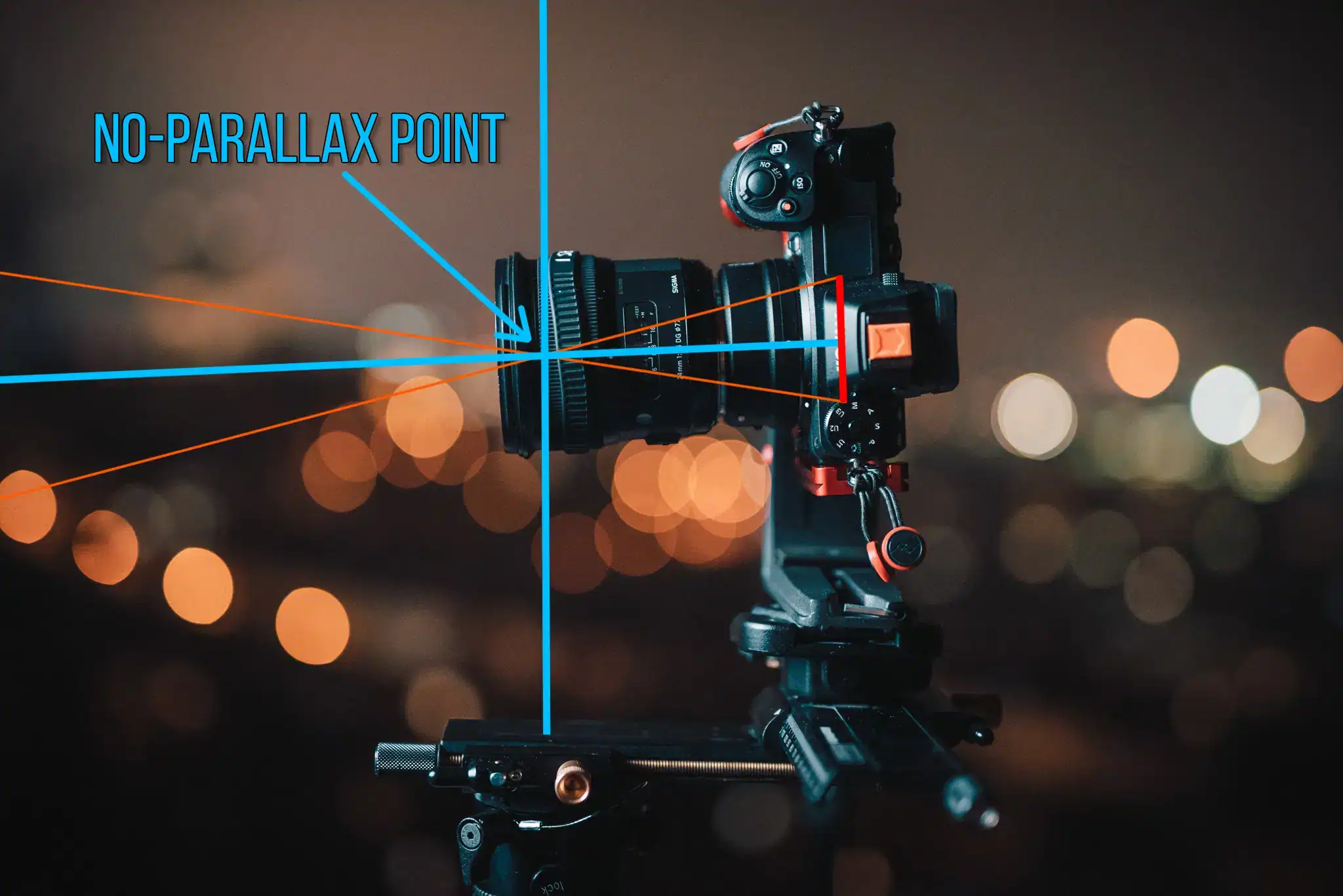
- Panoramic head with fore‑aft and left‑right rails: aligns the lens’ entrance pupil (no‑parallax point) over the rotation axis to prevent foreground/background shifting. This is critical for clean stitches with rectilinear lenses.
- Stable tripod with a leveling base: fast, precise leveling without adjusting legs on uneven ground.
- Remote trigger or SnapBridge app: eliminate vibration and enable consistent cadence between frames.
Optional Add-ons
- Pole or car mount: always add a safety tether, clamp to stable structures, and watch wind loading. Rotate slower to avoid oscillations.
- Lighting aids: small LED panels or bounced flash for dim interiors; keep lighting consistent across frames.
- Weather protection: rain cover, silica packs; wipe lens often in sea spray or mist.
Watch: Panorama Head Setup (Video)
Seeing nodal alignment once makes everything click. This practical walkthrough reinforces the steps below.
Step-by-Step Shooting Guide
Standard Static Scenes
- Level the tripod and head. Use the leveling base bubble and the camera’s virtual horizon. A level platform reduces warping in the stitch and makes horizon leveling trivial later.
- Align the nodal point. Place two light stands or vertical poles—one near, one far—so they overlap in the view. Rotate left/right on the pano head. Adjust the fore-aft rail until the near object stays aligned with the far object during rotation. Mark the rail for the Sony 14mm GM (with your adapter) for repeatability.
- Set manual exposure and lock white balance. Meter a mid-tone area and switch to M. Use a fixed Kelvin or preset WB (Daylight/Tungsten) to avoid stitch color shifts. Turn off Auto ISO. On the Z6 II, switch IBIS (VR) OFF on a tripod to avoid sensor micro-movements during long exposures.
- Focus manually and lock it. At 14mm and f/8, the hyperfocal distance is roughly 0.8–1.0 m; set focus slightly past 1 m for front-to-infinity sharpness. Use magnified live view to confirm.
- Capture with consistent overlap. For single-row landscapes, shoot 8–10 frames around at 30–35% overlap. For full 360°, shoot three rows: +45°, 0°, −45°, 8 shots per row (45° yaw increments), then add 1 zenith and 1–2 nadir frames. Use a remote to keep cadence steady.
- Nadir (ground) shot. After the main sequence, remove the camera and shoot a clean ground plate for easier tripod removal in post. Alternatively, rotate the column 180° and offset the tripod to patch later.
HDR / High Dynamic Range Interiors
- Bracket ±2 EV (3–5 frames). The Z6 II’s bracketing is reliable and consistent. Use exposure bracketing in Manual mode and lock WB; shoot full rows per exposure before changing EV if your workflow prefers batch alignment in PTGui.
- Avoid flicker. Keep shutter and aperture consistent across the pano; only ISO or shutter should change inside the bracket sequence (most choose shutter variations).
Low-Light / Night Scenes
- Prefer longer exposures over high ISO. Start around f/4–f/5.6, ISO 100–400, and let shutter run 2–15s. For moving crowds or flags, compromise with ISO 800–1600 to keep shutter ≥1/4–1/2s.
- Stability matters. VR OFF on tripod. Use a remote, 2s self-timer, or exposure delay mode to reduce micro-shake. Shield the setup from wind.
Crowded Events
- Two passes strategy. First pass quickly for coverage; second pass slowly to capture gaps in moving people.
- Mask in post. In PTGui/Photoshop, blend the clean areas from the second pass over ghosts from the first.
Special Setups (Pole / Car / Rooftop)
- Secure everything. Use a safety tether and rigid clamps. For poles, keep extensions moderate and rotate slowly to minimize sway.
- Mind vibration and wind. Raise shutter speed (≥1/125s) or shoot bursts to increase chances of sharp frames; consider IBIS ON for handheld/pole, OFF for tripod/rigid mounts if it causes drift.
Field-Tested Scenarios
Indoor Real Estate (Windows + Mixed Light)
Shoot 3-row 360 with 8 around per row at f/8, ISO 100, bracket ±2 EV. Lock WB (Tungsten or 4000–4500K for warm interiors), and cover all corners near walls for clean control points. Expect 24×3 exposures if bracketing 3 frames per angle, so plan for a steady cadence.
Outdoor Sunset Cityscape
Single-row is often enough: 10 shots around at f/8, 1/100s, ISO 100–200. If the sky has strong gradients, add a tilted up row (+30–45°) for better zenith coverage and seamless sky gradients.
Rooftop on a Windy Day
Use a heavier tripod, hang a weight from the center column, and keep the center column retracted. If wind gusts cause shake, use ISO 400–800 to keep shutter ≥1/60s. Take a second pass—wind changes quickly and a spare set of frames is priceless for masking.
Recommended Settings & Pro Tips
Exposure & Focus
| Scenario | Aperture | Shutter | ISO | Notes |
|---|---|---|---|---|
| Daylight outdoor | f/8–f/11 | 1/100–1/250 | 100–200 | Lock WB (Daylight); VR OFF on tripod |
| Low light/night | f/4–f/5.6 | 1/2–15s | 100–400 (800–1600 if needed) | Tripod & remote; prioritize lower ISO |
| Interior HDR | f/8 | Bracket ±2 EV | 100–400 | Balance windows vs lamps; lock WB |
| Action / moving subjects | f/5.6–f/8 | 1/200+ | 400–1600 | Freeze motion; consider double pass |
Critical Tips
- Manual focus at or just past the hyperfocal distance (~0.8–1.0 m at 14mm, f/8). Tape the focus ring if needed.
- Nodal point calibration: for the 14mm GM + adapter, expect the entrance pupil to sit forward of the sensor mark by several centimeters; use the two‑stick method and mark your rail precisely. Re‑check if you change focus distance significantly.
- White balance lock: Kelvin or preset per scene. Mixed lighting? Favor a neutral WB and correct globally in post.
- RAW capture: always. You’ll gain highlight headroom, smoother gradients, and better deghosting.
- IBIS (VR) usage: OFF on a tripod; ON for handheld or pole work if it improves hit rate. Test both ways—some rigs prefer OFF to avoid drift.
Stitching & Post-Processing
Software Workflow
Ingest RAWs into Lightroom or Capture One for basic culling and lens corrections (disable geometry corrections if your stitcher expects native projections). Export 16‑bit TIFFs to PTGui, Hugin, or your preferred stitcher. Rectilinear ultra‑wide shots benefit from 25–35% overlap for robust control point placement. PTGui’s optimizer handles multi‑row 14mm sequences very well, and you can mask moving subjects or choose “blend priority” areas to favor the cleanest frame where overlaps don’t match perfectly. For VR output, export a 2:1 equirectangular (e.g., 8000×4000 or 12000×6000 for higher quality). For general guidance on DSLR/mirrorless 360 workflows, see the Oculus creator guide for 360 photos at the end of this paragraph. Using a DSLR or mirrorless camera to shoot and stitch a 360 photo.
Cleanup & Enhancement
- Nadir patch: export a layered PSD from PTGui and patch the tripod using Content-Aware Fill, generative tools, or a clean ground plate shot.
- Color and noise: unify WB if mixed; apply mild Luminance NR on Z6 II night frames (start around 10–20 in Lightroom) and mask fine textures.
- Level and straighten: use horizon tools, then fine‑adjust yaw/pitch/roll in your viewer or stitcher.
- Output: For web/VR, equirectangular JPEG at quality 90–95; for archiving, 16‑bit TIFF. Keep a layered master for future revisions.
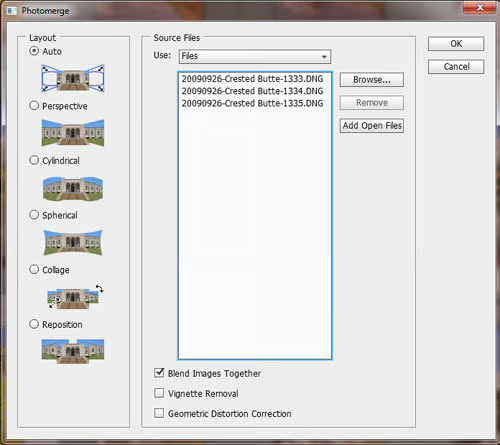
PTGui remains an industry standard for complex multi‑row work and masking. For a practitioner’s take, Fstoppers has a solid review of PTGui’s strengths. PTGui review on Fstoppers.
Useful Tools & Resources
Software
- PTGui panorama stitching (masking, fast GPU blending)
- Hugin (open source, powerful control point tools)
- Lightroom / Photoshop (RAW development, cleanup)
- AI tripod removal / generative fill for nadir patches
Hardware
- Panoramic heads (Nodal Ninja, Leofoto, Sunwayfoto) with dual rails
- Carbon fiber tripods with leveling bases
- Wireless remote shutters
- Pole extensions / car mounts with safety tethers
Further reading: a clear panoramic head setup tutorial helps cement nodal alignment concepts. Panoramic head tutorial (360 Rumors).
Disclaimer: software/hardware names provided for search reference; check official sites for details.
Common Mistakes & How to Avoid Them
- Parallax error → Use a proper pano head and align the entrance pupil; verify with the two‑stick test before every major shoot.
- Exposure flicker → Manual mode, fixed WB, constant aperture; bracket with consistent steps if using HDR.
- Tripod shadows or visible legs → Capture a nadir plate; patch in post with content‑aware or generative fill.
- Ghosting from movement → Shoot a second pass and mask; in PTGui, use masking and “use this image” priorities.
- Night noise and color blotches → Favor longer exposures at low ISO; apply measured NR and keep WB consistent.
Frequently Asked Questions
- Can I shoot handheld panoramas with the Nikon Z6 II?
Yes for single‑row panos in good light—use IBIS ON, high shutter (≥1/200s), and 35% overlap. For 360° spheres or interiors, use a tripod and pano head to avoid parallax and stitching errors.
- Is the Sony FE 14mm f/1.8 GM wide enough for a single‑row 360?
No. It’s rectilinear, not fisheye, so you’ll need multi‑row (typically three rows of 8–10 around) plus zenith and nadir. It’s excellent for clean geometry and sharp edges compared to fisheyes.
- Do I need HDR for interiors with bright windows?
Usually yes. Bracket ±2 EV (3–5 frames) to capture window detail and room shadows. The Z6 II has great DR, but windows often exceed single‑exposure range.
- How do I avoid parallax issues with this 14mm lens?
Use a dual‑rail pano head and align the entrance pupil. Start with the near/far stick test; mark your rail position for the Sony 14mm GM + adapter. Re‑check if focus distance changes significantly.
- What ISO range is safe on the Z6 II in low light?
On a tripod, stick to ISO 100–400 and lengthen shutter. If motion forces faster shutter, ISO 800–1600 is still very usable, with careful noise reduction in post.
References & Further Learning
For a structured, end‑to‑end DSLR/mirrorless 360 workflow, the Oculus guide is practical. Using a DSLR or mirrorless camera to shoot and stitch a 360 photo.
If you’re new to panoramic heads, this illustrated tutorial covers alignment fundamentals. Panoramic head tutorial (360 Rumors).
Safety, Reliability, and Workflow Integrity
Always inspect clamps and rails before lifting the camera. On rooftops or poles, add a secondary tether and keep people clear of the rotation path. In vehicles, use vibration‑damped mounts and double‑check fasteners every stop. Maintain a reliable backup: dual card writing on the Z6 II, and redundant RAW backups when you return. When using the Sony FE 14mm GM via an E‑to‑Z adapter, periodically re‑check for play in the mount and clean contacts—tiny shifts can show up as misalignments in a multi‑row pano.
For more panorama fundamentals and software comparisons, consider these resources after you practice with the steps above: PTGui review on Fstoppers.