Why This Camera & Lens Are Great for Panoramas
If you want to know how to shoot panorama with Nikon D850 & Tokina ATX-i 11-20mm f/2.8, you’re pairing a professional full-frame DSLR with a nimble ultra-wide rectilinear zoom. The Nikon D850’s 45.7MP full-frame sensor (approx. 4.35 µm pixel pitch) delivers exceptional detail with class-leading base ISO 64 dynamic range (~14.8 EV), which is perfect for high-contrast scenes like interiors with bright windows or sunset cityscapes. The Tokina ATX-i 11-20mm f/2.8 (Nikon F-mount, designed for APS-C/DX) is sharp stopped down, with manageable lateral chromatic aberration and mild distortion that stitches cleanly when you maintain good overlap.
Important note about compatibility: the Tokina ATX-i 11-20mm f/2.8 is a DX-format lens. On the D850 (an FX body), enable Auto DX Crop or manually set DX crop to avoid heavy vignetting. In DX crop mode, the D850 outputs approx. 19.4MP files—still plenty for high-quality 360 photo stitches, especially with multi-row capture. The rectilinear rendering means straight lines stay straight (useful for architecture), but you’ll need more frames than a fisheye to cover the full 360×180 sphere.
Quick Setup Overview
- Camera: Nikon D850 — Full Frame (FX) body, 45.7MP; use DX Crop (approx. 19.4MP) with this lens to avoid vignetting; base ISO 64 for maximum dynamic range.
- Lens: Tokina ATX-i 11-20mm f/2.8 — rectilinear ultra-wide zoom for DX; sharp from f/5.6–f/8; moderate lateral CA at edges, easily corrected in post.
- Estimated shots & overlap (DX crop used):
- At 11mm (≈16.5mm FF equivalent), multi-row: 8 shots around at -30°, 8 around at +30°, plus 1 zenith + 1 nadir (18 total) with ~30% overlap.
- At 16–20mm (≈24–30mm equiv), multi-row: 10–12 around at 0°, 10–12 around at +45°, 10–12 around at -45°, plus zenith/nadir (32–38 total) with ~30% overlap. Use when you need straighter edges and higher stitch robustness.
- Difficulty: Intermediate (rectilinear ultra-wide requires careful nodal alignment and disciplined overlap).
Planning & On-Site Preparation
Evaluate Shooting Environment
Look for moving subjects (cars, people, trees in wind), reflective surfaces (glass, polished floors), and tight spaces. Indoors, watch for mixed lighting (tungsten + daylight) as it complicates white balance across frames. Near glass, keep the front element 5–10 cm away and shoot at a slight angle to reduce flare and reflections. Outdoors at sunset, meter for highlights and plan to bracket for HDR panorama if windows or sun are in the frame.
Match Gear to Scene Goals
The D850’s low base ISO and wide dynamic range make it excellent for both low-light interiors and high-contrast skies. In DX crop, the 11–20mm Tokina still provides a very wide field, letting you keep straight architectural lines. Use 11–14mm for fewer frames; go longer (16–20mm) to minimize edge stretching and improve stitch precision at the cost of more shots. ISO 64–200 is ideal for daylight; for interiors, ISO 200–800 is typically safe on the D850 with minimal noise, and ISO 1600 remains usable if needed.
Pre-shoot Checklist
- Power & storage: full batteries; XQD/CFexpress Type B and UHS-II SD cards for reliability.
- Clean optics and sensor: dust will multiply across frames—blow, brush, and cloth.
- Tripod leveling & pano head: bubble or leveling base; pre-calibrate nodal point for this lens and mark it.
- Safety: secure straps and tethers on rooftops or poles; check wind; avoid crowds directly beneath pole setups.
- Backup workflow: shoot a second pass if critical; it saves projects when a single frame has motion blur.
Essential Gear & Setup
Core Gear
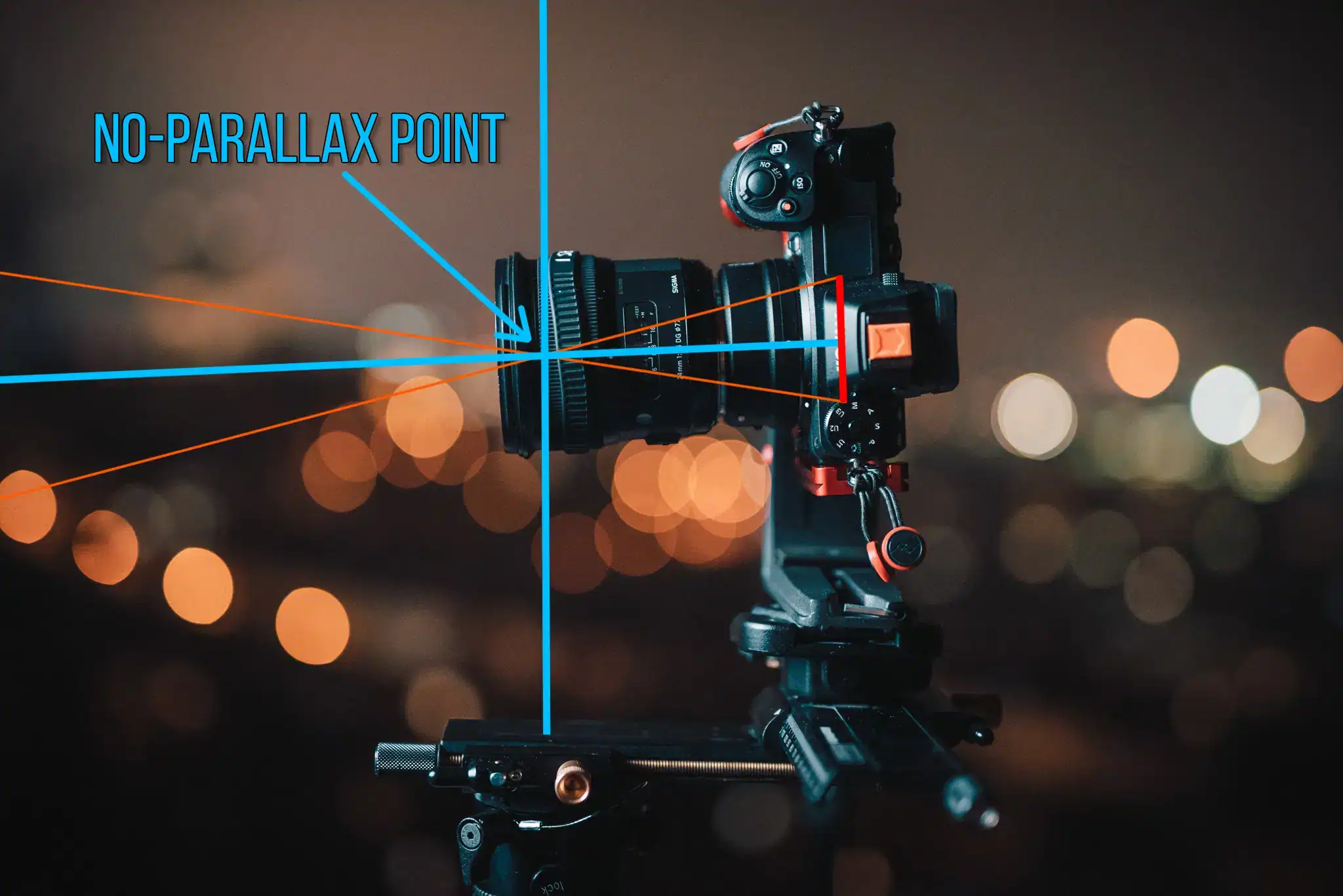
- Panoramic head: lets you rotate precisely about the lens’s no-parallax (nodal) point, eliminating parallax errors between foreground and background. This greatly improves stitching success, especially with rectilinear ultra-wide lenses.
- Stable tripod with leveling base: fast leveling ensures consistent horizons and repeatable rows. Carbon fiber cuts vibrations and weight.
- Remote trigger or app: use self-timer, Exposure Delay, or a remote to eliminate mirror/shutter shock.
Optional Add-ons
- Pole or car mount: great for elevated or moving viewpoints; always use a safety tether, minimize speed, and avoid high winds to reduce vibrations.
- Lighting aids: small LED panels to lift shadows in dim interiors (don’t use while shooting HDR brackets unless carefully balanced).
- Weather protection: rain covers, microfiber towels, and silica gel for humid environments.
Step-by-Step Shooting Guide
Standard Static Scenes
- Level and align: set the tripod on a stable surface. Level the base, then the panoramic head. Mount the D850 in DX crop mode and position the Tokina at your chosen focal length (start with 11mm for efficiency).
- Nodal calibration: slide the camera forward/back on the rail until objects at different distances overlap consistently as you pan. Mark the rail position for 11mm, 14mm, 20mm to speed future setups.
- Manual settings: M mode, fixed ISO, fixed white balance (Daylight outdoors; a neutral WB for interiors). Shoot RAW for maximum latitude.
- Capture sequence with overlap: for 11mm DX, shoot two rows: 8 frames around at -30°, 8 around at +30°, then add 1 zenith and 1 nadir. Use ~30% overlap and a consistent rotation angle per click.
- Nadir shot: after the main set, tilt down to capture a clean ground plate for tripod removal. A “viewpoint correction” shot taken from a slight offset can help with patching.
HDR / High Dynamic Range Interiors
- Bracket ±2 EV (3 or 5 frames): the D850’s bracketing is reliable and fast. Use base ISO 64–200 for maximum DR; aperture around f/8; maintain identical focus and WB across brackets.
- Keep the sequence consistent: shoot all frames for one view before rotating to the next position to avoid mixing exposures.
- Disable Auto ISO and auto WB: this prevents exposure and color shifts that cause stitching seams.
Low-Light / Night Scenes
- Long exposures: use f/4–f/5.6, ISO 200–800; use Exposure Delay Mode (1–3 s) and mirror-up or Live View to minimize vibrations. The D850’s EFCS (in Live View/mirror-up workflows) reduces shutter shock.
- Remote or timer: trigger without touching the camera. Take a “black frame” if you want to map hot pixels for later removal.
Crowded Events
- Two-pass capture: first pass fast to lock the environment; second pass while waiting for gaps. In post, mask people between passes for cleaner results.
- Slightly higher shutter: 1/200–1/320 when possible to freeze motion. If light is low, prefer ISO 800–1600 on the D850 rather than risking blur.
Special Setups (Pole / Car / Drone)
- Pole: keep the pole vertical; use a safety tether; shoot with shorter exposures to mitigate sway. Consider 11–14mm to reduce the total number of frames at height.
- Car mount: avoid high speed; choose smooth pavement; increase shutter speed to 1/500+; plan an efficient route around the nodal point even if not using a full pano head.
- Drone: not typical with this DSLR, but the same stitching principles apply if you adapt. Ensure vibration damping and follow local aviation laws.
Recommended Settings & Pro Tips
Exposure & Focus
| Scenario | Aperture | Shutter | ISO | Notes |
|---|---|---|---|---|
| Daylight outdoor | f/8–f/11 | 1/100–1/250 | 64–200 | Lock WB (Daylight); maximize DR at ISO 64 |
| Low light/night | f/4–f/5.6 | 1/30–1/60 (or longer on tripod) | 200–800 | Use Exposure Delay + remote; 1600 still usable on D850 |
| Interior HDR | f/8 | Bracket ±2 EV (3–5 shots) | 64–400 | Prevents blown windows; keep WB fixed |
| Action / moving subjects | f/5.6–f/8 | 1/200+ | 400–800 | Faster shutter to reduce ghosting |
Critical Tips
- Manual focus: set at or just beyond the hyperfocal distance. At 11mm DX and f/8, hyperfocal is about 0.9–1.2 m; use Live View with focus peaking on the D850 for precision.
- Nodal point: mark rail positions for 11, 14, 20mm. Reuse those marks to eliminate guesswork on location.
- White balance: lock WB to a single preset or Kelvin value; avoid Auto WB for panoramas.
- RAW capture: essential for HDR and color consistency across frames; correct lateral CA and vignetting in your RAW processor before stitching.
- Stabilization: the Tokina 11-20 has no VR; the D850 has no IBIS. Stability relies on your tripod, head, and technique—use Exposure Delay and/or mirror-up.
- Filters: avoid polarizers for wide panoramas; they create uneven skies. If you must, keep rotation angle small and shoot a full pass quickly under consistent light.
Stitching & Post-Processing
Software Workflow
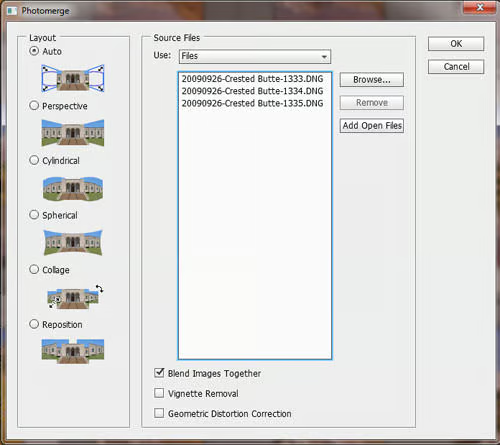
Import your RAWs, apply lens profile corrections (distortion, CA), lock a consistent white balance, and sync settings across the whole set. For stitching, PTGui and Hugin are the most common choices; Lightroom/Photoshop also work but PTGui is faster and more robust for complex multi-row sets and HDR panorama merging. Rectilinear ultra-wide shots typically need 25–30% overlap. Expect more frames than with fisheye, but with straighter edges—great for real estate and architecture.
For HDR series, you can merge brackets in PTGui’s HDR workflow, or pre-merge brackets per camera position in Lightroom, then stitch the merged HDRs in PTGui. After stitching, export an equirectangular image (2:1 aspect ratio). With the D850 in DX crop (≈19.4MP per frame) and 18–24 images, the final pano can easily reach 120–200 MP, depending on overlap and projection. For a deep-dive on pano software, see a thorough review of PTGui. Why PTGui is a top choice for creating incredible panoramas.
Cleanup & Enhancement
- Nadir patch: render a “viewpoint corrected” patch in PTGui or retouch with clone/AI tools to remove the tripod.
- Color and noise: balance color across rows; apply noise reduction sparingly to avoid smearing fine textures.
- Leveling: adjust pitch/roll/yaw; use vertical lines as references in architectural spaces.
- Output: export high-quality JPEG or TIFF equirectangular at target platform specs (e.g., 12k–16k width for VR). Oculus/Meta provides practical guidelines for DSLR 360 workflows. Using a DSLR to shoot and stitch a 360 photo.
Recommended Video
Watch this helpful video overview of panorama shooting and stitching. Use the ideas here alongside the D850-specific tips above.
For nodal theory and panoramic head setup techniques, this step-by-step guide is excellent. Panoramic head tutorial and best practices.
Useful Tools & Resources
Software
- PTGui panorama stitching (fast, HDR-aware, robust control point handling)
- Hugin (open-source, powerful, great for experimentation)
- Lightroom / Photoshop for RAW prep and finishing
- AI tripod/nadir removal tools for cleaner finishes
Hardware
- Panoramic heads: Nodal Ninja, Leofoto, or similar with fore/aft and lateral rails
- Carbon fiber tripods for stability vs. weight
- Leveling bases to speed alignment
- Wireless remote shutters or intervalometers
- Pole extensions / car mounts with safety tethers
Disclaimer: software/hardware names provided for search reference; check official sites for details.
Common Mistakes & How to Avoid Them
- Parallax errors: always rotate around the no-parallax point; test with near/far objects while panning.
- Exposure flicker: use full manual exposure and fixed white balance; avoid Auto ISO.
- Tripod shadows: plan the sun angle; shoot a clean nadir to patch later.
- Ghosting: when people/cars move, capture multiple passes and mask in post.
- Uneven sky with polarizer: avoid CPLs on ultra-wide panoramas.
- Insufficient overlap: with rectilinear ultra-wide, keep at least 25–30% overlap and consistent yaw steps.
- Vibration blur: on the D850, use Exposure Delay, Live View, a remote, and a sturdy tripod.
Real-World Case Studies
Indoor Real Estate (Bright Windows)
Set WB to a fixed Kelvin (e.g., 4000–4600K for mixed light), ISO 64–200, f/8, and bracket ±2 EV in 5 frames. Shoot at 11–14mm DX to reduce total frames (two rows + zenith/nadir). Merge HDR per position or in PTGui. Keep lights either all on or all off across the scene to avoid flicker. The D850’s DR lets you keep window detail without heavy halos.
Outdoor Sunset Cityscape
Use ISO 64–100, f/8–f/11. Expose for highlights and bracket 3 shots if needed. Wind can be an issue on rooftops; hang a small weight from the tripod, use Exposure Delay 1–3 s, and a short self-timer or remote. Expect to mask moving cars/people. Consider two passes if crowds are heavy.
Event Crowds
Prioritize shutter speed (1/200–1/320) and shoot at ISO 800–1600 if necessary. Capture two complete rows quickly, then a second set waiting for gaps. In post, use masks to replace busy areas with cleaner frames from the second pass.
Rooftop Pole Shooting
At 11mm, a two-row capture minimizes time aloft. Watch wind; keep exposures short; tape loose cables; always tether your pole. If you can’t use a pano head, keep rotation increments consistent and overlap generously (30–40%).
Safety, Limitations, and Backup Strategy
Because the Tokina 11–20mm is DX, remember to enable DX crop on the D850 to avoid harsh vignetting. The lower per-frame resolution in DX mode is offset by multi-row coverage. The D850’s lack of IBIS and lens VR means you must rely on tripod stability; plan accordingly for wind and foot traffic. Protect gear with a tether on rooftops, and never extend a pole near power lines or in strong winds. For critical shoots, capture a full backup pass and keep redundant cards; one bad frame can break a stitch.
If you want to go deeper into spherical resolution math and planning, the Panotools wiki is a valuable reference. Understanding DSLR spherical resolution.
Frequently Asked Questions
- Can I shoot handheld panoramas with the Nikon D850?
Yes for partial panos and very fast skies, but for 360×180 spheres, use a tripod and panoramic head. Handheld introduces parallax and inconsistent overlaps, especially with rectilinear ultra-wide lenses. If you must, keep the camera rotating around the lens as much as possible and use high shutter speeds.
- Is the Tokina ATX-i 11–20mm f/2.8 wide enough for single-row 360?
Not in rectilinear mode. At 11mm (DX), a single horizontal row won’t capture the zenith and nadir. Use at least two rows plus dedicated zenith and nadir shots. For fewer frames overall, a fisheye lens would be more efficient—but you’d trade rectilinear lines for fisheye distortion.
- Do I need HDR for interiors with bright windows?
Usually yes. The D850 has excellent dynamic range, but interiors with bright windows benefit from ±2 EV bracketing (3–5 shots). Merge in PTGui or pre-merge in Lightroom, then stitch the HDRs. Keep WB fixed to avoid color shifts.
- How do I avoid parallax issues with this setup?
Use a panoramic head and calibrate the no-parallax point for each focal length (11, 14, 20mm). Align with near and far objects; when panning, they should not shift relative to each other. Mark the rail positions so you can repeat quickly on location.
- What ISO range is safe on the D850 in low light?
ISO 64–200 is optimal; 400–800 remains very clean; 1600 is still usable with good exposure and mild noise reduction. Prefer a tripod and longer exposure over pushing ISO too high.
Extra Learning Resources
For a broader panorama workflow from capture to VR presentation, this guide is useful. Set up a panoramic head for high-end 360 photos.