Why This Camera & Lens Are Great for Panoramas
If you’re researching how to shoot panorama with Nikon D850 & Olympus 8mm f/1.8 PRO Fisheye, you’ve already picked two legendary pieces of gear. The Nikon D850 is a 45.7MP full-frame DSLR with class-leading dynamic range at base ISO and superb color depth—ideal for 360 photo capture where shadow lifting and highlight protection matter. The Olympus M.Zuiko Digital ED 8mm f/1.8 PRO is one of the sharpest fisheyes ever made, offering a 180° diagonal field of view on Micro Four Thirds and outstanding low-light capability for night panoramas and interiors.
Important compatibility note: the Olympus 8mm f/1.8 PRO is a Micro Four Thirds (MFT) lens and does not mount or focus correctly on a Nikon F-mount DSLR like the D850. The MFT flange distance and electronic aperture/focus control make passive adapting to Nikon F impractical for panoramic work. To realize this guide on a D850, use a native or adaptable full-frame fisheye (e.g., Nikon AF-S 8–15mm f/3.5–4.5E, Sigma 8mm f/3.5 circular, or Samyang/Rokinon 12mm). If you specifically want to use the Olympus 8mm, pair it with an MFT body. The shooting workflow, overlap strategy, and stitching process below apply to both paths; where settings differ, we call them out clearly.
Why the combo concept still matters: the D850’s 45.7MP BSI sensor (approx. 4.35 µm pixel pitch) and ~14.8 EV dynamic range at ISO 64 give you extremely clean, detailed 360s, while a fast fisheye lens keeps exposures short with fewer frames to stitch. Fisheye optics trade rectilinear straightness for coverage—perfect for spherical panoramas—so distortion is expected and handled by the stitcher.
Quick Setup Overview
- Camera: Nikon D850 — full-frame 35mm (45.7MP), base ISO 64, class-leading dynamic range and color depth. Excellent for 14-bit RAW pano capture.
- Lens: Olympus M.Zuiko 8mm f/1.8 PRO — diagonal fisheye (180° on MFT), very sharp by f/2.8–f/5.6, well-controlled CA. Note: not natively compatible with Nikon F; use with a Micro Four Thirds body or pick a D850-native fisheye.
- Estimated shots & overlap:
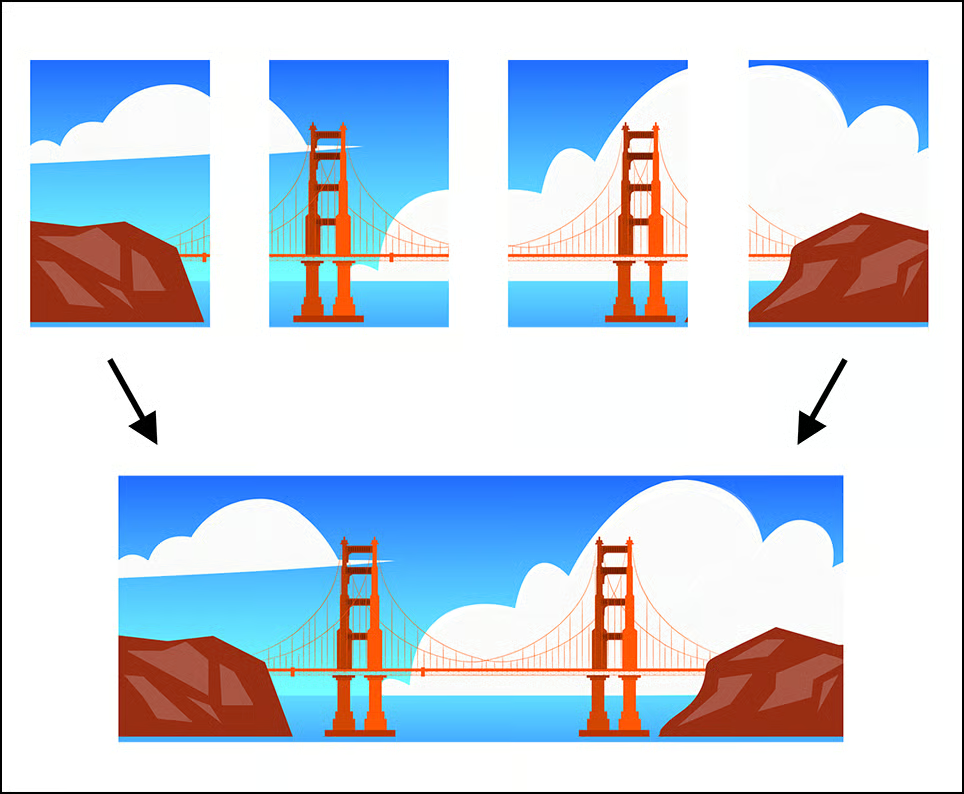
- D850 + 8mm circular fisheye (e.g., Sigma 8mm): 3 around at 120° + optional zenith + nadir, ~30–35% overlap.
- D850 + diagonal fisheye (e.g., Nikon 8–15mm at 12–15mm): 6 around + zenith + nadir, ~25–30% overlap.
- Olympus 8mm on MFT: 6 around + zenith + nadir, ~25–30% overlap.
- Difficulty: Easy–Moderate (easy if using a calibrated panoramic head; moderate in cramped interiors or windy rooftops).
Planning & On-Site Preparation
Evaluate Shooting Environment
Walk the scene and think in 360°. Identify bright windows, reflective glass, shiny floors, or moving crowds. If you must shoot near glass, keep the lens as perpendicular as possible and about a hand-span away to minimize reflections and ghosting. Note wind exposure on rooftops and balcony flex. In interiors, watch mixed lighting and color temperature shifts that can complicate stitching.
Match Gear to Scene Goals
The D850’s dynamic range at ISO 64–200 helps handle high-contrast situations; its files tolerate deep shadow lifting. For handheld or low-light scenes, the Olympus 8mm’s bright f/1.8 aperture (on an MFT body) helps shorten shutter speed, though for high-quality 360 photo capture a tripod and panoramic head still win. On the D850, aim to keep ISO at 64–400 for maximum quality; ISO 800–1600 is still excellent for practical work. Fisheye advantages: fewer shots, faster capture, and easier stitching—at the cost of predictable distortion that stitchers correct in output.
Pre-shoot Checklist
- Charge batteries; bring spares. High-res bracketing drains quickly.
- Use large, fast cards (UHS-II or XQD/CFexpress via adapter in other bodies) and shoot 14-bit lossless compressed RAW on the D850.
- Clean front element and sensor. Fisheyes see everything; dust shows up.
- Level tripod and confirm panoramic head calibration (nodal/entrance pupil alignment).
- Safety: wind ties on rooftops, tether your pole/camera, avoid public walkways below when doing pole or car-mounted capture.
- Backup workflow: do a second full pass in case a frame is blurry or someone walked through a seam.
Essential Gear & Setup
Core Gear
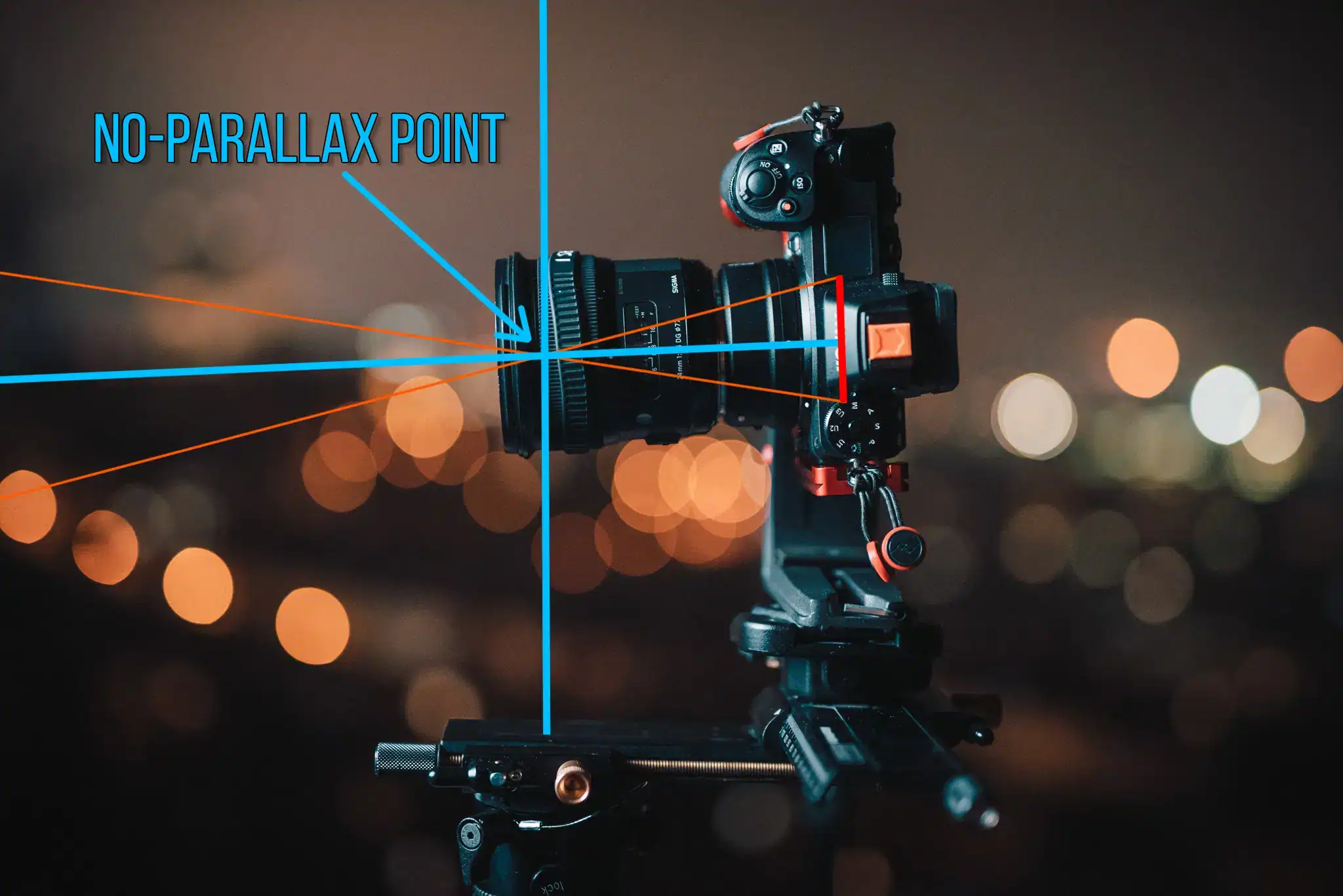
- Panoramic head: Align the lens’s entrance pupil over the rotation axis to eliminate parallax. This ensures objects at different distances line up across frames.
- Stable tripod with leveling base: A bubble or half-ball level speeds setup and keeps your horizon straight.
- Remote trigger or app: Fire the D850 via remote release; in Live View, enable Exposure Delay Mode or Electronic Front Curtain Shutter to minimize vibration.
Optional Add-ons
- Pole or car mount: Use a safety tether and minimum rotation speed to reduce vibration. Check wind; avoid crowded areas for overhead work.
- Lighting aids: Small LED panels for dim interiors; keep color temperature consistent.
- Weather protection: Rain cover, microfiber cloths, and gaffer tape for sudden wind gusts.
Step-by-Step Shooting Guide
Standard Static Scenes
- Level and align: Level your tripod. Mount the panoramic head and slide the camera so the lens’s entrance pupil sits exactly over the rotation axis. A quick test: rotate the rig while observing the relative position of a near object against a distant one—if they shift, adjust fore/aft until they don’t.
- Set camera to manual: On D850, use M mode, 14-bit RAW, ISO 64–200 if bright or 200–400 indoors. Lock white balance (Daylight for outdoors, a fixed Kelvin or preset for interiors). Disable Auto ISO.
- Focus: Use Live View, magnify, focus about a third into the scene or at the hyperfocal distance; then switch to manual focus to lock. For fisheyes at f/8, depth of field is generous.
- Capture sequence:
- Full-frame circular fisheye: 3 shots around at 120° yaw. Add a zenith (tilt up) and a nadir (tilt down) if necessary to cover tripod area and ceiling gaps.
- Diagonal fisheye (FF 12–15mm or MFT 8mm): 6 shots around at 60° yaw. Then zenith and nadir.
- Nadir shot for tripod removal: After the main pass, move the tripod slightly and shoot a clean ground patch, or use a nadir adapter to swing the tripod out of frame while keeping the nodal alignment consistent.
HDR / High Dynamic Range Interiors
- Bracket exposure: On the D850, set exposure bracketing for ±2 EV (3 or 5 frames). This preserves window highlights and lifts shadow detail without noisy pushes.
- Keep color consistent: Lock white balance and shoot all brackets at each yaw position before rotating the head.
- Mirror/shutter behavior: Use Live View with Electronic Front Curtain Shutter and Exposure Delay to eliminate vibrations during longer HDR exposures.
Low-Light / Night Scenes
- Use a tripod and remote: Even with a bright fisheye, long exposures are common at night. Start at f/4–f/5.6, 1–5 s, ISO 100–400 on the D850 for clean files.
- Noise discipline: The D850 stays very clean to ISO 800–1600, but base ISO with longer shutter gives the smoothest gradients in skies.
- Disable stabilization: If your lens has VR/IS, switch it off on a tripod to avoid micro-blur.
Crowded Events
- Two-pass method: First pass quickly for coverage; second pass wait for gaps in crowds or reposition for clean seams.
- High shutter speed: 1/200–1/500 to freeze movement if you want crisp people; or embrace motion blur by using longer exposures consistently across all frames.
Special Setups (Pole / Car / Drone)
- Pole: Use lightweight gear, a compact panoramic rotator, and a safety tether. Keep the pole vertical and rotate slowly to reduce wobble.
- Car-mounted: Use vibration-damping mounts, park the car, and let the engine off for the shot sequence. Avoid public traffic areas.
- Drone: If you’re experienced, manual multi-row fisheye capture is possible; obey regulations and avoid people and property.
Recommended Settings & Pro Tips
Exposure & Focus
| Scenario | Aperture | Shutter | ISO | Notes |
|---|---|---|---|---|
| Daylight outdoor | f/8–f/11 | 1/100–1/250 | 64–200 | Lock WB (Daylight); EFCS + Exposure Delay on D850 |
| Low light/night | f/4–f/5.6 | 0.5–5 s | 100–400 | Tripod & remote; disable VR/IS on tripod |
| Interior HDR | f/8 | Bracket ±2 EV | 64–400 | Balance windows and lamps; keep WB fixed |
| Action / moving subjects | f/5.6–f/8 | 1/200+ | 400–800 | Freeze motion; consider two-pass shooting |
Critical Tips
- Manual focus at or near the hyperfocal distance; confirm sharpness at 100% in Live View before locking focus.
- Nodal alignment: Start with the lens roughly centered over the rotator’s axis. For many diagonal fisheyes, the entrance pupil is near the front group—fine-tune using a near/far alignment test.
- White balance lock: Mixed lighting causes banding or color jumps across frames. Use a fixed Kelvin or consistent preset.
- RAW over JPEG: 14-bit RAW on the D850 preserves micro-contrast and color depth, crucial for HDR or strong shadow recovery.
- Use EFCS and Exposure Delay: On the D850, Electronic Front Curtain Shutter in Live View plus a 0.2–0.5 s delay reduces micro-vibration at longer exposures.
Stitching & Post-Processing
Software Workflow
After capture, import into your stitcher of choice. PTGui is the industry workhorse for fisheye-based 360s, with robust control point detection, masking, and HDR merging. Hugin is an excellent open-source option. Lightroom/Photoshop can handle simple panos but are limited for spherical 360 workflows. Set lens type to “Fisheye,” focal length appropriately (e.g., 8mm), and use 25–35% overlap guidance. Export an equirectangular 2:1 panorama (e.g., 12K–16K wide for D850 sources) for VR platforms and virtual tour builders. See this overview of why PTGui is a top choice for pros. Fstoppers: PTGui review
Cleanup & Enhancement
- Nadir patch: Render a masked nadir or clone out the tripod. Some AI tools can speed this up, but manual cloning gives clean results on patterned floors.
- Color matching: Use global WB/exposure tweaks first; then local brushes for windows, corners, or gradients. Apply gentle noise reduction for night skies.
- Leveling: Use the panorama’s horizon tools (pitch/roll/yaw) to set the horizon and correct any tilt.
- Sharpening: Apply mild radius sharpening; fisheye edges can look over-processed if pushed too far.
- Export: Save layered source project files. Output a high-quality JPEG for tours and a 16-bit TIFF master for archiving.
Learn by Watching
For a quick visual walkthrough of stitching fisheye panoramas, this video complements the steps above:
If you’re new to setting up a panoramic head, this practical reference covers entrance pupil alignment and workflow best practices. Panoramic head tutorial (360 Rumors)
Useful Tools & Resources
Software
- PTGui panorama stitching
- Hugin (open source)
- Adobe Lightroom / Photoshop
- AI tripod/nadir removal tools
Hardware
- Panoramic heads: Nodal Ninja, Leofoto, Sunwayfoto
- Carbon fiber tripods with leveling base
- Wireless remote shutters (Nikon-compatible)
- Pole extensions and safe car mounts
VR delivery tip: For platform guidelines on DSLR 360 capture and equirectangular output, see this concise creator reference. Oculus: Using a DSLR to shoot and stitch a 360 photo
Disclaimer: software/hardware names are provided for search reference; always check official sites for specs and latest updates.
Common Mistakes & How to Avoid Them
- Parallax error: Not aligning the entrance pupil leads to mismatched seams—calibrate once and mark your rails.
- Exposure flicker: Auto exposure changes between frames cause visible bands; use Manual mode and locked WB.
- Tripod shadows: Shoot a dedicated nadir or patch later to remove legs and shadows.
- Ghosting: People or trees moving between frames create doubles; mask or use two-pass method.
- Night noise: Overusing ISO; favor longer shutter at base ISO on a solid tripod for the cleanest results.
Frequently Asked Questions
-
Can I shoot handheld panoramas with the Nikon D850?
Yes, for quick partial panos or when a tripod is impossible. Use high shutter speed (1/250+), overlap more generously (40–50%), and keep the camera rotating around the lens, not your body. For true 360 photo work in tight interiors or with foreground objects, a tripod and panoramic head are strongly recommended.
-
Is the Olympus 8mm f/1.8 PRO wide enough for single-row 360?
On Micro Four Thirds, the 8mm f/1.8 is a 180° diagonal fisheye—perfect for single-row spherical capture: 6 around + zenith + nadir typically covers a full 360×180°. However, it is not natively compatible with the D850. On the D850, use a comparable full-frame fisheye (e.g., Nikon 8–15mm) and follow a similar frame count.
-
Do I need HDR for interiors with bright windows?
Usually yes. Even with the D850’s excellent dynamic range, window highlights can clip. Bracket ±2 EV (3–5 frames) to retain highlight detail and cleanly lift shadows. Stitch in HDR mode in PTGui or merge brackets first, then stitch—both workflows are valid.
-
How do I avoid parallax problems?
Calibrate the entrance pupil on your panoramic head. Use a near object (e.g., a light stand) and a distant object; adjust the fore/aft rail until the near object doesn’t shift against the distant object while panning. Mark the rail positions for your lens so you can repeat the setup quickly.
-
What ISO range is safe on the D850 for low light?
For top quality, stay at ISO 64–400 on a tripod. ISO 800–1600 remains very usable when shutter times must be kept short (wind, moving subjects). For night cityscapes or interiors on a tripod, prioritize longer exposures at lower ISO for cleaner gradients and better color.
-
Does the D850 have custom modes like C1/C2 for pano settings?
Instead of C1/C2, the D850 uses Shooting Menu Banks and Custom Settings Banks. Create a dedicated “PANO” bank with Manual mode, RAW 14-bit, Auto ISO off, fixed WB, EFCS on (in Live View), and your preferred bracketing. Switch to that bank to speed up setup.
-
How do I minimize flare with a fisheye?
Fisheyes are flare-prone because of their huge field of view. Shade the lens with your hand (kept out of frame), avoid direct bright light sources at the frame edge, and clean the front element. Slight position changes can dramatically reduce ghosts.
-
What’s the best tripod head for this setup?
A dedicated panoramic head with fore/aft and lateral rails (e.g., Nodal Ninja, Leofoto) for precise entrance pupil alignment. For lightweight pole work, consider compact rotators designed for fisheyes. Ensure the head supports your D850’s weight securely.
Real-World Scenarios & Settings
Indoor Real Estate
Use the D850 at ISO 64–200, f/8, shutter varying by light. Bracket ±2 EV, 6 around + zenith + nadir with a diagonal fisheye. Lock WB to a fixed Kelvin (e.g., 4000–4500K) if mixed lighting. Shoot a clean nadir patch before moving on.
Outdoor Sunset
Leverage ISO 64 for maximum highlight headroom. Meter for the sky and add 2–3 stops of brackets to protect shadows. Expect 1/30–1/125 at f/8 depending on conditions. Use EFCS and a remote release to avoid micro-shake in the twilight shutter speeds.
Event With Crowds
Increase ISO to 400–800 and shutter to 1/200–1/500 to freeze people if that’s your style. Shoot two passes; mask or choose the “cleanest” frames during stitching. If a person walks through a seam, PTGui’s masking is excellent for resolving overlaps.
Rooftop / Pole Shooting
Balance safety and motion: tether the camera, watch wind gusts, and rotate slowly. Use shorter exposures (raise ISO to 400–800) to minimize blur from pole wobble. Consider shooting two sets and take the sharpest.
Further reading on DSLR/virtual tour strategy and camera/lens selection can provide context if you’re building a professional workflow. DSLR virtual tour FAQ and lens guide