
Why This Camera & Lens Are Great for Panoramas
Before we dive into how to shoot panorama with Nikon D850 & Fujifilm XF 8-16mm f/2.8 R LM WR, there’s one crucial reality check: this lens is Fujifilm X-mount (APS-C) and is not physically compatible with the Nikon D850 (Nikon F-mount DSLR). There is no practical adapter that preserves focus/aperture control for this pairing. That said, the techniques in this guide apply perfectly to both systems—and we’ll provide exact steps and shot counts for the D850 with an equivalent ultra-wide lens, and for the Fujifilm XF 8-16mm on a Fuji X body. If you own both ecosystems, you’ll be covered. If you only have one, use the relevant settings and shot counts for your kit.
The Nikon D850 is a full-frame 45.7MP BSI-CMOS DSLR (sensor size 35.9 × 23.9 mm) with extremely high resolving power and industry-leading dynamic range at base ISO 64 (about 14.8 EV). Its large pixels (≈4.35 μm pitch) handle low ISO impeccably and remain clean up to ISO 1600–3200 with judicious noise reduction. For panoramas—particularly 360° and gigapixel—this means immaculate detail, smooth tonal transitions, and strong headroom in highlights.
The Fujifilm XF 8-16mm f/2.8 R LM WR is a pro-grade rectilinear ultra-wide zoom for APS-C (12–24mm FF equivalent). It’s sharp from wide open, especially from f/4–f/5.6, with excellent control of coma and well-managed distortion for a lens this wide. Its bulbous front element and fixed hood keep flare reasonable but require careful sun positioning. As a rectilinear lens, it preserves straight lines—great for architecture and interiors—at the cost of needing more frames than a fisheye for full 360° coverage.
Bottom line: use the D850 with an equivalent rectilinear UWA (e.g., AF-S 14-24mm f/2.8, 16-35mm f/4, or even the AF-S 8-15mm fisheye for efficiency), or mount the XF 8-16mm to a Fujifilm X camera (X-T5/X-H2). The capture workflow, exposure discipline, nodal alignment, and stitching best practices are the same.
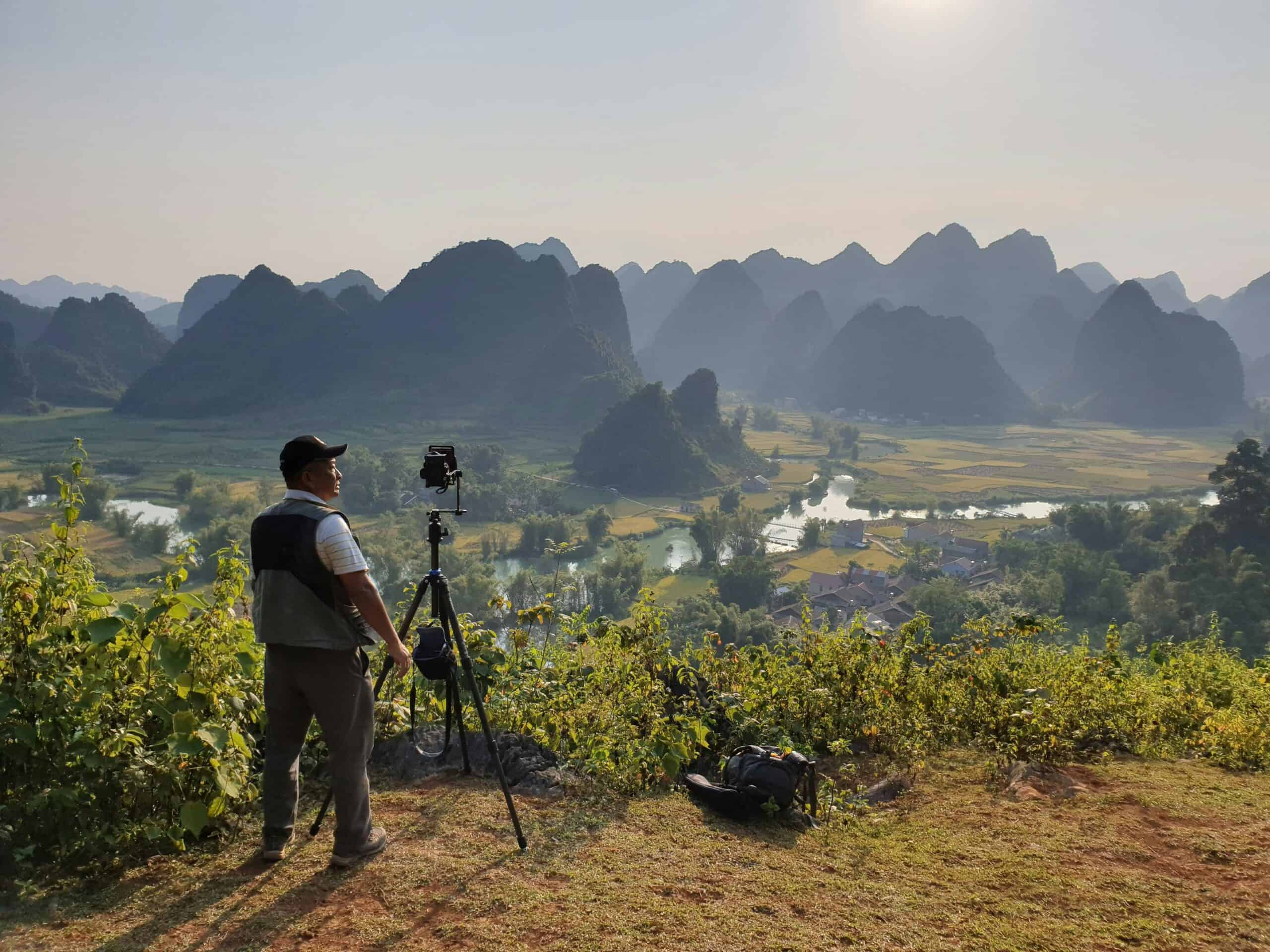
Quick Setup Overview
- Camera: Nikon D850 — Full-frame 45.7MP (35.9 × 23.9 mm), base ISO 64, ≈14.8 EV DR at base, pixel pitch ≈4.35 μm.
- Lens: Fujifilm XF 8-16mm f/2.8 R LM WR — Rectilinear APS-C ultra-wide (12–24mm equiv), very sharp at f/4–f/8, minimal lateral CA for its class, bulbous front element (no front filter).
- Compatibility note: This XF lens does not mount to the D850. Use it on a Fujifilm X body, or use a similar Nikon F-mount ultra-wide (14–24mm, 16–35mm) on the D850. Techniques and settings below are provided for both.
- Estimated shots & overlap (tested safe ranges):
- D850 + 14mm rectilinear (FF): 8–10 shots around at 0°, plus a ±45° row (8–10 each), plus zenith + nadir. Total ~26–32 frames. Overlap 25–30%.
- D850 + 16mm rectilinear (FF): 10–12 around × 3 rows, plus zenith + nadir. Total ~32–38 frames. Overlap 25–30%.
- Fujifilm X + XF 8mm (APS-C rectilinear): 12 around × 3 rows (0°, +45°, −45°), plus zenith + nadir. Total ~38 frames. Overlap 25–30%.
- Efficiency note: A fisheye (e.g., Nikon 8–15mm at 8mm) can do 4–6 around + zenith + nadir.
- Difficulty: Intermediate (precise nodal alignment and consistent exposure required).
Planning & On-Site Preparation
Evaluate Shooting Environment
Assess light direction, sun position, and moving elements (people, cars, foliage, water). For interiors, note mixed lighting (tungsten + daylight) and reflective surfaces. If shooting through glass, get the front element as close as safely possible (1–2 cm) or at least 30–50 cm away and angled to avoid your own reflections. Bring a black cloth or rubber lens hood to “cup” around windows and cut reflections.
Match Gear to Scene Goals
For D850 users, leverage base ISO 64 for maximum dynamic range outdoors. You can safely operate at ISO 100–400 in most daylight or well-lit interiors, pushing to ISO 800–1600 at night with a tripod and longer exposures. For the XF 8–16mm on Fuji X, the constant f/2.8 helps in darker interiors, but be aware of edge stretching and keep the horizon centered where possible. Rectilinear lenses preserve architecture lines and are preferred for real estate and design-critical spaces; fisheyes reduce shot count but need careful de-fishing and can bend straight edges if not stitched properly.
Pre-shoot Checklist
- Charge batteries; bring spares and high-speed, high-capacity cards.
- Clean lens and sensor; dust ruins skies and ceilings in 360°.
- Level tripod; verify panoramic head calibration (entrance-pupil alignment).
- Safety: On rooftops, use a sandbag and a safety tether; in wind, lower the center column; in vehicles, secure all mounts.
- Backup workflow: Shoot an extra safety round or an additional nadir plate for easier tripod removal.
Essential Gear & Setup
Core Gear
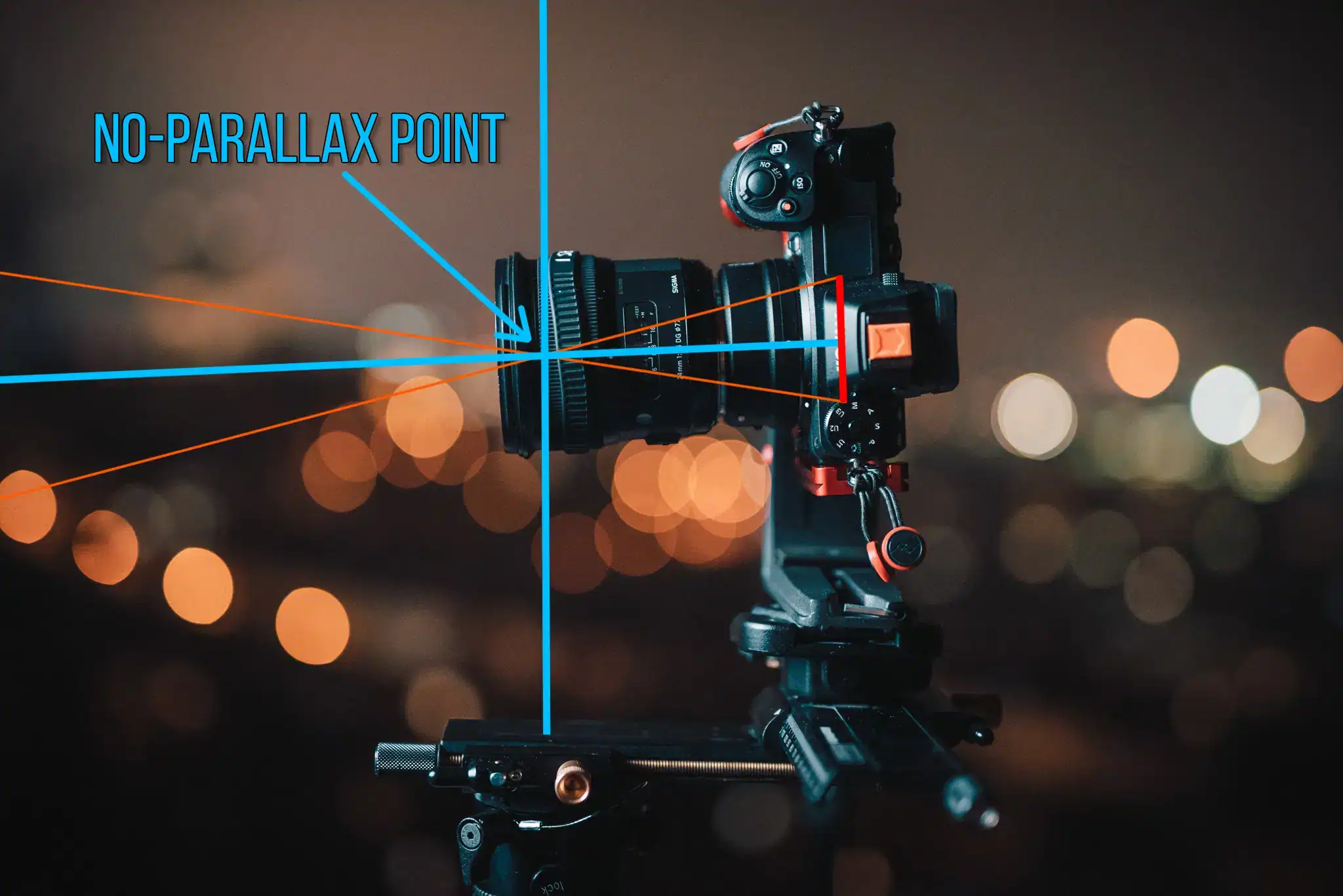
- Panoramic head: A two-axis panoramic head lets you rotate around the lens’s entrance pupil (nodal point) to eliminate parallax. This is non-negotiable for multi-row 360° with rectilinear lenses.
- Stable tripod with leveling base: Level the base, not just the head, so every frame shares the same horizon.
- Remote trigger or app: Use a cable release, wireless remote, or camera app to avoid micro-shake. Enable exposure delay if available.
Optional Add-ons
- Pole or car mount: For elevated or car-mounted panoramas, use a safety tether, check wind gusts, and avoid long exposures due to vibration.
- Lighting aids: Small LED panels or bounced flash for dark interiors can even out exposure, reducing the need for extreme HDR brackets.
- Weather protection: Rain covers and microfiber cloths for sea spray or mist. The D850 is well-sealed; the XF 8–16 is WR too, but the bulbous element needs extra care.
For a deeper primer on panoramic heads and why they matter, see this panoramic head tutorial. Panoramic head tutorial
Step-by-Step Shooting Guide
Standard Static Scenes
- Level the tripod and align the nodal point: Use your panoramic head’s fore-aft and lateral rails to align the entrance pupil. Place two vertical objects (near/far) in frame and rotate—adjust until they don’t shift relative to each other.
- Set manual exposure and white balance: Meter the brightest part you need to preserve (e.g., sky near sun), set exposure in Manual, and lock white balance (Daylight/Tungsten/Custom). Avoid Auto WB to prevent color shifts across the set.
- Focus: Switch to manual focus and set near the hyperfocal distance. For FF 16mm at f/8, hyperfocal is about 1.1 m; for APS-C 8mm at f/8, ≈0.5 m. Confirm with magnified live view.
- Capture with sufficient overlap: Follow the shot counts from the Quick Setup section. Rotate consistently, use a built-in detent if your head has click-stops, and watch your pitch angles for multi-row coverage.
- Nadir shot: After the main set, tilt down to capture a clean ground plate for tripod removal. Take an extra offset nadir if you’ll patch later.
HDR / High Dynamic Range Interiors
- Bracket ±2 EV (3 or 5 frames): This balances bright windows and dark interiors. Keep bracket intervals uniform across the entire panorama.
- Lock WB and focus: Consistency is paramount; changes between brackets cause visible seams.
- Use the camera’s exposure delay or electronic front-curtain (if available) and a remote release to keep bracketing sharp.
- Consider shooting two complete HDR passes if windows are extremely bright—one exposed for view, one for interior—then blend selectively.
Low-Light / Night Scenes
- Use a sturdy setup: Lower the tripod, hang a weight bag, turn off lens VR/IS on a tripod (D850 has no IBIS; if using a VR lens, disable VR).
- Exposure: f/4–f/5.6, shutter 1–10 s as needed, ISO 100–800 on D850; ISO 200–800 on Fuji X. Avoid pushing ISO unless wind or subject motion forces faster shutter.
- Long exposure noise reduction: Consider it only if you can afford the time; otherwise handle hot pixels in post.
Crowded Events
- Two-pass technique: First pass quickly for base coverage, second pass patiently capturing gaps as people move.
- Shorter shutter speeds: 1/125–1/250 at f/5.6–f/8, ISO 400–800 to freeze motion.
- Mask in post: In PTGui, use masks to keep the best instance of each area.
Special Setups (Pole / Car / Elevated)
- Secure gear: Use a safety line and a rigid pole with guy lines if possible. Balance the rig to avoid rotation drift.
- Account for vibration: Use higher shutter speeds and perhaps fewer, wider-spaced frames; consider a fisheye to minimize shots when stability is marginal.
- Plan for wind: Keep exposures short and avoid gust-prone positions.
Recommended Settings & Pro Tips
Exposure & Focus
| Scenario | Aperture | Shutter | ISO | Notes |
|---|---|---|---|---|
| Daylight outdoor | f/8–f/11 | 1/100–1/250 | 64–200 (D850), 160–200 (Fuji X) | Lock WB to Daylight; protect highlights |
| Low light/night | f/4–f/5.6 | 1/30–10 s | 200–800 | Tripod + remote; disable VR on tripod |
| Interior HDR | f/8 | Bracket ±2 EV | 100–400 | Match brackets across all frames |
| Action / moving subjects | f/5.6–f/8 | 1/200+ | 400–800 | Two-pass capture to aid masking |
Critical Tips
- Manual focus at or near hyperfocal: For FF 16mm at f/8, ~1.1 m; for APS-C 8mm at f/8, ~0.5–0.8 m is safe. Verify in live view.
- Nodal calibration: Calibrate once and tape-mark your rails for this camera/lens combo. Keep a calibration card in your bag.
- White balance lock: Mixed lighting? Create a custom WB with a gray card to avoid cross-frame color shifts.
- RAW capture: Always shoot RAW for maximum dynamic range and color latitude—vital for HDR panoramas.
- Stabilization: D850 has no IBIS; disable lens VR on a tripod to avoid micro-blur.
Stitching & Post-Processing
Software Workflow
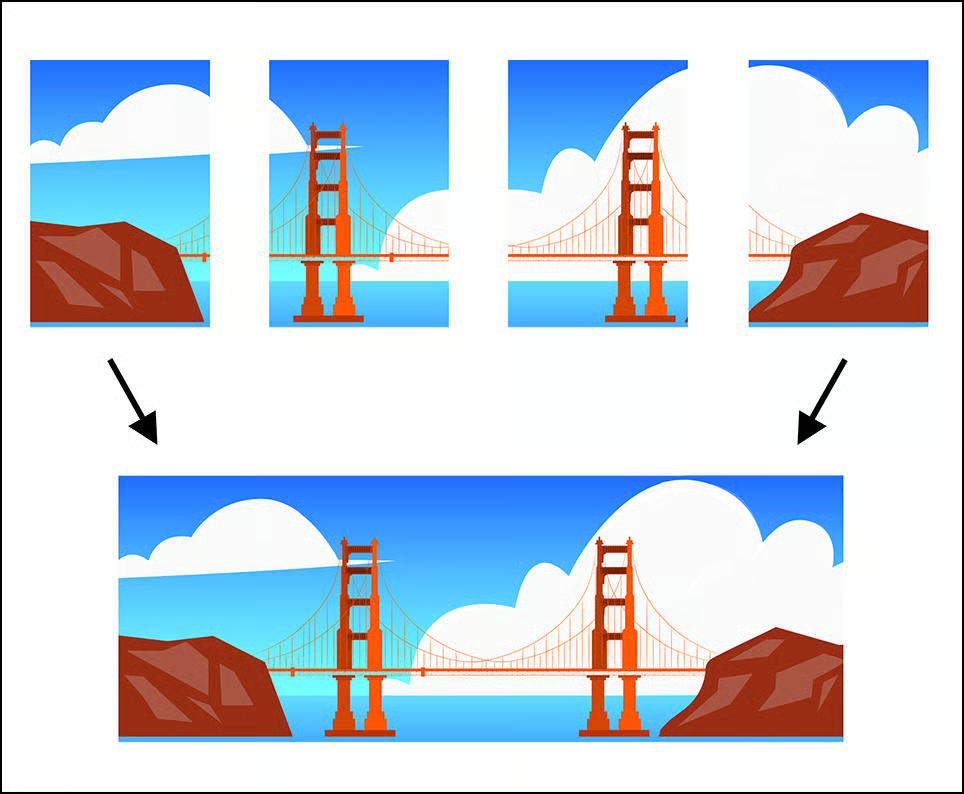
Import RAWs, apply consistent lens profile (if available), sync exposure/WB, and export 16-bit TIFFs or send RAWs directly to a stitcher that supports them. In PTGui or Hugin, define lens type as rectilinear (not fisheye) for the XF 8–16mm and typical Nikon UWAs. Establish control points, optimize yaw/pitch/roll and lens parameters, and check the optimizer report for error outliers. Industry overlap recommendations: ~25–30% for ultra-wides and fisheyes; 20–25% for longer focal lengths. PTGui review and workflow insights
Cleanup & Enhancement
- Tripod/nadir patch: Capture a clean nadir and patch with clone/heal tools or a logo plate. Many tools offer AI-assisted tripod removal.
- Color and noise: Unify color temperature across the set; apply gentle noise reduction to shadow areas, especially at ISO 800+.
- Leveling: Use horizon/vertical alignment tools to correct roll/yaw/pitch and maintain straight architecture lines.
- Export: For VR, export equirectangular 2:1 (e.g., 10000 × 5000 px or 16000 × 8000 for high-res). Mind platform limits.
For a foundation on DSLR 360 capture and stitching concepts, Oculus’ guide is concise and practical. Using a DSLR to shoot and stitch a 360 photo
Video: Multi-row panorama essentials
Prefer learning visually? This video covers important field and stitching practices.
Useful Tools & Resources
Software
- PTGui (fast, robust control-point editing and masking)
- Hugin (open-source alternative)
- Lightroom / Photoshop (RAW prep and retouching)
- AI tripod removal tools (content-aware fill, generative erase)
Hardware
- Panoramic heads: Nodal Ninja, Leofoto, Really Right Stuff
- Carbon fiber tripods with leveling bases
- Wireless remote shutters
- Pole extensions / vehicle mounts with safety tethers
For resolution planning versus focal length, the Panotools wiki is a classic resource. DSLR spherical resolution
Disclaimer: software/hardware names provided for search reference; check official sites for details.
Common Mistakes & How to Avoid Them
- Parallax error: Not aligning the entrance pupil leads to stitching ghosts—calibrate the panoramic head.
- Exposure flicker: Auto exposure or Auto WB creates seams—lock both in Manual.
- Insufficient overlap: Too few frames with ultra-wides; target 25–30% overlap.
- Tripod shadows and footprints: Shoot and patch a clean nadir.
- High ISO noise at night: Use a stable tripod and longer shutter before raising ISO.
- Flare: Avoid pointing directly at strong light sources; shade the lens with your hand or reposition.
Real-World Case Studies
Indoor Real Estate (D850 + 16–35mm at 16mm)
Set f/8, ISO 100–200, Manual WB (3500–4000K if tungsten), and bracket ±2 EV. Use 10–12 around for three rows (0°, ±45°), plus zenith/nadir. Mask windows using the window-optimized bracket. The D850’s base ISO latitude preserves highlight detail and avoids HDR halos.
Outdoor Sunset (D850 + 14–24mm at 14mm)
At ISO 64–100, f/8–f/11, target shutter around 1/125 s. Shoot 8–10 around at 0°, plus ±45° rows, zenith/nadir. If the sun is in-frame, consider a second pass with your hand shading the lens just off-frame; blend to minimize flare.
Event Crowd (Fuji X + XF 8–16mm at 10–12mm)
Use 1/200–1/400 s at f/5.6–f/8, ISO 400–800. Do two passes to catch clean gaps. In PTGui, use masks to keep one clear instance of each area, reducing ghosting.
Rooftop or Pole Capture
Keep the rig low and secure. Favor a fisheye or fewer frames if wind is strong. For rectilinear multi-row, use faster shutter speeds (1/125–1/250 s) and higher ISO to reduce motion blur. Safety first: tether everything.
Frequently Asked Questions
-
Can I actually mount the Fujifilm XF 8–16mm f/2.8 on my Nikon D850?
No. The XF 8–16mm is X-mount and not compatible with the Nikon F-mount. Use it on a Fujifilm X body, or use a comparable Nikon ultra-wide (14–24mm, 16–35mm) or a fisheye on the D850. The panorama techniques in this guide apply to both.
-
Is the XF 8–16mm wide enough for single-row 360°?
Not for full spherical coverage. Rectilinear 8mm (APS-C) requires multi-row capture—typically 12 around per row across 2–3 rows plus zenith and nadir. A fisheye lens is the usual choice for single-row 360°.
-
Do I need HDR for interiors with bright windows?
Usually yes. Bracket ±2 EV (3 or 5 frames) to preserve both window views and interior shadows. Keep WB and focus locked to avoid stitching issues.
-
What ISO range is safe on the D850 for low light panoramas?
Base ISO 64–200 is ideal. ISO 400–800 remains very clean with tripod support; ISO 1600–3200 is usable with careful noise reduction. Prefer longer shutters over higher ISO when possible.
-
How do I avoid parallax issues with these ultra-wide rectilinear lenses?
Use a panoramic head and align the entrance pupil. Set up near/far vertical references in the frame, rotate the camera, and slide the rail until the near/far alignment stays constant through rotation. Mark the rail positions for quick repeatability.
For a broader panorama FAQ and kit suggestions across systems, this guide is a helpful complement. DSLR virtual tour FAQ and lens guide
Safety, Care, and Data Integrity
- Wind and height: Sandbag the tripod; add a tether. Avoid extending the center column in gusts.
- Lens protection: The XF 8–16mm has a bulbous front element—use the fixed hood wisely and watch for protruding obstacles.
- Redundancy: Shoot a second full round when feasible; it provides insurance against motion, blinkers, or stitching outliers.
- Backup: Copy your cards to two separate drives at day’s end; keep one off-site if traveling.
If you’re new to perfectly setting up a panoramic head, this step-by-step from industry training is concise and reliable. Set up a panoramic head for high-end 360 photos