Why This Camera & Lens Are Great for Panoramas
If you want to learn how to shoot panorama with Nikon D750 & Sony FE 14mm f/1.8 GM, you’re aiming for a razor-sharp, ultra‑wide, low‑light‑capable setup. The Nikon D750 is a full-frame DSLR with a 24.3MP sensor (pixel pitch ~5.97 µm), excellent dynamic range at base ISO (about 14+ stops), and reliable ergonomics—ideal for consistent, manual-controlled multi-shot panoramas. The Sony FE 14mm f/1.8 GM is a rectilinear ultra‑wide prime with superb edge-to-edge sharpness, very low coma and chromatic aberration, and a fast f/1.8 aperture that excels for night scenes and astro.
Important compatibility note: Sony FE 14mm f/1.8 GM is a Sony E‑mount lens and does not physically adapt to a Nikon F‑mount DSLR like the D750 while retaining infinity focus or aperture control. To keep this exact lens, you need a Sony E‑mount body. If you want to stay with the Nikon D750 body, use an equivalent 14mm F‑mount option such as the Sigma 14mm f/1.8 Art (Nikon F), the Nikon AF‑S 14‑24mm f/2.8G at 14mm, or the Samyang/Rokinon 14mm f/2.8. All panorama counts and techniques below apply identically to a 14mm rectilinear on full frame.
Quick Setup Overview
- Camera: Nikon D750 — Full Frame (36×24mm), 24.3MP, strong DR at ISO 100, reliable manual control, no IBIS.
- Lens: Sony FE 14mm f/1.8 GM — Rectilinear ultra‑wide prime (114° diagonal FOV), very sharp by f/2.8–f/5.6, low CA, minimal distortion. Note: not natively compatible with Nikon D750; use a 14mm F-mount equivalent or a Sony E‑mount body.
- Estimated shots & overlap (full 360×180 with 14mm rectilinear on FF):
- Efficient: 6 shots at −55°, 6 at 0°, 6 at +55° + 1 zenith + 1 nadir (≈20 shots), ~30% overlap.
- Quality: 8 shots at −45°, 8 at 0°, 8 at +45° + 1 zenith + 1 nadir (≈26 shots), ~30–35% overlap.
- Minimal (non‑critical scenes): 8 around at ~+15° tilt + 1 zenith + 1 nadir (≈10 shots), risk of stitching stress near poles.
- Difficulty: Intermediate — rectilinear ultrawide needs careful nodal alignment; more shots than fisheye.
Planning & On-Site Preparation
Evaluate Shooting Environment
Walk the scene and note light direction, moving elements (people, trees, waves), reflective or transparent surfaces (windows, cars, glossy floors), and any strong point lights (street lamps, the sun). For glass, shoot as close as safely possible (a few centimeters) and shade the lens to reduce reflections and ghosting. Decide whether you need HDR brackets to hold both shadows and highlights, especially at sunset or indoors with bright windows.
Match Gear to Scene Goals
The Nikon D750 offers high dynamic range and clean ISO up to ~1600, with best quality at ISO 100–400. That’s excellent for interiors and dusk scenes when paired with a tripod. A 14mm rectilinear lens like the Sony FE 14mm f/1.8 GM (or a Nikon‑mount alternative) keeps straight lines straight—perfect for architecture and real estate—at the cost of needing more frames than a fisheye. The f/1.8 maximum is great for night skies, but for panoramas you’ll typically stop down to f/5.6–f/8 for uniform sharpness.
Pre-shoot Checklist
- Batteries charged, ample storage, lens and sensor cleaned.
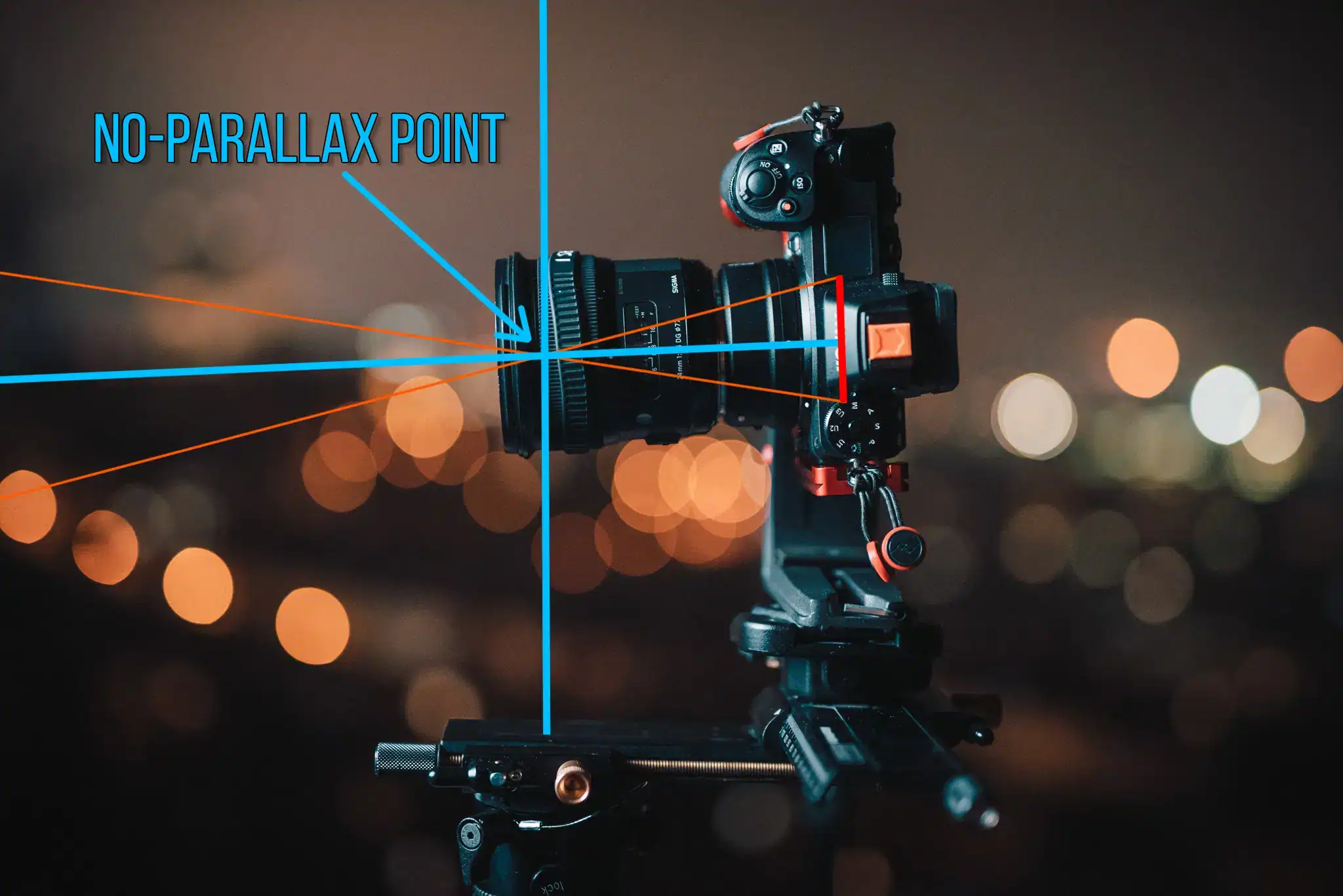
- Tripod leveled; panoramic head calibrated to the lens’s entrance pupil (no‑parallax point).
- Safety: assess wind, crowds, rooftop edges; use tethers and weight bags; in cars, use secure rigid mounts and avoid traffic hazards.
- Backup workflow: shoot a second full rotation if time allows to cover stitching errors or unexpected motion.
Essential Gear & Setup
Core Gear
- Panoramic head: Lets you rotate around the lens’s entrance pupil to eliminate parallax. Use a rail to position the lens front-back until near and far objects don’t shift while panning.
- Stable tripod with a leveling base: A leveling base speeds setup and keeps rows consistent, reducing software warping.
- Remote trigger or app: On the D750, use a simple cable release or set Exposure Delay to avoid mirror shock.
Optional Add-ons
- Pole or car mount: For elevated or moving shots. Use safety tethers, minimize wind profile, and keep speeds low to reduce vibration.
- Continuous lights or flashes: For interior fills; ensure consistent color temperature and power across frames.
- Weather protection: Rain covers, microfiber cloths, and silica packs to keep optics clear.
Step-by-Step Shooting Guide
Standard Static Scenes
- Level the tripod and align the nodal point. Put two vertical objects (one near, one far) in frame. Pan the rig; adjust the rail until their relative position doesn’t shift. Mark the rail for your 14mm setting.
- Set manual exposure and lock white balance. Turn off Auto ISO. Pick a WB preset (Daylight, Tungsten) or dial Kelvin to match the scene so all frames color-match.
- Focus: Switch to manual focus. At 14mm, hyperfocal at f/8 on full frame is roughly 0.8 m. Focus once and tape the ring if needed.
- Capture the rows. For efficiency, shoot 6 frames at −55°, 6 at 0°, 6 at +55°, then a zenith and a nadir. Overlap ~30% between frames.
- Nadir shot: After the main set, remove the tripod or shift it slightly and shoot a clean ground plate for patching.
HDR / High Dynamic Range Interiors
- Bracket exposures around ±2 EV to hold window detail and shadow tone. The D750 bracketing and exposure delay combo helps reduce vibration.
- Keep WB and focus locked for all brackets. Shoot each bracket series per camera position before rotating.
- Consider 5‑ or 7‑frame brackets in ultra-contrasty scenes; merge to 32‑bit HDR or exposure-fuse in PTGui/Hugin.
Low-Light / Night Scenes
- Use a tripod; disable lens stabilization if present (the 14GM has none). Start at f/4–f/5.6, ISO 100–400, and lengthen shutter (1–10 s) as needed.
- Enable Exposure Delay Mode (D750) or use a remote to avoid mirror and shutter shock on long exposures.
- Watch for star movement if doing astro; keep exposures within the 500/N rule if necessary, or accept minor trails and rely on overlap for blending.
Crowded Events
- Do two passes: a fast “coverage” pass, then a careful pass as gaps appear. Ask nearby people to hold for 2–3 seconds when possible.
- Mask moving subjects in post. Shoot extra frames of problem zones (doorways, cashiers, crossing pedestrians) to give yourself clean plates.
Special Setups (Pole / Car / Drone)
- Poles: Keep to calm winds. Use a lightweight head and minimal gear. Shoot fewer frames quickly to reduce movement between shots.
- Car mounts: Use rigid suction or clamp mounts on static vehicles when possible. Avoid public-road shooting; vibrations ruin overlap alignment.
- Drones: 14mm rectilinear is not typical on drones; follow your airspace regs and use the drone’s native pano modes when available.
Recommended Settings & Pro Tips
Exposure & Focus
| Scenario | Aperture | Shutter | ISO | Notes |
|---|---|---|---|---|
| Daylight outdoor | f/8–f/11 | 1/100–1/250 | 100–200 | Lock WB (Daylight); manual mode for consistency |
| Low light/night | f/4–f/5.6 | 1/2–10 s | 100–400 (up to 800 if needed) | Tripod + exposure delay or remote; watch wind |
| Interior HDR | f/8 | Bracket ±2 EV | 100–400 | Merge or fuse to control windows and lamps |
| Action / moving subjects | f/5.6–f/8 | 1/200+ | 400–800 | Freeze motion; consider two-pass capture |
Critical Tips
- Manual focus at hyperfocal distance (~0.8 m at 14mm f/8 on full frame) for edge-to-edge consistency.
- Nodal calibration: Use the near/far object test and mark your rail once; re-check if you change aperture or focus significantly.
- White balance lock: Set Kelvin (e.g., 5500K daylight, 3200K tungsten) to avoid stitch seams from color shifts.
- RAW over JPEG: The D750’s RAW files hold extra DR and color latitude, critical for HDR and mixed lighting.
- Stabilization: Disable stabilization on tripod; with the D750 there is no IBIS, so just keep the rig solid and use delay/remote.
- D750 body tips: Enable Live View with Virtual Horizon for leveling; use Exposure Delay (1–3s) to damp mirror shock.
Stitching & Post-Processing
Software Workflow
Import and cull in Lightroom/Bridge, correct lens chromatic aberration if needed, and synchronize white balance across the set. For stitching, PTGui is a fast, industry-favorite tool with robust control points and masking; Hugin is a solid open-source alternative. Rectilinear ultrawide lenses typically need 25–35% overlap to ensure strong control points. Expect more frames vs a fisheye, but straighter edges and better architectural lines. After a first stitch, refine yaw/pitch/roll and horizon, then render to a high-bit TIFF for finishing. See PTGui’s capabilities discussed in this review. PTGui is a top-tier choice for complex panoramas.
Cleanup & Enhancement
- Nadir patch: Use a dedicated nadir frame or PTGui’s Viewpoint Correction; finish with Photoshop’s clone/heal or AI patch tools.
- Color and noise: Balance mixed light with selective HSL or Color Mixer; apply modest noise reduction for high-ISO or night frames.
- Leveling: Set the panorama’s horizon and anchor verticals; ensure straight architectural lines for real estate and interiors.
- Export: For VR, deliver equirectangular 2:1 JPEG/TIFF (e.g., 16k for high-res tours). Keep an archived master TIFF/PSB.
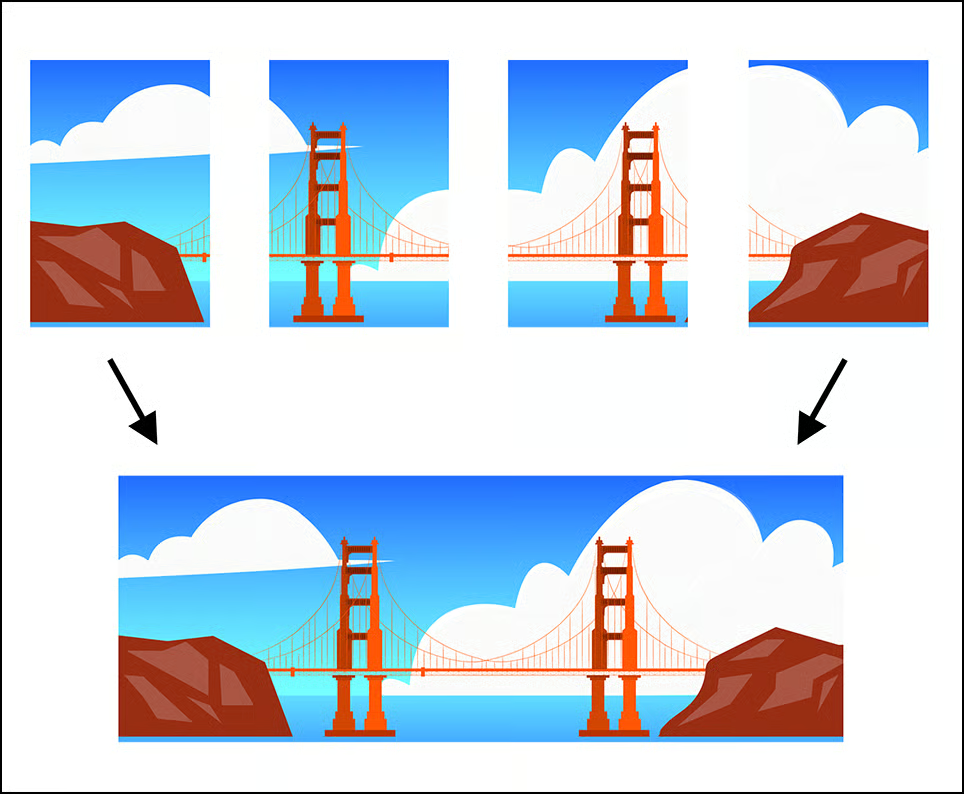
For a broader guide on setting up a panoramic head and workflow for high‑end 360 images, this resource is helpful. How to set up a panoramic head for high-end 360 photos.
Video: Practical panoramic head setup and capture flow for consistent stitches.
Useful Tools & Resources
Software
- PTGui panorama stitching
- Hugin (open-source)
- Lightroom / Photoshop for RAW, color, and cleanup
- AI tripod removal and nadir patch tools
Hardware
- Panoramic heads: Nodal Ninja / Leofoto / Fanotec
- Carbon fiber tripods and leveling bases
- Wireless remotes or intervalometers
- Pole extensions and car mounts (with safety tethers)
Disclaimer: software/hardware names provided for search reference; check official sites for details.
If you’re new to pano heads and want a quick foundations refresher, this guide is a good start. Panoramic head tutorial and best practices.
Common Mistakes & How to Avoid Them
- Parallax error → Always align to the lens’s entrance pupil; re-check after changing focus or aperture.
- Exposure flicker → Shoot in full manual; fix WB; avoid Auto ISO.
- Tripod shadows and footprints → Shoot a dedicated nadir and patch in post.
- Ghosting from moving subjects → Take extra frames and use masks; shoot faster shutters in windy scenes.
- Night noise → Keep ISO low (100–400 on D750 when possible) and lengthen shutter with exposure delay.
- Insufficient overlap → Maintain 25–35% overlap; more if the scene lacks detail (blank walls, sky).
Real-World Case Studies
Indoor Real Estate
Set the D750 to ISO 100–200, f/8, and bracket ±2 EV to hold window views. Use a 3‑row capture at 14mm for straight architectural lines. Lock WB to 4000–4500K for mixed daylight/tungsten, then fine-tune in post. Keep the tripod away from reflective surfaces to avoid complicated reflections around the nadir.
Outdoor Sunset
Arrive 30 minutes early to lock your nodal mark and test overlaps. Shoot a standard 3‑row. As the sun sets, adjust shutter time only to maintain consistent exposure. Consider a second full rotation 10 minutes later to choose the best sky in post or to blend a better horizon.
Event Crowds
Use faster shutters (1/200–1/320) at ISO 400–800 and f/5.6–f/8 to reduce motion blur. Shoot two passes and take extras of key sectors (stage, entryways). In post, pick the cleanest frames per sector and mask to a single composite.
Rooftop / Pole
Balance wind risk against pole height. Keep capture speed high: minimal rows, faster rotation, and slightly higher ISO to gain shutter speed. Wear a harness when near edges; tether your rig. Avoid overhanging the street; respect local safety regulations.
Frequently Asked Questions
- Can I shoot handheld panoramas with the Nikon D750?
Yes, for partial panos or low‑detail scenes. For 360×180 work, a tripod and pano head are strongly recommended to control parallax and overlap, especially with a rectilinear 14mm.
- Is the Sony FE 14mm f/1.8 GM wide enough for single‑row 360?
For full spheres, you typically need multi‑row at 14mm rectilinear. You can attempt a minimal set (8–10 frames + zenith/nadir) but risk gaps and heavy stretching near poles. Multi‑row (e.g., 6×3 + Z/N) is more reliable.
- Can I mount the Sony 14mm f/1.8 GM on a Nikon D750?
No. It’s a Sony E‑mount lens and cannot be adapted to Nikon F‑mount DSLRs with proper infinity focus/aperture control. Use a Nikon‑mount 14mm alternative on the D750, or use a Sony E‑mount body with the 14GM.
- Do I need HDR for interiors with bright windows?
Usually yes. Bracketing ±2 EV (3–7 frames) protects window highlights and interior shadows. Exposure fusion or HDR in PTGui/Hugin evens out contrast.
- What ISO range is safe on the D750 for low light?
For tripod‑based panoramas, keep ISO 100–400 when possible for maximum DR and color fidelity. ISO 800–1600 is usable; beyond that, expect more noise and reduced DR.
- How do I avoid parallax issues?
Use a proper pano head and align the entrance pupil. Do the near/far object test, mark the rail, and avoid changing focus after calibration. Re‑check if you bump the rig.
- Can I create custom settings on the D750 for pano?
Yes. Save a User Setting (U1/U2) with manual mode, Auto ISO OFF, fixed WB, manual focus, and Exposure Delay ON. This speeds up field setup.
- What’s the best tripod head for this setup?
A multi‑row panoramic head with fore‑aft rail and rotator detents (e.g., Nodal Ninja/Fanotec, Leofoto) ensures consistent overlap and repeatable nodal alignment.
Safety, Care, and Data Protection
Always tether on rooftops, weigh your tripod in wind, and keep hands on the pole when elevated. Avoid roadside and crowd hazards. Use lens hoods to minimize impacts and flare. For data integrity, write to dual cards if available (the D750 has dual SD slots) and back up to two locations after each shoot. Create a simple log of shot counts and rows per scene to catch missing frames before leaving the location.
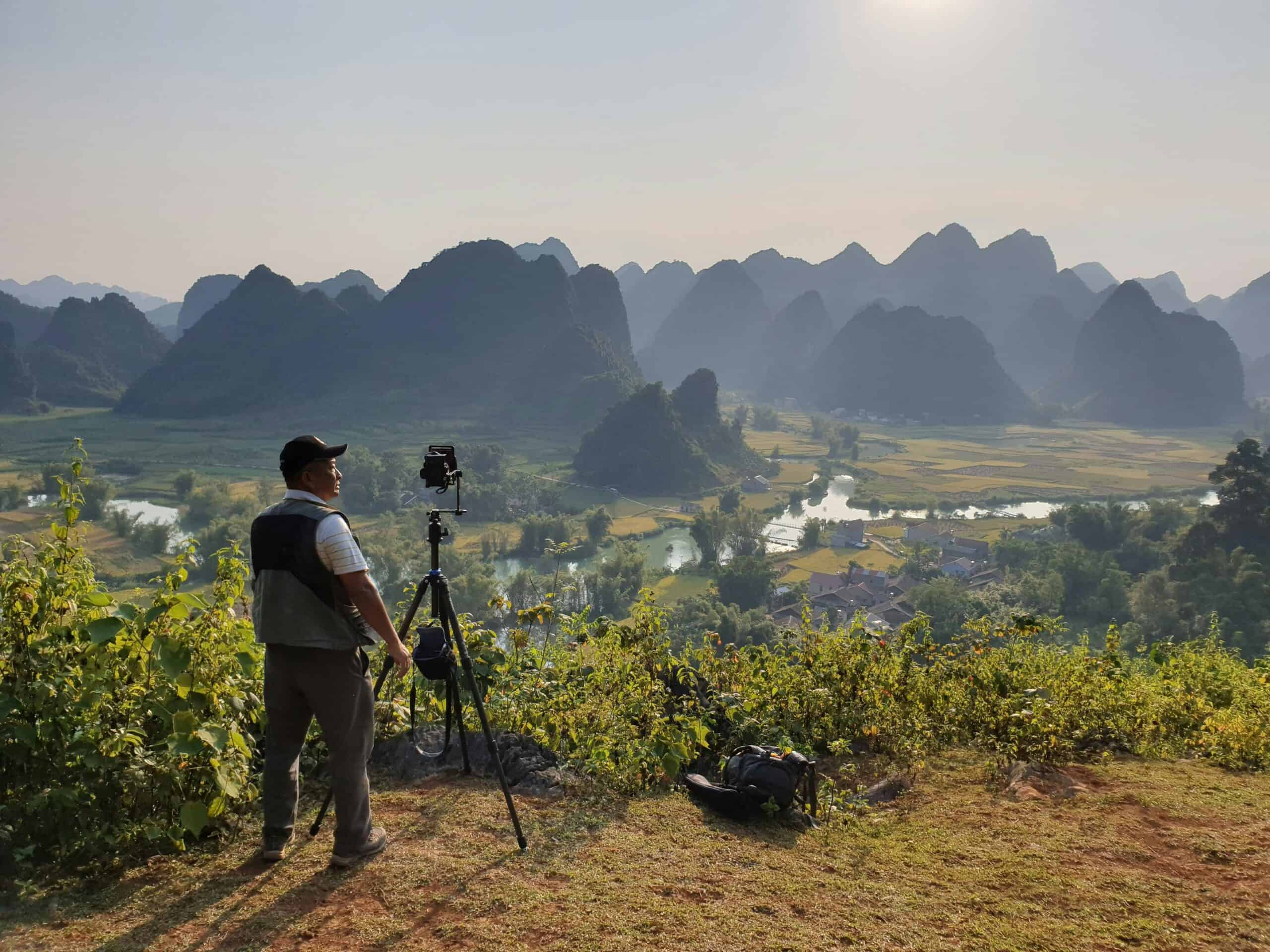
For a broader discussion of DSLR/MLS pano capture and stitching for VR delivery, review this guide. Using a DSLR or mirrorless camera to shoot and stitch a 360 photo.
Final Thoughts
If your goal is how to shoot panorama with Nikon D750 & Sony FE 14mm f/1.8 GM, remember that while the D750 is a stellar full‑frame body for panoramas, the Sony 14GM is not mechanically compatible with it. Pair the D750 with a Nikon‑mount 14mm alternative and follow the same capture patterns, or use the 14GM on a Sony E‑mount body. Either way, a well‑calibrated panoramic head, disciplined manual exposure and white balance, and clean overlap will deliver seamless, high‑resolution 360s ready for virtual tours or large prints.
Disclaimer: Always check the latest documentation for your camera, lens, head, and stitching software, and confirm local regulations for elevated or vehicle-mounted shooting.