Why This Camera & Lens Are Great for Panoramas
The Nikon D750 paired with the Sigma 8mm f/3.5 EX DG Circular Fisheye is a proven, budget-friendly rig for 360° panoramas. The D750’s 24.3MP full-frame sensor (35.9 × 24 mm, ~6 µm pixel pitch) delivers excellent dynamic range at base ISO (~14+ EV) and low noise up to ISO 1600–3200, which is ideal for clean skies, interior shadows, and smooth gradients. The body is robust, has U1/U2 custom modes to speed up pano setup, a tilting screen for low/high angles, and reliable auto-bracketing for HDR. Autofocus is fast, but for panoramas you’ll typically use manual focus at hyperfocal distance for consistency.
The Sigma 8mm f/3.5 is a circular fisheye that projects a 180° field of view in all directions on full-frame, forming a circular image. For 360 capture, that means fewer shots, faster shooting, and fewer seams—especially helpful in changing light or crowds. Stop down to f/5.6–f/8 for peak sharpness and better corner quality. Chromatic aberrations are typical of fisheye lenses but are easily corrected in modern stitching software. Since the D750 lacks in-body stabilization and the lens has no optical stabilization, plan to shoot from a sturdy tripod or a well-held pole.
Quick Setup Overview
- Camera: Nikon D750 — Full-frame (FX), 24.3MP, excellent dynamic range at ISO 100, practical low noise up to ISO 1600–3200.
- Lens: Sigma 8mm f/3.5 EX DG Circular Fisheye — circular fisheye, very wide 180° FOV, sharpest around f/5.6–f/8, moderate CA that’s easy to fix.
- Estimated shots & overlap (field-tested):
- 3 around at 120° + nadir (optional) — fastest field workflow, good overlap.
- 4 around at 90° + nadir — safer overlap for complex scenes and precise stitching.
- Zenith is often covered by the circular frame; confirm in software and add a zenith shot if needed.
- Difficulty: Easy on tripod (2/5). Handheld/pole (3–4/5) due to parallax and leveling demands.
Planning & On-Site Preparation
Evaluate Shooting Environment
Survey the scene for lighting extremes, moving subjects, reflective surfaces, and wind. Indoors, watch for mirrors and glass—stand a bit farther to reduce your reflection and flare. Outdoors, plan your rotation order to manage moving clouds and shifting sun. If you must shoot through glass, get the lens as close as safely possible (but do not touch with the protruding fisheye element) and use a cloth to shade reflections.
Match Gear to Scene Goals
With its strong dynamic range, the D750 handles bright windows and deep shadows well when bracketed. Indoors, ISO 100–400 is ideal; 800 is still very clean if you must shorten shutter speeds. The circular fisheye drastically reduces shot count, so you can nail a 360 before the light changes or people shift. Expect more distortion (normal for fisheye), but stitching software understands this projection and compensates during alignment.
Pre-shoot Checklist
- Charge batteries, clear high-speed cards, and clean both lens and sensor. Fisheye elements show dust easily.
- Level your tripod and verify pano head calibration for the no-parallax point.
- Safety: weigh down tripod in wind; use tethers on rooftops or poles; inspect clamps and plates.
- Backup workflow: capture a second complete round at a different yaw start to ensure you have patch choices.
Essential Gear & Setup
Core Gear
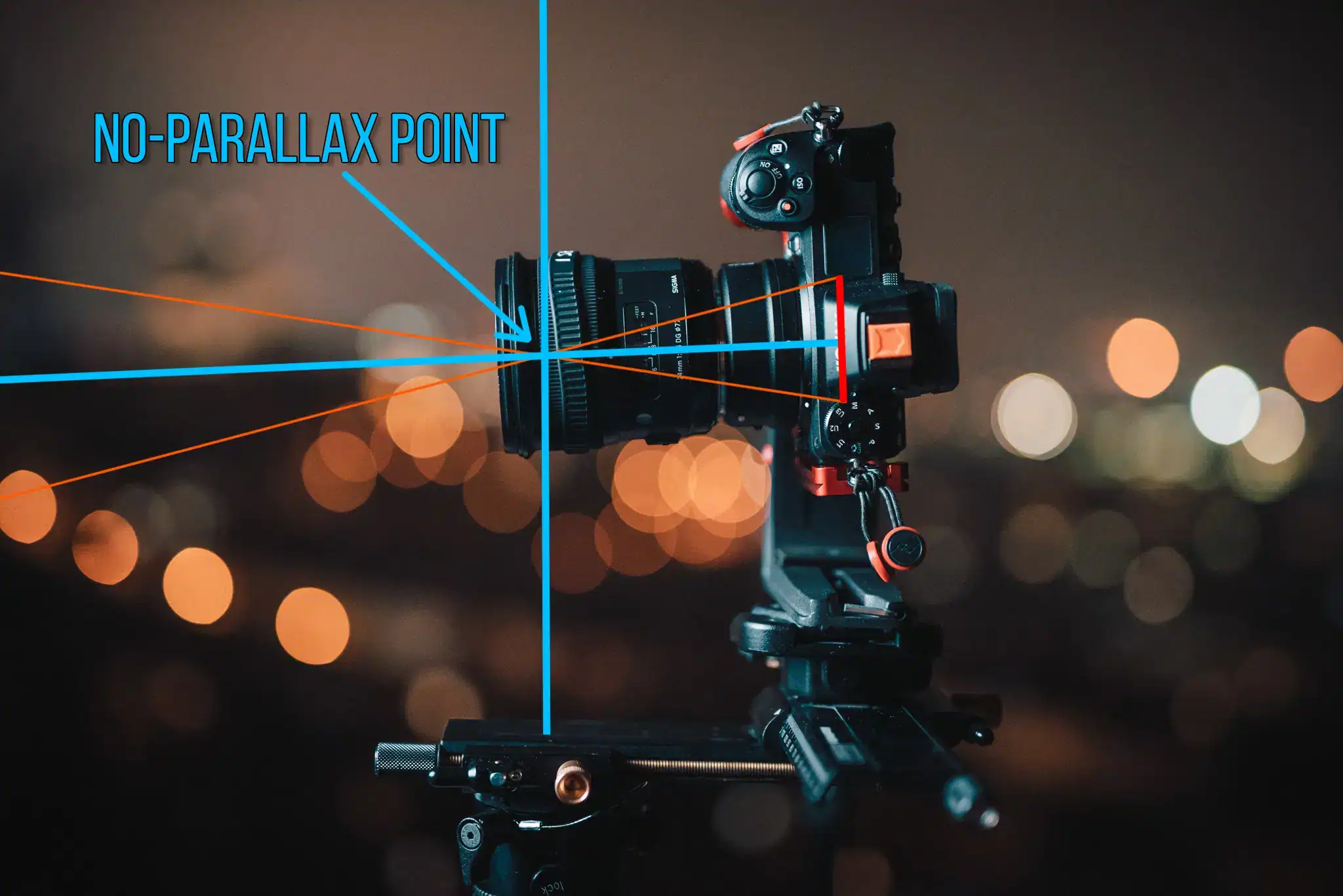
- Panoramic head: Align the camera so rotation occurs around the lens’s no-parallax point (entrance pupil). This minimizes stitching errors when near objects overlap.
- Stable tripod with leveling base: A leveled base speeds precise yaw increments and keeps horizons straight.
- Remote trigger or Nikon app: Use a cable release or SnapBridge-compatible trigger to avoid shake. Enable exposure delay mode (1–3 s) if needed.
Optional Add-ons
- Pole or car mount: Useful for crowds or over obstacles. Safety first—use a tether, stay within weight limits, and consider wind loads.
- Lighting aids: Small LED panels for shadow fill in dark interiors; keep them off while rotating if they cause inconsistent light.
- Weather covers: Protect the D750 and the Sigma’s exposed front element from mist or rain. Carry a microfiber cloth.
Step-by-Step Shooting Guide
Standard Static Scenes
- Level and align: Level the tripod with the leveling base. Mount the D750 on the pano head and slide the rails to align the Sigma 8mm’s entrance pupil over the rotation axis. A practical starting point: the entrance pupil lies forward of the sensor plane; start with the upper-rail scale around the lens mount’s center and refine using a parallax test on a near object (0.5–1 m) against a far background.
- Manual exposure and white balance: Set manual mode. Meter the brightest part you need to preserve and expose to protect highlights. Set white balance to a fixed preset (Daylight, Tungsten) or a Kelvin value (e.g., 5600K). Disable Auto ISO.
- Capture sequence: With 8mm circular fisheye, shoot either:
- 3 shots at 120° yaw intervals (0°, 120°, 240°) + 1 nadir.
- 4 shots at 90° yaw intervals (0°, 90°, 180°, 270°) + 1 nadir for safer overlap.
Use the same exposure for all images in the round unless bracketing for HDR.
- Nadir shot: Tilt down and shoot the ground for tripod removal. If using a rotator with an offset, you can also shoot a handheld nadir and patch later.
HDR / High Dynamic Range Interiors
- Bracket to capture windows and shadows: Use the D750’s auto bracketing to capture 5–7 frames at 1 EV steps, or do 3 frames at ±2 EV manually. Keep WB locked.
- Shoot the full rotation for each exposure level in the same order to make batch stitching simpler.
Low-Light / Night Scenes
- Use a tripod, exposure delay, and a remote trigger. Target ISO 100–400 for maximum quality; if wind or movement forces shorter shutter speeds, ISO 800–1600 remains clean on the D750.
- Open to f/4–f/5.6 and use longer exposures. Avoid touching the camera; use mirror lock-up or exposure delay to reduce vibration.
Crowded Events
- Two-pass strategy: First pass quickly for coverage. Second pass wait for gaps or better body positions. In post, mask moving subjects for optimal continuity.
- Consider the 4-around method for more overlap and easier masking at seams.
Special Setups (Pole / Car / Drone)
- Pole: Keep rotations slow to reduce sway. Use a safety tether, balance the rig, and watch for overhead hazards. The fisheye’s reduced shot count shines here—3 around + nadir is realistic.
- Car mounts: Only on private property with permissions. Tighten all clamps, use safety cables, and plan routes to avoid vibration. Shoot when stationary for best sharpness.
- Drones: Not typical for this DSLR combo; consider a lighter mirrorless setup if aerial is required.
Recommended Settings & Pro Tips
Exposure & Focus
| Scenario | Aperture | Shutter | ISO | Notes |
|---|---|---|---|---|
| Daylight outdoor | f/8–f/11 | 1/100–1/250 | 100–200 | Lock WB (Daylight or 5600K) |
| Low light/night | f/4–f/5.6 | 1/4–1/30 | 100–800 (up to 1600 if needed) | Tripod, exposure delay, remote trigger |
| Interior HDR | f/8 | Bracket (5–7 shots, 1 EV) | 100–400 | Protect highlights; fix WB |
| Action / moving subjects | f/5.6–f/8 | 1/200+ | 400–800 | Freeze motion, consider 4-around for overlap |
Critical Tips
- Manual focus at hyperfocal: On the Sigma 8mm, set focus near the ∞ mark and stop down to f/5.6–f/8 to keep near-to-far sharp. Verify at 100% on the D750’s LCD.
- Nodal calibration: Perform a simple parallax test—line up a near object with a distant one and rotate. Adjust the fore/aft rail until there’s no relative shift. Mark your rail scale for quick setups.
- White balance lock: Mixed lighting can cause color seams. Use a fixed WB preset or Kelvin value across the entire pano.
- RAW workflow: Shoot RAW for maximum dynamic range, precise CA removal, and color consistency.
- Stabilization: The D750 has no IBIS; the Sigma has no OS. On tripod, stabilization isn’t needed—focus on eliminating vibrations with a remote and delay timer.
Stitching & Post-Processing
Software Workflow
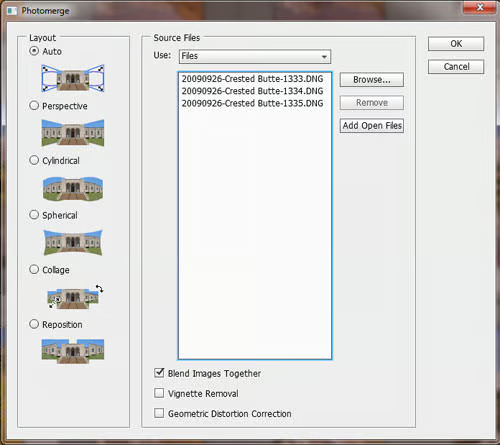
Import RAW files and apply consistent basic adjustments (WB, lens CA removal) before stitching. In PTGui or Hugin, set the lens type to circular fisheye and the focal length to 8mm. The software will find control points and optimize. Fisheye panoramas stitch easily because of the lens’s predictable projection and generous overlap, but you’ll still want to inspect control points and tweak masks near seams. Industry guidelines suggest ~30–40% overlap for fisheye; 20–25% can work but offers less room for masking. For learning pano heads and no-parallax setups, see this panoramic head tutorial at 360 Rumors for visual guidance. Panoramic head fundamentals.
Cleanup & Enhancement
- Tripod/nadir patch: Export a nadir viewpoint and patch using content-aware fill or a cloned tile. PTGui’s Viewpoint Correction and masking tools are excellent. You can also use VR-specific patching tools.
- Color and noise: Apply gentle noise reduction for night scenes; maintain detail in textures by masking NR selectively.
- Leveling: Use horizontal/vertical line constraints in PTGui or Hugin to set a perfect horizon and correct roll/pitch/yaw.
- Export: Equirectangular JPEG or 16-bit TIFF. For virtual tours, 12000 × 6000 px is a practical target from a 24MP source; your achievable width depends on overlap and optimization. See PanoTools’ spherical resolution notes for deeper math. DSLR spherical resolution considerations.
To evaluate PTGui’s capabilities and performance on large HDR sets, this review offers a grounded perspective: Fstoppers on PTGui for panoramas.
Recommended Learning Video
For a concise visual walkthrough of pano fundamentals and shooting discipline, watch the following tutorial:
For a DSLR-to-360 pipeline overview and best practices from a platform perspective, see Oculus’ creator notes on DSLR 360s. Using a DSLR to shoot and stitch a 360 photo.
Useful Tools & Resources
Software
- PTGui panorama stitching
- Hugin open source
- Lightroom / Photoshop for RAW and finishing
- AI tripod removal or patching tools (e.g., content-aware fill)
Hardware
- Panoramic heads (Nodal Ninja, Leofoto, Fanotec)
- Carbon fiber tripods and leveling bases
- Wireless remote shutters / intervalometers
- Pole extensions / car mounts with safety tethers
Disclaimer: Names provided for search reference; check official sites for the latest specs, compatibility, and safety instructions.
Field-Tested Scenarios
Indoor Real Estate
Mount the D750 on a leveled tripod in the room center. Use f/8, ISO 100–200, and a 5–7 shot bracket at 1 EV steps to balance bright windows and lamp-lit corners. Shoot 4-around + nadir for easiest seam placement away from windows. Turn off flickering light sources or balance color temperatures. The Sigma’s 8mm FOV keeps shot count low, speeding multi-room coverage.
Outdoor Sunset
Expose for the sky highlights to avoid clipping; f/8, ISO 100–200, 3-around + nadir. If the sun is near the frame edge, shoot a quick second pass to capture a clean sunburst and later blend the cleaner sun region. Expect some flare with a fisheye—shield with your hand just out of frame when possible.
Event Crowds
Handheld or monopod shooting can work thanks to the 3-around approach, but parallax increases with near subjects. Keep the camera vertical, rotate from your torso, and shoot quickly to minimize subject movement across frames. In post, use masks to handle ghosting on people at seams.
Rooftop / Pole Shooting
Use a lightweight carbon pole and a safety tether. Add a small counterweight to reduce sway. Keep shutter speeds up (1/100–1/250 at ISO 200–800, f/5.6–f/8). Aim for 3-around + nadir; do a quick second round if wind gusts during the first.
Car-Mounted Capture
Mount only when stationary and permitted. Use 4-around to increase overlap because small vibrations reduce sharpness. Keep ISO modest but use 1/200+ shutter. Always inspect every clamp before shooting.
Common Mistakes & How to Avoid Them
- Parallax error: Not aligning the entrance pupil. Spend five minutes calibrating once—then mark your rail positions for the D750 + Sigma 8mm.
- Exposure flicker: Using auto exposure between frames. Shoot in full manual or bracket with fixed base settings.
- Color shifts: Auto white balance changes per frame. Lock WB to a preset or Kelvin.
- Tripod shadows and footprints: Always capture a nadir and be prepared to patch.
- High ISO noise: Night scenes tempt high ISO; the D750 looks great up to ~1600, but use a tripod and longer exposures where possible.
- Front element damage: The Sigma’s bulbous front is exposed—use the cap between locations, never place lens face-down, and be cautious near glass or walls.
Frequently Asked Questions
- Can I shoot handheld panoramas with the Nikon D750?
Yes, especially with the 8mm fisheye since it needs only 3–4 around shots. Keep the camera perfectly vertical, rotate from one point (your body as the “pivot”), and use fast shutter speeds (1/200+). Expect more stitching cleanup compared with a pano head.
- Is the Sigma 8mm f/3.5 wide enough for a single-row 360?
Absolutely. With a circular fisheye on full-frame, you can often get full coverage with 3-around + nadir, or 4-around + nadir for safer overlap. The zenith is commonly covered, but confirm in your stitcher. Add a zenith shot if you see gaps.
- Do I need HDR for interiors with bright windows?
Usually, yes. The D750’s dynamic range is strong, but bright windows and dark interiors often exceed a single exposure. Use 5–7 shots at 1 EV or do ±2 EV sets to retain both exterior detail and interior shadows.
- How do I avoid parallax issues with this combo?
Calibrate the no-parallax point on your pano head: align a near object with a distant one, rotate, and adjust the upper rail until there’s no relative shift. Mark your rail position for the D750 + Sigma 8mm so you can repeat it instantly.
- What ISO range is safe on the D750 in low light?
ISO 100–400 is ideal. ISO 800–1600 is still clean and very usable for 360s. ISO 3200 can work with careful noise reduction. Whenever possible, use a tripod and keep ISO low to preserve fine textures for VR.
- Can I set up Custom Shooting Modes to speed pano work?
Yes. The D750’s U1/U2 are perfect for this. For example: U1 for daylight pano (manual exposure, WB Daylight, ISO 100), U2 for interior HDR (manual exposure base, auto bracketing, fixed WB, ISO 100–200).
- How do I reduce fisheye flare and ghosting?
Avoid strong backlight angles with the sun near the frame edge, use your hand or a flag just outside the frame to shade, keep the front element spotless, and consider a second pass to blend a cleaner sun region.
- What’s the best tripod head for this setup?
Look for a compact panoramic head with precise fore/aft and lateral adjustments (e.g., Nodal Ninja/Fanotec, Leofoto). Ensure it supports the D750’s weight and allows easy marking of your Sigma 8mm no-parallax position.
Safety, Care, and Data Protection
The Sigma’s front element is exposed—never set it lens-down or brush it against glass. Use a lens hood cap whenever you move locations. On rooftops or poles, use a tether and sandbag the tripod in wind. For car mounts, double up on clamps and safety lines, and shoot when parked. After each session, back up your cards to two locations (laptop + cloud or SSD). For professional jobs, shoot a second safety round and keep RAW files organized by bracket level and yaw order.
For a platform-agnostic overview of setting up a panoramic head to shoot premium 360s, see the guidelines here: Setting up a panoramic head for high-end 360 photos.
Bonus Inspiration