
Why This Camera & Lens Are Great for Panoramas
The Hasselblad X1D-50c is a medium-format mirrorless camera built around a 50 MP 44 × 33 mm CMOS sensor (approx. 43.8 × 32.9 mm). It delivers roughly 14 stops of dynamic range at base ISO, 14‑bit color, and large 5.3 µm pixels—fantastic for smooth tonal transitions, subtle color, and clean skies in 360 photos. For panoramas where you often push shadows or blend HDR brackets, the X1D’s color depth and DR are a real advantage.
The Nikon Z 20mm f/1.8 S is a top-tier rectilinear prime known for edge-to-edge sharpness by f/4–f/8, low lateral CA, and excellent coma control. Its natural look (no fisheye curvature) is ideal for architectural interiors and VR tours where straight lines should remain straight. However, a critical limitation: this lens is a Nikon Z-mount and is electronically controlled. The X1D-50c uses the Hasselblad XCD mount (18.14 mm flange distance), and there is no practical adapter that preserves electronic aperture/focus control. The Z 20mm also covers a full-frame image circle, not the larger 44 × 33 mm sensor. In short, the Nikon Z 20mm f/1.8 S cannot be meaningfully used on the X1D-50c.
What to do? Two workable paths:
- Use the X1D-50c with a native wide rectilinear XCD lens (e.g., XCD 21mm f/4 or XCD 30mm f/3.5). The field of view from XCD 21mm on 44×33 is close to a 17mm FF equivalent—excellent for multi-row 360s with relatively few shots.
- Or use the Nikon Z 20mm f/1.8 S on a Nikon Z body for capture; the panoramic shooting method in this guide (nodal calibration, overlap, bracketing) is the same. Then stitch your 360 photos from that camera.
Throughout this guide, we’ll be explicit when something is specific to the X1D-50c. Where we discuss the 20–21 mm rectilinear workflow, you can apply it directly to XCD 21mm on the X1D or to the Nikon Z 20mm on a Z-mount body.

Quick Setup Overview
- Camera: Hasselblad X1D-50c — 44 × 33 mm medium-format sensor, 50 MP, ~14 stops DR, 14‑bit color, excellent base ISO 100 performance. No IBIS.
- Lens: Nikon Z 20mm f/1.8 S — rectilinear prime, superb sharpness by f/4–f/8, low coma and CA; note: incompatible with X1D body. Use XCD 21mm (native) on X1D or mount the Z 20mm on a Nikon Z camera instead.
- Estimated shots & overlap (rectilinear ~20–21mm):
- On X1D + XCD 21mm: 6 shots around per row × 3 rows (−45°, 0°, +45°) + zenith + nadir = 20 shots with ~30% overlap.
- On Nikon Z + 20mm: 8 shots around per row × 3 rows + zenith + nadir = 26 shots with generous overlap; minimum: 6×3 + Z/N = 20 shots if your coverage is tight and calibration is good.
- Difficulty: Intermediate (nodal alignment and multi-row shooting required).
Planning & On-Site Preparation
Evaluate Shooting Environment
Survey light direction, contrast, and moving elements (people, trees, water). Watch for reflective surfaces—glass railings, glossy floors, polished stone—that generate ghosting if overlap is low or if parallax isn’t controlled. When shooting through windows, keep the front element as close as safely possible (1–2 cm) and shield with your hand or a flexible hood to minimize reflections and flare.
Match Gear to Scene Goals
If you’re using the X1D-50c, leverage its dynamic range. Indoors with bright windows, bracket ±2 EV to preserve view detail while keeping interior shadows clean. On the X1D, ISO 100–400 is pristine; ISO 800–1600 remains very usable if you expose to the right and stitch from RAW. The XCD 21mm provides a comfortably wide rectilinear perspective for single-location 360s without fisheye distortion. If you’re capturing with a Nikon Z body and the 20mm S, you’ll get similarly excellent sharpness with a slightly narrower horizontal field of view compared to XCD 21mm on 44×33, so plan a few more shots per row.
Pre-shoot Checklist
- Charge batteries and bring spares; medium-format live view and long exposures drain power faster.
- Clean the lens and sensor; dust at f/8–f/11 will show in big skies and ceilings.
- Level the tripod; calibrate the panoramic head’s no-parallax (entrance pupil) position for your lens.
- Safety first: tether gear on rooftops, mind wind gusts, and avoid loose straps that can catch wind when using poles.
- Backup workflow: shoot a safety second pass of the entire panorama, especially for commercial jobs.
Essential Gear & Setup
Core Gear
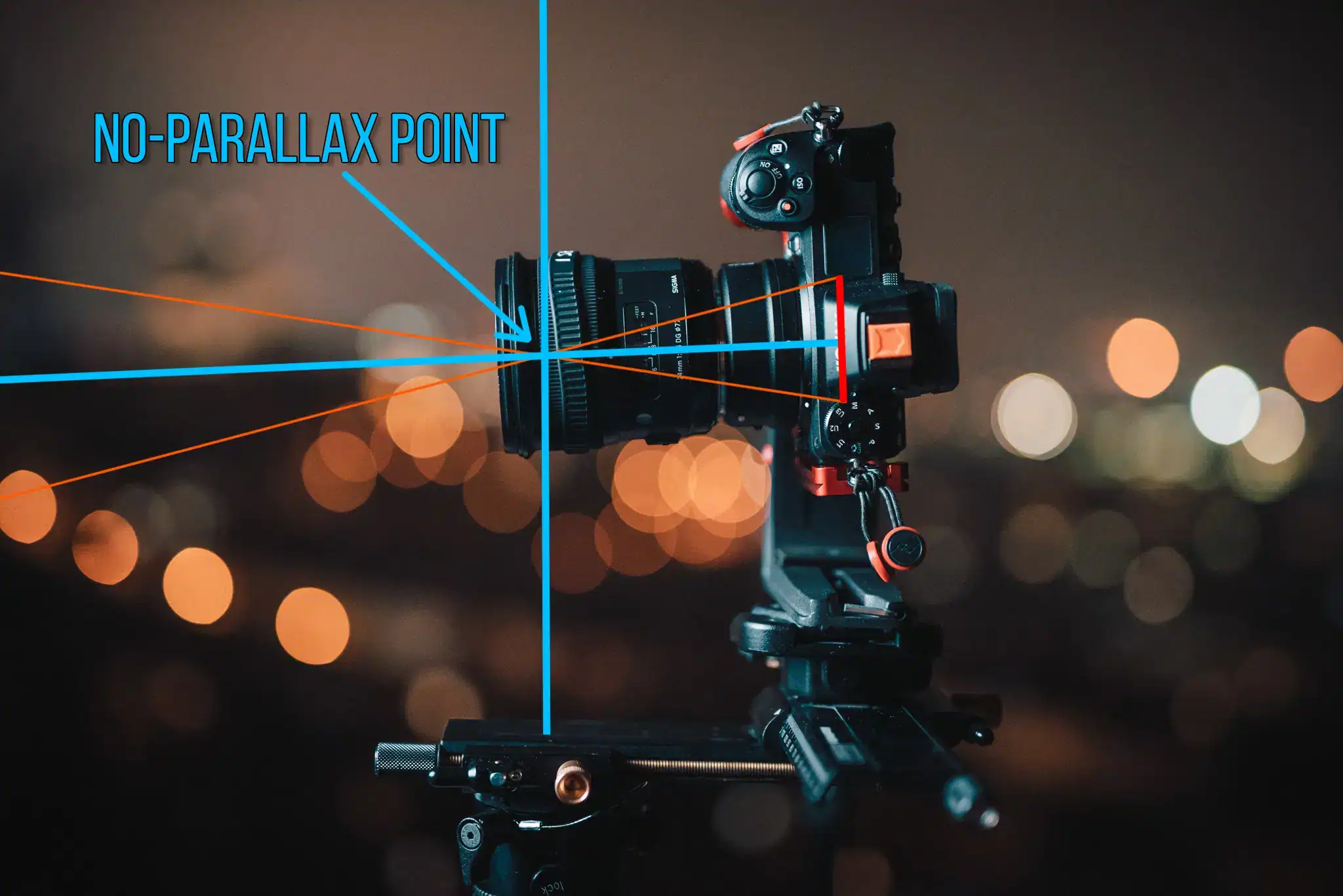
- Panoramic head: Lets you rotate the camera-lens system around the lens’s entrance pupil, minimizing parallax between foreground and background—critical for clean stitches. Calibrate once, mark your rails, and your field setup gets much faster.
- Stable tripod with a leveling base: A leveling base under the pano head speeds up leveling without fiddling with leg lengths and keeps your horizon straight in every frame.
- Remote trigger or self-timer: Trigger via cable release, app, or a 2-second timer to avoid micro-shake. The X1D-50c can be triggered via self-timer or tethered; Nikon Z bodies support remotes and SnapBridge-based control.
Optional Add-ons
- Pole/car mount: Great for elevated or vehicle-based 360s. Always tether the camera, minimize speed, avoid sudden moves, and respect local regulations. Wind load can be severe on poles—keep exposures brief and rotations slower.
- Lighting aids: LED panels or bounced flash to lift dim interiors. Keep lighting consistent across frames to avoid stitch seams.
- Weather gear: Rain covers, silica gel packs, and lens hoods help maintain clarity and keep water off the front element.
Step-by-Step Shooting Guide
Standard Static Scenes
- Level and align: Level the tripod via the leveling base. On the pano head, adjust fore-aft so the rotation axis passes through the lens’s entrance pupil. Test by placing a light stand close to the lens and a distant vertical edge in the background; rotate left/right—if their relative position shifts, adjust forward/backward until it doesn’t.
- Manual everything: Set manual exposure and lock white balance (Daylight for sun, Tungsten for warm interiors, or set a custom Kelvin). For rectilinear 20–21 mm, start at f/8–f/11, ISO 100–200 in daylight. Turn off autofocus after focusing at or near the hyperfocal distance.
- Capture with overlap:
- X1D + XCD 21mm on 44×33: 6 shots per row at −45°, 0°, +45°; add zenith and nadir. Aim for ~25–30% overlap.
- Nikon Z + 20mm: 8 shots per row at −45°, 0°, +45°; add zenith and nadir. More overlap simplifies stitching, especially with complex geometry.
- Nadir shot: Tilt down to capture a clean floor/ground patch for tripod removal or shoot a hand-held nadir and patch later.
HDR / High Dynamic Range Interiors
- Bracket ±2 EV: Shoot 3–5 frames per view, keeping ISO at 100–200 where possible. The X1D-50c’s DR is superb, but bracketing preserves bright window detail without muddying shadows.
- Lock white balance: Mixed lighting can shift per bracket if WB is on Auto. Keep WB fixed so brackets merge cleanly and stitch with consistent color.
- Work methodically: Complete all brackets at a given angle before rotating to the next shot to avoid exposure and alignment errors.
Low-Light / Night Scenes
- Use a solid base: Night panos demand longer shutter speeds: 1/30–1 second (or more) at f/4–f/5.6. On the X1D-50c, prefer ISO 100–800; use 1600 only if needed and expose to the right to protect shadows.
- Trigger safely: Use a remote or 2s timer. Turn off any stabilization in the camera body if applicable (X1D-50c has no IBIS; Nikon Z bodies should disable IBIS on a tripod to prevent drift).
- Mind moving lights: Cars and neon can cause stitching ghosts. Consider two passes to provide clean frames for masking in post.
Crowded Events
- Two-pass strategy: First pass quickly captures the full panorama. Second pass waits for gaps in foot traffic at troublesome angles.
- Blend later: In PTGui/Hugin, mark control points on static elements and mask moving people so one clean frame provides each area.
Special Setups (Pole / Car / Drone)
- Secure and tether: Always tether the camera to the pole/car mount. Keep the center of gravity low and verify all clamps are fully locked.
- Wind and vibration: Shorter exposures reduce blur. Rotate slowly to avoid oscillations and allow the system to settle before each shot.
- Safety first: Elevated gear above crowds carries risk. Choose quiet times/locations and follow local regulations.
Video: Panoramic head setup basics
Recommended Settings & Pro Tips
Exposure & Focus
| Scenario | Aperture | Shutter | ISO | Notes |
|---|---|---|---|---|
| Daylight outdoor | f/8–f/11 | 1/100–1/250 | 100–200 | Lock WB (Daylight) for consistent color |
| Low light/night | f/4–f/5.6 | 1/30–1s | 100–800 (up to 1600 on X1D if needed) | Tripod + remote; bracket if contrast is high |
| Interior HDR | f/8 | Bracket ±2 EV | 100–400 | Preserve window highlights; merge to 32-bit |
| Action / crowds | f/5.6–f/8 | 1/200+ | 400–800 | Freeze motion; use two-pass capture for masking |
Critical Tips
- Manual focus at hyperfocal: For 20–21 mm, focus ~1–1.5 m at f/8–f/11 to keep near-to-far sharp. Confirm with magnified live view.
- Nodal calibration: Find the entrance pupil once and mark your rails for this lens/body combo. For XCD 21mm, your fore/aft offset stays consistent; confirm if you add filters or change focus distance.
- White balance lock: Auto WB across frames/brackets can cause color seams. Pick a fixed Kelvin or preset that matches the scene.
- RAW capture: Always shoot RAW for latitude in highlight recovery, WB adjustment, and noise reduction.
- Stabilization: X1D-50c has no IBIS; if using a Nikon Z body, disable IBIS on a tripod to avoid sensor micro-movements during rotation.
Stitching & Post-Processing
Software Workflow
Import RAW files and apply a consistent baseline: enable lens profile corrections (if available for your lens), set a unified WB, and synchronize exposure tweaks. For HDR, first merge each bracketed angle to 32-bit (in Lightroom, Photoshop, or Photomatix), then stitch the merged set in PTGui or Hugin. Rectilinear lenses like 20–21 mm require more shots than fisheyes but deliver straight architecture with minimal geometric stretching near the horizon. For overlap, aim at ~25–30% with fisheyes and ~20–30% with rectilinears. PTGui’s control point generator and optimizer will get you close; finalize by setting correct projection (equirectangular for 360), straightening verticals, and leveling the horizon. A detailed PTGui overview is useful if you’re new to it. Read a PTGui review and why it excels at complex panoramas.
Cleanup & Enhancement
- Nadir patch: Shoot a clean ground plate and patch the tripod area. Use PTGui’s Viewpoint correction or clone/heal in Photoshop. Some AI tools can also remove tripods convincingly.
- Color and noise: Balance color across the pano; apply selective noise reduction to shadows for night scenes. Medium-format RAWs tolerate careful shadow lifting, but don’t overdo global noise reduction.
- Leveling and geometry: Use horizon/vertical guides in your stitcher to correct roll/yaw/pitch and keep walls/plumb lines straight.
- Export: For VR platforms, export equirectangular JPEG or 16-bit TIFF at the highest reasonable pixel dimensions. Keep metadata (ProjectionType=equirectangular) when targeting 360 viewers.
If you’re new to panoramic heads and technique, this primer is practical and concise. Panoramic head setup tutorial. For a platform-agnostic 360 workflow, especially for creators delivering VR-ready images, see this step-by-step from Meta. High-end 360 photo capture with a panoramic head.
Useful Tools & Resources
Software
- PTGui panorama stitching (fast CP generation, good optimizer, masking tools)
- Hugin open source (robust and free alternative)
- Lightroom / Photoshop (RAW development, HDR merges, retouching)
- AI tripod removal tools (content-aware fill or specialized plugins)
Hardware
- Panoramic heads (Nodal Ninja, Leofoto, Really Right Stuff) sized for medium-format weight
- Carbon fiber tripods with a leveling base (e.g., 75 mm half-bowl + adapter)
- Wireless remotes or intervalometers
- Pole extensions / suction-cup car mounts with safety tethers
Disclaimer: brand names are for search reference; verify compatibility and specs on the official sites.
Common Mistakes & How to Avoid Them
- Parallax errors: If nearby objects don’t align, re-check your entrance pupil position and ensure the camera rotates around that point.
- Exposure flicker: Always shoot manual exposure and locked white balance; avoid auto ISO and auto WB when shooting panos.
- Tripod shadows and footprints: Take a dedicated nadir shot and patch in post; avoid stepping into your own frames.
- Ghosting from motion: Shoot a quick first pass, then a second pass to capture clean areas for masking.
- High ISO noise at night: Favor longer exposures on a solid tripod over pushing ISO. On X1D-50c, target ISO ≤800 when possible.
Frequently Asked Questions
- Can I mount the Nikon Z 20mm f/1.8 S on the Hasselblad X1D-50c?
No. The electronic Nikon Z lens is not compatible with the XCD mount and lacks mechanical aperture control; its FF image circle is also smaller than the 44×33 sensor. Use a native XCD wide-angle (e.g., 21mm) on the X1D or mount the 20mm on a Nikon Z body.
- Is a 20–21 mm rectilinear lens wide enough for a single-row 360?
Generally no. You’ll need a multi-row capture: for XCD 21mm on X1D, 6 shots × 3 rows + zenith + nadir is reliable. With a Nikon Z 20mm on FF, 8 × 3 + Z/N is a safe starting pattern.
- Do I need HDR for interiors with bright windows?
Often yes. Bracket ±2 EV (3–5 exposures) to keep window detail and clean shadows. Merge to 32‑bit per angle before stitching for smoother tonality and better color consistency.
- How do I avoid parallax issues in tight spaces?
Calibrate the entrance pupil on your pano head. Place a near object (0.5–1 m) and a distant vertical line; rotate and adjust the fore-aft rail until their alignment doesn’t shift. Mark the rail so you can repeat it quickly in the field.
- What ISO range is safe on the X1D-50c for low light panos?
ISO 100–400 is ideal; ISO 800–1600 is acceptable if you expose to the right and process from RAW. Beyond that, noise and color degradation become more noticeable, especially across multi-image stitches.
Real-World Scenarios & Field Advice
Indoor Real Estate
Use the X1D-50c’s DR advantage. Shoot at f/8, ISO 100–200, bracket ±2 EV, and keep WB fixed (around 3200–3800K for warm interiors). The rectilinear look preserves straight lines in door frames and cabinets. If you’re mixing daylight and tungsten, consider a custom WB or gray card shot to harmonize color later.
Outdoor Sunset
Time your capture for when the sun is just below the horizon to balance dynamic range. Shoot one normal pass and one bracketed pass. Keep overlap generous (30%+) to help the stitcher handle fine cloud structure. For the X1D, ISO 100 and f/8–f/11 yields maximum micro-contrast.
Event Crowds
Lock your exposure and WB to avoid banding seams. Shoot two passes: a fast global pass for safety, then a second pass waiting for gaps. In PTGui, use masks to choose the cleanest people positions. If music lighting changes, reduce the time between rows to keep lighting consistent.
Rooftop / Pole Shooting
Stability is everything. Use a lightweight but rigid pole, keep the camera close to the pole’s axis, and use a safety tether. In wind, shorten exposure and pause between frames to let oscillations settle. Avoid overextending when people are below—safety first.
For deeper reading on focal lengths and panorama planning, this primer is helpful at the planning stage. Panoramas, focal lengths, and planning considerations.
Compatibility Notes and Honest Limitations
The Hasselblad X1D-50c uses XCD lenses with leaf shutters integrated in the lens. Although the X1D later gained an electronic shutter mode for some adapted manual lenses, the Nikon Z 20mm f/1.8 S is fully electronic and offers no mechanical aperture ring. There is no practical way to control its aperture or focus from the X1D, and the full-frame image circle won’t properly cover the 44×33 mm sensor. If your project specifically requires a 20–21 mm rectilinear look on the X1D, choose the XCD 21mm f/4 (or XCD 30mm if 21mm is unavailable) rather than attempting to adapt the Nikon Z 20mm. The shooting methods in this guide apply directly to those native options.