
Why This Camera & Lens Are Great for Panoramas
If you want to learn how to shoot panorama with Fujifilm X-T5 & Nikon Z 20mm f/1.8 S, you’re pairing a high-resolution APS-C mirrorless body with a modern, optically excellent wide-angle prime. The Fujifilm X‑T5 brings a 40MP APS‑C X‑Trans CMOS 5 HR sensor (approx. 23.5 × 15.6 mm) with fine 3.23 µm pixel pitch, strong base ISO dynamic range (≈13+ stops), and robust 7‑stop IBIS for handheld work. The Nikon Z 20mm f/1.8 S is a rectilinear, full-frame lens known for sharp corners, controlled coma, minimal distortion, and clean micro-contrast—traits that help stitching software find crisp control points and deliver clean lines in architecture.
Important compatibility note: Nikon Z lenses cannot be passively adapted to Fujifilm X‑mount (the Nikon Z flange distance is shorter than Fujifilm X, so there is no simple, non-optical adapter). If you cannot physically mount the Nikon Z 20mm on your X‑T5, you have two practical routes that still honor this shooting approach:
- Use a native X‑mount rectilinear lens that gives a similar field of view to a full-frame 20mm. On Fujifilm APS-C, that is roughly a 13–14mm lens (for example, XF 14mm f/2.8 or third‑party 13mm options).
- Use the Nikon Z 20mm f/1.8 S on a Nikon Z body for capture, then follow the same panoramic capture and stitching workflow described here. The stitching and HDR techniques are identical.
Throughout this guide, we assume a rectilinear wide-angle around 20mm full-frame equivalent field of view. We’ll note exact shot counts for a 20mm on APS‑C where relevant, and provide alternatives if you use a different focal length.
Quick Setup Overview
- Camera: Fujifilm X‑T5 — APS‑C (1.5× crop), 40MP X‑Trans CMOS 5 HR, approx. 3.23 µm pixel pitch, excellent DR at base ISO 125, strong detail retention.
- Lens: Nikon Z 20mm f/1.8 S — rectilinear prime, very low distortion, high corner sharpness from f/4–f/8, good coma control; note: not natively adaptable to Fujifilm X.
- Estimated shots & overlap (rectilinear 20mm on APS‑C):
- Single-row 360: not feasible; vertical FOV is insufficient. Plan multi-row.
- Multi-row: 10–12 shots per row with 25–30% overlap; 3 rows (−45°, 0°, +45°) + zenith + nadir = ~32–38 images total.
- If using ~13–14mm on APS‑C (≈20–21mm full-frame equivalent): 8–10 shots per row; 2–3 rows + zenith + nadir = ~22–30 images.
- Difficulty: Intermediate (precise nodal alignment and multi‑row capture required).
Planning & On-Site Preparation
Evaluate Shooting Environment
Before setting up, note lighting contrast, reflective surfaces, moving subjects, and wind. Bright windows vs dark interiors call for HDR bracketing. Glass and polished stone create flare/ghosting; if shooting near glass, position the camera as close as safely possible (a few centimeters) to reduce reflections. For outdoor cityscapes, watch for moving vehicles and people that may ghost between frames—plan multiple passes.
Match Gear to Scene Goals
The X‑T5’s 40MP sensor captures fine detail that benefits gigapixel or high-resolution 360 panoramas. Its DR at base ISO lets you hold highlights while lifting shadows in RAW, but interiors with bright windows still benefit from ±2 EV (or ±3 EV) bracketing. A rectilinear lens like the Nikon Z 20mm f/1.8 S has minimal geometric distortion, yielding straight architecture and easier multi‑row stitching, though it requires more frames than a fisheye. On the X‑T5, safe ISO for critical detail is typically ISO 125–800; ISO 1600 is usable with careful noise reduction. For low light, favor a tripod, longer shutter, and avoid pushing ISO too high when detail is paramount.
Pre-shoot Checklist
- Power & storage: fully charged batteries; dual cards or plenty of space (multi-row HDR eats storage fast).
- Optics clean: wipe front/rear elements and check sensor for dust; dust clones are painful across dozens of frames.
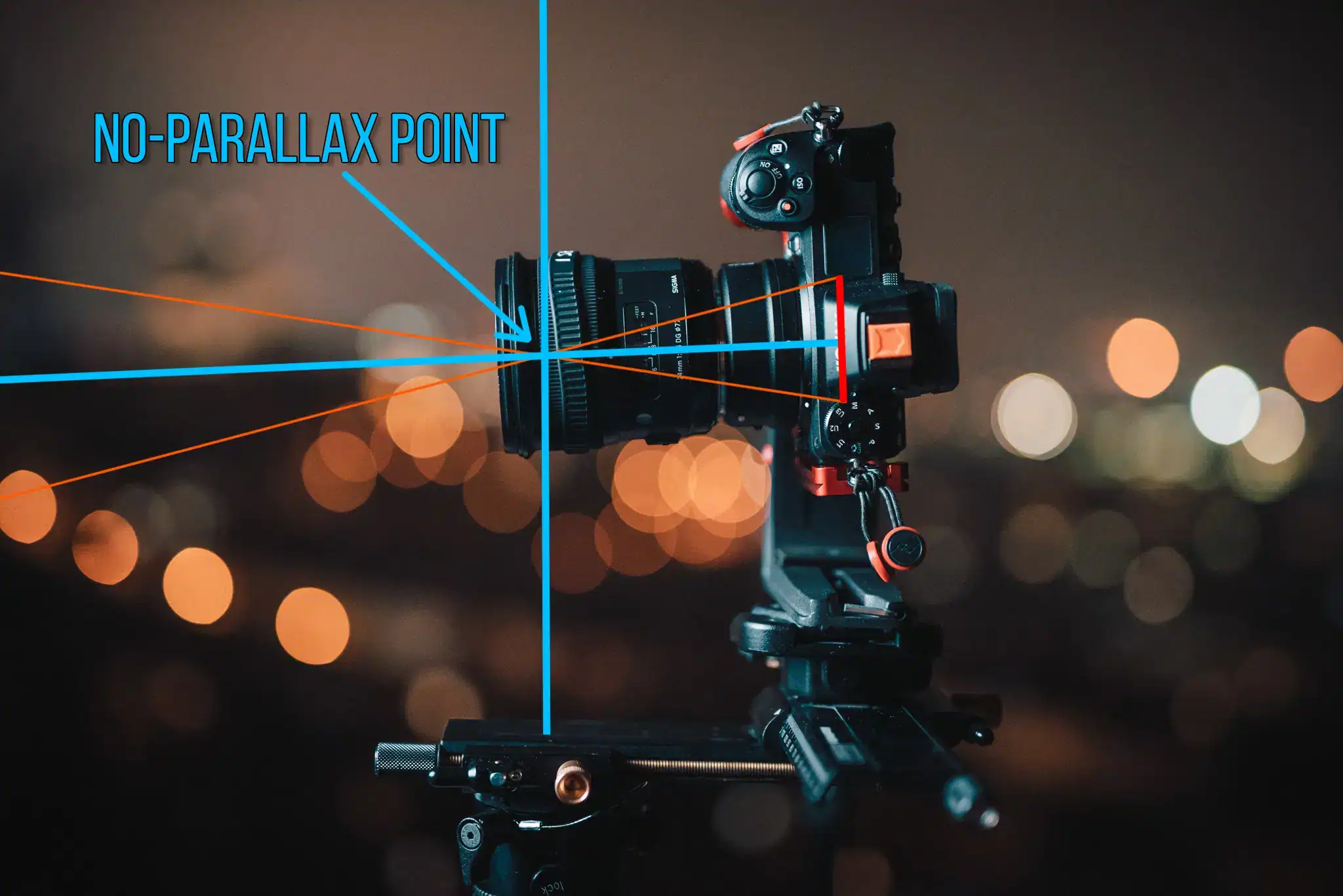
- Tripod & leveling: use a leveling base; calibrate your panoramic head so the entrance pupil (no-parallax point) is aligned for this body/lens combo.
- Safety: assess wind, rooftops, and crowds. Use a sandbag or weight hook. On cars/poles, use safety tethers and avoid public hazards.
- Backup plan: capture a second pass and a “security” nadir plate in case of stitching errors or people blocking a frame.
Essential Gear & Setup
Core Gear
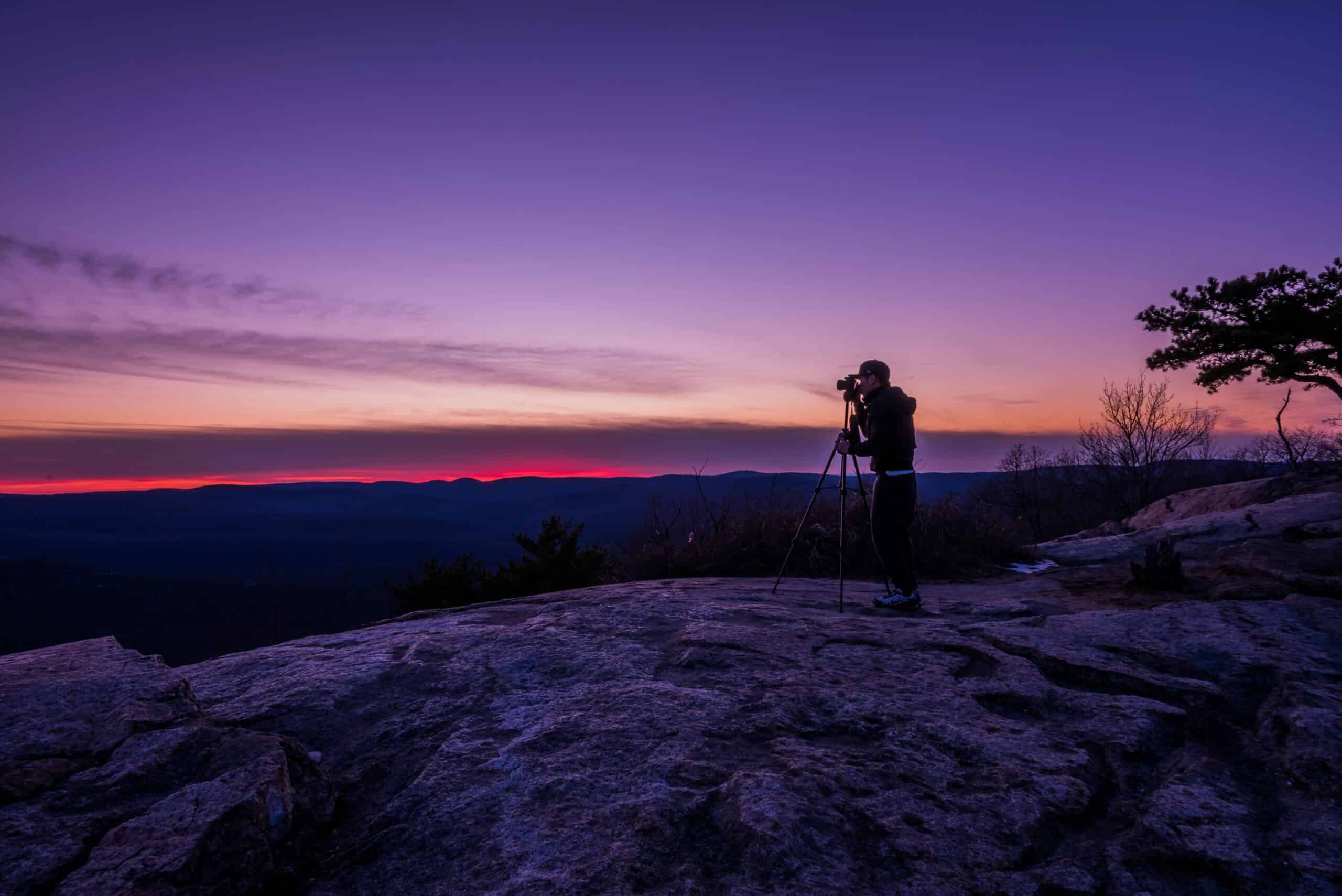
- Panoramic head: A rail-based panoramic head lets you place the lens’s entrance pupil over the rotation axis, minimizing parallax. This is crucial for clean stitches around nearby objects.
- Stable tripod with leveling base: Leveling simplifies keeping your rows consistent. A carbon fiber tripod is rigid yet portable.
- Remote trigger or app: Use the Fujifilm app or a wired remote to eliminate vibrations, especially at slower shutter speeds.
Optional Add-ons
- Pole or car mount: Great for elevated or moving perspectives. Watch wind and vibration; use guy lines and tethers.
- Lighting aids: Small LED panels or bounced flash can balance interiors, but keep lighting consistent across frames.
- Weather protection: Rain covers and lens hoods help in drizzle or sea spray; always protect gear first.
Step-by-Step Shooting Guide
Standard Static Scenes
- Level and align: Level the tripod and panoramic head. Slide the camera along the nodal rail to align the entrance pupil above the pivot. Verify by panning across a near object against a distant background; adjust until relative movement disappears.
- Manual exposure and WB: Meter your brightest area (e.g., sky) and darkest area (shadows), then choose a manual exposure that preserves highlights. Lock white balance (Daylight outdoors, a fixed Kelvin or Custom indoors) to avoid color shifts between frames.
- Capture with overlap: For 20mm APS‑C, use ~25–30% overlap and shoot 10–12 frames per row. For a full spherical, do three rows at +45°, 0°, and −45°, then add a zenith (up) and a nadir (down). Use a consistent yaw increment, e.g., 30–36° per click depending on your overlap.
- Take a nadir patch: After the main set, tilt up the camera or move the tripod slightly and shoot a clean ground plate to patch out the tripod later.
HDR / High Dynamic Range Interiors
- Bracket exposures: Use ±2 EV (or ±3 EV for very bright windows). The X‑T5 supports auto-bracketing; shoot RAW for all brackets.
- Consistent color: Keep white balance fixed for all brackets. Avoid auto ISO; lock at ISO 125–200 for clean files.
- Workflow: You can merge HDR per angle first, then stitch, or stitch each EV set and blend exposures in the stitcher. PTGui handles both approaches well.
Low-Light / Night Scenes
- Use a tripod and remote: Disable IBIS on a locked-down tripod to prevent micro-blur. Favor longer exposures over higher ISO to preserve detail (ISO 125–800 preferred; 1600 if necessary).
- Aperture: f/4–f/5.6 keeps corners sharp on rectilinear wides without pushing ISO too high.
- Long exposures: If using bulb/long shutter, cover the viewfinder/EVF eyepiece to prevent light leaks and keep the scene consistent across frames.
Crowded Events
- Two-pass strategy: First pass fast for coverage; second pass wait for gaps so you can mask clean backgrounds.
- Short shutter: Aim for 1/200s+ and ISO 400–800 to freeze motion, then blend frames in post to remove ghosts.
Special Setups (Pole / Car / Drone)
- Pole: Secure all clamps; use a safety tether. Shoot fewer rows to keep the session short in wind. Consider 360° rotation stops with a click collar for even spacing.
- Car-mounted: Use suction mounts on clean glass/paint, safety cables, and avoid busy roads. Increase shutter speed to fight vibration, and overshoot a few extra frames.
- Drone: If you adapt this workflow to aerial, use single-row with gimbal tilt sequences and plenty of overlap. Lock exposure and WB.
Field-tested mini case studies
Indoor real estate with bright windows
Bracket ±2 EV at f/8, ISO 125–200. Use three rows + zenith/nadir. Keep the camera close to glass when necessary, and shoot a second pass for clean window views to mask later.
Outdoor sunset rooftop
Expose to preserve highlights at base ISO, f/8–f/11, 1/100–1/250s. Capture quickly through golden to blue hour to blend the best sky later if needed. Use a security tether in wind.
Event floor with crowds
Raise shutter to 1/200–1/400s at f/5.6–f/8, ISO 400–800. Do two passes and plan masks for moving subjects. Consider a slightly higher vantage for fewer occlusions.
Recommended Settings & Pro Tips
Exposure & Focus
| Scenario | Aperture | Shutter | ISO | Notes |
|---|---|---|---|---|
| Daylight outdoor | f/8–f/11 | 1/100–1/250 | 125–200 | Lock WB to Daylight; keep overlap 25–30% |
| Low light/night | f/4–f/5.6 | 1/30–1/60 (tripod) or longer | 125–800 | Remote trigger; disable IBIS on tripod |
| Interior HDR | f/8 | Bracket ±2 EV | 125–400 | Merge HDR per angle or inside PTGui |
| Action / crowds | f/5.6–f/8 | 1/200+ | 400–800 | Two-pass capture for clean masks |
Critical Tips
- Focus: Set AF‑S on a mid‑distance subject at your working aperture, then switch to MF to lock. Hyperfocal at ~13–14mm APS‑C and f/8 will keep near‑to‑far sharp.
- Nodal alignment: Calibrate once per body/lens and record the rail scales. Re-check if you change filters or focus distance significantly.
- White balance: Lock WB to avoid panel‑to‑panel color shifts. In mixed light, shoot a custom Kelvin or gray card and keep it fixed.
- RAW over JPEG: The X‑T5’s 14‑bit RAW gives headroom for highlights and shadows, vital for HDR and night scenes.
- IBIS: Turn off when the camera is on a tripod to avoid micro‑jitters; enable if you must shoot a quick handheld pano.
Stitching & Post-Processing
Software Workflow
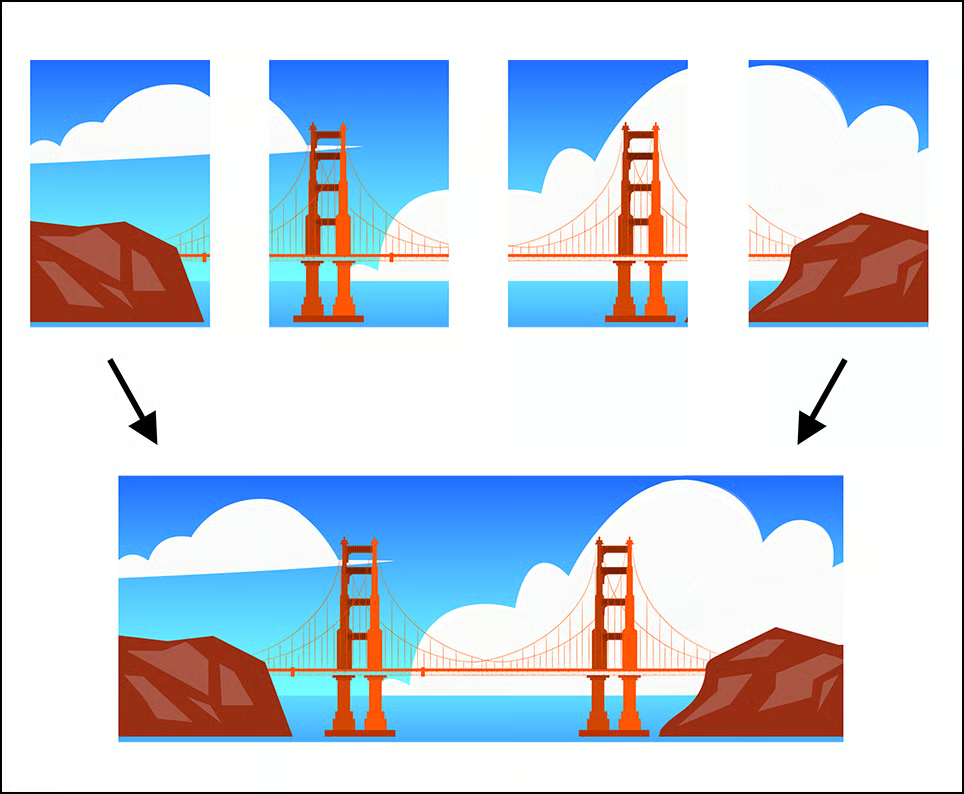
Import RAWs, apply a consistent basic profile (lens corrections if using a native X‑mount lens), and sync exposure/WB across each row. Stitch in dedicated panorama software. PTGui is an industry standard for multi-row HDR panoramas thanks to robust control point generation and masking tools; Hugin is an open-source alternative that is very capable once configured. Rectilinear wides need more shots than fisheyes, but reward you with straight lines—a win for architecture and interiors. Typical overlap targets: 25–30% for fisheye, 20–30% for rectilinear. For multi-row, keep vertical overlap around 25% as well. For a deeper dive on professional pano head setup, see this panoramic head tutorial at the end of this paragraph. Panoramic head setup guide.
Cleanup & Enhancement
- Nadir patch: Use PTGui’s Viewpoint correction, a clean nadir plate, or AI-based retouching to remove the tripod.
- Color and noise: Apply gentle noise reduction for night scenes. Use selective color tools to balance mixed lighting indoors.
- Leveling: Level horizon and adjust yaw/pitch/roll so the equirectangular output aligns correctly for 360 viewers.
- Export: Deliver as 16‑bit TIFF for archival or JPEG (8–12 quality) for web. For VR platforms, export an equirectangular 2:1 image (e.g., 16000×8000 pixels if target hosting supports it). See this official overview on using mirrorless cameras for 360 delivery. DSLR/mirrorless 360 capture guide.
If you want a second opinion on software choice, this review explains why many pros use PTGui for complex jobs. PTGui review and workflow notes.
Video: Setting up a panoramic head and shooting a 360 sequence
Useful Tools & Resources
Software
- PTGui panorama stitching
- Hugin open source
- Lightroom / Photoshop for RAW prep and cleanup
- AI tripod removal or object removal tools
Hardware
- Panoramic heads (Nodal Ninja, Leofoto)
- Carbon fiber tripods with leveling bases
- Wireless remote shutters
- Pole extensions / car mounts with safety tethers
Disclaimer: software/hardware names provided for search reference; check official sites for details.
Common Mistakes & How to Avoid Them
- Parallax error → Carefully calibrate entrance pupil; re-check if you change focus or add filters.
- Exposure flicker → Manual exposure and locked WB. Avoid auto ISO and auto WB across frames.
- Tripod shadows / visible legs → Shoot a nadir plate and patch. Adjust timing to avoid harsh directional shadows.
- Ghosting from movement → Take multiple passes and mask moving objects in post.
- Noise at night → Keep ISO low and use longer exposures with a remote trigger.
- Insufficient overlap → Use consistent yaw increments; aim for 25–30% overlap to give stitchers enough control points.
Frequently Asked Questions
- Can I actually mount the Nikon Z 20mm f/1.8 S on a Fujifilm X‑T5?
Not with a simple adapter. Nikon Z lenses have a shorter flange distance than Fujifilm X, so there’s no widely available passive adapter. Use a native X‑mount lens with similar FOV (≈13–14mm) or shoot the Z 20mm on a Nikon Z body and follow the same panoramic workflow.
- Is a 20mm rectilinear wide enough for a single‑row 360 on APS‑C?
No. A 20mm on APS‑C (≈30mm full‑frame equivalent) has too little vertical FOV for a single‑row spherical 360. Plan a multi‑row capture: typically three rows plus zenith and nadir.
- Do I need HDR for interiors with bright windows?
Usually yes. Bracket ±2 EV (or ±3 EV for very bright exteriors) to preserve both viewable highlights and interior detail. Merge per angle or in your stitcher for a smooth tonal map.
- How do I avoid parallax issues with this setup?
Use a proper panoramic head and align the entrance pupil. Pan the camera while watching a near object against a far background; adjust the rail until relative motion disappears. Record your rail measurements for consistency.
- What ISO range is safe on the X‑T5 in low light for high‑detail panos?
ISO 125–800 is the sweet spot for maximum detail. ISO 1600 is usable with careful noise reduction. Favor longer shutter times on a tripod rather than pushing ISO.
- Can I set up Custom Modes for pano on the X‑T5?
Yes. Save a mode with Manual exposure, fixed WB, RAW, MF, IBIS off (tripod use), self‑timer or remote enabled, and your preferred bracketing. This speeds up on‑site work.
- What tripod head is best?
A two‑rail panoramic head (e.g., Nodal Ninja, Leofoto) with click‑stops or marked degrees is ideal for multi‑row. A leveling base under the head saves time and errors.
Safety, Reliability, and Workflow Integrity
Always prioritize safety with elevated setups (rooftops, poles) and around traffic. Use tethers and avoid crowd pathways. In wind, shorten rows, increase shutter speed, and add ballast to the tripod. For data integrity, shoot a second pass when feasible, back up cards immediately, and keep a consistent file naming scheme per row and bracket. When in doubt, overshoot—extra coverage is insurance during stitching.
For a foundational perspective on DSLR/mirrorless 360 technique and panoramas, see this curator’s FAQ on composition, lenses, and workflows. DSLR virtual tour FAQ and lens guide.