
Why This Camera & Lens Are Great for Panoramas
If you’re looking for a fast, ultra-compact way to capture full 360° images, learning how to shoot panorama with Fujifilm X-T5 & Laowa 4mm f/2.8 Circular Fisheye is a winning path. The X-T5’s 40MP APS-C X-Trans CMOS 5 HR sensor delivers excellent detail with roughly 13.5 EV of dynamic range at base ISO, and its in-body image stabilization (IBIS) is helpful for handheld scouting. Pair that with Laowa’s 4mm f/2.8 circular fisheye—producing a ~210° field of view on Fuji X—and you can cover the entire sphere with just a handful of shots. Fewer frames means faster shooting, fewer stitch seams, and higher success when people or clouds are moving.
The X-T5 is mirrorless, lightweight, and offers refined manual controls—ideal for locking exposure, white balance, and focus across a panorama. The Laowa is a fully manual lens, which is perfect for panoramas because it prevents focus breathing or AF shifts between frames. Because it’s a circular fisheye, you’ll see a circular image with black edges; stitching software interprets this directly without needing to “defish” first. Just remember that circular fisheyes demand thoughtful nodal (entrance pupil) alignment to prevent parallax, and their ultra-wide projection can emphasize flare if the sun or bright lights enter the frame.
Quick Setup Overview
- Camera: Fujifilm X-T5 — APS-C 40MP (X-Trans CMOS 5 HR, approx. 23.5×15.6 mm), base ISO 125 (extended low available), 14-bit RAW, IBIS up to 7 stops, pixel pitch ~3.0 µm.
- Lens: Laowa 4mm f/2.8 Circular Fisheye — manual focus, fully circular projection on APS-C, ~210° FOV, very sharp center by f/4–f/5.6, some purple fringing wide open, minimum focus ~8 cm.
- Estimated shots & overlap (field-tested):
- Fast: 2 shots around (0°/180°) + zenith + nadir = 4 frames total (30–40% overlap).
- Safe: 3 around at 120° spacing + nadir = 4 frames total (strong overlap, cleaner seams).
- Handheld: 4 around at 90° spacing (no zenith/nadir) for quick coverage; patch later.
- Difficulty: Beginner-friendly (3/5). Ultra-wide FOV reduces shot count but requires careful nodal alignment and flare management.
Planning & On-Site Preparation
Evaluate Shooting Environment
Scan for moving elements (people, leaves, flags) and reflective surfaces (glass, polished floors, cars). With a circular fisheye, stray highlights, the tripod, and even your feet can creep into frame—clean the scene where possible. If you must shoot through glass, place the lens hood or a black cloth flush against it to reduce reflections and ghosting, and switch off interior lights behind you to avoid back reflections.
Match Gear to Scene Goals
The X-T5’s high resolution and strong dynamic range make it suitable for HDR interiors and high-contrast sunsets. Indoors, aim for ISO 125–400 when on a tripod; push to ISO 800–1600 only when necessary (e.g., handheld scouting) and plan to denoise in post. The Laowa 4mm reduces your total shot count dramatically versus rectilinear lenses, which is ideal for crowds or changing skies. The trade-off is fisheye distortion (handled in the stitch) and potential flare; keep bright light sources away from the lens edge or shield with your hand just outside the frame.
Pre-shoot Checklist
- Charge batteries, format fast UHS-II cards, and clean the lens front element carefully.
- Level your tripod; calibrate your panoramic head so the entrance pupil stays over the rotation axis.
- Safety first: tether gear on rooftops, weigh down tripod in wind, and avoid overhanging obstacles.
- Backup workflow: shoot an extra full round in case of people movement or stitching issues.
Essential Gear & Setup
Core Gear
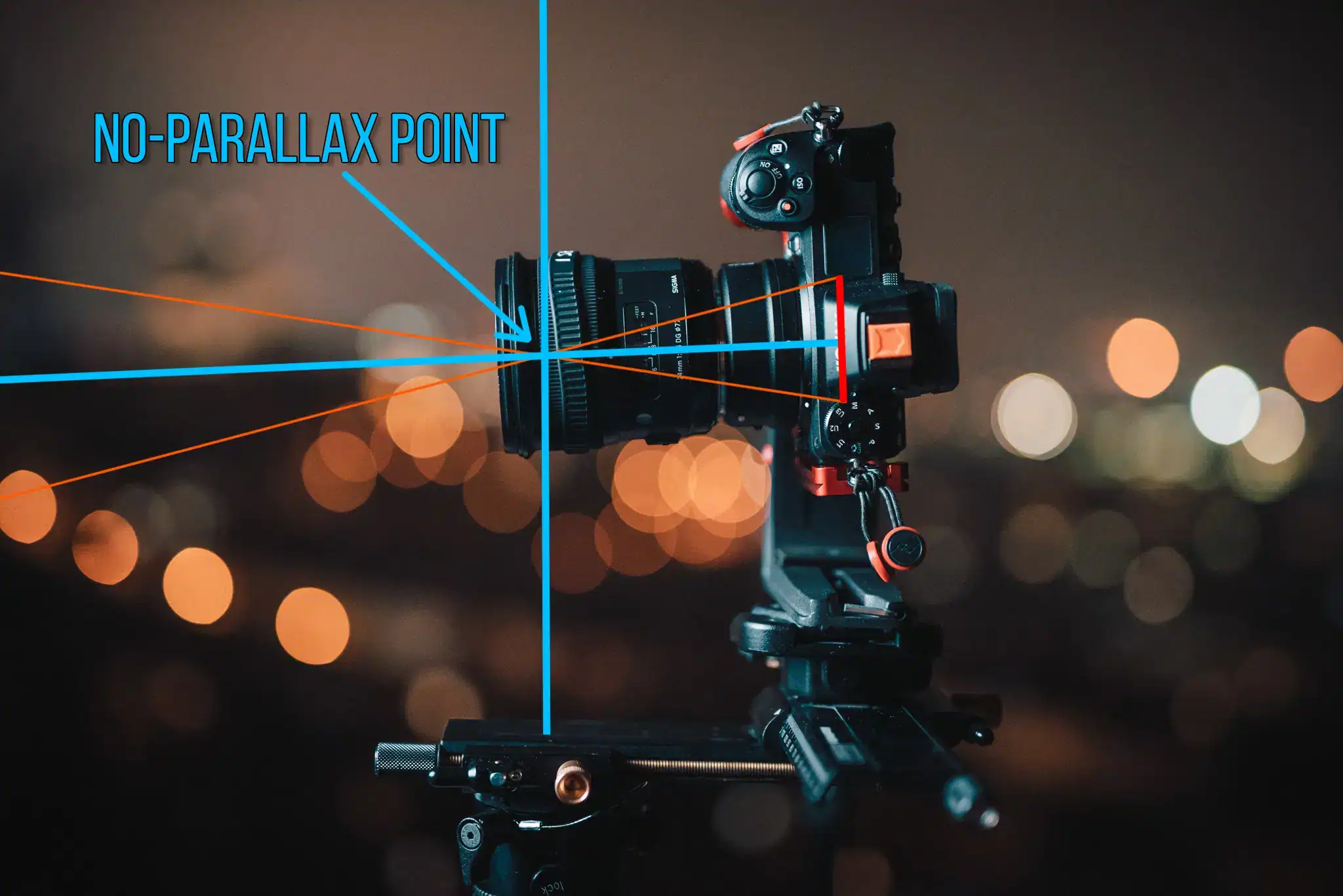
- Panoramic head: This allows you to rotate around the lens’s entrance pupil (nodal point) to eliminate parallax between foreground and background. With a circular fisheye, small misalignments can still stitch, but precision significantly reduces ghosting.
- Stable tripod with leveling base: Leveling ensures your rotation remains in a perfect plane, simplifying stitching and horizon leveling later.
- Remote trigger or the Fujifilm app: Fire the shutter without touching the camera to avoid vibration. Use a 2 s timer if you don’t have a remote.
Optional Add-ons
- Pole or car mount: Great for elevated or moving vantage points. Use tethers, check wind load, and avoid excessive speeds that induce vibration.
- Lighting aids: Small LED panels or bounced flash (if allowed) help lift shadows in dim interiors while keeping ISO low.
- Weather protection: Rain covers and lens cloths; even a drop of water on a fisheye shows up dramatically.
Step-by-Step Shooting Guide
Standard Static Scenes
- Level and align: Level the tripod via the leveling base. Adjust the panoramic head so the camera rotates around the lens’s entrance pupil. For the Laowa 4mm, the entrance pupil sits very close to the front element—start there and fine-tune using a near/far object test.
- Lock exposure and white balance: Switch to Manual (M). Meter the brightest part you need to keep detail in, then set a mid-exposure to protect highlights (watch the histogram). Lock WB (e.g., Daylight or custom Kelvin). Disable auto-ISO.
- Focus: Set manual focus around the hyperfocal distance. At 4 mm and f/5.6–f/8 on APS-C, focusing ~0.2–0.3 m keeps everything from near to infinity acceptably sharp. Turn off focus peaking after setting focus so the overlay doesn’t distract.
- Capture the sequence:
- Fast 4-shot method: 2 around (0° and 180°) plus zenith (+90°) and nadir (−90°). Aim for 30–40% overlap.
- Safe 4-shot method: 3 around at 0°/120°/240° plus nadir. This gives generous overlap for robust control points.
- Take a clean nadir: If the tripod intrudes, shoot an offset nadir (lean the rig slightly or move the tripod and shoot the floor plate) for easy patching later.
HDR / High Dynamic Range Interiors
- Bracket exposures: Use ±2 EV (3 or 5 frames) when windows are bright relative to interiors. The X-T5 can bracket multiple frames—configure AE bracketing and shoot the full bracket at each yaw angle.
- Keep WB locked: Mixed lighting can cause color shifts; a fixed Kelvin or custom WB ensures consistency across brackets.
- Mind micro-movements: Use electronic first curtain or mechanical shutter and a remote to avoid slight shifts across brackets.
Low-Light / Night Scenes
- Stabilize: On a tripod, turn IBIS off to prevent sensor creep on long exposures. Use the remote and a 2–5 s shutter delay if needed.
- Exposure: f/4–f/5.6, 1/30–1/60 s, ISO 200–800. Stay as low as possible on ISO for clean shadows; expose to protect highlight signs and street lamps.
- Hot pixels and noise: Shoot RAW; apply moderate noise reduction later. Consider dark-frame subtraction only if you’re seeing significant hot pixels.
Crowded Events
- Two-pass method: Do one quick round for safety, then wait for gaps and reshoot frames with fewer people. You can mask and blend later.
- Favor fewer frames: The Laowa’s coverage lets you stick to 3–4 frames total, minimizing subject movement between shots.
- Mind your own shadow: Rotate your body behind the camera and step away from reflections; the fisheye sees almost everything.
Special Setups (Pole / Car / Elevated)
- Secure everything: Use a safety tether and clamp rated well above your rig’s weight. Avoid extending poles in high winds; the fisheye’s frontal area catches gusts.
- Slow rotations: On moving platforms or in wind, pause a second to let vibrations settle before each frame.
- Car-mount note: Shoot at lower speeds and choose smooth pavement to reduce micro-blur. Consider higher shutter speeds (1/250+).
Recommended Settings & Pro Tips
Exposure & Focus
| Scenario | Aperture | Shutter | ISO | Notes |
|---|---|---|---|---|
| Daylight outdoor | f/8–f/11 | 1/100–1/250 | 125–200 | Lock WB (daylight or 5200–5600K) |
| Low light/night | f/4–f/5.6 | 1/30–1/60 | 200–800 | Tripod & remote; keep ISO modest for cleaner skies |
| Interior HDR | f/8 | Bracket ±2 EV | 125–400 | Balance windows & lamps with 3–5 frames |
| Action / moving subjects | f/5.6–f/8 | 1/200+ | 400–800 | Freeze motion; consider 3-around to minimize timing gaps |
Critical Tips
- Manual focus near hyperfocal (~0.2–0.3 m at f/5.6–f/8). Tape the focus ring to avoid accidental bumps.
- Nodal calibration: Place a light stand 50–100 cm in front of the camera and a vertical object several meters away. Rotate and adjust the fore-aft slider until the near and far objects maintain alignment. Mark the rail once set.
- White balance lock: Fisheyes see multiple light sources at once. A fixed Kelvin WB avoids color shifts between frames.
- RAW over JPEG: The X-T5’s 14-bit RAW is forgiving for HDR merges and recovering window highlights.
- IBIS off on tripod: Prevent subtle sensor drift. For handheld scouting panos, IBIS can help—just keep overlap more generous.
- Shutter mode: Prefer mechanical or EFCS to avoid LED banding and rolling shutter artifacts under artificial light.
Stitching & Post-Processing
Software Workflow
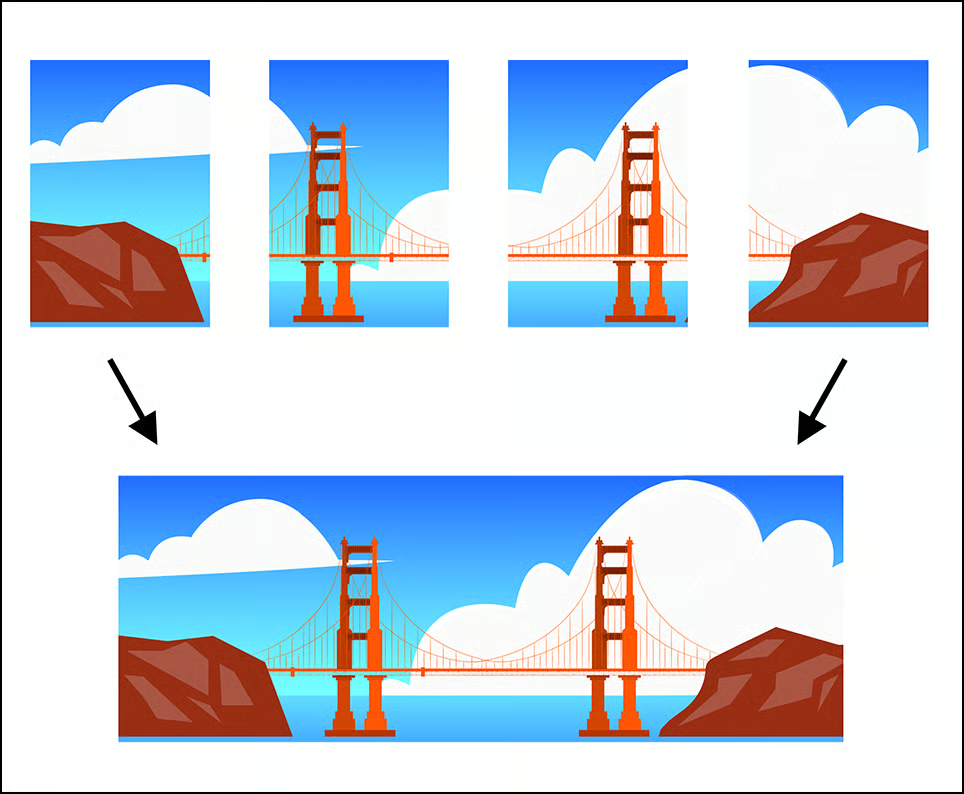
Use specialized panorama software that understands circular fisheye projection. PTGui is the industry workhorse for speed and control point robustness, while Hugin is a powerful open-source alternative. In PTGui, set the lens type to “circular fisheye,” and the FOV to ~210° for the Laowa 4mm on APS-C. Maintain 25–40% overlap between frames to ensure a clean stitch. Export an equirectangular 2:1 image for VR and 360 platforms. For reference-level results and a guided walkthrough, many pros rely on PTGui for complex HDR 360s at speed.
For newcomers wanting to understand panoramic head setup and best practices before stitching, a panoramic head tutorial can clarify entrance pupil alignment and rotation strategies. If you’re building virtual-tour 360s, review platform-specific recommendations for projection, resolution, and export formats after stitching.
Recommended Reading and Tools
Deep dive on PTGui’s strengths for complex panoramas at Fstoppers’ review: Why PTGui remains a top stitching tool for pros.
Learn entrance pupil alignment fundamentals with this guide: Panoramic head setup and nodal point tutorial.
If you’re publishing to VR platforms, see best practices from Meta: Using a mirrorless camera to shoot and stitch a 360 photo.
Cleanup & Enhancement
- Nadir patching: Use a clean offset-shot or an AI-based tripod removal tool; content-aware fill helps on simple patterns.
- Color and tone: Balance WB across the whole sphere; apply lens flare correction or clone out hot spots caused by bright lights.
- Noise reduction: Apply mild, detail-preserving NR—especially in sky and shadow areas; don’t obliterate texture.
- Leveling: Use the “horizon” or “verticals” tools to correct pitch/roll; ensure the horizon is flat and straight.
- Export: For web VR, 8–12K equirectangular JPEG is common; for archival or pro tour platforms, consider 12–16K when the subject justifies it.
Video: A Practical Panorama Walkthrough
Watch a hands-on overview of shooting and stitching techniques that translate directly to the X-T5 + Laowa 4mm workflow:
Useful Tools & Resources
Software
- PTGui panorama stitching
- Hugin open source
- Adobe Lightroom / Photoshop
- AI tripod removal or content-aware tools
Hardware
- Panoramic heads (Nodal Ninja, Leofoto, Sunwayfoto)
- Carbon fiber tripods with leveling bases
- Wireless remote shutters (Fujifilm RR-100 or app)
- Pole extensions / car suction mounts with safety tethers
Disclaimer: brand names are provided as examples; verify compatibility and specs on official sites.
Real-World Case Studies
Indoor Real Estate (Bright Windows)
Tripod, panoramic head, f/8, ISO 125, bracket 5 frames at ±2 EV per yaw. Shoot 3-around + nadir. Keep WB at 5200K to avoid color drift between frames. In PTGui, enable exposure fusion or merge HDR first in Lightroom, then stitch. This keeps window detail while maintaining clean interior tones.
Outdoor Sunset Lookout
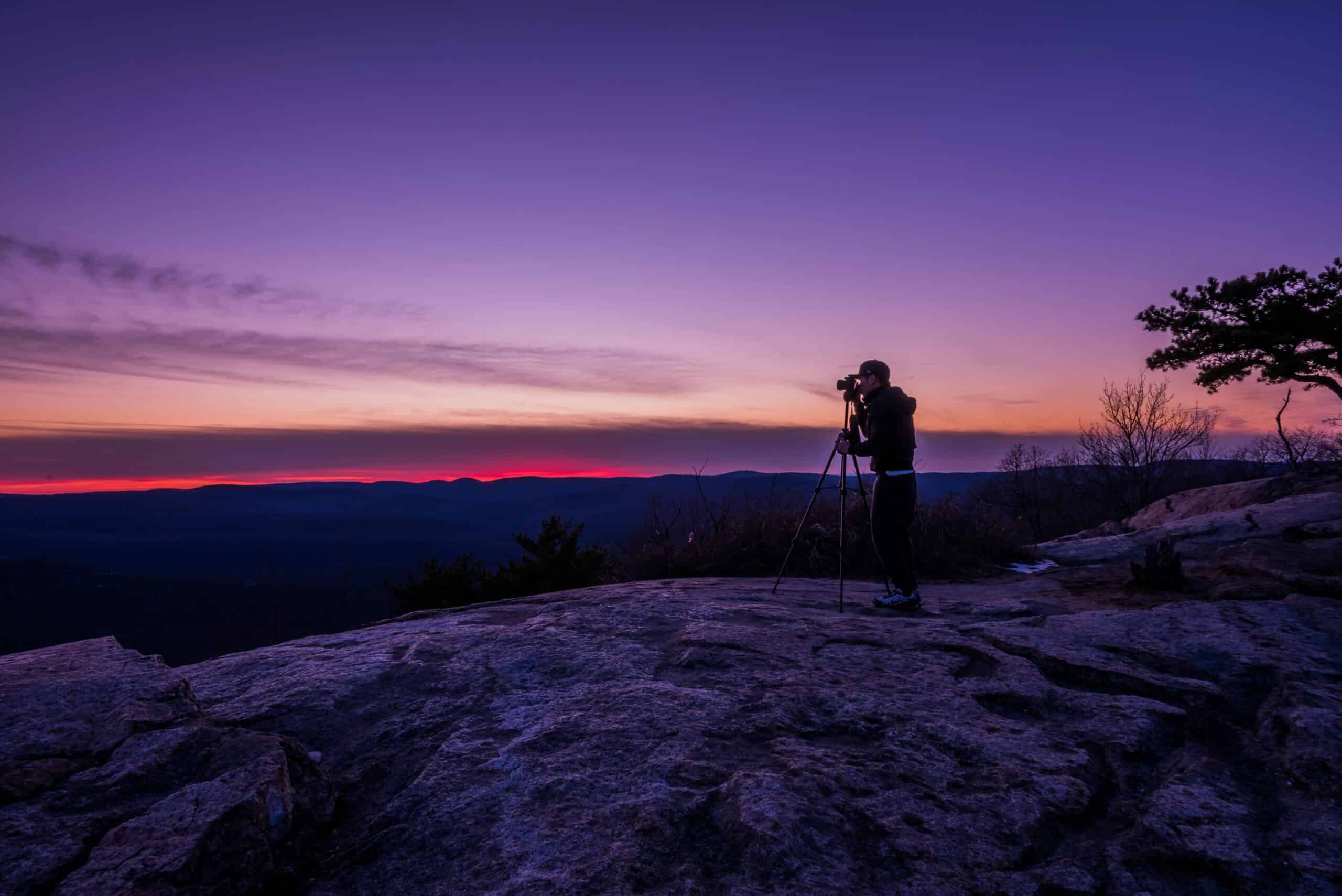
Tripod or stable clamp, f/8, ISO 125–200, 1/100–1/250 s, 3-around + zenith. As the sun nears the horizon, shield flare with a finger or card just outside the circle, then capture a second clean frame without the shield to blend later. The circular fisheye makes flare management easier if you plan two passes.
Crowded Event or Festival
Fast 4-shot approach: 2-around + zenith + nadir, f/5.6–f/8, 1/200 s at ISO 400–800. Do two full sequences—one right away and another after waiting for gaps. Mask moving people during post to reduce ghosts.
Rooftop or Pole Capture
Use a lightweight carbon pole; keep total weight low. Shoot 3-around at 120° to minimize rotation time, f/8 and 1/250 s, ISO 200–400. Tether everything and don’t overextend in gusts. Elevated views benefit from fewer frames because the wind isn’t waiting for you.
Common Mistakes & How to Avoid Them
- Parallax error → Align the entrance pupil precisely on a pano head; re-check if you change focus or aperture.
- Exposure flicker → Manual exposure and locked WB. Avoid auto-ISO and auto-WB between frames.
- Tripod in frame → Capture an offset nadir or plan to patch with an extra floor shot.
- Ghosting from movement → Shoot fewer frames faster; take a second pass and mask in post.
- Flare with fisheye → Shade the lens, avoid bright light sources near the frame edge, and consider blending.
- Noise at night → Keep ISO modest (≤800) on the X-T5 and use tripod + longer exposure instead.
Frequently Asked Questions
- Can I shoot handheld panoramas with the Fujifilm X-T5?
Yes, especially with the Laowa 4mm since you need very few frames. Use 4-around at 90° spacing for extra overlap, enable IBIS, and use faster shutter speeds (1/200+). Expect slightly lower stitching reliability compared with a tripod and pano head.
- Is the Laowa 4mm f/2.8 wide enough for a single-row 360?
Absolutely. As a circular fisheye (~210°), it can cover a full sphere with 3–4 frames. A typical robust set is 3-around + nadir, or 2-around + zenith + nadir. The key is solid nodal alignment and 30–40% overlap.
- Do I need HDR for interiors with bright windows?
Often yes. The X-T5 has strong dynamic range, but interiors with bright windows typically need ±2 EV bracketing (3–5 frames) to preserve highlights and shadow detail. Merge to HDR before or during stitching in PTGui or Lightroom.
- How do I avoid parallax issues with this combo?
Mount the X-T5 on a panoramic head and slide the camera so the rotation happens around the lens’s entrance pupil, which is near the Laowa’s front element. Use a near/far alignment test and mark your rail once calibrated.
- What ISO range is safe on the X-T5 in low light?
On a tripod, keep ISO at 125–400 for the cleanest files; push to 800 if needed. Handheld scouting can go to 1600 with careful exposure and later denoising. For critical 360s, prioritize longer shutter times over high ISO.
- Can I make a custom shooting preset on the X-T5?
Yes. Assign a custom mode with manual exposure, locked WB, RAW, IBIS off (for tripod), and your preferred bracketing setting. This speeds up setup and reduces errors on location.
- How do I reduce flare with a circular fisheye?
Keep bright light sources away from the frame edge, shield the lens with your hand just outside the circle when needed, clean the front element often, and consider a second clean frame for blending if you must shade the lens.
- What panoramic head works best here?
Any head that allows precise fore-aft and lateral adjustment (e.g., Nodal Ninja or Leofoto systems) works well. Look for an indexed rotator (click stops) at 90°/120° to match your shot plan for quick and repeatable rotations.
Safety, Limitations, and Trust Tips
The Laowa 4mm’s dome-like front element is exposed—use a cap when moving and keep a microfiber cloth handy. On rooftops or with poles, always tether the rig and check local regulations and permissions. Back up your panorama sequences immediately after the shoot; a second full round at the scene is your best insurance against stitching surprises. For additional fundamentals, see practical Q&A discussions on panorama technique: Best techniques to take 360 panoramas.