
Why This Camera & Lens Are Great for Panoramas
If you’re learning how to shoot panorama with Fujifilm X-T5 & 7Artisans 10mm f/2.8 II Fish-Eye, you’ve picked a highly capable, affordable, and travel-friendly setup. The Fujifilm X-T5 uses a 40MP APS-C X-Trans CMOS 5 HR sensor that delivers excellent detail and color with roughly 13+ stops of dynamic range at base ISO. That means your 360 photos and panoramas can resolve fine textures, hold bright skies and dark interiors, and export cleanly to 10K–14K equirectangular for VR or web usage. The body also brings 7-stop IBIS (image stabilization), which is useful for handheld shooting, although you’ll typically disable it on a tripod for maximum sharpness and stitching consistency.
The 7Artisans 10mm f/2.8 II Fish-Eye (X-mount) is a manual-focus, diagonal fisheye lens with approximately 180° diagonal field of view on APS-C. Fisheyes are ideal for panoramic capture because they reduce the number of shots needed. Compared to rectilinear lenses, you’ll shoot fewer frames around the horizon and still cover a full sphere with proper overlap. Distortion is expected and desirable at capture time—stitching software uses the fisheye projection to align frames accurately, resulting in a clean equirectangular output. Stopped down to f/5.6–f/8, this lens becomes quite sharp across the frame, while chromatic aberration and coma improve compared to f/2.8. The all-manual operation (focus and aperture) is straightforward for panoramas: you’ll typically set a hyperfocal distance and leave it locked for the whole sequence.
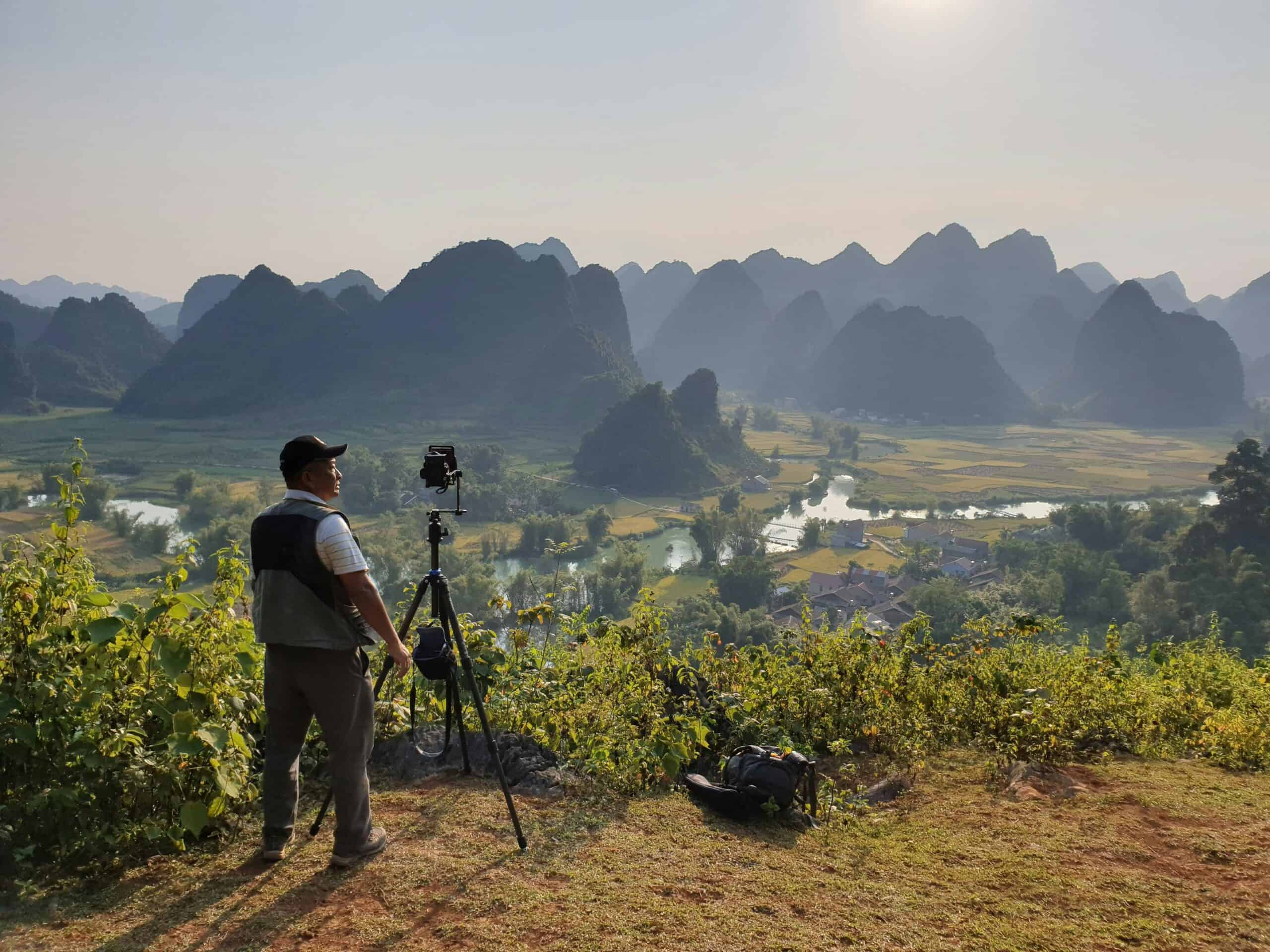
Quick Setup Overview
- Camera: Fujifilm X-T5 — APS-C (23.5×15.6 mm) sensor, 40MP, base ISO 125, strong dynamic range, 7-stop IBIS.
- Lens: 7Artisans 10mm f/2.8 II Fish-Eye — diagonal fisheye, manual focus/aperture, best at f/5.6–f/8, moderate CA at wide apertures.
- Estimated shots & overlap (tested):
- Standard high-quality 360: 6 around (every 60°) + 1 zenith + 1 nadir, 25–30% overlap.
- Safety for tight interiors/glass: 8 around + zenith + nadir.
- Handheld: plan for 8 around to compensate for imperfect rotation.
- Difficulty: Intermediate (easy capture; careful nodal alignment and post essential).
Planning & On-Site Preparation
Evaluate Shooting Environment
Walk the scene before you set up. Look for moving elements (people, cars, trees in wind), reflective surfaces (windows, mirrors, polished floors), and direct light sources that could cause flare. If you’re shooting through glass, keep the front element within a few centimeters of the glass to minimize reflections and ghosting. For interiors, note mixed lighting (tungsten + daylight) and consider where the brightest highlights are (windows, fixtures) to plan HDR bracketing.
Match Gear to Scene Goals
The X-T5’s 40MP sensor resolves fine detail across a sphere, which is perfect for high-quality 360 photo output and panoramic prints. It holds up well at ISO 125–800, with ISO 1600 still very usable when exposed correctly. Pairing it with the 7Artisans 10mm fisheye means fewer shots to cover the sphere—great in busy environments or tight timelines. The trade-off is fisheye distortion at the edges; stitching software handles that, but you’ll want to manage flare and keep verticals as clean as possible by leveling the head and avoiding extreme tilts unless needed.
Pre-shoot Checklist
- Charge two batteries and carry a fast, high-capacity UHS-II SD card (the X-T5 can generate large RAW stacks with HDR bracketing).
- Clean the lens front element and the sensor; fisheyes show dust and smudges easily.
- Level your tripod and verify pano head calibration marks for this lens.
- Safety: add a sandbag or weight to the tripod center column outdoors; use a tether on rooftops; avoid extending poles in high winds.
- Backup workflow: capture a second full rotation, especially for paid work or complex lighting.
Essential Gear & Setup
Core Gear
- Panoramic head: A calibrated panoramic head lets you rotate around the lens’s entrance pupil (nodal point), eliminating parallax between foreground and background—a crucial step for clean stitches.
- Stable tripod with leveling base: A leveling base speeds setup and ensures each shot in the rotation has consistent pitch and roll.
- Remote trigger or Fujifilm app: Trigger the shutter without touching the camera to avoid vibrations and keep framing consistent.

Optional Add-ons
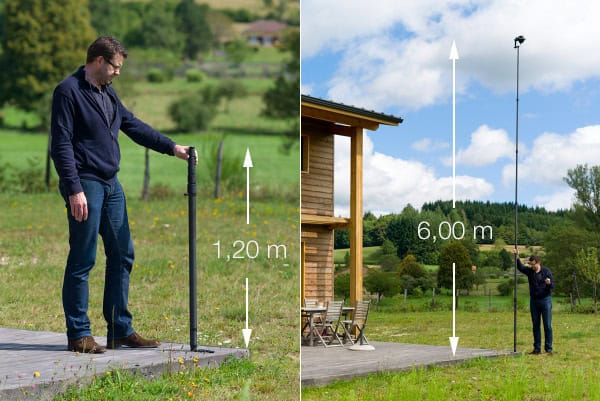
- Pole or car mount: Excellent for elevated viewpoints and moving shots, but add a safety tether and consider wind and vibration at all times.
- Lighting aids: Small LED panels or bounced flash can lift shadows in dim interiors; keep lighting consistent across frames.
- Weather protection: Rain covers and microfiber cloths keep the fisheye front element clear of drops—one drop can ruin multiple frames.
Step-by-Step Shooting Guide
Standard Static Scenes
- Level and nodal alignment: Level the tripod, then set your panoramic head so the lens rotates around the entrance pupil. Use a simple parallax test: place a light stand 0.5 m in front of the camera and a vertical edge several meters behind it. Rotate the camera left/right; adjust the rail until the foreground and background remain aligned. Mark the rail position for the X-T5 + 7Artisans 10mm combo.
- Manual exposure and white balance: Switch to M mode. Meter the brightest part you want to retain and expose to preserve highlights (especially in skies or windows). Lock white balance (Daylight outdoors, 4000–5000K in mixed indoor lighting) to ensure consistent stitching.
- Capture sequence with overlap: For this fisheye, shoot 6 frames around the horizon at 60° yaw increments. Then tilt up for a zenith shot and tilt down for a nadir shot. If you have lots of near objects or glass, add two extra around shots (8 total) for safer overlap.
- Nadir capture: Take a dedicated downward shot after moving the tripod or using a viewpoint-adjusted capture to simplify patching the tripod in post.
HDR / High Dynamic Range Interiors
- Bracket ±2 EV: Use exposure bracketing (3–5 frames) to balance bright windows and interior shadows. The X-T5’s auto bracketing works well—just ensure the whole pano is shot with the same bracketing pattern.
- Lock WB and focus: Maintain a fixed Kelvin WB and manual focus to keep color and sharpness uniform across all brackets.
- Shoot quickly: You’ll multiply your total frames by 3–5; maintain a steady rhythm to minimize changes in natural light or people movement.
Low-Light / Night Scenes
- Use a tripod and remote: Keep ISO in the 125–800 range for best quality; go to 1600 if necessary and expose carefully to protect shadows.
- Long exposures: 1–4 seconds per frame is common at night. Disable IBIS on tripod to avoid micro-blur. Consider the electronic front curtain shutter and a 2s self-timer to minimize vibration.
- Disable long exposure NR: Turn off in-camera long-exposure noise reduction so the camera doesn’t perform a dark-frame subtraction that doubles your capture time; handle NR in post.
Crowded Events
- Two passes: First pass captures structure and environment; second pass is timed for gaps in foot traffic. This gives options for masking in post.
- Faster shutter: Use 1/200s+ and ISO 400–800 to freeze motion where possible. Expect some ghosting; plan to blend the cleanest parts from multiple frames.
Special Setups (Pole / Car / Elevated)
- Secure gear: Use a safety tether and check all clamps. Elevated systems amplify vibration—avoid windy conditions and sudden movements.
- Slow rotations: Use deliberate, smooth rotations and consider shooting more around frames (8–10) to increase overlap and help the stitcher deal with minor shifts.
Case Studies
Indoor Real Estate
For a living room with bright windows, bracket 5 frames at ±2 EV, f/8, ISO 200. Shoot 6 around + Z + N using a pano head. Keep the lens close to windows if you must shoot through glass. Avoid mixed lighting by turning off a few accent lights if they cause heavy color casts.
Outdoor Sunset
Expose for the sky at base ISO 125–200 and f/8. Consider a 3-frame bracket to protect highlights. Wind can cause tripod vibration—use a bag weight on the center column and the 2s timer.
Event Crowd
Timing is key: shoot two passes and favor frames with fewer faces in the stitch boundaries. Use 8 around shots and faster shutter speeds to minimize motion artifacts.
Recommended Settings & Pro Tips
Exposure & Focus
| Scenario | Aperture | Shutter | ISO | Notes |
|---|---|---|---|---|
| Daylight outdoor | f/8–f/11 | 1/100–1/250 | 125–200 | Lock WB to Daylight; turn off Auto DR for consistent exposure |
| Low light/night | f/4–f/5.6 | 1/30–4s | 200–800 (1600 if needed) | Tripod + remote; IBIS off on tripod; timer or EFCS |
| Interior HDR | f/8 | Bracket ±2 EV | 125–400 | Balance windows and lamps; keep WB fixed |
| Action/moving subjects | f/5.6–f/8 | 1/200+ | 400–800 | Freeze motion; shoot a second pass for clean masks |
Critical Tips
- Manual focus at hyperfocal: For 10mm on APS-C at f/8, hyperfocal is roughly 0.6 m; set focus slightly beyond 0.6 m and everything from ~0.3 m to infinity stays sharp.
- Nodal calibration: Perform a foreground/background alignment test, then mark your pano rail for the X-T5 + 7Artisans 10mm position. Re-check if you add filters or change mounting plates.
- White balance lock: Use Kelvin mode (e.g., 5200K outdoors, ~4200–4800K indoors). Avoid Auto WB—it shifts between frames and complicates stitching.
- Shoot RAW: RAW maximizes dynamic range and color fidelity for blending and stitched panoramas; film simulations affect previews but not RAW data.
- IBIS usage: On a tripod, disable IBIS to prevent micro-movements that affect alignment. For handheld panos, IBIS can help stabilize frames.
- Consistency over perfection: With a fisheye, minor composition variations are fine—consistent exposure, WB, and rotation matter most.
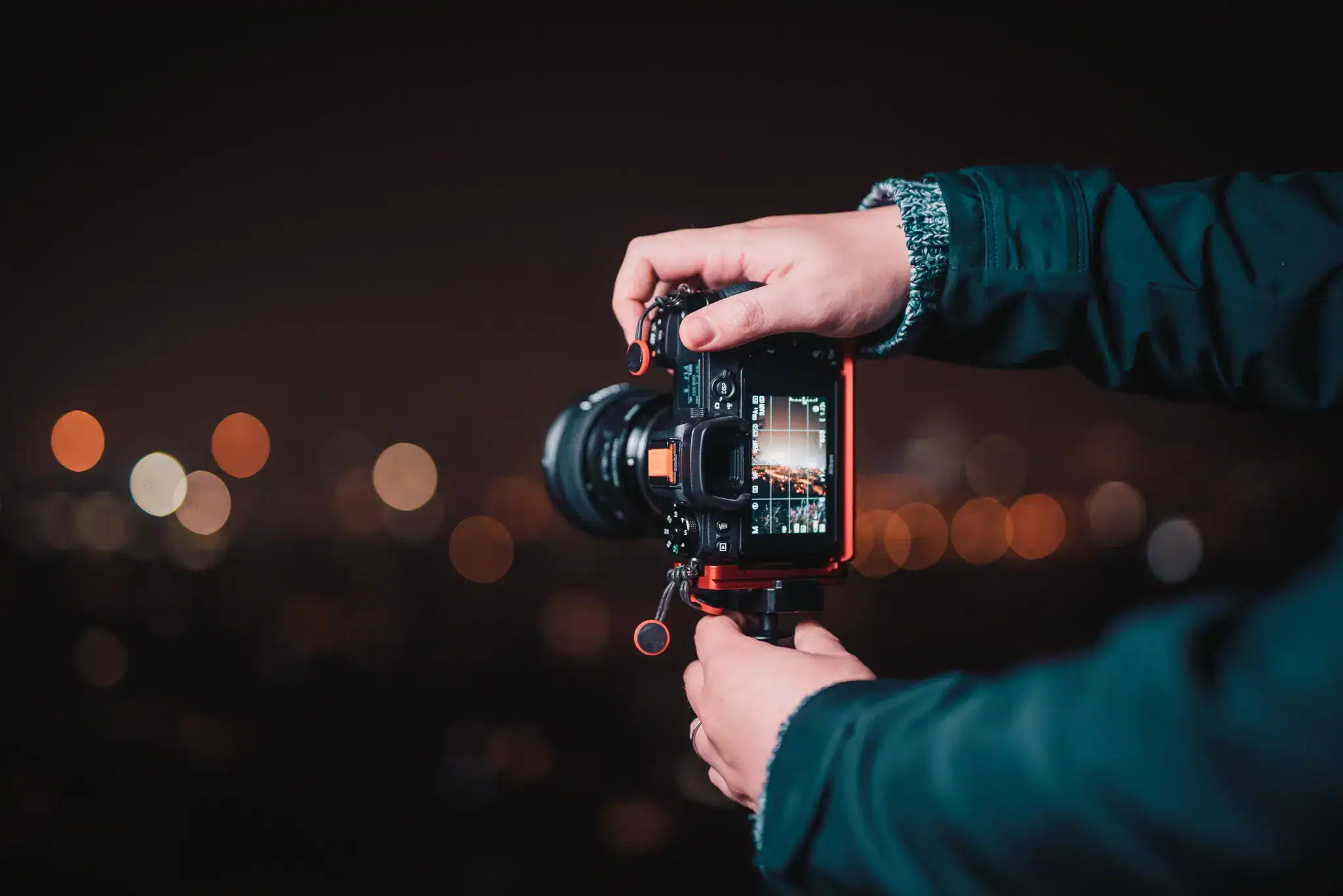
Stitching & Post-Processing
Software Workflow
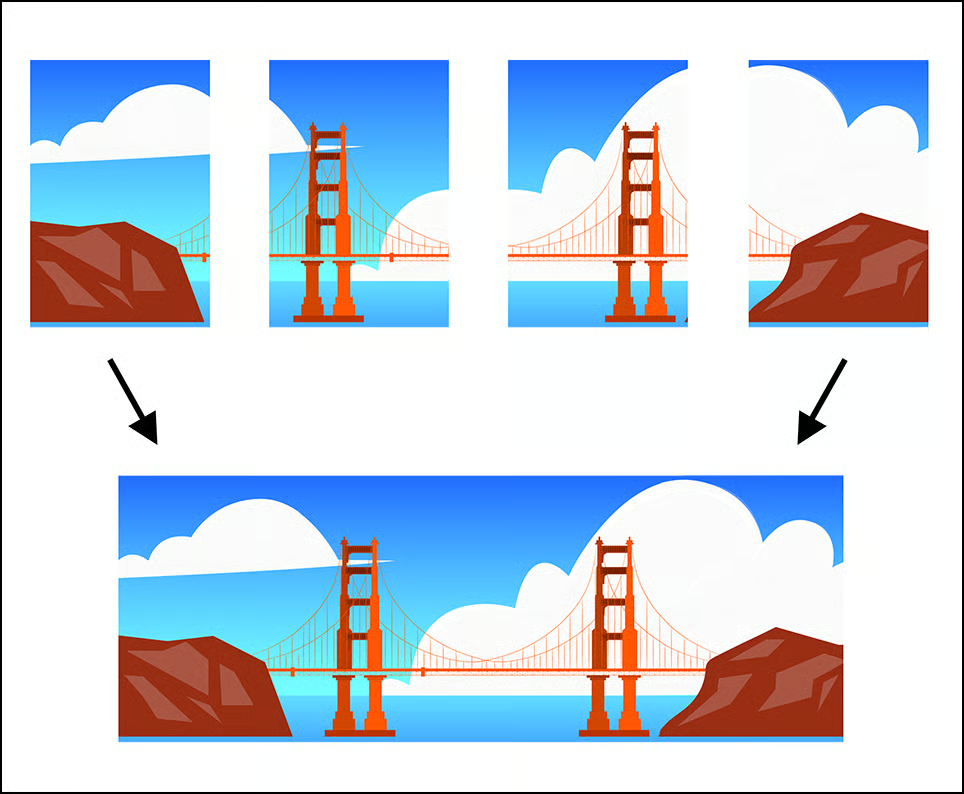
Import your RAW files into Lightroom or Capture One for initial culling, lens corrections (disable automatic distortion corrections for fisheye), and basic exposure tweaks if needed. Export 16-bit TIFFs for stitching in PTGui or Hugin. In PTGui, set lens type to “fisheye” and allow the optimizer to solve for lens parameters since third-party fisheyes can vary slightly. Aim for ~25–30% overlap with fisheyes and let the control point assistant do the heavy lifting. Consider creating a PTGui template for your X-T5 + 10mm fisheye once calibrated. For professional comparisons of PTGui’s strengths, see this review. PTGui review on Fstoppers
Cleanup & Enhancement
- Nadir patch: Use viewpoint correction in PTGui or clone/heal in Photoshop. Some AI tools can remove tripods quickly; double-check for patterned floors where cloning is obvious.
- Color consistency: Apply a unified white balance if needed; use HSL to tame fringing from the fisheye and reduce purple/green CA near edges.
- Noise reduction: Apply a light denoise on shadows for night scenes; avoid over-smoothing detail.
- Leveling: Use horizon tools in PTGui or Photoshop to correct roll/pitch/yaw so verticals are vertical in the final equirectangular.
- Export: Common outputs include 8K–12K equirectangular JPEG (quality 90–95) for web/VR, and 16-bit TIFF masters for archival or further edits.
For a great primer on DSLR/mirrorless 360 capture and stitching concepts (including equirectangular output for VR platforms), this guide is helpful. Using a mirrorless camera to shoot and stitch a 360 photo (Meta/Oculus)
Resolution Expectations
With 6 around + Z + N at 40MP, expect stitched equirectangulars in the 10K–14K pixel width range depending on overlap and cropping. More around shots or multi-row approaches push resolution higher. For a deeper dive into spherical resolution math and field-of-view, see the Panotools community resource. DSLR spherical resolution (PanoTools Wiki)
Useful Tools & Resources
Software
- PTGui panorama stitching
- Hugin open-source stitcher
- Lightroom / Photoshop for RAW and retouch
- AI tripod removal tools (content-aware fill, generative remove)
Hardware
- Panoramic heads (Nodal Ninja, Leofoto, Sunwayfoto)
- Carbon fiber tripods with a leveling base
- Wireless remote shutters or intervalometers
- Pole extensions / car mounts with safety tethers
Disclaimer: product names are for research reference—check official specs and manuals for the most accurate, up-to-date information.
If you’re new to nodal alignment, this panoramic head tutorial is a solid starting point. Panoramic head tutorial (360 Rumors)
Common Mistakes & How to Avoid Them
- Parallax error: Always align the entrance pupil. Test and mark the rail for the X-T5 + 10mm combo before real jobs.
- Exposure flicker: Shoot in full manual; disable Auto WB and Auto DR to keep exposures consistent across frames.
- Tripod shadows/footprint: Capture a dedicated nadir or plan a clean patch in post.
- Ghosting from movement: Take two passes and mask moving subjects during blending.
- High ISO noise: Prefer long exposures at lower ISO on tripod; reserve ISO 1600+ for fast-moving scenes.
- Flare with fisheyes: Shade the lens, avoid direct sun when possible, and clean the front element frequently.
Frequently Asked Questions
- Can I shoot handheld panoramas with the Fujifilm X-T5?
Yes, especially with the X-T5’s IBIS, but stitching reliability drops as parallax increases. For full 360s, use at least 8 around shots for overlap, faster shutter speeds (1/200s+), and keep rotation around your body’s center. A tripod with a pano head is strongly recommended for critical work.
- Is the 7Artisans 10mm f/2.8 II wide enough for single-row 360?
Yes. On APS-C it’s a diagonal fisheye near 180° diagonal FOV. You can cover a full sphere with 6 around + zenith + nadir. In tight interiors or handheld, 8 around gives safer overlap.
- Do I need HDR for interiors with bright windows?
Often yes. Bracket ±2 EV in 3–5 frames to hold window highlights and interior shadows. Keep WB and focus locked so all brackets stitch seamlessly.
- How do I avoid parallax issues with this lens?
Use a panoramic head and calibrate the entrance pupil. Align a near object with a distant edge, rotate the camera, and slide the lens along the rail until the relative positions don’t shift. Mark that spot for quick setup next time.
- What ISO range is safe on the X-T5 for low light panoramas?
For best quality, use ISO 125–800 on tripod with longer exposures. ISO 1600 remains very usable with correct exposure. Reserve ISO 3200 for situations where motion forces faster shutter speeds.
- Can I use Custom Modes on the X-T5 to speed pano setup?
Yes. Save a “Pano Tripod” set with M mode, fixed WB, IBIS off, EFCS, 2s timer, and bracketing off; and a “Pano HDR” set with bracketing configured. This reduces setup errors in the field.
- How can I reduce flare using a fisheye?
Avoid shooting directly into the sun, use your hand or a flag just out of frame to shade the front element, and clean the glass frequently. Slightly reframe the sun across shots so the stitcher can pick the cleanest segment.
- What panoramic head features should I look for?
Look for a multi-row head with clear scales, fore-aft and vertical rails (for entrance pupil alignment), a rotator with positive click-stops (e.g., 60°), and a compact design that fits your bag.
Watch: Panorama Head Setup & Stitching Basics
Prefer to learn visually? This video covers practical setup and workflow concepts that pair well with your X-T5 + fisheye approach.
For an additional step-by-step on setting up a panoramic head for pro-grade 360s, see this guide. Set up a panoramic head for high-end 360 photos (Meta/Oculus)
Safety, Limitations, and Honest Advice
Fisheyes invite bold compositions, but they also magnify mistakes. The 7Artisans 10mm is sharp stopped down, yet shows edge softness and CA wide open; avoid f/2.8 unless you truly need light. On a tripod, disable IBIS and use the 2-second timer or a remote to prevent micro-blur. Outdoors, wind is the #1 pano killer—stabilize the tripod and keep your rotation smooth and deliberate. Elevated and car-mounted setups demand strict safety practices: double-check clamps, add redundant tethers, and never operate over people or traffic. Finally, protect your files: use dual-card backup (RAW + RAW or RAW + JPEG), and if the scene is important, run a second complete rotation before you pack up.
