
Why This Camera & Lens Are Great for Panoramas
If you’re looking to create ultra-clean, high-resolution 360° panoramas, the Fujifilm GFX 50S / 50R is a superb foundation. Both bodies share a 51.4MP 44×33mm medium-format sensor with generous 14-bit color and approximately 14 stops of dynamic range at base ISO. Pixel pitch is about 5.3 µm, which helps deliver excellent tonal gradation and low noise when you expose correctly. The files grade beautifully and survive aggressive blending and masking during stitching.
The Nikon Z 20mm f/1.8 S is a modern rectilinear prime renowned for its across-frame sharpness by f/4–f/5.6, low coma, minimal chromatic aberration, and high microcontrast—traits that are valuable for panoramas because they keep edges crisp and control artifacts during stitch blending.
Important compatibility note: the Nikon Z 20mm f/1.8 S cannot be directly mounted to the Fujifilm GFX G-mount (there is no practical electronic adapter from Z-mount to G-mount as of writing). For a panorama workflow that matches this lens’s field of view on the GFX system, use a native or adapted lens with similar coverage (for example, the GF 23mm f/4 R LM WR or Laowa 20–23mm-class options for GFX). Alternatively, use the Nikon Z 20mm f/1.8 S on a Nikon Z body and apply the same panorama techniques described below. In this guide, we’ll reference the target field of view of a 20mm full-frame rectilinear and translate it to the GFX system so you can still follow along with the GFX 50S/50R.
Quick Setup Overview
- Camera: Fujifilm GFX 50S / 50R — 44×33mm (medium format), 51.4MP, ~14 stops DR at base ISO, 14-bit RAW, pixel pitch ~5.3 µm.
- Lens: Nikon Z 20mm f/1.8 S (rectilinear prime) — razor-sharp by f/4–f/8, low CA and coma, 77mm front filters. Note: not mountable on GFX; use a GFX lens with a similar full-frame equivalent FOV (GF 23mm ≈ 18mm FF eq; GF 30mm ≈ 24mm FF eq). If you shoot the 20mm on a Nikon Z body, the shot counts below still apply.
- Estimated shots & overlap (20mm FF rectilinear equivalent):
- Single-row 360° sphere: not sufficient. You’ll need multi-row for zenith/nadir coverage.
- Two-row spherical: 8 shots around at tilt +30°, 8 shots around at tilt −30° (30–35% overlap), plus 1–2 zenith and 1–2 nadir shots → ~18–20 images.
- Safety pass: add a second nadir and a second upper-row pass in dynamic scenes.
- Difficulty: Moderate. Rectilinear wide primes require careful nodal alignment and enough overlap; stitching is straightforward if you shoot cleanly.
Planning & On-Site Preparation
Evaluate Shooting Environment
Scan for bright light sources, reflective glass, and moving subjects (people, traffic, trees in wind). Reflections increase ghosting risk; if you must shoot through glass, press a lens hood or cloth against the pane and stay as perpendicular as possible. Keep 2–3 cm off the glass to reduce contact vibrations and avoid smearing. For outdoor sunsets, anticipate high dynamic range—plan to bracket exposures. In crowded scenes, note repeating patterns and surfaces; they help your stitcher find more control points.
Match Gear to Scene Goals
The GFX 50S/50R shines where tonality and detail matter. Base ISO 100 gives you maximum dynamic range; ISO 200–800 is generally safe for clean details. Indoors, the sensor’s latitude helps even before HDR, but bracketed sets (±2 EV) produce significantly cleaner window pulls. A 20mm full-frame rectilinear field of view is versatile: wide enough for interiors but not so wide that edges distort unnaturally. On GFX, a GF 23mm f/4 (≈18mm FF eq) is a strong substitute when you can’t mount the Nikon Z 20mm.
Pre-shoot Checklist
- Power & storage: full batteries, fast cards, and 20–50% extra capacity for HDR brackets.
- Clean optics and sensor: dust becomes a cloning slog across many frames.
- Tripod & leveling: a leveling base speeds setup and reduces horizon correction later.
- Panoramic head: pre-calibrate your nodal point for the chosen lens.
- Safety: wind forecast for rooftops/poles, tethers for elevated rigs, and keep clear of edges.
- Backup workflow: shoot a second pass, especially for critical client work or changing light.
Essential Gear & Setup
Core Gear
- Panoramic head: lets you rotate around the lens’s no-parallax (nodal) point to eliminate parallax. This is crucial for clean stitches in tight interiors.
- Stable tripod + leveling base: fast leveling means faster, more accurate rotations.
- Remote trigger or camera app: avoids shake and speeds bracket sequences.
Optional Add-ons
- Pole/car mount: use tethers, safety lines, and limit exposure to wind. Check all clamps and torque before lifting overhead or mounting on a vehicle.
- Lighting aids: small LEDs or bounced flashes for dim corners in real estate and interiors.
- Weather protection: rain covers, microfiber towels, and silica gels.

Step-by-Step Shooting Guide
Standard Static Scenes
- Level the tripod and align the nodal point. Slide the camera on your pano head’s rail until a near and far vertical edge stay aligned while you pan. Mark the rail position for your lens so you can set it quickly next time.
- Manual exposure and fixed white balance. Set exposure based on a mid-tone reading; lock WB (Daylight/Tungsten/etc.) to prevent color shifts between frames.
- Capture with overlap. For a 20mm FF rectilinear equivalent:
- Row 1: tilt +30°, shoot 8 frames around (45° yaw increments).
- Row 2: tilt −30°, shoot 8 frames around.
- Add: 1–2 zenith shots at +75° to +90° and 1–2 nadir shots at −75° to −90°.
- Nadir coverage. Take an extra offset nadir after moving the tripod slightly, or capture a handheld nadir and patch later.
HDR / High Dynamic Range Interiors
- Bracket ±2 EV for each camera position (3–5 exposures). The GFX 50S/50R handles highlights well at base ISO; bracketing ensures window detail and clean shadows.
- Lock white balance and focus before starting brackets, and use a remote or self-timer to avoid micro-blur.
- Choose whether to merge HDR first or after stitching. For moving scenes, stitch first and HDR-merge afterward per view as needed; for static interiors, pre-merge to reduce the number of files in PTGui/Hugin.
Low-Light / Night Scenes
- Shoot at f/4–f/5.6 to control star/point light rendering and keep shutter speeds manageable. Use ISO 200–800 for best GFX quality; ISO 1600 is usable if you expose to the right.
- Use a remote release and shoot during wind lulls. On the 50S/50R (no IBIS), stability is everything.
- Consider long exposure noise reduction if you are not bracketing heavily, or plan for noise reduction in post.
Crowded Events
- Do two passes: one fast for coverage, one slow while waiting for gaps in the crowd.
- Mark a reference frame in each row with your hand or a clap for later syncing and selection.
- In post, mask people between the two passes to minimize double images and ghosting.
Special Setups (Pole / Car / Drone)
- Use a safety tether and inspect clamps every few minutes. Keep speeds low and avoid sudden turns for car rigs.
- Increase overlap (35–40%) and rotate more slowly to minimize vibration blur.
- Avoid very long exposures on poles. Raise ISO moderately instead of risking motion blur.
Field-Proven Mini Case Studies
Indoor Real Estate
Use two-row capture at f/8, ISO 100–200, 1/2–1/15 s depending on ambient light. Bracket ±2 EV. Shoot windows last to avoid changing color temp from sunlight shifts. A 20mm FF equivalent FOV balances coverage and edges for natural-looking rooms.
Outdoor Sunset
Lock WB to Daylight, bracket ±2 EV or ±3 EV if sun is in frame. Take a quick safety sequence before peak light, then a high-quality sequence at peak color. Watch for flare; shield the lens for the frame pointing toward the sun.
Event Crowds
Use 1/200 s or faster, ISO 400–800, and accept a slightly wider aperture (f/5.6) for speed. Two passes allow you to mask motion without losing context.
Rooftop/Pole
Add a tether, use a lighter head if possible, and keep exposures under 1/30 s. Boost ISO to 400–800 rather than risking blur. Take an extra nadir from the ground later if the pole nadir is risky.
Recommended Settings & Pro Tips
Exposure & Focus
| Scenario | Aperture | Shutter | ISO | Notes |
|---|---|---|---|---|
| Daylight outdoor | f/8–f/11 | 1/100–1/250 | 100–200 | Lock WB to Daylight; watch for flare |
| Low light/night | f/4–f/5.6 | 1/30–1/60 | 200–800 | Tripod + remote; test 1600 only if necessary |
| Interior HDR | f/8 | Bracket ±2 EV | 100–400 | Expose to protect highlights near windows |
| Action / moving subjects | f/5.6–f/8 | 1/200+ | 400–800 | Two passes for masking moving people |
Critical Tips
- Manual focus and hyperfocal: For a 20mm FF equivalent at f/8, focus a few meters out and switch to MF to keep frames consistent.
- Nodal calibration: Align a near edge with a far vertical line; slide the camera along the rail until no relative shift occurs while panning. Mark this setting on your rail for the lens you use on GFX.
- White balance lock: Mixed lighting can vary frame to frame; fix WB to avoid color seams.
- RAW vs JPEG: Shoot RAW for maximum dynamic range and easier color matching.
- Stabilization: The GFX 50S/50R lack IBIS; keep everything locked down. If using a body with IBIS, turn it off on a tripod to prevent micro-jitters.
Stitching & Post-Processing
Software Workflow
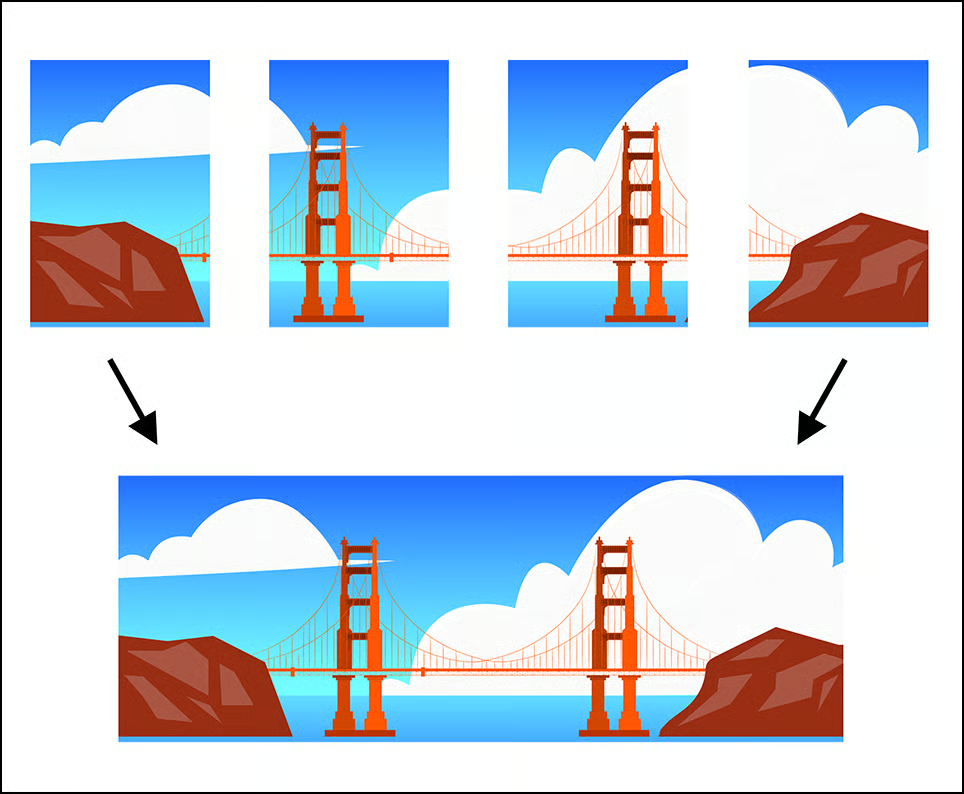
PTGui and Hugin are industry standards for full spherical panoramas. Import your frames, set lens type to rectilinear for a 20mm-equivalent setup, and use at least 25–35% overlap. Rectilinear primes require more images than fisheyes but give a natural, low-distortion look in architectural spaces. Expect two-row stitching with separate zenith/nadir images for a complete sphere. PTGui’s optimizer and masking tools are excellent for removing moving people and dealing with hard edges. For Lightroom or Photoshop users, you can merge HDR first (for static scenes) or stitch first (for scenes with movement) depending on the complexity. For a deeper dive on high-end pano head setup and workflow, see the Oculus Creator guide and panoramic head tutorial resources at the end of this section.
Industry overlap guidelines: about 25–30% for fisheyes and 30–35% for rectilinear wides are reliable baselines. More overlap helps in low-contrast or low-texture environments such as plain walls or skies.
Cleanup & Enhancement
- Nadir patch: Clone manually in Photoshop or use an AI-powered patch. A clean handheld nadir plate shot makes this faster.
- Color and noise: Apply consistent color grading across the panorama. Use noise reduction sparingly on the highest ISO zones.
- Horizon leveling: Use the “Level” or “Verticals” tool in PTGui, then fine-tune yaw/pitch/roll until verticals are true.
- Export: Save a 16-bit TIFF master and an equirectangular JPEG (2:1 ratio) for VR platforms.
Recommended references: Learn panoramic head basics and best practices from the panoramic head tutorial and a stitching tool review for PTGui to refine your workflow. Panoramic head tutorial (360 Rumors). PTGui review and workflow tips (Fstoppers). For an end-to-end DSLR/MILC 360 process, see Oculus Creator: Using a DSLR/MILC to shoot and stitch a 360 photo.
Useful Tools & Resources
Software
- PTGui panorama stitching
- Hugin (open source)
- Lightroom / Photoshop for HDR and cleanup
- AI tripod/nadir removal tools
Hardware
- Panoramic heads: Nodal Ninja, Leofoto
- Carbon fiber tripods with leveling base
- Wireless remote shutters
- Pole extensions / car mounts with safety tethers
Disclaimer: software/hardware names are provided for search reference; verify features and compatibility with official sources.
Common Mistakes & How to Avoid Them
- Parallax error → Align to the no-parallax point and keep the camera orientation consistent across rows.
- Exposure flicker → Manual exposure and locked white balance across the entire sequence.
- Tripod shadows/feet → Capture dedicated nadir frames and patch cleanly in post.
- Ghosting from moving subjects → Shoot two passes, then mask in PTGui/Photoshop.
- Night noise/blur → Keep ISO modest (≤800 on GFX when possible) and use a remote release with wind-aware timing.
Frequently Asked Questions
- Can I shoot handheld panoramas with the Fujifilm GFX 50S/50R?
You can for partial panoramas in bright light, but for full 360° spheres—especially indoors—a tripod and panoramic head are strongly recommended. The high resolution of GFX punishes any misalignment during stitching.
- Is the Nikon Z 20mm f/1.8 S wide enough for single-row 360?
No. A single row won’t capture zenith and nadir sufficiently. Plan at least two rows (e.g., +30° and −30°) plus dedicated zenith/nadir frames for a complete sphere. If using an ultra-wide fisheye, single-row can be possible, but the look is very different.
- Can I mount the Nikon Z 20mm f/1.8 S on the GFX 50S/50R?
Not practically. There is no reliable Z-to-GFX electronic adapter to control aperture/AF. Use a GFX lens with a similar FOV (GF 23mm f/4 or GF 30mm f/3.5) on your GFX body, or shoot the 20mm on a Nikon Z body and follow the same pano steps.
- Do I need HDR for interiors with bright windows?
Usually yes. Bracket ±2 EV (3–5 frames) to balance window highlights and interior shadows. The GFX sensor has strong DR, but HDR keeps noise low and preserves delicate highlight detail.
- What ISO range is safe on the GFX 50S/50R for low light?
ISO 100–400 is ideal; 800 is typically clean when exposed to the right. ISO 1600 is usable in a pinch with careful noise reduction, but prioritize tripod stability and longer shutter speeds first.
- How do I avoid parallax issues with a rectilinear wide?
Use a calibrated panoramic head. Find the lens’s entrance pupil: align near/far vertical lines and slide the camera on the rail until there’s no shift while panning. Record that rail position for repeatable setups.
- Can I create custom shooting modes on GFX for pano work?
Yes. Save a Custom Setting with manual exposure, fixed WB, MF, bracketing parameters, and self-timer/remote preferences. Recall it before each shoot to reduce errors.
- What’s the best tripod head for this setup?
A two-axis panoramic head with fore-aft and lateral adjustment for nodal alignment (e.g., Nodal Ninja, Leofoto) plus a leveling base. For multi-row work, ensure the vertical arm is rigid and repeatable.
Expert Notes, Limitations & Safety
GFX 50S/50R strengths include very clean base ISO files, excellent midtone detail, and resilient 14-bit color—ideal for blending. Limitations: no IBIS, slower AF compared to modern smaller sensors, and heavier rigs. For Nikon Z 20mm f/1.8 S users, remember it’s not a native match to GFX. Don’t attempt improvised adapters that risk your mount or sensor; instead, choose a GFX lens that approximates the FOV, or use a Nikon Z body for that lens and apply the same capture methodology.
Safety: When working on rooftops, use tethers and keep away from edges. For poles and car rigs, employ secondary safety lines and double-check clamp torque. Weather changes quickly—rain protection and a microfiber cloth can save your shoot.
For more on technique and lens/sensor coverage for spherical panoramas, see the Panotools knowledge base on coverage and resolution: Panotools: DSLR spherical resolution.
Working Visuals
Below are a couple of visuals that pair with techniques above—use them as mental checklists on location and in post.
Final Checklist for How to Shoot Panorama with Fujifilm GFX 50S / 50R & Nikon Z 20mm f/1.8 S
- Lens compatibility: Use a GFX lens with similar FOV to the Nikon Z 20mm on the GFX body, or use the Nikon lens on a Nikon Z camera. The capture workflow remains the same.
- Tripod leveled, panoramic head calibrated to the lens’s nodal point.
- Manual exposure and white balance locked; RAW capture.
- Two-row strategy for 360°: 8 around at +30°, 8 around at −30°, plus zenith and nadir frames.
- For interiors: bracket ±2 EV; consider pre-merging HDR for static scenes.
- Safety practices: tethers for elevated work; monitor wind; avoid edges; protect gear from weather.
- Stitch in PTGui/Hugin; mask moving subjects; patch nadir; export equirectangular for VR.
Want a broader perspective on camera/lens combos for virtual tours and pano work? This explainer complements the techniques above: DSLR/Mirrorless virtual tour guide (360 Rumors).
