
Why This Camera & Lens Are Great for Panoramas
If you’re wondering how to shoot panorama with Fujifilm GFX 100 II & Samyang 12mm f/2.8 ED AS NCS Fish-Eye, you’re already on a promising path. This combo pairs a massively detailed 102MP medium-format sensor with a fast, ultra-wide fisheye that minimizes shot count. The GFX 100 II’s 43.8 × 32.9 mm BSI CMOS sensor delivers ~14+ stops of dynamic range at base ISO with 16-bit RAW options, excellent color depth, and pixel-level fidelity (approx. 3.76 µm photosites) that pays off in clean stitches and huge output files for VR and large prints. In-body image stabilization (IBIS) up to ~8 stops is helpful hand-held, but we’ll disable it on a tripod for best precision.
The Samyang 12mm f/2.8 is a manual-focus diagonal fisheye covering 180° diagonally on 35mm full-frame. On the GFX 100 II you have two practical choices: use the camera’s 35mm crop mode to fully cover the sensor area (no black corners) while still retaining ~61MP capture, or shoot full 44×33 and accept heavy corner vignetting that you’ll mask out in stitching. For most workflows, the 35mm crop mode is the cleanest option. The lens is sharp by f/5.6–f/8, focuses smoothly, and its NCS coatings help resist flare—great for outdoor panoramas and interiors with bright windows. Being a fisheye, it keeps your shot count low and overlap high, easing stitches in PTGui/Hugin. The trade-off is curvature: you’ll embrace that during stitching (no need to “defish” before stitching for 360 equirectangular output).
Quick Setup Overview
- Camera: Fujifilm GFX 100 II — Medium format (43.8 × 32.9 mm), 102MP BSI CMOS, ~14+ stops DR at base ISO, 16-bit RAW, IBIS. Pixel pitch ~3.76 µm.
- Lens: Samyang 12mm f/2.8 ED AS NCS Fish-Eye — diagonal fisheye for 35mm full-frame, manual focus, best sharpness at f/5.6–f/8, moderate lateral CA, excellent value.
- Estimated shots & overlap (35mm crop mode recommended):
- Single-row 360: 6 around at 60° spacing (+ one zenith, + one/two nadir) with ~30–35% overlap.
- Safety variation: 8 around if the scene is complex (nearby objects, crowds).
- HDR: bracket each position ±2 EV, 3–5 frames.
- Difficulty: Moderate. Fisheye reduces shot count but nodal alignment is critical for perfect stitches.
Planning & On-Site Preparation
Evaluate Shooting Environment
Survey the scene for strong light sources, moving subjects, and reflective surfaces (glass, polished floors). If you must shoot through glass, get the lens as close as possible (1–2 cm) and shoot perpendicular to the surface to minimize reflections and ghosting. Check the nearest objects—if anything is within 0.5–1 m of the lens, expect more visible parallax unless your nodal point is dialed in perfectly. For sunsets or interiors with bright windows, note that you’ll likely need HDR bracketing to preserve highlight detail while keeping shadows clean.
Match Gear to Scene Goals
The GFX 100 II’s wide dynamic range and low read noise make it ideal for challenging lighting. In real estate or museum interiors, base ISO 80–200 yields clean, deep shadows; you can safely push to ISO 400–800 if needed without significant stitch noise. Outdoors at sunset, the fisheye reduces shot count, which is crucial as the sky changes minute to minute. For events or busy streets, fewer frames mean fewer moving elements to mask later.
Pre-shoot Checklist
- Power and storage: Fully charge batteries; use fast CFexpress Type B and a backup SD (enable dual-card backup). Format cards in-camera.
- Clean optics: Blow off dust; clean front element of the Samyang and check for smudges. Inspect the sensor for spots (they multiply in skies).
- Level and calibrate: Level the tripod, confirm your panoramic head’s nodal settings for this combo (details below).
- Safety checks: On rooftops or poles, tether gear, check wind gusts, and avoid overhead wires. For car mounts, verify local laws and use secondary tethers.
- Backup workflow: Shoot one complete safety round after the main set, especially if people or clouds are moving.
Essential Gear & Setup
Core Gear
- Panoramic head: A proper pano head lets you rotate around the lens’s entrance pupil (nodal point) to eliminate parallax. This is essential when foreground objects are close. Mark your rail position once calibrated.
- Stable tripod with leveling base: A leveling base speeds up setup; a perfectly level yaw axis keeps horizons straight and reduces post corrections.
- Remote trigger or camera app: Use a remote release or the Fujifilm app’s shutter to avoid touching the camera. Enable a 2-second timer as a backup.
Optional Add-ons
- Pole or car mount: Great for elevated or moving viewpoints. Use guy lines in wind and always keep a safety tether attached to the camera and pole.
- Lighting aids: Small LED panels or bouncing flashes help interiors with deep shadows. Keep light consistent across frames.
- Weather protection: Rain cover, microfiber cloth, and silica packets for humidity.
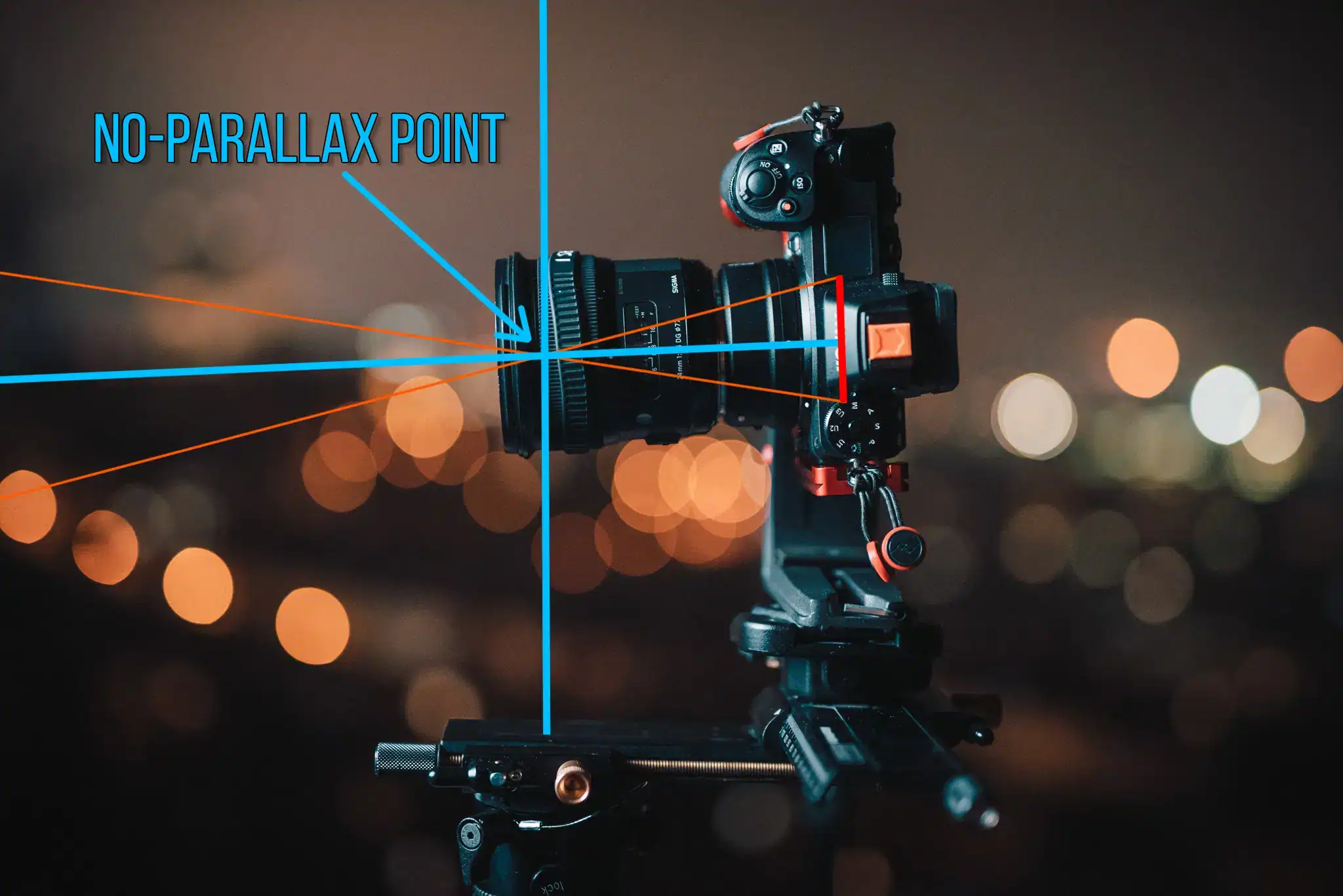
Recommended pano head brands include Nodal Ninja and Leofoto. If you’re new to nodal alignment, this panoramic head tutorial is an excellent primer: understanding and setting the entrance pupil.
Step-by-Step Shooting Guide
Standard Static Scenes
- Level and Nodal Alignment
- Mount the GFX 100 II in 35mm crop mode to avoid corner vignetting with the Samyang 12mm.
- Start with the camera in portrait orientation on the pano head. Level the base using the bowl/leveling base and confirm with the camera’s electronic level.
- Calibrate the nodal point: place two vertical objects (one near, one far) along the frame edge; rotate 30–60° and adjust the fore-aft rail so their relative position doesn’t shift. Expect an entrance pupil offset roughly 55–65 mm forward of the sensor plane for this lens-plus-adapter, but verify and mark your exact setting. Adapters change the number.
- Manual Exposure and White Balance
- Set manual exposure. Meter for highlights outdoors; meter midtones for interiors when bracketing.
- Lock white balance (Daylight outside; Custom/Fluorescent/Tungsten inside). Avoid Auto WB across the set.
- Disable IBIS when on tripod. Enable EFCS (electronic first curtain) to minimize shutter shock.
- Capture Sequence
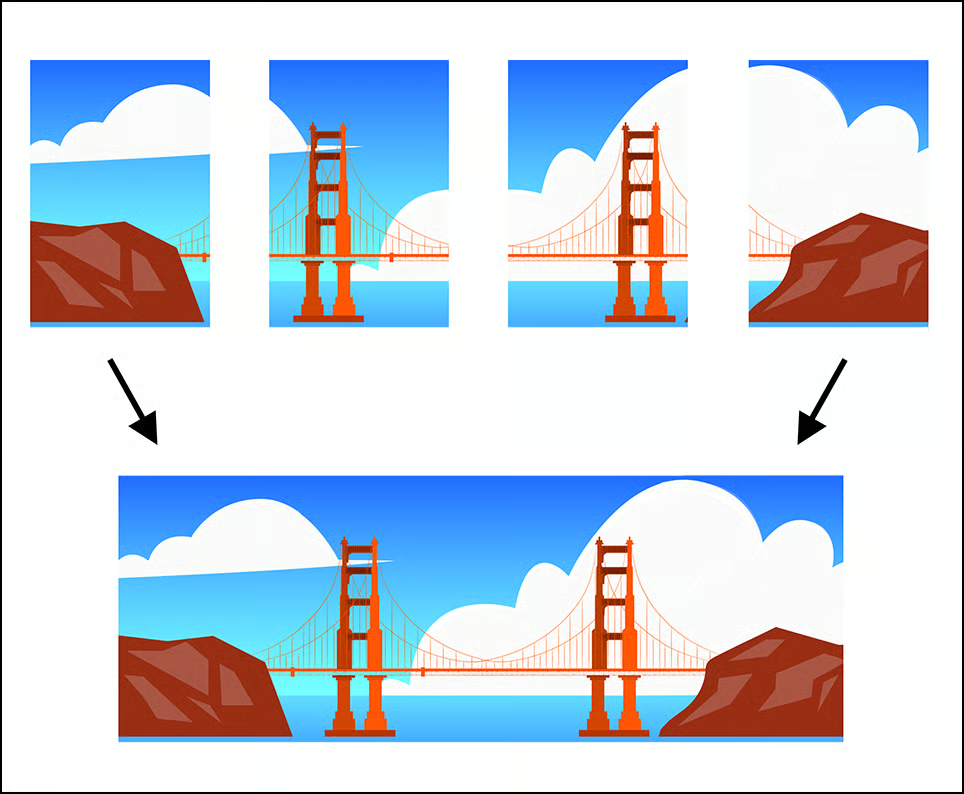
- Set 6 positions around at 60° increments. Aim for 30–35% overlap.
- Add 1 zenith (tilt up ~60–90°). Add 1–2 nadir shots (tilt down) for tripod removal. For a clean nadir, shift the camera laterally with the nodal rail or shoot an offset handheld patch shot.
- Nadir Shot and Cleanup
- After the main ring, tilt down for nadir. If needed, lift the tripod, rotate 180°, and shoot again to get a second patch option.
HDR / High Dynamic Range Interiors
- Bracket each position ±2 EV (3–5 frames). With the GFX 100 II’s DR, 3 frames often suffice, but 5 is safer for bright windows.
- Keep WB locked. Avoid Aperture priority; use Manual and adjust shutter speed to bracket.
- Use self-timer or remote release. Confirm that the pano head is fully settled before each bracket set.
Low-Light / Night Scenes
- Use f/4–f/5.6 to keep exposure reasonable; shutter may drop to 1–10 s. The GFX 100 II is clean at ISO 100–400; ISO 800–1600 remains usable with careful noise reduction.
- Turn off IBIS on tripod. Use a remote release. Enable EFCS; consider full electronic shutter for very long exposures to avoid shock.
- Watch moving lights and crowds; take a second pass if needed for clean plates to blend later.
Crowded Events
- Two passes: first for the scene, second while anticipating gaps in movement. Markers on the head help you repeat positions quickly.
- Shorter shutter (1/200s or faster) and ISO 800–1600 help freeze motion. Mask moving subjects in post using layers.
Special Setups (Pole / Car / Drone)
- Pole: Use a light carbon pole with a compact pano head. Keep the lens over the pole axis to preserve nodal alignment. Add a safety tether from camera to pole.
- Car mount: Use vibration-damping mounts and shoot at stops or very low speeds. Secure a secondary tether inside the vehicle.
- Wind: Rotate slower, let oscillations settle, and consider 8-around instead of 6 for safer overlap.
Recommended Settings & Pro Tips
Exposure & Focus
| Scenario | Aperture | Shutter | ISO | Notes |
|---|---|---|---|---|
| Daylight outdoor | f/8–f/11 | 1/100–1/250 | 80–200 | Lock WB to Daylight; EFCS on |
| Low light/night | f/4–f/5.6 | 1/30–8 s | 100–800 (1600 if needed) | Tripod + remote; IBIS off |
| Interior HDR | f/8 | Bracket ±2 EV | 80–400 | Expose for windows; 3–5 brackets |
| Action / people | f/5.6–f/8 | 1/200+ | 400–1600 | Two-pass strategy to reduce ghosting |
Critical Tips
- Focus: Use manual focus with peaking. At 12mm, set around the hyperfocal distance. At f/8, a practical starting point is ~0.7 m; confirm with magnified view.
- Nodal calibration: Mark your rail position for this lens+adapter on your pano head. Remember: different adapters change the entrance pupil location slightly.
- White balance: Lock WB to one value per panorama to avoid color shifts in stitching.
- RAW vs JPEG: Shoot 14/16-bit RAW. The GFX 100 II’s 16-bit files give extra flexibility for HDR and color grading.
- Stabilization: Turn IBIS off on tripods to prevent micro-drift between frames. Handheld pilots might enable IBIS but expect more stitching work.
- Crop mode: Use 35mm crop mode for clean fisheye coverage without black corners; you still get ~61MP capture per frame.
Stitching & Post-Processing
Software Workflow
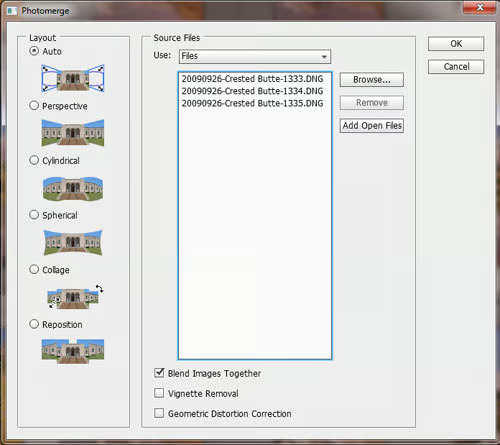
Import RAW files to Lightroom or Capture One. Apply lens-neutral settings: disable heavy sharpening and noise reduction initially. Export 16-bit TIFFs or stitch directly from RAW in PTGui Pro. In PTGui/Hugin, set lens type to “Fisheye,” focal length 12mm, and the correct crop factor (1.0 if using 35mm crop on the GFX). For fisheye captures, 25–35% overlap is ideal; rectilinear lenses typically prefer 20–25% overlap. PTGui is a robust, industry-standard choice for complex sets, HDR merges, and masking. For an overview of why many pros prefer it, see this review: PTGui as a pro stitching tool.
Cleanup & Enhancement
- Tripod/nadir patch: Export with a hole or with tripod visible and patch in Photoshop. You can also use AI-based tools to remove tripods quickly.
- Color and NR: Apply gentle global noise reduction at ISO 800–1600; finesse color balance and contrast. Keep sky gradients smooth.
- Level horizon: Use the optimizer or horizon tool to correct roll/pitch. Check for subtle vertical bending in architectural scenes.
- Export: For VR, export 2:1 equirectangular JPEG/TIFF. With this setup, 12–16K width outputs are realistic and razor sharp.
If you’re new to end-to-end DSLR/mirrorless 360 workflows, Meta’s guide offers a solid grounding: Using a DSLR or mirrorless camera to shoot and stitch a 360 photo.
Useful Tools & Resources
Software
- PTGui (Pro) for advanced stitching, HDR, and masking.
- Hugin (open source) for budget-friendly stitching.
- Lightroom / Photoshop for RAW prep and nadir patching.
- AI tripod removal tools for quick nadir cleanup.
Hardware
- Panoramic heads: Nodal Ninja, Leofoto, or similar L-bracket + rail systems.
- Carbon fiber tripods with a leveling base for fast setup.
- Wireless remotes or intervalometers with 2–s delay options.
- Pole extensions or suction car mounts with secondary tethers.
Disclaimer: software/hardware names provided for search reference; check official sites for details.
To deepen your technique, this panoramic head setup guide is also helpful: Set up a panoramic head for perfect high-end 360 photos.
Common Mistakes & How to Avoid Them
- Parallax error: Always rotate around the entrance pupil. Calibrate and mark your nodal setting for the Samyang 12mm + your adapter.
- Exposure flicker: Don’t use Auto modes. Lock exposure and WB across the set; bracket in Manual for HDR.
- Tripod shadows or footprints: Plan a clean nadir shot or patch later with a dedicated plate.
- Ghosting from moving subjects: Shoot two passes and use masking in PTGui/Photoshop to keep a clean base plate.
- High ISO noise at night: Use a solid tripod, longer shutter, and keep ISO as low as practical (100–800). The GFX files tolerate gentle NR well.
- Fisheye flare: Shield from sun with your hand off-frame or shoot when the sun is behind objects; the Samyang’s coatings help, but angle matters.
Field-Proven Scenarios
Indoor Real Estate
Use f/8, ISO 100–200, and 3–5 bracketed exposures at each position. Keep the lens about 1–1.5 m from walls to reduce parallax pressure. Turn off flickering lights or set shutter speeds that avoid banding. The GFX 100 II’s color depth makes mixed lighting more manageable—still lock WB to a single setting and correct in post across the entire pano.
Outdoor Sunset 360
Meter for highlights and bracket ±2 EV. Work quickly—do the 6-around first, then zenith, then nadir. If the sky changes rapidly, prioritize the sky ring and patch the nadir later. The fisheye’s wide coverage minimizes the time between frames, reducing exposure drift.
Crowded Events
Pre-plan your rotation marks and shoot a fast first pass at 1/250–1/500s, ISO 800–1600. Wait a few seconds at each position for people to move into better compositions. Shoot a second pass to get clean gaps for blending. Mask in PTGui to choose the best parts of each position.
Rooftop or Pole Shooting
Keep the rig compact and balanced. Tighten clamps, use a wrist tether, and avoid gusty conditions. Rotate slowly, allowing any oscillation to settle. Consider 8-around for safety if movement is noticeable.
Frequently Asked Questions
- Can I shoot handheld panoramas with the Fujifilm GFX 100 II?
Yes, but it’s not ideal. IBIS can help with stability, but parallax becomes harder to control and overlap can vary. For high-quality 360 photos, use a tripod and pano head. Handheld is acceptable for quick partial panos or if nothing is close to the camera.
- Is the Samyang 12mm f/2.8 wide enough for a single-row 360?
Yes. In 35mm crop mode, 6 shots around + zenith + nadir is a reliable recipe with ~30–35% overlap. In complex scenes, consider 8 around.
- Do I need HDR for interiors with bright windows?
Usually yes. Bracket ±2 EV (3–5 frames). The GFX 100 II has great DR, but windows can exceed it. HDR ensures clean highlights and shadow detail.
- How do I avoid parallax issues with this combo?
Use a panoramic head and calibrate the entrance pupil. With an EF-GFX or similar adapter, your nodal offset may differ—expect ~55–65 mm from the sensor plane as a starting point, then fine-tune using the near/far object method.
- What ISO range is safe on the GFX 100 II in low light?
For tripod-based panoramas, try ISO 80–400 first. ISO 800 remains clean; ISO 1600 is usable with gentle noise reduction. Prefer longer shutter over higher ISO for static scenes.
- Can I set custom modes for faster pano shooting?
Yes. Assign a custom mode with Manual exposure, fixed WB, RAW, EFCS, IBIS off, and a 2 s self-timer. Create a second custom mode for HDR with bracketed exposures.
- How do I reduce flare with a fisheye?
Avoid pointing directly at the sun; shield with your hand just outside the frame. Shoot when the sun is low and partially occluded, or bracket and blend to reduce artifacts. The Samyang’s NCS helps, but composition is key.
- What’s the best tripod head for this setup?
A two-axis panoramic head with fore-aft and lateral rails (e.g., Nodal Ninja) is ideal. Ensure it supports the GFX body weight and allows portrait orientation with precise rotation detents (60°/45°).
Safety, Data Integrity, and Further Reading
Always secure your gear when elevated or near edges. Use a neck strap and a tether point on the camera body. In wind, lower the center column, spread tripod legs wide, and hang a weighted bag from the hook. Back up images to both cards in-camera and clone to a laptop or SSD immediately after the shoot.
To compare focal lengths and projections in panoramas, this overview is useful: Panoramas, focal lengths, and projections. For broader DSLR/virtual tour technique, see: DSLR virtual tour FAQs and lens guide.