
Why This Camera & Lens Are Great for Panoramas
If you’re researching how to shoot panorama with Fujifilm GFX 100 II & Canon RF 15-35mm f/2.8L IS USM, you’re clearly aiming for ultra-high resolution and premium optics. The GFX 100 II is a 102MP medium-format mirrorless camera with a 43.8×32.9 mm BSI sensor (approx. 1.7× the area of full frame). It delivers exceptional dynamic range (about 14–15 stops at base ISO), fine color gradation, and a pixel pitch of roughly 3.76 µm—ideal for large, seamless 360 photos and gigapixel panoramas. The Canon RF 15-35mm f/2.8L IS USM is a professional, rectilinear ultra-wide zoom with excellent sharpness (especially around f/4–f/8), fast AF on Canon bodies, and robust weather sealing; it’s a workhorse for interiors and landscapes where straight lines must remain straight.
Important compatibility note: Canon RF lenses are not natively mountable on Fuji GFX bodies, and there is no commonly available RF-to-GFX electronic adapter. Practically, you have two reliable paths:
- Use the RF 15-35mm on a Canon RF-mount body (e.g., EOS R5/R6/R7). The shooting technique and stitching workflow below still apply.
- Use a functionally equivalent ultra-wide on the GFX 100 II (e.g., GF 20-35mm f/4 R WR, or adapted Canon EF ultra-wides via EF-to-GFX adapter). The framing, overlap, and nodal-point guidance below is tailored to ultra-wides in this range.
Either way, the combination of a high-resolution body with a pro-grade rectilinear wide-angle lens is superb for 360 photo capture, architectural panoramas, and high-fidelity virtual tours. Rectilinear glass minimizes curvature of straight lines (vs. fisheye), giving you cleaner geometry at the cost of more frames per panorama. That’s a good trade when you want pixel-perfect detail and minimal distortion correction in post.
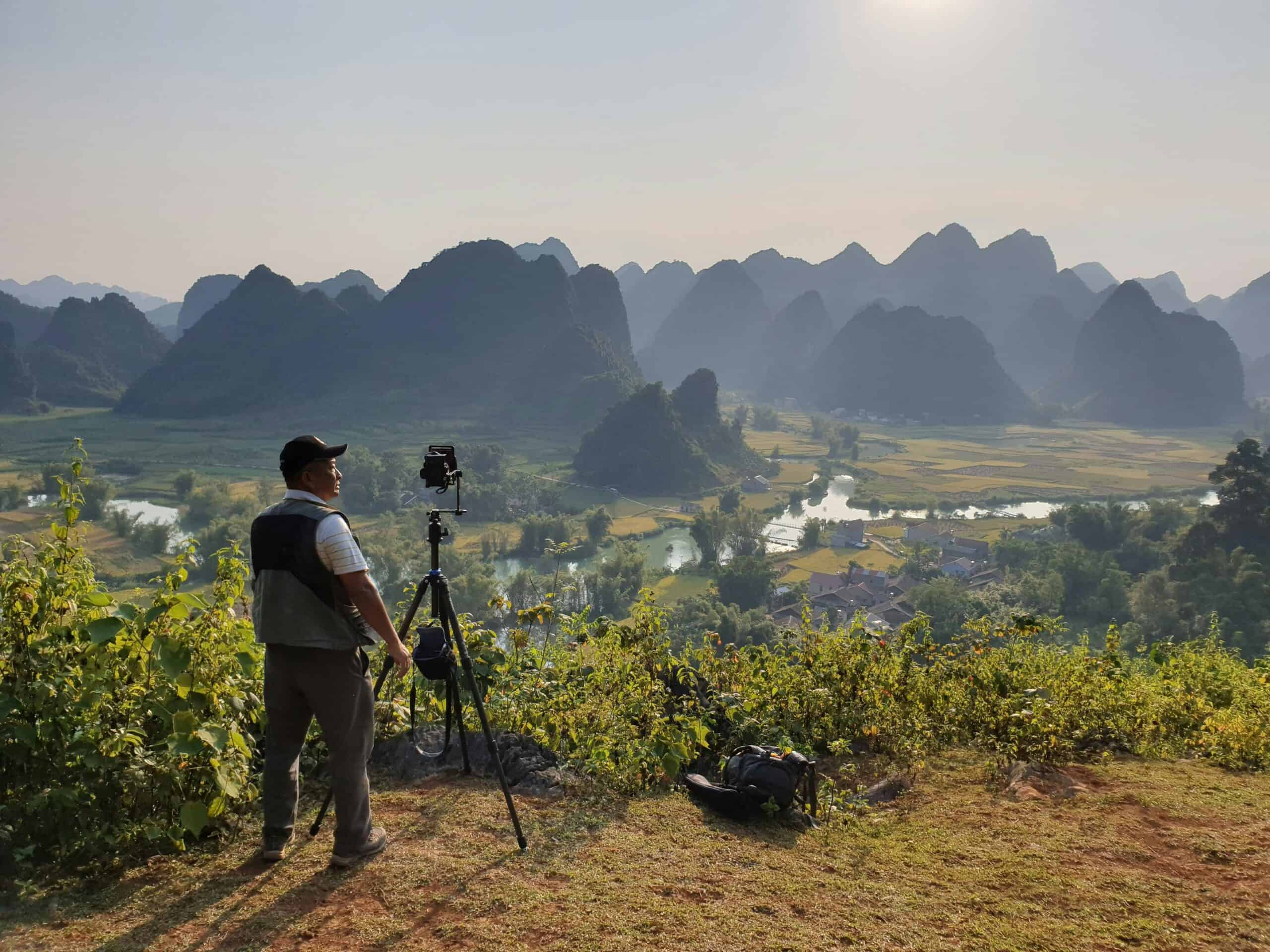
Quick Setup Overview
- Camera: Fujifilm GFX 100 II — 43.8×32.9 mm medium-format sensor, 102MP, base ISO 80, outstanding DR and color depth, IBIS up to ~8 stops.
- Lens: Canon RF 15-35mm f/2.8L IS USM — rectilinear ultra-wide zoom for full-frame Canon RF; very sharp stopped down, fast at f/2.8, software-corrected barrel distortion at the wide end, some vignetting wide open.
- Estimated shots & overlap (rectilinear ultra-wide, 15–20mm FF-equivalent):
- Minimal 360×180: 2 rows of 8 (±35° pitch) + 1 zenith + 1 nadir = 18 shots (25–30% overlap).
- Safe coverage 360×180: 2 rows of 10 (±35°) + zenith + nadir = 22 shots.
- High-res architecture: 3 rows of 10 (−45°, 0°, +45°) + zenith + nadir = 32 shots.
- On GFX with GF 20–35 at 20mm (≈16mm FF eq.): Use the same counts as above; the field of view is comparable.
- Difficulty: Moderate. Rectilinear panoramas need accurate nodal alignment and good overlap management.
Planning & On-Site Preparation
Evaluate Shooting Environment
Start by reading the light and motion. For interiors, note bright windows, mixed lighting (LED, tungsten, daylight), and reflective surfaces like glass and polished stone. For exteriors, watch for moving elements: people, traffic, trees in wind, and fast clouds at sunset. If you must shoot through glass, place the lens hood directly on the glass and shoot as perpendicular as possible; even a 2–3 cm gap invites reflections and ghosting.
Match Gear to Scene Goals
The GFX 100 II’s dynamic range lets you retain highlight detail in sky or windows while lifting shadows cleanly at base ISO 80–200. For interior 360 photos, plan for HDR bracketing (±2 EV is a solid starting point). If you’re committed to the RF 15–35, use a Canon RF body; on GFX, choose a GF 20–35 or adapted EF ultra-wide to achieve nearly the same perspective. Rectilinear lenses require more frames than a fisheye but keep lines straight—ideal for real estate, architecture, and any pano where geometric fidelity matters.
Pre-shoot Checklist
- Batteries charged and spares packed; large, fast cards (UHS-II/CFexpress) formatted.
- Clean front/rear elements and the sensor; filter off for interiors (to avoid flare/ghosts).
- Tripod leveled; panoramic head calibrated to the lens’s no-parallax point (NPP).
- Safety: monitor wind loads on rooftops or when using a pole/car mount; use tethers and wrist straps.
- Backup workflow: shoot a second pass at the same node in case people or cars move mid-sequence.
Essential Gear & Setup
Core Gear
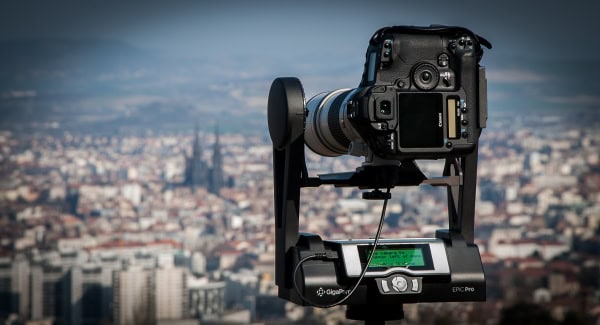
- Panoramic head: Aligns rotation around the lens’s nodal point (more precisely, the entrance pupil) to eliminate parallax. This is key for rectilinear ultra-wide lenses, especially in tight interiors with nearby objects.
- Stable tripod with leveling base: A bowl-leveling base or half-ball keeps the rotator level independent of leg adjustments.
- Remote trigger or camera app: Prevents vibration at slow shutter speeds; also helpful for bracketing.
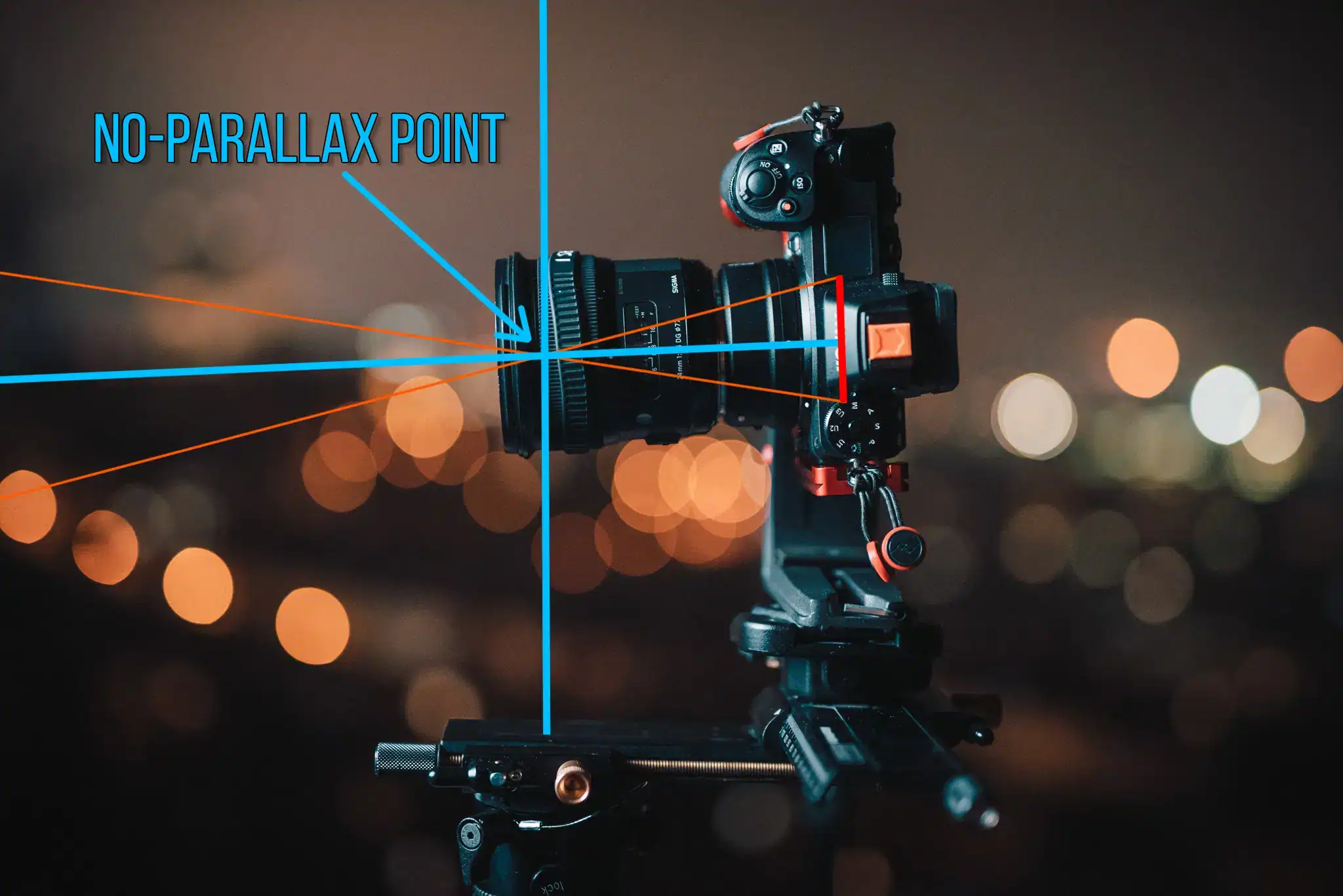
For a deeper visual walkthrough on panoramic heads and the no-parallax point, see this panoramic head tutorial by an industry resource. Panoramic head: setup and theory
Optional Add-ons
- Pole or car mount: Use safety tethers and monitor wind. Avoid high speeds, and plan for longer shutter speeds only when vibration is manageable.
- Lighting aids: Constant LED panels or bounced flash can tame mixed lighting in interiors—be consistent shot-to-shot.
- Weather protection: Rain covers, silica gel packs, and microfiber cloths; the GFX 100 II and Canon L lenses are sealed, but water on glass still ruins panos.
Step-by-Step Shooting Guide
Standard Static Scenes
- Level the tripod and align the nodal point: With your pano head, slide the camera fore/aft until foreground and background alignment does not shift as you pan. Mark this position on the rail for your working focal lengths (e.g., 15mm, 20mm, 24mm).
- Set manual exposure and lock white balance: Meter a mid-tone in the scene, then switch to full manual (M). Choose a fixed WB (Daylight for outdoor, custom Kelvin indoors). This prevents exposure flicker and WB shifts across frames.
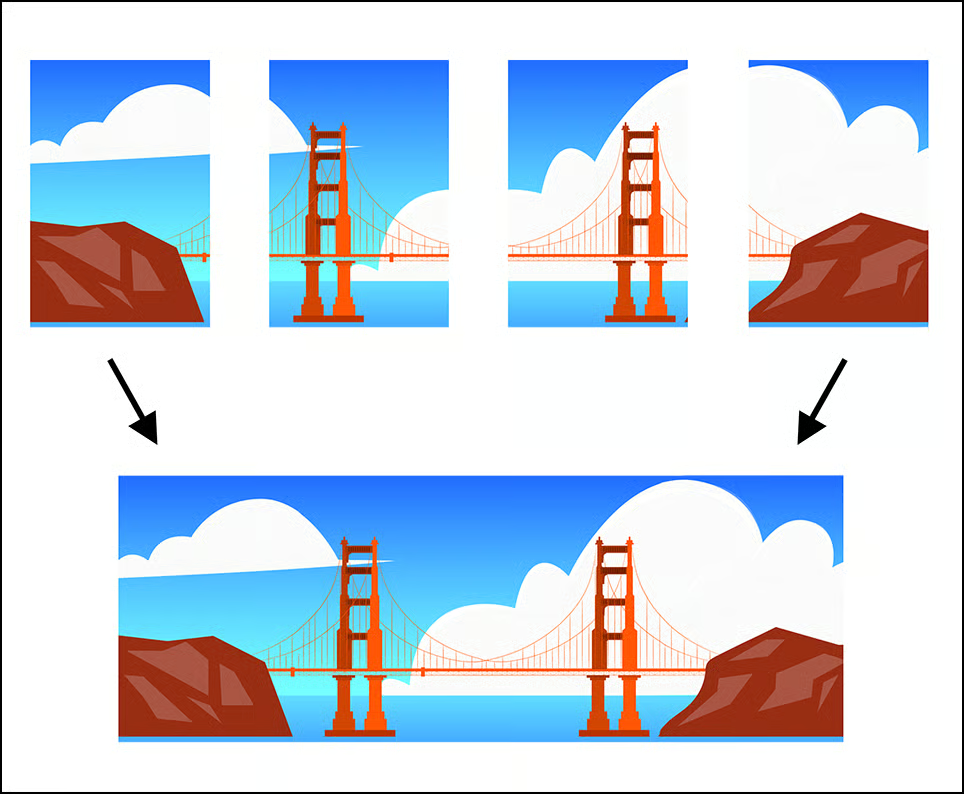
- Capture with the tested overlap for this lens/focal: For a 360, a reliable set at 15–20mm rectilinear is 2 rows of 8–10 (+/−35° pitch) plus a zenith and nadir. Use 25–30% overlap. Rotate consistently—use the click-stops on your rotator.
- Nadir shot for tripod removal: Shoot a downward frame by tilting the camera or moving the tripod slightly and shooting a patch frame to cover the tripod feet.
HDR / High Dynamic Range Interiors
- Bracket exposures: ±2 EV (3–5 frames) is a good starting point to balance windows and interior shadows. Keep aperture constant (e.g., f/8) and vary shutter speed.
- Lock WB: Use a fixed Kelvin value (e.g., 4000–5000 K for mixed interior light), or create a custom WB on-site. Consistent WB makes merging and stitching cleaner.
- Sequence: For each position, shoot all brackets before rotating to the next yaw angle to maintain consistency.
Low-Light / Night Scenes
- Use long exposures and low ISO: On the GFX 100 II, ISO 80–400 preserves maximum DR; 800–1600 is workable if needed. Turn off IBIS when on a solid tripod to avoid micro-jitter.
- Remote trigger and self-timer: A 2s delay or a wireless release ensures zero shake, critical with 1/2–8s exposures.
- Watch moving lights: Cars, signs, and water can cause ghosts. Consider shooting two passes to aid masking in post.
Crowded Events
- Two passes strategy: First pass quickly for coverage; second pass wait for gaps in foot traffic. This gives you clean options when masking.
- Higher shutter speed: Aim 1/200s+ at f/5.6–f/8 with ISO 400–800 to freeze people if you want minimal motion blur.
- Mind overlap: Keep 30% overlap to give the stitcher enough data for control points despite moving subjects.
Special Setups (Pole / Car / Drone)
- Secure everything: Use safety tethers, lock all clamps firmly, and don’t exceed safe extension in wind.
- Manage vibration: For poles and vehicles, use faster shutter speeds (1/250–1/1000s), higher ISO if needed, and avoid long exposures.
- Rotate slower: Give the camera time to settle between frames. On a pole, consider single-row panos to reduce complexity.
Recommended Settings & Pro Tips
Exposure & Focus
| Scenario | Aperture | Shutter | ISO | Notes |
|---|---|---|---|---|
| Daylight outdoor | f/8–f/11 | 1/100–1/250 | 100–200 | Lock WB (Daylight); prioritize edge-to-edge sharpness |
| Low light/night | f/4–f/5.6 | 1/30–long | 400–800 (1600 if needed) | Tripod + remote; IBIS OFF on tripod |
| Interior HDR | f/8 | Bracket ±2 EV | 100–400 | Expose for highlights; merge before stitching or use exposure fusion |
| Action / moving subjects | f/5.6–f/8 | 1/200+ | 400–800 | Freeze motion; shoot double pass for masking |
Critical Tips
- Manual focus at hyperfocal: Set MF and focus just shy of infinity at f/8–f/11. On GFX, magnify to confirm micro-contrast.
- Nodal point calibration: For each focal length you’ll use (e.g., 15mm, 20mm, 24mm), find and mark the entrance-pupil position on your rail. Recheck if you add/remove filters.
- White balance lock: Mixed lighting shifts between frames cause color seams. Fix WB and keep it fixed.
- RAW over JPEG: RAW provides latitude for HDR merges and color correction, especially with the GFX 100 II’s DR.
- IBIS/IS: On tripod, disable IBIS (and lens IS) to avoid micro-movements during long exposures. Handheld panos benefit from stabilization.
For a deeper dive into pano fundamentals and best practices from different systems, this Q&A thread is a handy knowledge base. Techniques to take 360 panoramas
Stitching & Post-Processing
Software Workflow
After capture, import your frames into your RAW developer (Lightroom, Capture One). If you bracketed, either:
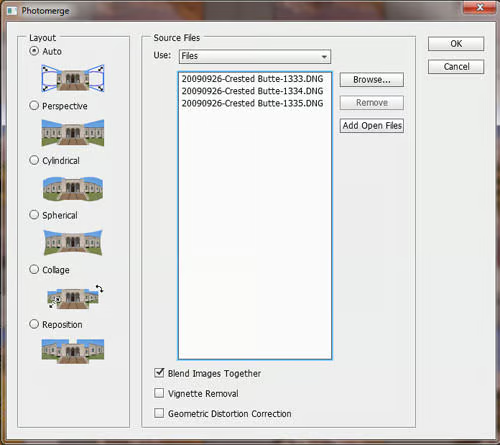
1) Merge brackets to 32-bit HDRs first (maintaining identical crop and geometry), then stitch; or 2) Feed bracket stacks directly into a stitcher that supports exposure fusion. PTGui is a gold standard for complex rectilinear panos and multi-row 360 photos. Hugin is an excellent open-source alternative. With rectilinear lenses, aim for ~20–25% overlap; with fisheye, 25–30% is typical. Rectilinear panos require more frames than fisheye but yield straighter lines and more uniform detail at edges. For an overview of PTGui’s strengths in pro workflows, see this review. PTGui review and why pros use it
Cleanup & Enhancement
- Nadir/tripod patch: Use a cloned patch, a photographed floor tile, or AI tools to remove the tripod footprint.
- Color and noise: Match color across the pano, reduce noise for high-ISO shots, and add slight clarity only after stitching.
- Leveling: Ensure horizon is level; correct yaw/pitch/roll in the stitcher’s panorama editor.
- Export: For VR or web players, export an equirectangular 2:1 JPEG or 16-bit TIFF. Typical outputs: 12k–16k wide; GFX 100 II high-res workflows can exceed 20k if you captured many frames.
Want a visual walkthrough of high-end panoramic head setup for perfect 360 photos? This guide from Meta’s Creator resources is concise and reliable. Setting up a panoramic head for high-end 360 photos
Video: A Practical Pano Walkthrough
Seeing the process helps. Here’s a compact video that reinforces the key steps from setup to stitching.
For system-agnostic VR capture tips (applicable to GFX and Canon workflows), this primer is also helpful. Using a mirrorless/DSLR to shoot and stitch a 360 photo
Useful Tools & Resources
Software
- PTGui panorama stitching
- Hugin (open source)
- Lightroom / Photoshop for RAW and finishing
- AI tripod removal and content-aware fill tools
Hardware
- Panoramic heads (Nodal Ninja, Leofoto)
- Carbon fiber tripods (3–4 leg sections for stability)
- Leveling bases and rotators with click-stops
- Wireless remote shutters
- Pole extensions / car mounts (with safety tethers)
Disclaimer: software/hardware names provided for search reference; check official sites for the latest specs and compatibility.
Common Mistakes & How to Avoid Them
- Parallax error: Always align the nodal point and lock it before you start rotating.
- Exposure flicker: Shoot in full Manual and fix WB and ISO across the entire capture.
- Tripod shadows or feet in frame: Capture a dedicated nadir shot or patch during post.
- Ghosting from movement: Shoot two passes and mask in post; increase shutter speed for crowds.
- Night noise/banding: Keep ISO low on the GFX 100 II (80–800 ideal) and use longer exposures with a remote trigger.
Real-World Case Studies & Field Advice
Indoor Real Estate (Bright Windows)
Set f/8, base ISO (80–200), and bracket ±2 EV. Turn off any flickering lights or balance color temperature (4000–5000 K is a solid starting point). Capture 2 rows of 10 frames with 30% overlap plus zenith and nadir. Merge HDRs per yaw angle, then stitch. The GFX 100 II’s DR helps preserve sky detail without heavy halos.
Outdoor Sunset Landscape
At 15–20mm, shoot 2 rows of 8 with 25% overlap, manual exposure set off the sunlit clouds. The GFX 100 II’s base ISO 80 preserves gradient smoothness. If the sun is in frame, angle slightly to reduce flare and consider a second pass as the sun dips to blend the best sky and foreground later.
Crowded Events
Use 1/200s or faster at f/5.6–f/8 and ISO 400–800. Shoot a quick coverage pass first, then a patience pass for gaps. Later, in PTGui/Photoshop, mask moving people with frames from the second pass to clean up overlaps and reduce ghosts.
Rooftop or Pole Shooting
Wind is the enemy. Tighten all clamps, use safety tethers, and keep the camera near the pole’s centerline. Use faster shutter speeds (1/250–1/500s) to fight vibration and avoid HDR for minimal exposure time. Consider 1-row partial panoramas if conditions are unstable.
Frequently Asked Questions
- Can I shoot handheld panoramas with the Fujifilm GFX 100 II?
Yes for simple, single-row stitches in good light, but for 360×180 or multi-row, a leveled tripod and nodal alignment are strongly recommended. The GFX’s resolution magnifies small alignment errors.
- Is the Canon RF 15-35mm f/2.8L IS USM wide enough for a single-row 360?
No. With a rectilinear 15–20mm, you’ll typically need two rows plus zenith and nadir for full spherical coverage. A fisheye lens can do it in fewer shots, but with more curvature to manage.
- Do I need HDR for interiors with bright windows?
Usually yes. Bracket ±2 EV (3–5 frames) per view to balance windows and shadows. Merge brackets consistently before stitching or use exposure fusion in your stitcher.
- How do I avoid parallax issues with this setup?
Use a panoramic head and align the entrance pupil at each focal length. Keep the camera level and rotate only around the vertical axis through the NPP. Avoid changing focus distance mid-shoot.
- What ISO range is safe on the GFX 100 II for low light?
ISO 80–400 is ideal; 800–1600 is workable with careful exposure and noise reduction. Prefer longer shutter speeds on a tripod over pushing ISO.
- Can I assign Custom Modes for pano work?
Yes. Save a “Pano” custom set that locks Manual exposure, MF, fixed WB, IBIS off (for tripod), 2s self-timer, and your bracketing preset. This speeds repeatable results under pressure.
- Which tripod head is best for this setup?
A dedicated panoramic head with fore/aft and lateral adjustment rails (e.g., Nodal Ninja style) is best. Look for click-stop rotators and a leveling base for rapid setup.
Trust, Safety & Workflow Integrity
High-resolution workflows magnify every mistake. Calibrate your panoramic head, shoot methodically, and keep a backup pass. When working on rooftops or with poles, prioritize safety: tethers, wind checks, and conservative shutter speeds. Keep an organized folder structure (Scene > Row > Yaw angle > Brackets) so stitching later isn’t guesswork. Finally, test your overlap counts at each focal length you plan to use; one evening of tests can save hours of post-production later.
If you’re new to virtual tour rigs and want an external reference on the camera/lens trade-offs for 360 photo capture, this overview is a solid primer. DSLR/mirrorless virtual tour camera & lens guide