Why This Camera & Lens Are Great for Panoramas
The Canon EOS RP paired with the Canon RF 14–35mm f/4L IS USM is a compact, full-frame combo that punches far above its weight for panoramic and 360° photography. The EOS RP’s 26.2MP full-frame sensor (approx. 35.9 × 24 mm) provides a healthy balance of detail and forgiving noise performance. With a pixel pitch of roughly 5.76 µm and base-ISO dynamic range around ~11.5–12 EV, the files grade well and stitch reliably when exposure is managed properly. Dual Pixel AF makes prefocusing quick and precise, then you can switch to manual focus for consistency.
The RF 14–35mm f/4L IS USM is a rectilinear ultra-wide zoom covering dramatic views at 14mm and tighter, higher-resolution mosaics at 35mm. It’s sharp across the frame at f/5.6–f/8, with modern coatings that reduce flare. Distortion at 14mm is corrected in-camera for JPEGs; for stitching RAW panoramas, it’s often better to leave corrections off and let your stitcher model the lens. The lens’ optical IS is useful for quick handheld tests, but disable stabilization when mounted on a tripod to avoid micro-blur. As a mirrorless full-frame setup, the RP + RF 14–35 is lightweight, easy to carry on rooftops or hikes, and fully compatible with panoramic heads and L-brackets.
Quick Setup Overview
- Camera: Canon EOS RP — Full Frame, 26.2MP, Dual Pixel AF, approx. 5.76 µm pixel pitch, strong base ISO performance (best at ISO 100–400).
- Lens: Canon RF 14–35mm f/4L IS USM — Rectilinear ultra-wide zoom; very good sharpness at f/5.6–f/8; typical UWA distortion at 14mm (software-correctable); well-controlled CA for an UWA.
- Estimated shots & overlap (tested guidelines):
- 14mm rectilinear, single-row cylindrical: 8–10 shots around with 30% overlap.
- 14mm full spherical 360×180: 2 rows of 10 shots each at approximately +35° and −35°, plus 1 zenith and 1–2 nadir shots (total ~22–23).
- 20–24mm full spherical: 12 shots per row × 2 rows + zenith/nadir (total ~26–27).
- 35mm multi-row (high detail): 16–18 shots per row × 3 rows + zenith/nadir (total 50+ for gigapixel-grade detail).
- Difficulty: Moderate (easy outdoors; requires care indoors due to parallax and DR).
Planning & On-Site Preparation
Evaluate Shooting Environment
Survey the scene for moving elements (people, cars, trees in wind), reflective surfaces (glass, glossy floors), and light sources. If shooting through windows, keep the lens close (2–5 cm) to the glass and shade it with your hand or a flag to minimize internal reflections. For sunsets and night cityscapes, note the biggest contrast zones so you can plan HDR brackets. Check for obstructing objects near the camera that could complicate the nadir patch (tripod legs) or increase parallax risk.
Match Gear to Scene Goals
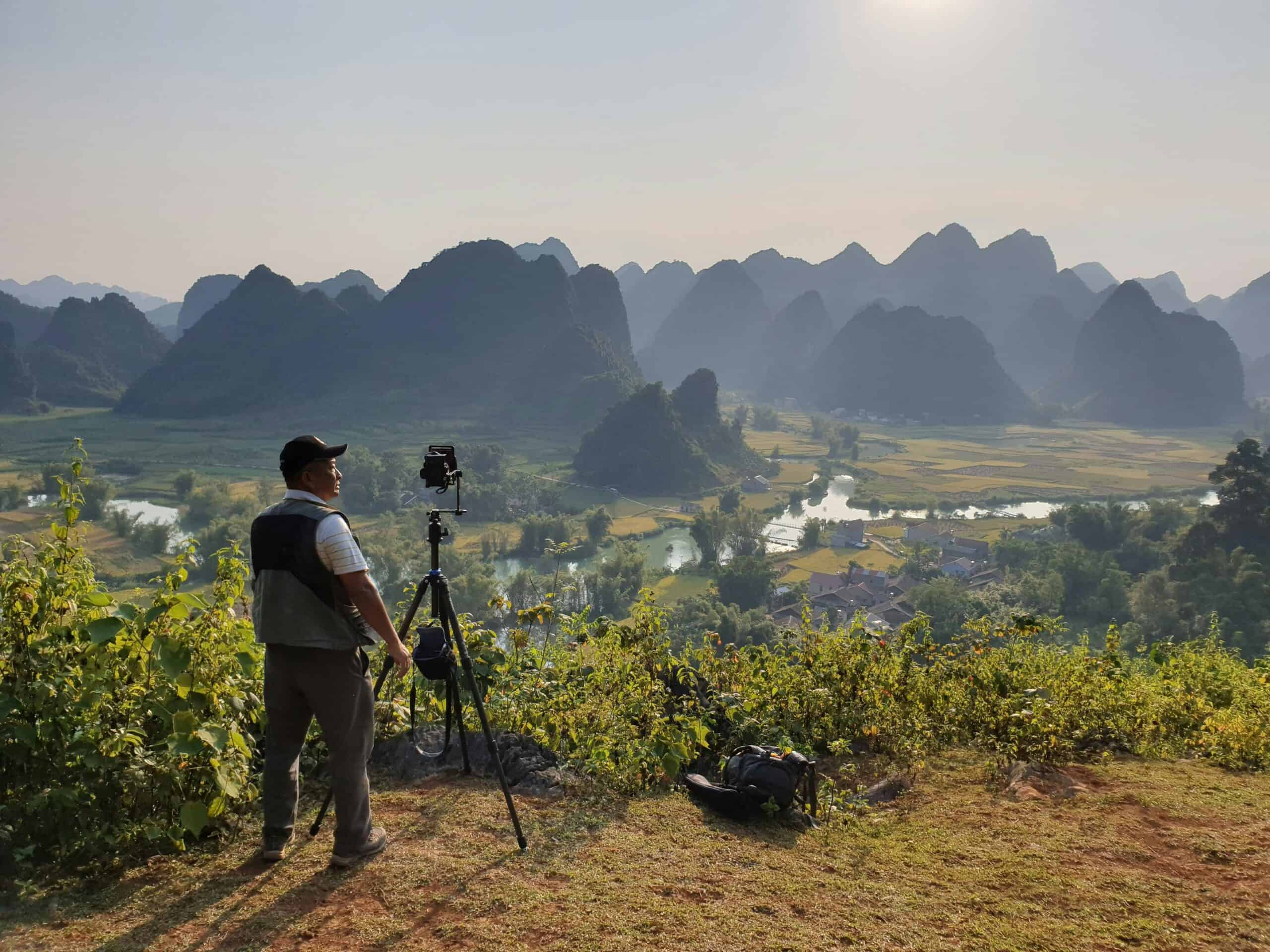
Choose focal length by output needs. At 14mm you’ll cover large areas quickly (fewer shots) with minimal stitching time—ideal for fast-changing skies or crowds. At 24–35mm, your mosaic gains resolution and detail, perfect for fine architecture or virtual tours that need zoomable clarity. The EOS RP’s dynamic range is respectable but not class-leading; for high-contrast interiors, lean on HDR bracketing (±2 EV) instead of pushing ISO. Practical ISO limits: 100–400 for best quality; ISO 800 is still usable with careful noise reduction. Avoid going beyond ISO 1600 unless necessary for handheld safety or time constraints.
Pre-shoot Checklist
- Power & storage: Full batteries, dual cards if possible; format and verify empty space.
- Optics: Clean front and rear elements; check sensor for dust (panos reveal spots).
- Support: Leveling base tightened; panoramic head calibrated for nodal point.
- Safety: Use sandbags or a weight hook in wind; tether gear on rooftops or when over railings; check car mounts for vibration and legal limitations.
- Backup workflow: If time allows, shoot an extra pass at the same settings as insurance.
Essential Gear & Setup
Core Gear
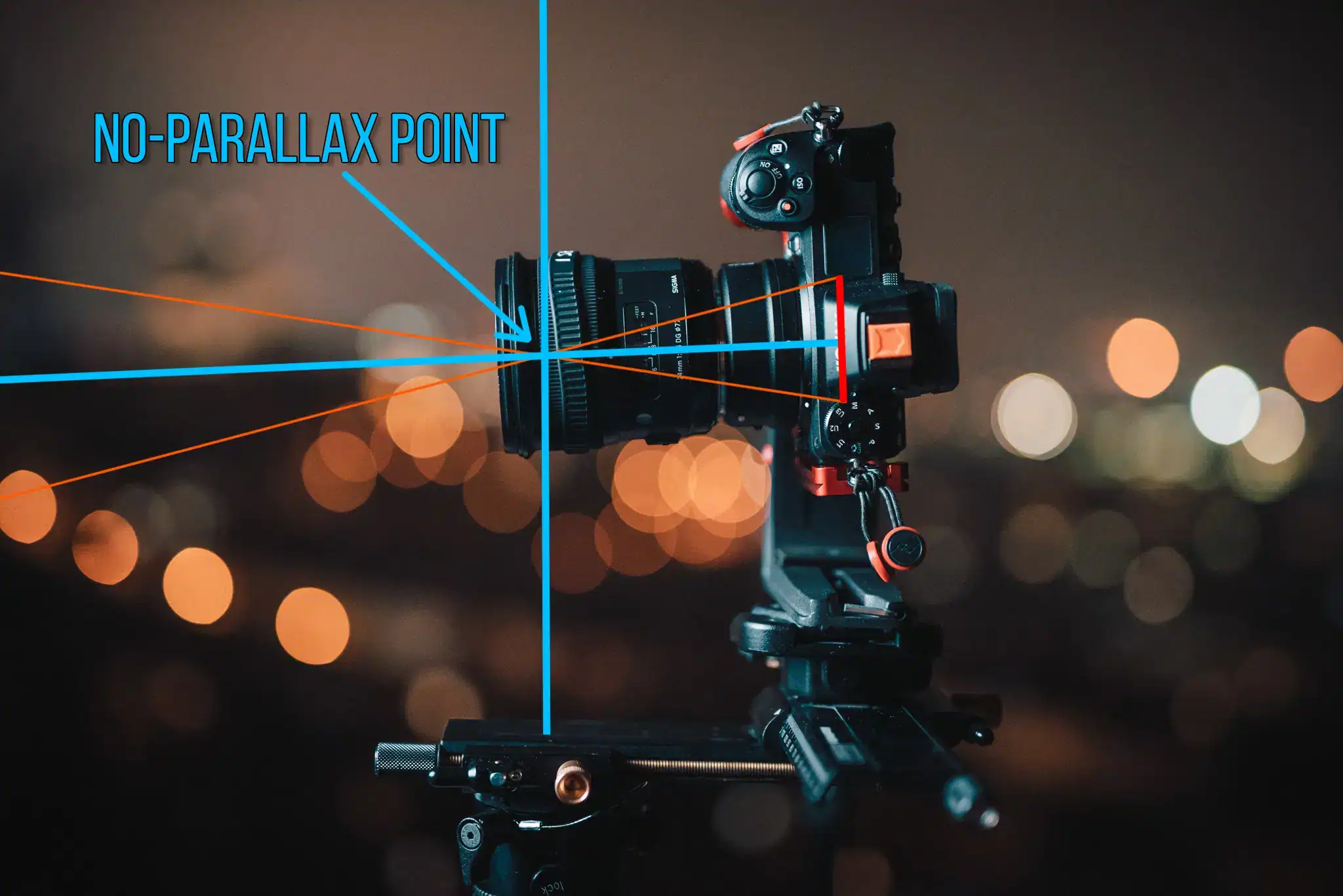
- Panoramic head: Enables rotation around the lens’ entrance pupil (nodal point) to eliminate parallax. This ensures foreground and background align cleanly during stitching.
- Stable tripod with leveling base: Leveling under the pano head keeps rows consistent and prevents horizon drift.
- Remote trigger or Canon Camera Connect app: Prevents vibrations; the 2-sec timer is a good fallback.
Optional Add-ons
- Pole or car mount: Great for elevated views or drive-by facades; always safety-tether, avoid strong winds, and keep to moderate speeds to reduce vibration blur.
- Lighting aids: Small LEDs or bounced flash to fill dark corners in interiors—keep it consistent across frames.
- Weather protection: Rain covers and microfiber cloths; in cold, keep spare batteries warm.
New to panoramic heads? This concise panoramic head tutorial provides a solid foundation for zero-parallax setup. Learn more about panoramic head setup.
Step-by-Step Shooting Guide
Standard Static Scenes
- Level and align: Use the tripod’s leveling base to get the head perfectly level. Set your panoramic head so the rotational axis is vertical.
- Nodal calibration: Aim at two vertical objects (one near, one far). Rotate left-right and adjust the fore-aft rail until there’s no relative shift between them. Mark the rail position for your RF 14–35 at common focal lengths (14, 20, 24, 35mm).
- Exposure and WB: Set Manual mode. Meter for the midtones and highlight headroom. Lock white balance (Daylight for sun, Tungsten for warm interiors) to avoid color shifts between frames.
- Focus: Use AF once on a mid-distance subject, then switch to MF. At 14mm, focusing ~0.8 m at f/8 is near hyperfocal, keeping everything sharp to infinity.
- Capture sequence: Rotate in consistent increments using the click-stops on your head. For 14mm single-row cylindrical, take 8–10 frames around with ~30% overlap. For full spheres, use the multi-row counts in the Quick Setup Overview.
- Nadir shot: Tilt straight down and capture 1–2 frames for tripod removal. If the tripod obstructs too much, shoot a handheld nadir at the same exposure and WB.
HDR / High Dynamic Range Interiors
- Bracket ±2 EV: Use AEB to capture three to five exposures per camera angle. This balances bright windows and deep shadows.
- Keep constants: Lock WB and focus. Use the same aperture and ISO for the entire pano; vary only shutter speed across brackets.
- Sequence discipline: Complete all brackets before rotating to the next angle to minimize ghosting.
Low-Light / Night Scenes
- Stability first: Use a sturdy tripod; disable lens IS when on tripod to avoid micro-jitter.
- Exposure: f/4–f/5.6, ISO 100–400 (up to 800 if needed), and longer shutter speeds. Use the 2-sec timer or remote release.
- Avoid pushing ISO: The EOS RP is cleanest at base ISO; longer shutter speeds produce better results than high ISO noise.
Crowded Events
- Two-pass method: Do a fast pass to capture coverage, then a second pass waiting for people to move for clean patches.
- Short shutters: Use 1/200s+ when you must freeze motion. You can still stitch if overlap is solid.
- Mask later: In post, blend the clean areas from different passes to remove duplicate people and ghosting.
Special Setups (Pole / Car / Drone)
- Pole work: Use a light carbon pole. Keep rotations slower and take extra overlap (35%+) to counter sway.
- Car mounts: Only at safe, legal speeds; shoot when the car is stationary or moving very slowly; consider higher shutter speeds or increased ISO for safety.
- Safety tether: Always tether camera and lens; prioritize safety over shot lists.
Recommended Settings & Pro Tips
Exposure & Focus
| Scenario | Aperture | Shutter | ISO | Notes |
|---|---|---|---|---|
| Daylight outdoor | f/8–f/11 | 1/100–1/250 | 100–200 | Lock WB to Daylight; avoid clipping clouds |
| Low light/night | f/4–f/5.6 | 1/30–multi-sec | 100–800 | Tripod + remote; turn lens IS off on tripod |
| Interior HDR | f/8 | Bracket ±2 EV | 100–400 | Balance windows vs interior lamps; constant WB |
| Action / moving subjects | f/5.6–f/8 | 1/200+ | 400–800 | Freeze motion; consider two-pass method |
Critical Tips
- Manual focus at or near hyperfocal: At 14mm and f/8, focus ~0.8 m for front-to-back sharpness.
- Nodal point calibration: Mark your panoramic head rail positions for 14, 20, 24, and 35mm so you can recall them fast.
- White balance lock: Consistent color across frames stitches cleaner; mixed lighting benefits from a fixed WB preset.
- RAW over JPEG: 14-bit RAW from the EOS RP preserves highlight headroom and shadow detail for better HDR merges and color correction.
- Stabilization: On tripod, disable lens IS. Handheld tests can use IS at slower shutters, but stitching success may vary.
Stitching & Post-Processing
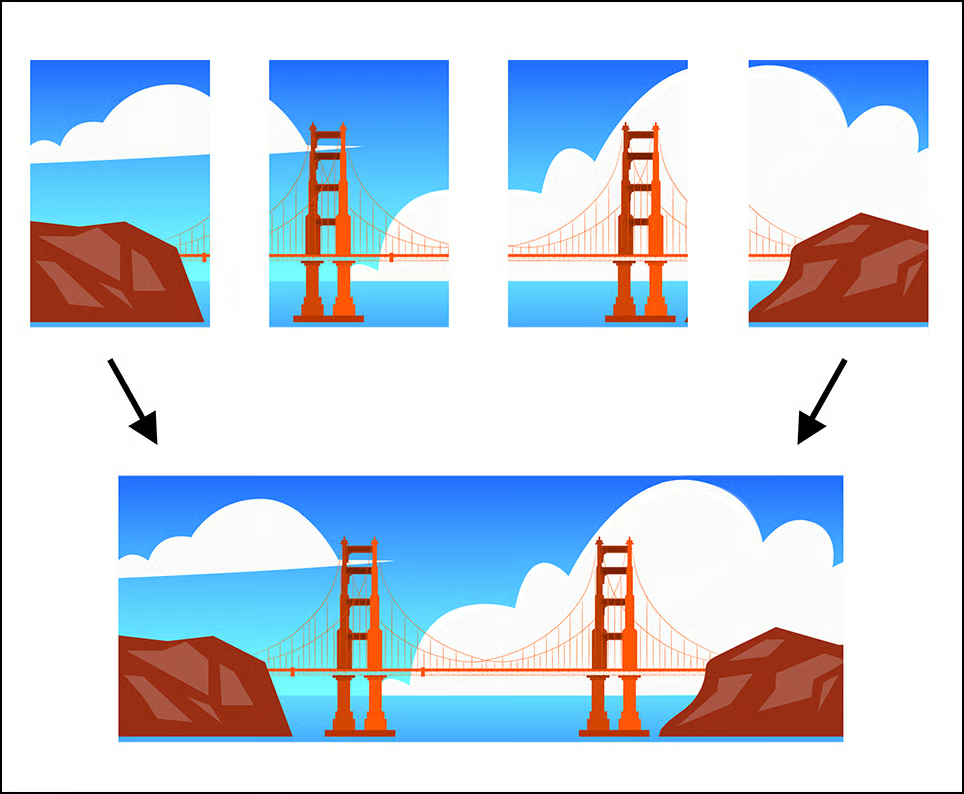
Import your RAWs into Lightroom or your preferred converter. Apply only essential global adjustments (WB, exposure match). Avoid heavy local edits before stitching, as they can introduce seams. Export as 16-bit TIFF or feed RAWs directly into your stitcher if supported. For this rectilinear zoom, PTGui or Hugin can estimate lens parameters automatically; use sufficient overlap (20–25% for rectilinear, 25–30% for fisheye) to help the optimizer place control points robustly.
Software Workflow
- Stitching in PTGui/Hugin: Load images, set lens type to rectilinear, and let the software detect control points. If mis-registrations occur near the edges at 14mm, add manual control points on high-contrast details.
- Optimize and level: Use the optimizer to refine yaw/pitch/roll and lens parameters. Level the horizon using vertical control points or the panoramic editor’s horizon tool.
- Blend and mask: For crowds or moving foliage, use the mask tool to choose your preferred version of each region.
- Nadir patch: Export a layered TIFF with a nadir region masked, then clone/heal in Photoshop, or insert a logo patch for virtual tours.
- Export: Save an equirectangular 2:1 TIFF/JPEG at your target resolution (e.g., 12k or higher for multi-row). For VR platforms, match their upload specs.
PTGui remains a benchmark for speed and control in complex panoramas; this field review is a good overview of its strengths. Read the PTGui review on Fstoppers.
Cleanup & Enhancement
- Tripod/nadir removal: Use content-aware fill or a dedicated nadir logo plate.
- Color harmony: Match color casts from mixed lighting (tungsten vs daylight) with selective HSL and white balance tweaks.
- Noise reduction: Apply moderate luminance NR for EOS RP high-ISO frames; avoid smearing fine detail.
- Perspective and level: Use vertical guides to ensure buildings are straight; correct roll for a comfortable viewing experience.
- Output variants: Keep a master 16-bit TIFF; export web-ready JPEGs and a compressed equirectangular for VR hosting.
For a broader perspective on DSLR/mirrorless 360 pipelines, the Meta/Oculus guide is a concise reference. Using a mirrorless camera to shoot and stitch a 360 photo.
Video: A clear, practical walkthrough that complements the steps above.
Useful Tools & Resources
Software
- PTGui panorama stitching
- Hugin (open-source) for cost-effective stitching
- Lightroom / Photoshop for RAW prep and finishing
- AI tripod removal tools (Content-Aware Fill, generative tools)
Hardware
- Panoramic heads: Nodal Ninja, Leofoto, and similar
- Carbon fiber tripods with leveling bases
- Wireless remotes or phone apps
- Pole extensions and vehicle mounts with safety tethers
Disclaimer: software/hardware names provided for search reference; check official sites for details.
For a deeper FAQ on panoramic best practices, this community thread covers helpful techniques. Best techniques to take 360 panoramas.
Real-World Use Cases with the EOS RP & RF 14–35mm
Indoor Real Estate (Bright Windows + Dark Corners)
At 14–20mm, shoot multi-row with ±2 EV brackets. Keep WB fixed (Tungsten or custom) across the entire property. The EOS RP at ISO 100–200 with 5-shot brackets gives smooth tonality. Expect 20–30 images per room for a full sphere. In PTGui, use exposure fusion or HDR merge, then fine-tune with curves to make spaces feel natural and inviting.
Outdoor Sunset from a Rooftop
Wind can be a concern—hang a weight under the tripod. At 14–18mm, single-row for a fast capture if the sky is changing quickly; or add a second row for full spherical coverage. Meter for highlights and raise shadows in post. Take a second pass a minute later in case of ghosting from moving clouds.
Event Crowds
Use 1/200s and ISO 400–800 to freeze motion. Favor fewer shots at wider focal lengths to reduce alignment issues from moving people. Mask duplicates during blending. If you must include yourself, shoot a clean plate and blend later.
Rooftop/Pole Shooting
Mount the camera on a pole at 14mm to minimize the shot count. Increase overlap to ~35% to mitigate sway; shoot multiple passes and keep the best-aligned set. Always tether your gear; never lean outside safety barriers.
Car-Mounted Facade Capture
Stop the car for each pano if possible. If you must roll slowly, use faster shutter speeds and extra overlap. The RF 14–35 at 20–24mm balances coverage with manageable stitching. Avoid heavy traffic and keep safety first.
Pro Optimizations for This Combo
- Lens corrections: For RAW workflows, disable auto distortion/vignetting corrections before stitching to keep geometry consistent. Apply global lens profiles after stitch if needed.
- Custom modes: Assign a “PANO” setup to C1 (Manual, WB fixed, ISO 100, f/8, single shot) and “HDR-PANO” to C2 (AEB ±2 EV, same WB and aperture) for rapid deployment.
- Zenith coverage: At 14mm, you may cover zenith with a +60–75° tilted row; still capture a dedicated zenith shot for safety in narrow spaces.
- Focus peaking: On the RP, use focus peaking to double-check MF at hyperfocal, then turn it off while shooting to keep the view uncluttered.
If you’re new to full workflows for virtual tour output, this guide is a pragmatic overview from gear to publish. Virtual tour gear and workflow overview.
Visual Examples
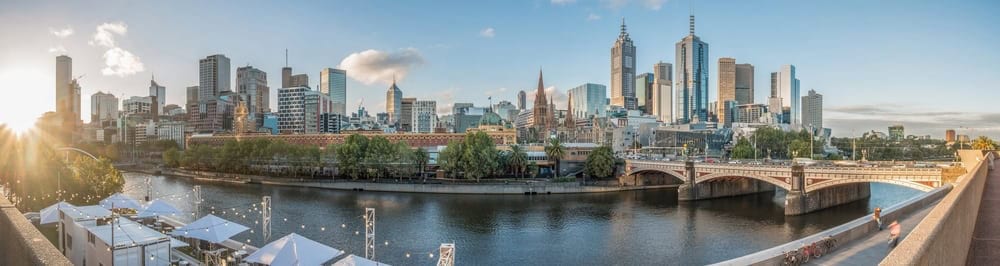
Common Mistakes & How to Avoid Them
- Parallax error: Calibrate and use your nodal marks; avoid moving the tripod between rows.
- Exposure flicker: Manual exposure and locked WB only; do not let Auto ISO or AWB vary across frames.
- Tripod shadows and footprints: Plan your nadir and shoot a clean plate; patch in post.
- Ghosting: Shoot two passes and mask; minimize gaps between frames in windy scenes.
- High ISO noise: Prefer longer shutter times on tripod rather than raising ISO beyond 800.
Frequently Asked Questions
- Can I shoot handheld panoramas with the Canon EOS RP?
Yes for quick cylindrical panos, especially at 14–20mm with 30–40% overlap. However, for full 360° spheres or interiors with close foregrounds, use a panoramic head and tripod to avoid parallax and stitching errors.
- Is the RF 14–35mm f/4L wide enough for single-row 360?
For full spherical 360×180, a single row at 14mm typically won’t capture zenith and nadir cleanly. Plan on two rows (±35°) plus dedicated zenith/nadir shots. For cylindrical (horizon-only) panos, one row is fine.
- Do I need HDR for interiors with bright windows?
Usually yes. Bracket ±2 EV (3–5 frames) to retain window detail and clean shadows. Lock WB and focus, and keep aperture and ISO constant across brackets.
- How do I avoid parallax issues with this lens?
Use a panoramic head and align the entrance pupil (nodal point). Calibrate once and mark the rail for 14, 20, 24, and 35mm. Keep the camera level and don’t shift the tripod between rows.
- What ISO is safe on the EOS RP in low light?
ISO 100–400 is ideal. ISO 800 is still very usable with good noise reduction. Try not to exceed 1600 unless necessary; prefer longer shutter speeds on a stable tripod.
Notes on Standards and Best Practices
These recommendations reflect field-tested practices for rectilinear ultra-wide lenses on full-frame mirrorless bodies. Overlap guidance aligns with common stitching standards in PTGui/Hugin communities. For a structured, step-by-step panoramic head setup, this training resource is also helpful. Set up a panoramic head for high-end 360 photos.
Disclaimer: Always verify your software’s latest documentation; firmware updates and new stitcher versions can change optimal settings and workflows.