
Why This Camera & Lens Are Great for Panoramas
The Canon EOS R6 Mark II is a 24.2MP full-frame mirrorless body with excellent low-light performance, robust in-body image stabilization (IBIS), and fast, accurate AF. Its 14-bit RAW files deliver roughly 13.5–14 EV of usable dynamic range at base ISO, and the generous ~6.0 μm pixel pitch keeps noise controlled while preserving detail—ideal for clean, stitchable frames in 360 photo work. The body also includes a dual-axis electronic level, exposure bracketing, and bulletproof reliability for long shoots, all of which matter when creating a seamless HDR panorama.
The Olympus M.Zuiko Digital ED 8mm f/1.8 Fisheye PRO is a diagonal fisheye designed for Micro Four Thirds (MFT). On an MFT body, it gives a 180° diagonal field of view with outstanding sharpness, minimal lateral chromatic aberration, and excellent flare resistance thanks to Olympus’s ZERO coating. That fast f/1.8 aperture is fantastic when you need shorter exposures indoors with moving subjects or when you’re shooting low-light scenes. However, there’s a critical compatibility note: this lens is not designed for Canon RF mount, and its MFT image circle will not cover full frame. Additionally, there is no practical passive adapter to mount MFT lenses on an RF full-frame body while preserving infinity focus and electronic aperture control. In short, you can’t directly use this Olympus fisheye on an EOS R6 Mark II for full-frame coverage.
What does this mean for you? If your goal is how to shoot panorama with Canon EOS R6 Mark II & Olympus 8mm f/1.8 PRO Fisheye, the best practice is to recognize the limitation and proceed in one of two ways:
- Use the R6 Mark II with a comparable full-frame diagonal fisheye (e.g., Canon EF 8–15mm f/4L Fisheye at 15mm via EF–RF adapter, or a Samyang/Rokinon 12mm fisheye) and apply the capture settings below. The workflow is identical for stitching, exposure control, nodal alignment, etc.
- If you already own the Olympus 8mm, pair it with an MFT body for capture, then stitch as usual. The shooting sequence and overlap recommendations we list for “diagonal fisheye” apply closely to the Olympus 8mm on MFT.
Either path yields professional 360 photos; the R6 Mark II provides top-tier image quality and low noise, while the Olympus 8mm (on MFT) keeps your shot count low because of its extreme field of view.
Quick Setup Overview
- Camera: Canon EOS R6 Mark II — Full Frame (36×24 mm), 24.2MP, ~6.0 μm pixel pitch, excellent high-ISO performance and 14-bit RAW.
- Lens: Olympus M.Zuiko 8mm f/1.8 PRO — diagonal fisheye (MFT only), 180° diagonal FOV on Micro Four Thirds, very sharp stopped down to f/5.6–f/8; strong flare control; minimal lateral CA. Note: not natively compatible with Canon RF; image circle does not cover full frame.
- Estimated shots & overlap:
- R6 Mark II + full-frame diagonal fisheye (~15–16mm): 6 around (60° yaw spacing) + zenith + nadir, ~30% overlap.
- R6 Mark II + full-frame circular fisheye (8mm): 3–4 around + zenith + nadir, ~30–40% overlap.
- Olympus 8mm on MFT body: 6 around + zenith + nadir, ~30% overlap.
- Difficulty: Moderate — easy outdoors; interiors and HDR require careful bracketing and nodal alignment.
Planning & On-Site Preparation
Evaluate Shooting Environment
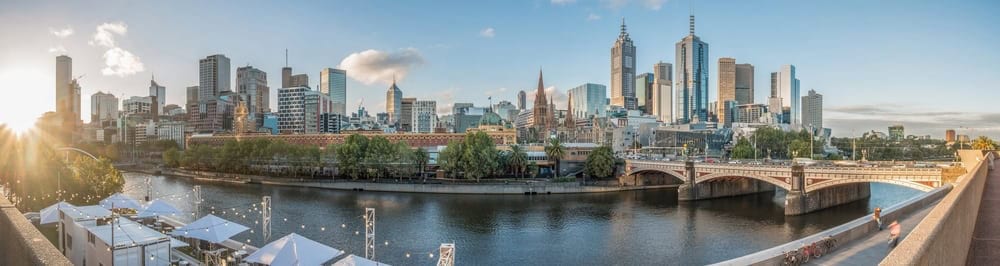
Walk the location and assess lighting, moving subjects, and reflective surfaces like glass, polished floors, or cars. Position the rig at least 30–50 cm from glass to reduce mirror ghosting and avoid pressing the lens hood against windows, which can introduce flare and alignment errors. For outdoor sunset scenes, note the sun path and decide whether an HDR panorama will be necessary to balance sky and foreground.
Match Gear to Scene Goals
The EOS R6 Mark II offers strong dynamic range at ISO 100–400 and very clean files up to ISO 1600–3200, which helps maintain consistent quality across stitched frames. With a fisheye, you’ll need fewer shots, reducing ghosting risk in moving scenes. The Olympus 8mm f/1.8 is excellent for low-light due to its fast aperture, but remember it’s an MFT lens; on the R6 Mark II, use a native or adapted full-frame fisheye to replicate the benefits (e.g., EF 8–15mm at 15mm for diagonal 180° coverage).
Pre-shoot Checklist
- Charge batteries (R6 Mark II uses LP‑E6NH) and prepare dual UHS‑II cards with plenty of space for brackets.
- Clean lens front element and the camera sensor. Dust becomes obvious in skies after stitching.
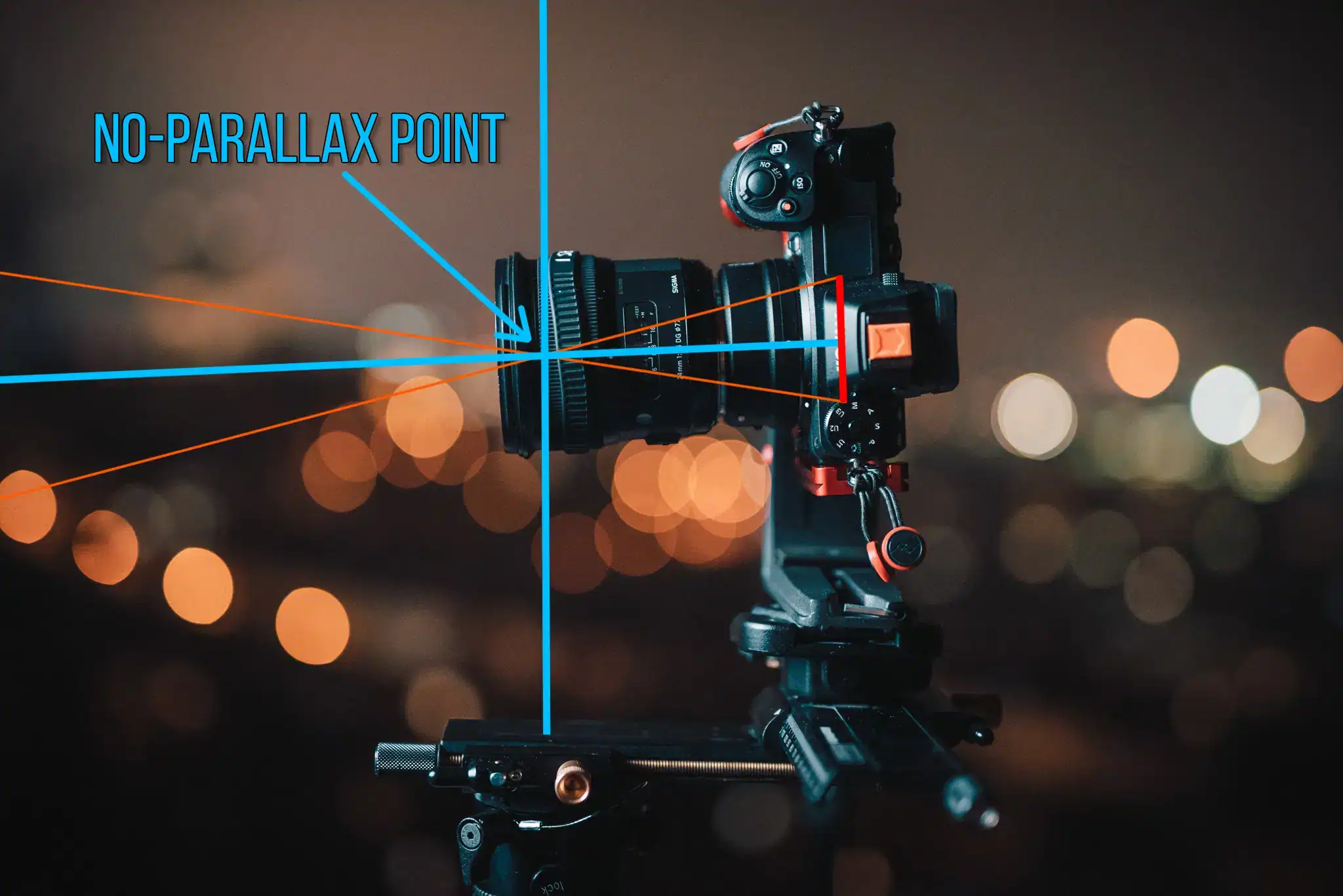
- Level your tripod and verify your panoramic head is calibrated to the lens’s entrance pupil (no-parallax point).
- Safety: secure on rooftops with a weight/tether; avoid overhanging railings; check wind if using a pole or car mount.
- Backup workflow: when time allows, shoot a second full pass in case one frame is compromised by movement or flare.
Essential Gear & Setup
Core Gear
- Panoramic head: enables yaw rotation around the lens’s no-parallax point to eliminate parallax errors during stitching. Calibrate fore–aft and left–right so near and far objects do not shift relative to each other when you pan.
- Stable tripod with leveling base: a leveling base speeds up setup and keeps rotations consistent, minimizing horizon tilt.
- Remote trigger or smartphone app: the R6 Mark II works well with remote releases or Canon Camera Connect to avoid vibrations.
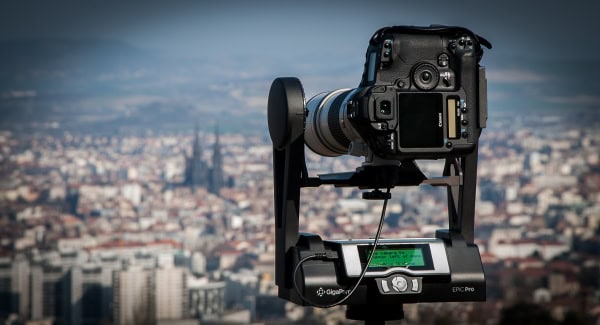
Optional Add-ons
- Pole or car mount: useful for crowds, rooftops, or vehicle shots. Always tether the rig, watch wind gusts, and keep shutter speeds high to reduce blur from vibration.
- Lighting aids: small LED panels or bounced flash for interiors can lift deep shadows, reducing the need for extreme HDR.
- Weather protection: a simple rain cover, microfiber cloths, and silica packets keep your gear safe and dry.
Step-by-Step Shooting Guide
Standard Static Scenes
- Level tripod & align the nodal point: on your pano head, slide the camera forward/backward until foreground and background features don’t shift relative to each other as you pan. Mark the rail positions for your chosen fisheye.
- Manual exposure & locked white balance: set exposure in Manual; lock WB (Daylight outside; a custom Kelvin for interiors). This avoids color and exposure flicker across frames that can cause seams.
- Capture sequence with overlap:
- R6 Mark II + diagonal fisheye (≈15–16mm): 6 shots around at 60°, then a zenith and a nadir shot.
- R6 Mark II + circular fisheye (8mm): 3–4 around at 90–120°, plus zenith and nadir.
- Olympus 8mm on MFT: 6 around, plus zenith and nadir. Aim for 25–30% overlap.
- Take a nadir shot: tilt down to capture the ground to replace the tripod footprint in post. Consider a quick “handheld off-tripod” nadir plate if the scene allows.
HDR / High Dynamic Range Interiors
- Bracket ±2 EV (3 or 5 frames): the R6 Mark II’s AEB can automate this. Keep the same aperture across brackets; vary shutter speed only.
- Lock WB and keep ISO low (100–400) for maximum dynamic range. This balances bright windows and interior shadows without banding or excessive noise.
Low-Light / Night Scenes
- Use longer exposures on a stable mount. On the R6 Mark II, a safe ISO is 100–800 for tripod-based pano; go to ISO 1600–3200 only if motion demands it.
- Turn off IBIS and lens IS when on a tripod to prevent micro-tremor blur from sensor movement.
- Use a remote trigger and a 2s self-timer to avoid vibrations at the start of each frame.
Crowded Events
- Make two passes: one quick pass to get your base coverage, then a slower pass timing frames between moving crowds.
- In post, mask people where necessary to reduce ghosting. Higher overlap helps the stitcher find stable control points.
Special Setups (Pole / Car / Drone)
- Secure gear and tether everything. For pole shots, stand upwind and keep the pole vertical; rotate slowly to avoid swing.
- For car-mount panoramas, use high shutter speeds (1/500–1/2000) and avoid cobblestones or bumpy roads to reduce micro-blur.
Field Scenarios & Case Notes
Indoor Real Estate
Set the R6 Mark II to ISO 100–200, f/8, and bracket ±2 EV. Use 6 around + z + n with a diagonal fisheye. Lock WB to a custom Kelvin that matches interior lighting to reduce color casts between frames. Shoot a clean nadir to patch the tripod.
Outdoor Sunset
Expose for highlights (protecting the sky), then use HDR brackets for foreground lift. Avoid pointing the fisheye directly at the sun for too long; capture that frame last to minimize sensor heating and flare.
Event Crowds
Favor a circular fisheye to reduce total shots; it lowers the chance that moving people appear multiple times. Time your rotations when subjects are momentarily still.
Rooftop / Pole
Wind is the main enemy. Hang a small counterweight from the tripod, keep your center column down, and consider slightly faster shutter speeds even if it pushes ISO to 400–800.
Recommended Settings & Pro Tips
Exposure & Focus
| Scenario | Aperture | Shutter | ISO | Notes |
|---|---|---|---|---|
| Daylight outdoor | f/8–f/11 | 1/100–1/250 | 100–200 | Lock WB (Daylight), expose to protect highlights |
| Low light/night | f/4–f/5.6 | 1/30–1/60 (tripod) | 400–800 | Remote trigger; IBIS OFF on tripod |
| Interior HDR | f/8 | Bracket ±2 EV | 100–400 | Balance windows & lamps; manual WB |
| Action / moving subjects | f/5.6–f/8 | 1/200+ | 400–800 | Freeze motion; two-pass strategy |
Critical Tips
- Manual focus at hyperfocal: with a fisheye at f/8, set focus just short of infinity; verify at 100% magnification.
- Nodal point calibration: use two verticals (one near, one far). Pan between them; adjust fore–aft until they align perfectly without shifting. Mark the rail with tape for repeatability.
- White balance lock: avoid mixed WB across frames. If lighting varies, shoot a ColorChecker and batch-correct in post.
- RAW over JPEG: RAW preserves highlight headroom and color for cleaner seam blending and HDR fusion.
- IBIS/Lens IS OFF on tripod: the R6 Mark II’s stabilization can introduce micro-misalignments when the camera is perfectly still.
Stitching & Post-Processing
Software Workflow
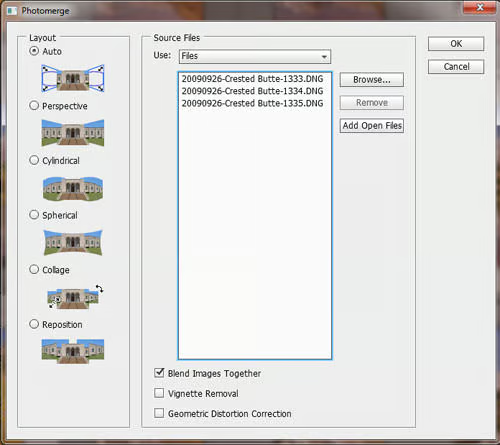
For a fisheye-based 360 photo, PTGui and Hugin are industry standards. Fisheye shots need fewer frames and are easier for stitchers to align; rectilinear ultrawides require more shots and overlap but have less edge distortion. Aim for ~25–30% overlap with fisheyes and 20–25% with rectilinear lenses. PTGui’s Fisheye Lens Type and automatic control-point generation make stitching fast, while Hugin offers a capable open-source alternative. If you’re new to setting control points and optimizing yaw/pitch/roll, consider learning resources and reviews that evaluate the latest PTGui builds at a professional level. Read a pro review of PTGui’s capabilities.
Cleanup & Enhancement
- Nadir patch: export a layered panorama and patch the tripod footprint using a logo tile or content-aware fill. There are AI tools that remove tripods quickly if your tripod stays within the nadir area.
- Color consistency: batch sync white balance and tone across all frames before stitching if your stitcher doesn’t handle it gracefully.
- Noise reduction: for low-light scenes, use luminance NR conservatively after stitching so you don’t blur seam areas.
- Leveling: set the horizon, then fine-tune yaw/pitch/roll for a level and natural look in a VR viewer.
- Export: for VR and web, export equirectangular JPEG (8-bit, quality 90–95). For grading or future edits, export 16-bit TIFF.
Recommended Learning
If you’re new to panoramic heads and entrance pupil setup, a practical walkthrough goes a long way. Here’s a concise video to visualize the process:
For broader 360-photo workflows using mirrorless/DSLR (capture to stitch), Meta’s creator documentation is a clear, vendor-neutral overview. See this DSLR/mirrorless 360 photo guide.
Want more on panoramic head setup and avoiding parallax? This deep-dive is practical and field-tested. Panoramic head and no-parallax tutorial.
Useful Tools & Resources
Software
- PTGui panorama stitching
- Hugin open-source stitcher
- Lightroom / Photoshop for RAW prep and retouching
- AI tripod/nadir removal tools
Hardware
- Panoramic heads (Nodal Ninja, Leofoto, Sunwayfoto)
- Carbon fiber tripods with leveling bases
- Wireless remote shutters or intervalometers
- Pole extensions and vehicle mounts with safety tethers
Disclaimer: software/hardware names provided for search reference; check official sites for details.
Common Mistakes & How to Avoid Them
- Parallax error: always align to the entrance pupil; a 5-minute calibration saves hours in post.
- Exposure flicker: use Manual exposure and locked WB; avoid Auto ISO for multi-frame panos.
- Tripod shadows: capture a clean nadir and patch later; reposition if the sun casts a hard tripod shadow into key frame areas.
- Ghosting from movement: shoot two passes and mask; higher overlap gives better control points.
- Night noise: keep ISO low on a tripod; extend shutter speed instead of pushing ISO.
- IBIS left ON: disable stabilization on a tripod to prevent micro-blur across frames.
Frequently Asked Questions
-
Can I shoot handheld panoramas with the EOS R6 Mark II?
Yes, but expect more stitching errors. Keep shutter speeds at 1/250+ and rotate around your body’s center as smoothly as possible. For 360 photos, a tripod and pano head dramatically improve results.
-
Is the Olympus 8mm f/1.8 PRO wide enough for single-row 360?
On an MFT body, yes—6 around plus zenith/nadir is typical. However, the lens is not practical on the R6 Mark II due to mount and image-circle incompatibility. Use a full-frame fisheye (e.g., EF 8–15mm at 15mm) to achieve similar coverage on the R6 Mark II.
-
Do I need HDR for interiors with bright windows?
Usually, yes. Bracket ±2 EV (3–5 frames). Keep aperture constant and vary shutter. The R6 Mark II’s low-noise sensor helps merge brackets cleanly with minimal ghosting.
-
How do I avoid parallax issues?
Use a panoramic head and calibrate the entrance pupil for your fisheye. Check that near and far vertical lines don’t shift while panning. Mark your rail positions for fast, repeatable setup.
-
What ISO range is safe on the R6 Mark II in low light?
For tripod-based panoramas, ISO 100–400 is ideal; 800 is still very clean. ISO 1600–3200 is usable if you need higher shutter speeds to reduce motion, but expect a bit more noise.
-
Can I set Custom Shooting Modes for pano?
Yes. Save a “Pano” preset (C1/C2) with Manual exposure, RAW, IBIS off, WB locked, 2s timer, and exposure bracketing active. This speeds up on-site work and keeps settings consistent.
Important Compatibility Note: R6 Mark II & Olympus 8mm f/1.8 PRO
While this guide focuses on how to shoot panorama with Canon EOS R6 Mark II & Olympus 8mm f/1.8 PRO Fisheye, it’s essential to be honest about the physical limitations:
- The Olympus 8mm f/1.8 is an MFT lens; its image circle does not cover full-frame. Even the R6 Mark II’s APS‑C crop (1.6×) is larger than MFT and will vignette heavily.
- There is no practical adapter that preserves infinity focus and electronic aperture for MFT lenses on Canon RF full-frame bodies.
- Recommendation: use a full-frame fisheye on the R6 Mark II to get equivalent coverage and follow the techniques in this article. If you already own the Olympus 8mm, use it on an MFT body and adopt the same nodal alignment, bracketing, and overlap strategies.
Safety, Storage, and Backup Workflow
Use a weighted hook or sandbag on the tripod in wind. On rooftops or poles, always tether the camera and keep bystanders clear. For cars, use redundant straps and check mounts before each drive. For data safety, record to both SD slots (simultaneous) and offload to two separate drives after the shoot. When possible, shoot a second full pano pass to insure against unexpected stitching problems.