Why This Camera & Lens Are Great for Panoramas
If you want to know how to shoot panorama with Canon EOS R3 & Samyang 12mm f/2.8 ED AS NCS Fish-Eye, this guide walks you through the entire process—from gear setup to stitching. The Canon EOS R3 is a 24.1MP full-frame, stacked CMOS mirrorless body with large 6.0 µm pixels and robust in-body stabilization. It delivers excellent high-ISO performance, fast and confident autofocus (even though you’ll typically use manual focus for panoramas), and a deep buffer for bracketing. The Samyang 12mm f/2.8 is a diagonal fisheye designed for full-frame: it captures a huge field of view with fewer shots than a rectilinear lens, reducing stitching time while maintaining strong edge-to-edge coverage when stopped down.
For 360 photos, a diagonal fisheye like the Samyang 12mm shines: it typically needs 6 shots around plus zenith and nadir to fully cover the sphere with overlap. Distortion is expected (it’s a fisheye), but modern stitching tools handle fisheye projection natively, resulting in clean, detailed equirectangular images. The R3’s dynamic range at base ISO is excellent for HDR panoramas, its high-capacity battery makes multi-pass work practical, and its weather-sealed body inspires confidence outdoors.
Quick Setup Overview
- Camera: Canon EOS R3 — Full-frame 24.1MP stacked CMOS, ~6.0 µm pixel pitch, strong IBIS, excellent ISO performance and color depth.
- Lens: Samyang 12mm f/2.8 ED AS NCS Fish-Eye — diagonal fisheye designed for full-frame; sharp from f/5.6–f/8, moderate CA that’s easy to correct; manual focus with smooth ring.
- Estimated shots & overlap: 6 around at approximately 60° yaw spacing + 1 zenith + 1 nadir, with ~30–35% overlap. In tight spaces or near subjects, 8 around improves parallax safety.
- Difficulty: Intermediate — easy capture once nodal point is calibrated; basic post skills required to patch the nadir and correct color.
Planning & On-Site Preparation
Evaluate Shooting Environment
Before you extend the tripod, look for moving elements (people, cars, trees in wind), reflective or glossy surfaces (glass, polished floors), and strong backlight sources that may flare a fisheye. If shooting through glass, stay as close as possible and shade the lens with a cloth or your hand to minimize reflections and ghosting. For sunset or night scenes, anticipate dynamic range challenges and plan for bracketing.
Match Gear to Scene Goals
The EOS R3’s clean ISO and generous dynamic range pair perfectly with the Samyang’s large field of view: you’ll capture a full 360 with fewer frames, which means less time waiting for the scene to clear between rotations. Indoors, the R3 is comfortable at ISO 400–800 with minimal noise; outdoors at base ISO 100–200, you’ll get crisp, high-contrast frames that stitch well. The fisheye’s main tradeoff is geometric distortion, but that is expected and handled by stitching software when you declare the lens type as “full-frame fisheye.”
Pre-shoot Checklist
- Fully charge a spare battery; format two fast cards. Bracketed panoramas can generate 100–300 files quickly.
- Clean the lens front element and your sensor. Dust spots are harder to retouch across 8–12 frames.
- Level the tripod and calibrate your panoramic head for the nodal (no-parallax) point.
- Safety checks: secure on rooftops, weigh down the center column if windy, use a tether when on poles or over railings.
- Backup workflow: after your primary pass, shoot a second quick pass as insurance against stitching or ghosting issues.
For a high-level DSLR/mirrorless 360 capture overview, see this practical guide for creators at the end of this section. Using a DSLR or mirrorless camera to shoot and stitch a 360 photo
Essential Gear & Setup
Core Gear
- Panoramic head: This allows the camera to rotate around the lens’s entrance pupil (nodal point), eliminating parallax. Without it, stitching near objects becomes unreliable.
- Stable tripod with a leveling base: Leveling once at the base lets you rotate without re-leveling the head. It speeds up capture and reduces horizon drift.
- Remote trigger or Canon Camera Connect app: Fire the shutter without touching the camera to avoid vibrations, especially for long exposures or HDR brackets.
Optional Add-ons
- Pole or car mount: Great for rooftops, crowds, or elevated perspectives. Always tether the camera, monitor wind, and avoid traffic or overhead hazards.
- Lighting aids: Small LED panels help balance mixed interior lighting and reduce the bracket spread you need.
- Weather protection: A rain cover or umbrella keeps droplets off the fisheye front element, which is otherwise hard to clean mid-shoot.
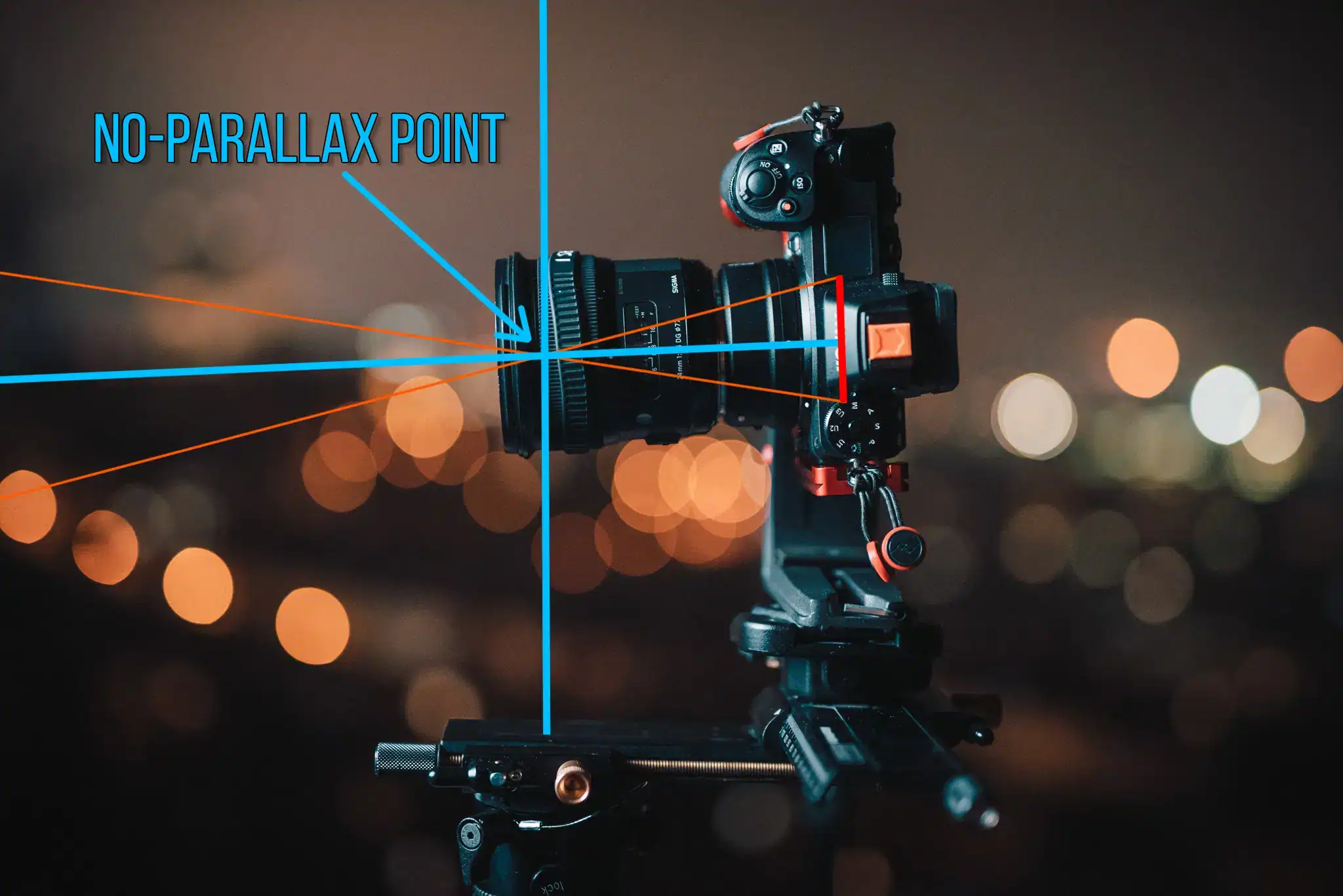
New to nodal alignment? This illustrated tutorial explains the principles and common pitfalls of panoramic heads. Panoramic head tutorial
Step-by-Step Shooting Guide
Standard Static Scenes
- Level tripod and align nodal point. With the R3 and the Samyang 12mm, set your upper and lower rails so the rotation axis passes through the entrance pupil. Check by placing two vertical objects (near and far) and rotating the camera—if they shift relative to each other, adjust the fore-aft rail until the shift disappears.
- Set manual exposure, manual focus, and lock white balance. Use RAW. For the Samyang 12mm, set focus slightly past the hyperfocal mark at f/8 to keep everything sharp; then tape the focus ring.
- Capture 6 shots around at ~60° yaw increments with 30–35% overlap. Tilt slightly down by 5–10° if you want more nadir coverage; then capture 1 zenith and 1 nadir frame.
- Take a dedicated nadir shot to patch the tripod. If your head allows a quick offset or if you can temporarily lift the rig and shoot the ground, do so.
HDR / High Dynamic Range Interiors
- Bracket ±2 EV (3 or 5 frames) to balance windows and interior shadows. The R3’s fast drive and deep buffer make bracketing across an entire rotation quick and safe.
- Keep white balance locked—Auto WB per frame will cause stitching mismatches. Choose “Daylight,” “Tungsten,” or a measured Kelvin value and stick with it.
- Turn off IBIS when on a tripod to avoid micro-blur during long exposures.
Low-Light / Night Scenes
- Use f/4–f/5.6, lengthen shutter speed, and keep ISO between 100–800 for the cleanest results. On the EOS R3, ISO 1600–3200 is still usable if you need to freeze light movement or reduce exposure time.
- Trigger with a remote or app and use a 2-second timer to avoid vibration. Disable IBIS on tripod.
- Consider two full rotations: one exposing for highlights (neon signs, skyline) and one for shadows, then blend selectively in post.
Crowded Events
- Shoot two passes. First, a fast, clean pass; second, pause at each angle for people to move, capturing “clean plates.”
- In post, mask moving subjects or choose the cleanest frame per angle to avoid ghosting.
- Use slightly faster shutter speeds (1/200s or faster) and ISO 400–800 to freeze motion while keeping noise in check.
Special Setups (Pole / Car / Drone)
- Secure all gear with a safety tether. Check all clamps and friction knobs; test rotation at low height before raising the pole.
- Manage vibrations and wind by using shorter exposures and increasing ISO if needed. Rotate slower and brace the pole against your body.
- For car mounts, avoid high speeds; shoot in a controlled environment or static positions, and mind reflections on the vehicle.
Recommended Settings & Pro Tips
Exposure & Focus
| Scenario | Aperture | Shutter | ISO | Notes |
|---|---|---|---|---|
| Daylight outdoor | f/8–f/11 | 1/100–1/250 | 100–200 | Lock WB to Daylight; RAW for maximal latitude |
| Low light/night | f/4–f/5.6 | 1/30–1/60 (or longer on tripod) | 400–800 (1600 if needed) | Disable IBIS on tripod; remote trigger |
| Interior HDR | f/8 | Auto-bracket ±2 EV (3–5 frames) | 100–400 | Balance windows and fixtures; keep WB fixed |
| Action / moving subjects | f/5.6–f/8 | 1/200+ | 400–800 | Two-pass capture to aid de-ghosting |
Critical Tips
- Manual focus at hyperfocal: At 12mm and f/8 on full-frame, hyperfocal distance is roughly 0.8–1 m; focus slightly past that and tape the ring.
- Nodal point calibration: Start with the camera slid back so the front of the lens aligns roughly above the rotation axis; fine-tune by watching near/far objects. Mark your rail positions for this body/lens combo for repeatability.
- White balance: Lock a consistent WB for all frames. Mixed lighting is common indoors—choose a compromise or gel lights for consistency.
- RAW capture: The R3’s 14-bit RAW files give ample room for exposure blending and color correction, especially with HDR brackets.
- IBIS on tripod: Turn it off. Stabilization can introduce micro-shifts when the camera is perfectly still.
Stitching & Post-Processing
Software Workflow
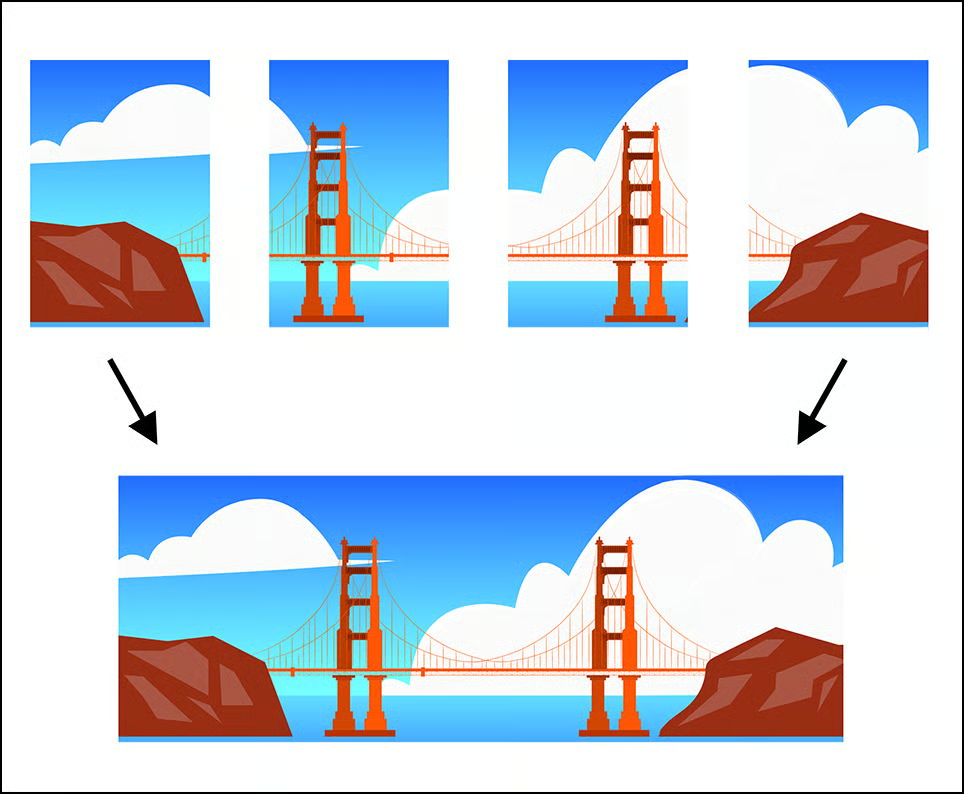
Import RAWs into Lightroom or Capture One, apply basic lens corrections (chromatic aberration, vignetting), synchronize WB and exposure across the set, and export 16-bit TIFFs. In PTGui or Hugin, declare the lens type as “full-frame fisheye 12mm” so control points fit the expected projection. Fisheye frames with 30–35% overlap stitch very reliably; aim for consistent coverage across the rotation. For reference-quality results, many professionals rely on PTGui’s optimizer and masking tools for de-ghosting and nadir blending. PTGui review and why it’s favored for complex panoramas
Set output to equirectangular 2:1 at your target size. With the EOS R3 + 12mm fisheye at 6 around + Z + N, expect final equirectangulars in the ~80–120 MP range depending on overlap and processing. If your scene has close objects or heavy parallax, increase overlap (8 around) and use PTGui’s masking to select the cleanest source areas.
Cleanup & Enhancement
- Nadir patch: Export a layered file to Photoshop, clone or patch the tripod, or use an AI tripod-removal tool for speed.
- Color and contrast: Apply a gentle S-curve, unify WB if mixed lighting persists, and remove color casts on floors/ceilings.
- Noise reduction: Apply NR to shadow brackets for interiors or night shots; the R3 handles ISO 800–1600 well, but subtle NR keeps textures natural.
- Leveling: In PTGui, use the “vertical line” or “horizon” tool to correct roll/pitch/yaw. Ensure the horizon is straight before exporting.
- Export: Save a high-quality 16-bit TIFF master and a JPEG equirectangular for web/VR. Keep a consistent naming scheme for project archiving.
If you’re new to panoramic head setup or want a refresher on capture-to-stitch best practices, this step-by-step is a solid companion. Set up a panoramic head for high-end 360 photos
Video: See the Flow in Action
Watching a full capture and stitch sequence makes the process click. Here’s a practical walkthrough covering key steps and pitfalls.
Useful Tools & Resources
Software
- PTGui panorama stitching
- Hugin open source
- Lightroom / Photoshop
- AI tripod removal tools
Hardware
- Panoramic heads (Nodal Ninja, Leofoto)
- Carbon fiber tripods
- Leveling bases
- Wireless remote shutters
- Pole extensions / car mounts
Disclaimer: software/hardware names provided for search reference; check official sites for details.
Common Mistakes & How to Avoid Them
- Parallax error: Always align the nodal point before serious work. Recheck if you change focus distance significantly.
- Exposure flicker: Manual exposure and locked WB only. Avoid Auto ISO or Auto WB across frames.
- Tripod shadows: Shoot a dedicated nadir and patch later, or reposition slightly for a clean plate.
- Ghosting from movement: Shoot two passes and mask moving elements in the stitcher.
- High-ISO noise: Keep ISO to 100–800 when possible on the R3; use the tripod and remote to allow longer exposures.
For more background on techniques and field-proven workflows, this Q&A thread collects best practices from experienced shooters. Best techniques to take 360 panoramas
Field-Proven Case Studies
Indoor Real Estate, Mixed Lighting
With bright windows and warm ceiling lights, use f/8, ISO 100–200, and 5-shot brackets at ±2 EV. Keep WB at a fixed Kelvin (e.g., 4200–5000K) to balance window daylight and interior tungsten. The Samyang 12mm covers entire rooms in 6 around + Z + N, minimizing time on-site. In post, blend brackets per angle, then stitch; or stitch bracket stacks directly in PTGui. Finish by selectively warming interior lights and neutralizing window casts.
Outdoor Sunset Overlook
At golden hour, set f/8, 1/125s, ISO 100–200 for base exposure. Capture a second rotation at +1 to +2 EV for shadow lift if needed. The R3’s color depth preserves subtle gradients in the sky; the fisheye’s flare control is good, but shade the front element when pointing near the sun. Use PTGui’s vertical/horizon tool to lock in a natural horizon before exporting.
Rooftop Pole Shot
Mount the R3 on a lightweight pole with a compact pano head. Keep exposures short, around 1/250s at ISO 400–800, to fight wind-induced movement. Rotate slowly, brace the pole, and shoot 6 around + Z; nadir can be patched. Always tether the camera and assess wind gusts—don’t risk gear or safety for the shot.
Car-Mounted Capture
For static scenes (no driving), mount the rig securely and shoot quickly to avoid passersby in frames. Reflections off the car body are inevitable; position the camera slightly higher on the pole to minimize intrusion. Use faster shutter speeds and modest ISO to ensure sharpness. Mask reflections during stitching where possible.
Frequently Asked Questions
- Can I shoot handheld panoramas with the EOS R3?
You can, but a panoramic head is strongly recommended. Handheld works for casual single-row panos outdoors with distant subjects. For 360 photos or interiors, parallax will cause stitching errors without rotating around the nodal point.
- Is the Samyang 12mm f/2.8 wide enough for single-row 360?
Yes. On full-frame, it’s a diagonal fisheye; 6 shots around plus zenith and nadir is a common, reliable workflow. In tight spaces or with near objects, increase to 8 around for extra overlap.
- Do I need HDR for interiors with bright windows?
Often yes. Bracketing ±2 EV (3–5 frames) captures window highlights and shadow detail cleanly. The R3’s low-noise files blend smoothly and minimize banding in gradients.
- How do I avoid parallax issues with this setup?
Calibrate the panoramic head so rotation occurs through the entrance pupil. Use near/far alignment tests and mark your rail positions for the R3 + Samyang 12mm combo. Recheck if you change focus distance significantly.
- What ISO range is safe on the EOS R3 in low light?
For critical work on a tripod, aim for ISO 100–800. ISO 1600–3200 is still usable with careful noise reduction. If you can lengthen shutter speed on a solid tripod, prefer lower ISO.
- Can I set Custom Modes (C1/C2) for panorama capture?
Yes. Save Manual exposure, fixed WB, RAW, IBIS off (tripod), and bracketing settings to a custom mode. It speeds up on-site setup and reduces mistakes.
- How do I reduce flare with a fisheye?
Avoid direct light sources near the frame edge, shade the lens with your hand or a flag, and clean the front element before every rotation. Slightly adjust yaw if a bright light produces a streak.
- What tripod head should I use?
A two-rail panoramic head with fore-aft and lateral adjustment (e.g., Nodal Ninja, Leofoto) makes nodal alignment precise and repeatable. A leveling base beneath the head saves time.
Safety, Reliability, and Backup Workflow
Rooftops, poles, and crowded locations require extra caution. Always tether the camera when elevated, weigh down your tripod in wind, and avoid obstructing pathways. On the EOS R3, disable IBIS when mounted on a tripod, and use a remote to keep vibrations low. For reliability, shoot a full second pass at the end—if one frame in the first pass is blurred or obstructed, your backup saves the project. After capture, duplicate your card to two locations, verify checksums where possible, and keep the RAWs intact until delivery is final.
In-Field Visuals
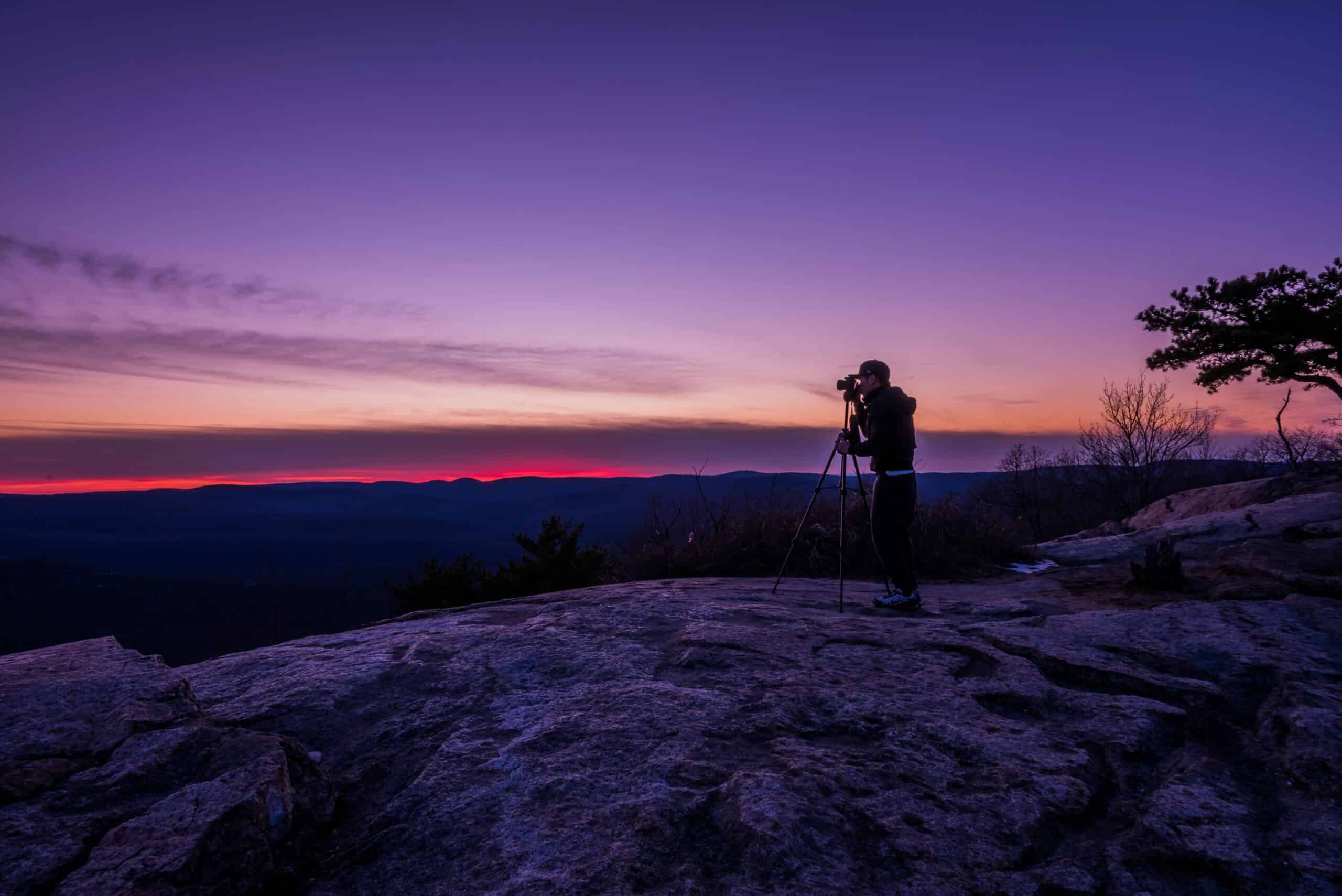
For deeper theory, a concise primer on focal lengths and panoramas can help when comparing lens choices. Panoramas, focal lengths, and stitching strategies