
Why This Camera & Lens Are Great for Panoramas
If you want to learn how to shoot panorama with Canon EOS R3 & Canon RF 15-35mm f/2.8L IS USM, you’ve picked a professional-grade combo that excels in both speed and quality. The EOS R3 uses a 24.1MP full-frame stacked BSI CMOS sensor (36×24 mm) with large ~6 µm pixels, giving excellent noise performance, fast readout, and robust dynamic range (~14 stops at base ISO). In practice, that means clean files at ISO 100–1600, workable at 3200–6400 with careful noise reduction—perfect for interior HDR and low-light cityscapes.
The RF 15-35mm f/2.8L IS USM is an ultra-wide rectilinear zoom. At 15mm it offers an expansive field of view without fisheye bending, which is ideal for architectural lines and real estate. It’s sharp stopped down (f/5.6–f/11), controls lateral chromatic aberration well, and focuses close without field curvature headaches. Paired with the R3’s in-body stabilization (IBIS), you get up to ~8 stops combined stabilization—handy for scouting shots—though you should disable stabilization on a tripod to avoid micro-drift during multi-shot pans.
Because this is a rectilinear lens (not fisheye), you’ll shoot more frames than with a fisheye, but your straight lines stay straight and stitching quality is excellent with good nodal alignment. The RF mount is also mechanically rigid, which helps maintain precise nodal point calibration on a panoramic head.
Quick Setup Overview
- Camera: Canon EOS R3 — Full-frame 24.1MP stacked BSI CMOS, excellent DR at base ISO, very clean ISO 100–1600; native ISO 100–102,400 (expandable). IBIS included.
- Lens: Canon RF 15-35mm f/2.8L IS USM — rectilinear ultra-wide zoom, best sharpness from f/5.6–f/8; well-controlled CA; stabilized (turn IS off on tripod).
- Estimated shots & overlap (tested guidance, rectilinear):
- At 15mm: 6–8 shots per row at ~30% overlap; do 3 rows (-50°, 0°, +50°) + zenith + nadir → ~20–26 total.
- At 20mm: 8 shots per row; 3–4 rows + Z/N → ~26–34 total.
- At 35mm (for gigapixel detail): 12–16 shots per row; 5–7 rows + Z/N → 60–110+ total.
- Difficulty: Moderate — easier than gigapixel telephoto; more frames than fisheye, but superior straight-line rendering.
Planning & On-Site Preparation
Evaluate Shooting Environment
Before you start, walk the scene. Note light direction and contrast, reflective surfaces (glass, polished floors), moving elements (people, trees, traffic), and tight spaces. If shooting through glass, get the lens as parallel and as close as possible (1–2 cm) to reduce reflections. Shade the lens with your hand or cloth, and avoid direct bright sources that could cause flare across the sequence.
Match Gear to Scene Goals
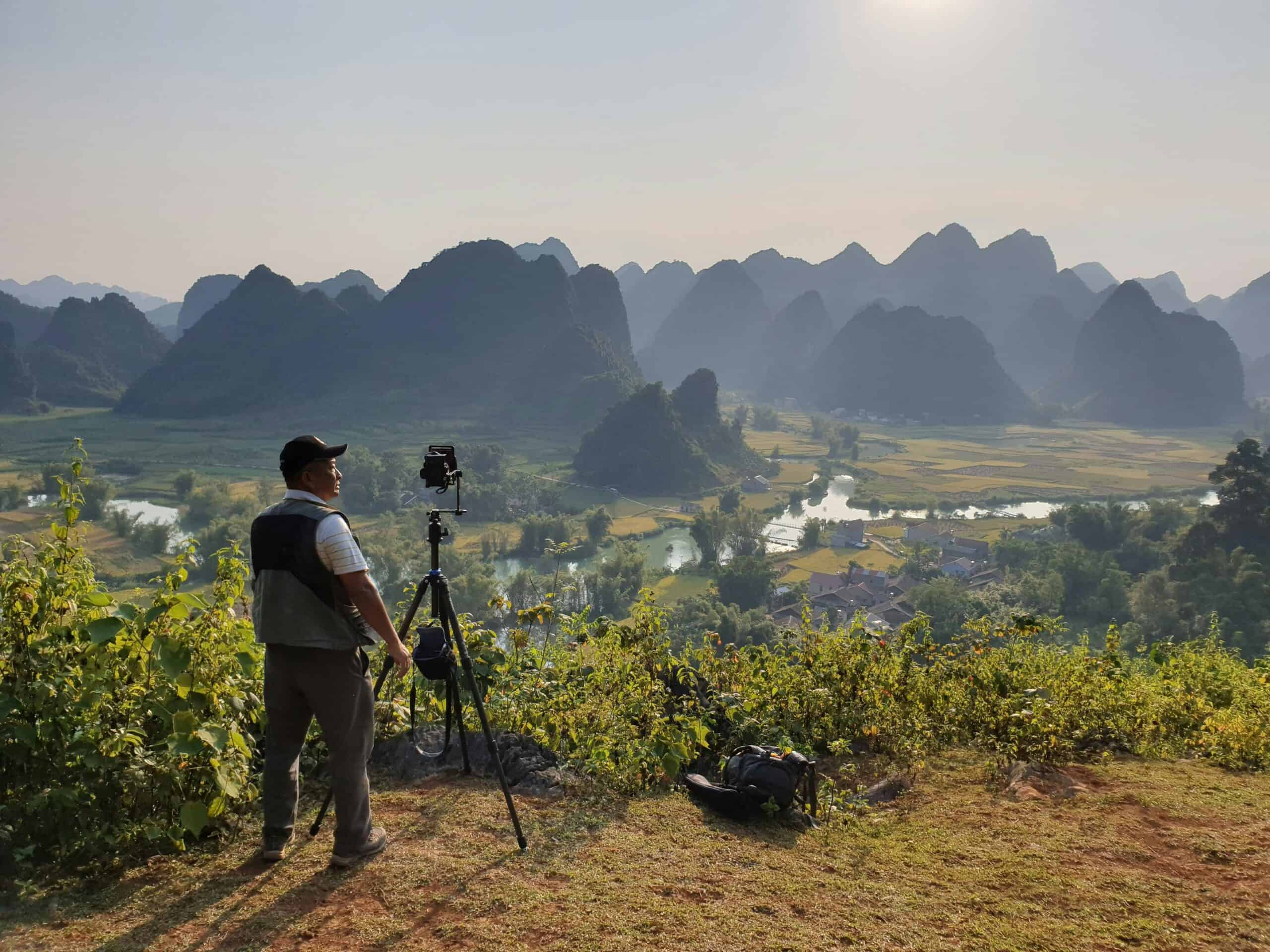
For clean architectural lines and virtual tours, this rectilinear 15–35mm is ideal. The R3’s dynamic range helps pull shadow detail and retain highlight information in windows. Indoors, expect to shoot at ISO 100–400 with bracketed exposures; outdoors at sunset, ISO 100–200 is perfect. In a pinch, ISO 800–1600 on the R3 remains very usable for night panoramas if you keep exposures stable on a tripod. The 15mm end reduces the number of frames; if you want ultra-high detail, zoom toward 24–35mm and increase rows and shots accordingly.
Pre-shoot Checklist
- Power & storage: Fully charged batteries; high-speed UHS-II/CFexpress card with ample capacity (HDR multiplies frames).
- Clean optics: Microfiber, blower for lens and sensor; dust spots become tedious to clone across 20+ frames.
- Tripod leveling & pano head calibration: Use a leveling base and confirm nodal point alignment for 15mm before the shoot.
- Safety checks: Assess wind on rooftops, secure straps and tethers. For car mounts, use secondary safety lines and obey local laws.
- Backup workflow: Shoot one full extra pass at base exposure. If HDR, consider a second bracket at slightly different shutter base.
Essential Gear & Setup
Core Gear
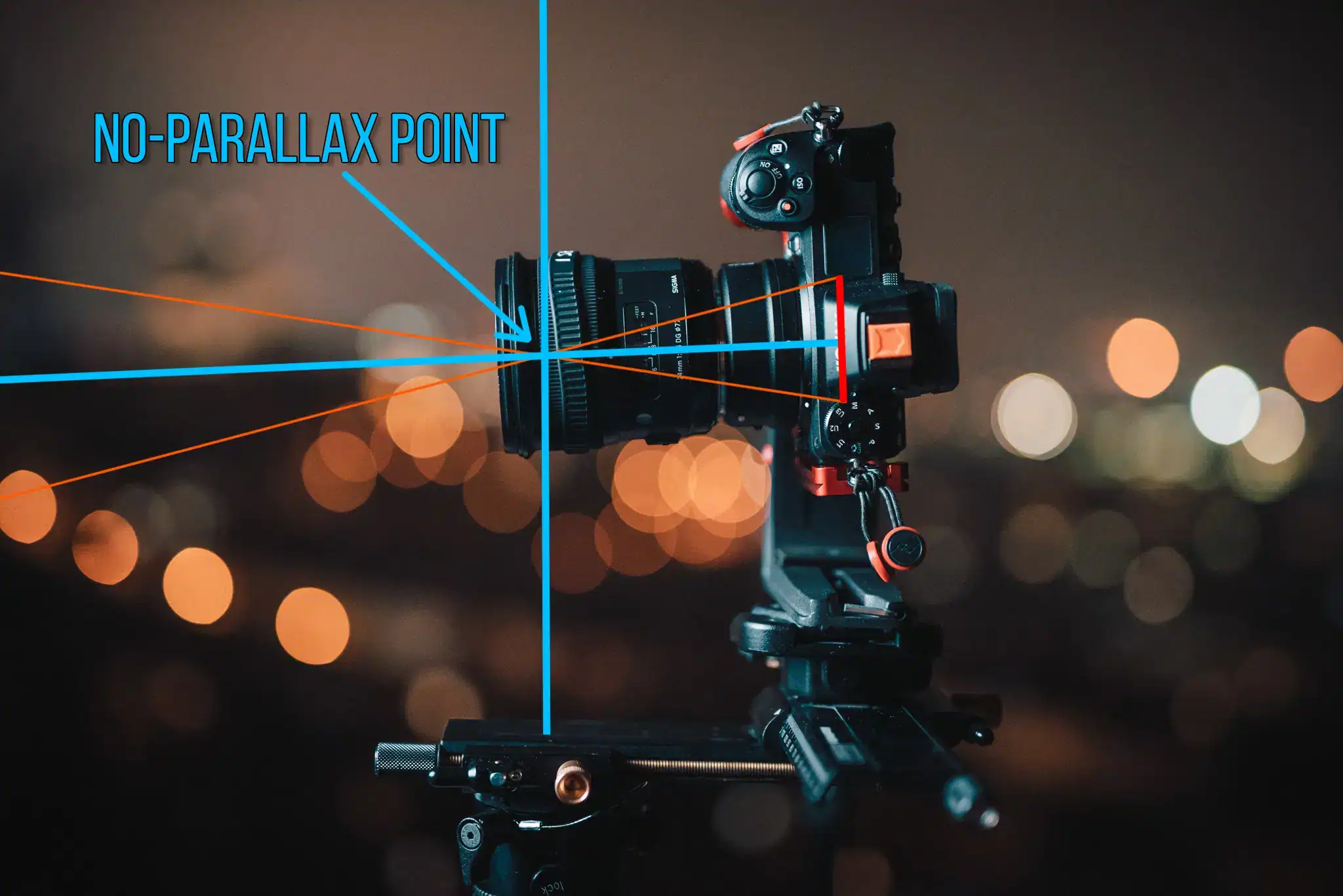
- Panoramic head: A proper pano head lets you rotate around the lens’s no-parallax (entrance pupil) point and eliminates parallax, ensuring clean stitches. Calibrate once and mark your rails for 15mm and 24mm positions.
- Stable tripod with leveling base: Fast leveling equals consistent horizons and less post-rotation. Carbon fiber helps in wind.
- Remote trigger or Canon Camera Connect: Trigger without touching the camera to prevent micro-blur during long exposures.
Optional Add-ons
- Pole or car mount: Use guy-lines for pole stability. On vehicles, use vibration-damped mounts, keep speeds low, and always tether.
- Lighting aids: Small LED panels or bounced flash for interiors; keep lighting consistent across the set to avoid stitching discrepancies.
- Weather gear: Rain cover for body/lens; gaffer tape to secure cables; hand warmers to prevent fog in cold conditions.
Step-by-Step Shooting Guide
Standard Static Scenes
- Level and anchor: Level your tripod using a leveling base, then lock everything down. Avoid extending center column if possible.
- Align the nodal point: With the RF 15-35 at 15mm, a good starting reference is ~70–80 mm forward of the sensor plane symbol (Ø with a line through it), but calibrate precisely by aligning near and far objects and sliding the rail until parallax disappears.
- Manual exposure and WB: Switch to M mode. Meter the midtones and set a single exposure for all frames (e.g., f/8, 1/100, ISO 100). Lock white balance to Daylight/Tungsten as appropriate to avoid color shifts between frames.
- Focus: Use MF. Focus at or near the hyperfocal distance for 15mm (around 1–1.2 m at f/8 on full frame) and then switch AF off. Use magnified live view to nail it.
- Stabilization: Turn off lens IS and IBIS on a tripod to prevent drift during long sequences.
- Capture sequence: At 15mm, shoot 6–8 frames around per row with about 25–30% overlap. Do three rows: +50°, 0°, −50°. Then shoot a zenith (straight up) and a nadir (straight down) for clean tripod removal.
- Nadir technique: After your main set, move the tripod slightly and shoot the ground plate for easier patching.
HDR / High Dynamic Range Interiors
- Bracket strategy: Use AEB with 5 frames at ±2 EV when scenes have bright windows and dark corners. If time is tight, 3 frames can suffice; for very high contrast, use 7 frames.
- Consistency: Lock WB and keep aperture fixed at f/8. Vary shutter speed only. This ensures identical depth of field and geometry across brackets.
- Workflow tip: Shoot in the same yaw order for each bracket set to avoid confusion later (e.g., always rotate clockwise).
Low-Light / Night Scenes
- Exposure: Use f/4–f/5.6, shutter 1/15–30 s, ISO 100–800 on tripod. The R3 files handle ISO 1600 well if you need faster shutter in wind.
- Stability: Use a remote trigger or 2 s timer. Shield the camera from gusts with your body. Hang a weight from the tripod hook if safe.
- Check star trails/traffic: For night skies, keep below 10–15 s to minimize star elongation at 15mm. For light trails, let the base frame run longer but ensure consistency across the set.
Crowded Events
- Two-pass method: First pass for complete coverage; second pass to capture empty gaps when people move. You’ll mask best segments in post.
- Faster shutter: Use 1/200 s or faster and ISO 400–800 to freeze motion. Avoid people too close to the lens—they create parallax issues.
Special Setups (Pole / Car / Drone)
- Pole: Secure with tethers and guy-lines; rotate slower to minimize oscillation. Consider fewer frames at 15mm to reduce time aloft.
- Car mount: Use vibration isolators and shoot at a standstill when possible. Turn off stabilization if you’re using a very rigid mount and short exposures.
- Legal/safety: Confirm local regulations for poles and car rigs. Never shoot while driving.
Watch: A practical panorama shooting demo
Seeing the rotation technique and overlap in action helps. The video below reinforces the fundamental steps covered above.
Recommended Settings & Pro Tips
Exposure & Focus
| Scenario | Aperture | Shutter | ISO | Notes |
|---|---|---|---|---|
| Daylight outdoor | f/8–f/11 | 1/100–1/250 | 100–200 | Lock WB (Daylight). Manual exposure across all frames. |
| Low light/night | f/4–f/5.6 | 1/15–1/60 | 100–800 (1600 if needed) | Tripod + remote; disable IS/IBIS on tripod. |
| Interior HDR | f/8 | Bracket ±2 EV (3–7 frames) | 100–400 | Windows vs. shadows; keep aperture fixed. |
| Action / moving subjects | f/5.6–f/8 | 1/200+ | 400–800 | Faster shutter to reduce ghosting; shoot two passes. |
Critical Tips
- Manual focus near the hyperfocal distance at 15mm for maximum sharpness; confirm with magnified live view.
- Nodal point: Calibrate once and mark your rail. For the RF 15-35 at 15mm, expect around 70–80 mm forward of the sensor plane as a starting mark; refine on-site.
- White balance: Lock it. Mixed lighting will stitch cleaner if every frame shares the same WB.
- Shoot RAW: Gives you extra DR and cleaner color matching. Set consistent Picture Style if you also need JPEG previews.
- Stabilization: On tripod, turn off IS/IBIS. Handheld scouting is fine with stabilization on, but keep the final set stabilized off.
- Use the R3’s C1/C2 modes for pano presets (Manual exposure, MF, WB lock, IS off) to speed setup.
Stitching & Post-Processing
Software Workflow
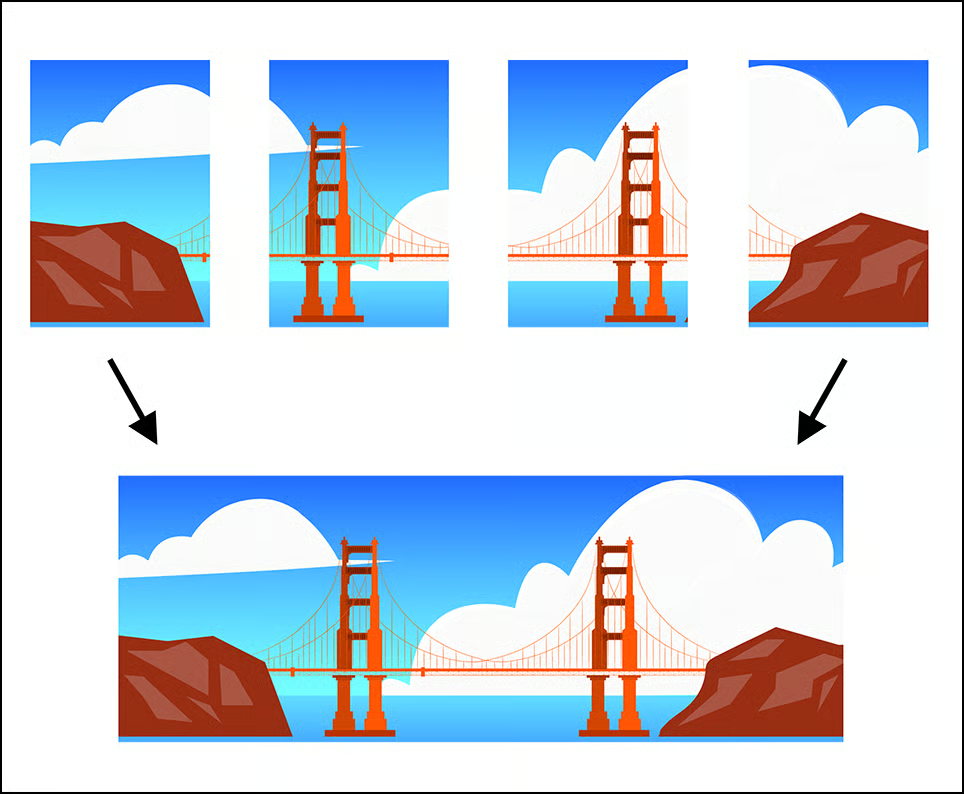
For rectilinear ultra-wide sets, PTGui and Hugin produce excellent stitches. PTGui is fast, offers robust control point generation, and handles HDR merging intelligently. Hugin is open-source and powerful with a steeper learning curve. Lightroom and Photoshop can work for single-row pans but are less ideal for full spherical 360×180 sets. Follow industry guidance for overlap: ~25–30% for fisheye, ~20–30% for rectilinear. With the RF 15-35 at 15mm, aim for ~30% to keep control points solid in blank skies and low-texture walls. Read a practical review of PTGui’s strengths for complex panoramas at the end of this section. PTGui review: why it’s a top choice for intricate panoramas
HDR Merge and Color
If you bracketed, merge each angle’s bracket set to 32-bit HDR or tone-map consistently before global stitching. PTGui Pro can handle HDR+stitching in one pass. Keep color neutral; apply creative grading after you have a leveled pano. When mixing daylight and tungsten interiors, consider targeted WB corrections per region in your editor after stitching.
Cleanup & Enhancement
- Tripod/nadir patch: Use a separate nadir plate shot or content-aware fill/cloning. Some AI tools can auto-remove tripods efficiently.
- Noise reduction: Apply moderate NR on ISO 800–1600 shots; do detail recovery selectively on textures (brick, foliage).
- Geometry: Level horizon and adjust roll/pitch/yaw for a natural look. Lock verticals for architecture.
- Export: For 360 platforms and virtual tours, export an equirectangular 2:1 image (e.g., 12000×6000 px) as JPEG or 16-bit TIFF for further edits.
For more on panoramic head setup and rotation technique, see this comprehensive guide. Setting up a panoramic head for high-end 360 photos
Useful Tools & Resources
Software
- PTGui panorama stitching
- Hugin (open-source) for advanced control
- Lightroom / Photoshop for RAW and finishing
- AI tripod removal tools (content-aware fill, generative tools)
Hardware
- Panoramic heads (Nodal Ninja, Leofoto, Really Right Stuff)
- Sturdy carbon fiber tripods
- Leveling bases and L-brackets
- Wireless remotes and intervalometers
- Pole extensions / car suction mounts (with tethers)
For estimating spherical resolution and planning capture densities with various focal lengths, consult this technical reference. Panotools: DSLR spherical resolution
For a primer on focal lengths and panorama choices from a general photography perspective, this overview is helpful. B&H: Panoramas, focal lengths, and Photoshop
Disclaimer: software/hardware names provided for search reference; check official sites for current features and compatibility.
Common Mistakes & How to Avoid Them
- Parallax error: Always rotate around the lens’s entrance pupil using a calibrated pano head.
- Exposure flicker: Use manual exposure and lock WB; don’t let auto modes change between frames.
- Tripod shadows and footprints: Plan the nadir shot or shoot a clean ground plate after the set.
- Ghosting from moving subjects: Shoot two passes and mask; use faster shutter to reduce movement blur.
- High ISO noise: Keep ISO low on a tripod (100–400). On the R3, 800–1600 is still strong if needed.
- IS/IBIS drift: Turn stabilization off on tripod for long sequences.
Real-World Scenarios and Settings
Indoor Real Estate (Bright Windows)
Use 15mm at f/8, ISO 100–200. Bracket 5 frames ±2 EV. Three rows (6–8 shots each) plus Z/N. Lock WB to “Daylight” or a measured Kelvin value to keep room colors consistent. Keep the camera at chest height to reduce furniture occlusion. Watch for mirrors and glass—position yourself to avoid appearing in reflections.
Outdoor Sunset Cityscape
Blue hour demands consistent exposure. Set f/8, 1/30–1/60 s, ISO 100–200. If wind picks up, increase ISO to 400 and keep shutter at 1/60–1/125 s. Use 6–8 shots per row, three rows. Capture a second set five minutes later when the city lights balance the sky; you can blend best moments across frames.
Event Crowd
At 15mm and f/5.6, set 1/200–1/400 s, ISO 400–800. Do a full pass quickly, then wait for gaps and reshoot problem angles. Mask in post to remove ghosted limbs. Keep the nearest subjects beyond 1.5 m from the lens whenever possible.
Rooftop or Pole Capture
At 15mm, reduce the frame count (e.g., 6 per row × 2 rows + Z/N) to minimize time aloft. Use 1/200 s or faster and ISO 200–400. Tether gear with safety lines. If the pole sways, increase shutter speed and take multiple passes to select the sharpest set later.
Frequently Asked Questions
- Can I shoot handheld panoramas with the Canon EOS R3?
You can for single-row pans, thanks to IBIS and the RF 15-35’s IS, but for full 360×180 spherical work, a tripod and pano head are strongly recommended to eliminate parallax and ensure perfect stitching.
- Is the RF 15-35mm f/2.8 wide enough for a single-row 360?
At 15mm rectilinear, a single row won’t cover zenith and nadir. Plan for three rows (up, level, down) plus dedicated zenith and nadir shots for a complete sphere.
- Do I need HDR for interiors with bright windows?
Usually yes. The R3 has strong DR, but bracketed sets (±2 EV, 3–5–7 frames) will preserve window detail and clean shadows, producing a more professional result.
- How do I avoid parallax issues with this lens?
Use a panoramic head and calibrate the entrance pupil at 15mm. Start around 70–80 mm from the sensor plane to the rotation axis, then refine by aligning near/far objects and sliding until their relative position remains constant while panning.
- What ISO range is safe on the EOS R3 in low light?
For tripod panoramas, ISO 100–400 is ideal. ISO 800–1600 remains very clean with thoughtful noise reduction. ISO 3200–6400 is usable for events or wind if you prioritize shutter speed.
- Can I save a custom pano setup on the R3?
Yes. Use Custom Shooting Modes (C1/C2) to save Manual exposure, MF, WB lock, IS off, Drive mode single, and your preferred bracketing. It speeds up repeated setups.
- What’s the best tripod head for this setup?
A multi-row panoramic head with fore-aft and lateral adjustment (e.g., Nodal Ninja or Leofoto) offers precise nodal alignment. Add a leveling base for quick horizons.
Safety, Reliability, and Best Practices
Wind and height demand caution. Always tether your R3 and pano head on rooftops and poles. Disable stabilization on a tripod. Keep a second pass as a backup—cards fail and brackets sometimes misfire. Maintain a consistent naming structure (separate folders per scene, subfolders per bracket pass) and keep at least one redundant copy in the field. For a deeper orientation to panoramic heads and technique, this tutorial is a strong companion read. Panoramic head tutorial: setup and tips
Key Takeaways
To master how to shoot panorama with Canon EOS R3 & Canon RF 15-35mm f/2.8L IS USM, lock down exposure and white balance, rotate around the lens’s entrance pupil with a calibrated panoramic head, and capture enough overlap—typically 6–8 frames per row at 15mm with three rows plus zenith and nadir. Use HDR bracketing for interiors, disable stabilization on a tripod, and stitch with reliable tools like PTGui or Hugin. The R3’s low-noise sensor and robust dynamic range, combined with the RF 15-35’s rectilinear rendering, produce clean, professional 360 photos when executed with care.