Why This Camera & Lens Are Great for Panoramas
The Canon EOS 6D and 6D Mark II are full‑frame DSLRs that deliver clean files, reliable color, and long-lasting batteries in the field—traits that matter when you’re building big, multi-row 360 photos. Both bodies use a 36×24 mm sensor; the original 6D is 20.2 MP (approx. 6.55 µm pixel pitch, ~12 EV base ISO dynamic range), while the 6D Mark II is 26.2 MP (approx. 5.76 µm pixel pitch, ~11.9 EV base ISO dynamic range). In practice, both are comfortable at ISO 100–800 for high-detail panoramas, with the 6D having a slight edge in base-ISO DR and the 6D Mark II offering more resolution for larger prints and virtual tours.
The Tamron 17–28mm f/2.8 Di III RXD is a fast, sharp, rectilinear ultra‑wide zoom with low weight and very good corner sharpness when stopped down to f/5.6–f/8—ideal attributes for panorama stitching. Important compatibility note: the 17–28mm Di III RXD is a Sony E‑mount lens and does not natively fit EF‑mount DSLRs such as the Canon EOS 6D/6D Mark II. There is no widely available, reliable E‑mount to EF DSLR adapter. For Canon EF users, treat the guidance below as directly applicable to an equivalent EF ultra‑wide (e.g., Canon EF 16–35mm, EF 17–40mm, Tamron 15–30mm). The capture technique, overlap, nodal alignment, and post‑processing steps are the same. If you do own the 17–28 Di III RXD, use it on a compatible mirrorless body; otherwise, use an EF ultra‑wide at comparable focal lengths (17–28mm) on your 6D/6D Mark II.
Quick Setup Overview
- Camera: Canon EOS 6D / 6D Mark II — Full Frame, 20.2 MP (6D) / 26.2 MP (6D Mark II); base ISO 100; strong high‑ISO performance for night panoramas.
- Lens: Tamron 17–28mm f/2.8 Di III RXD — rectilinear ultra‑wide, very sharp by f/5.6–f/8, low lateral CA; note: Sony E‑mount only. Use an EF‑mount equivalent on 6D/6D II; settings below assume 17–28mm rectilinear FOV on full frame.
- Estimated shots & overlap (rectilinear, ~20–25% overlap):
- At 17mm: 3 rows × 8 shots (about +35°, 0°, −35°) + zenith + nadir ≈ 26 frames.
- At 24mm: 3 rows × 10 shots + zenith + nadir ≈ 32 frames.
- At 28mm: 4 rows × 8–10 shots + zenith + nadir ≈ 34–42 frames.
- Difficulty: Moderate (requires nodal alignment and multi‑row capture for 360×180 coverage).
Planning & On-Site Preparation
Evaluate Shooting Environment
Look for changing light, reflective surfaces (glass, water), and moving subjects (people, traffic, foliage). If shooting through glass, place the lens hood close to the pane and shoot at a slight angle to reduce reflections; keep at least a few centimeters from the glass to avoid accidental contact and vibration. Avoid strong backlight unless you plan for HDR bracketing and flare control.
Match Gear to Scene Goals
With the Canon EOS 6D/6D Mark II, you can safely shoot at ISO 100–400 outdoors and 100–800 indoors for maximum detail. The 6D’s base‑ISO dynamic range is slightly better; the 6D Mark II trades a touch of DR for more pixels—useful when viewer zoom-ins are expected in virtual tours. A rectilinear ultra‑wide (17–28mm) produces straight lines—great for real estate and architecture—at the cost of more frames than a fisheye. Stopping down to f/8 boosts corner sharpness for clean stitches.
Pre-shoot Checklist
- Charge batteries and carry spares; large multi‑row panos consume time and power.
- Empty/format fast, reliable cards. Consider dual-card backup if available (6D II supports SD UHS‑I).
- Clean front/rear elements and your sensor; dust shows up repeatedly across frames.
- Level tripod and confirm pano head calibration to the lens’s entrance pupil (nodal point).
- Safety: check wind on rooftops, add a safety tether for poles or car mounts, never overreach near edges.
- Backup capture: after your first complete sphere, shoot a second pass; it’s cheap insurance against missed frames.
Essential Gear & Setup
Core Gear
- Panoramic head: A proper multi‑row head lets you rotate precisely around the lens’s entrance pupil to eliminate parallax, crucial for interiors with nearby objects and for clean zenith/nadir stitches.
- Stable tripod with a leveling base: Level once at the base so each row stays consistent; it speeds up capture and stitching.
- Remote trigger or Canon app: Avoid vibration; use a 2‑sec timer or remote release for tack‑sharp frames.
Optional Add-ons
- Pole or car mount: Use carbon poles, guy lines, and safety tethers. Mind wind, traffic, and bystanders; get permission where required.
- Lighting aids: Small continuous LEDs can balance dark corners; keep color temps consistent to simplify white balance.
- Weather gear: Rain covers, microfiber cloths, and silica packs protect equipment and reduce fogging.
Step-by-Step Shooting Guide
Standard Static Scenes
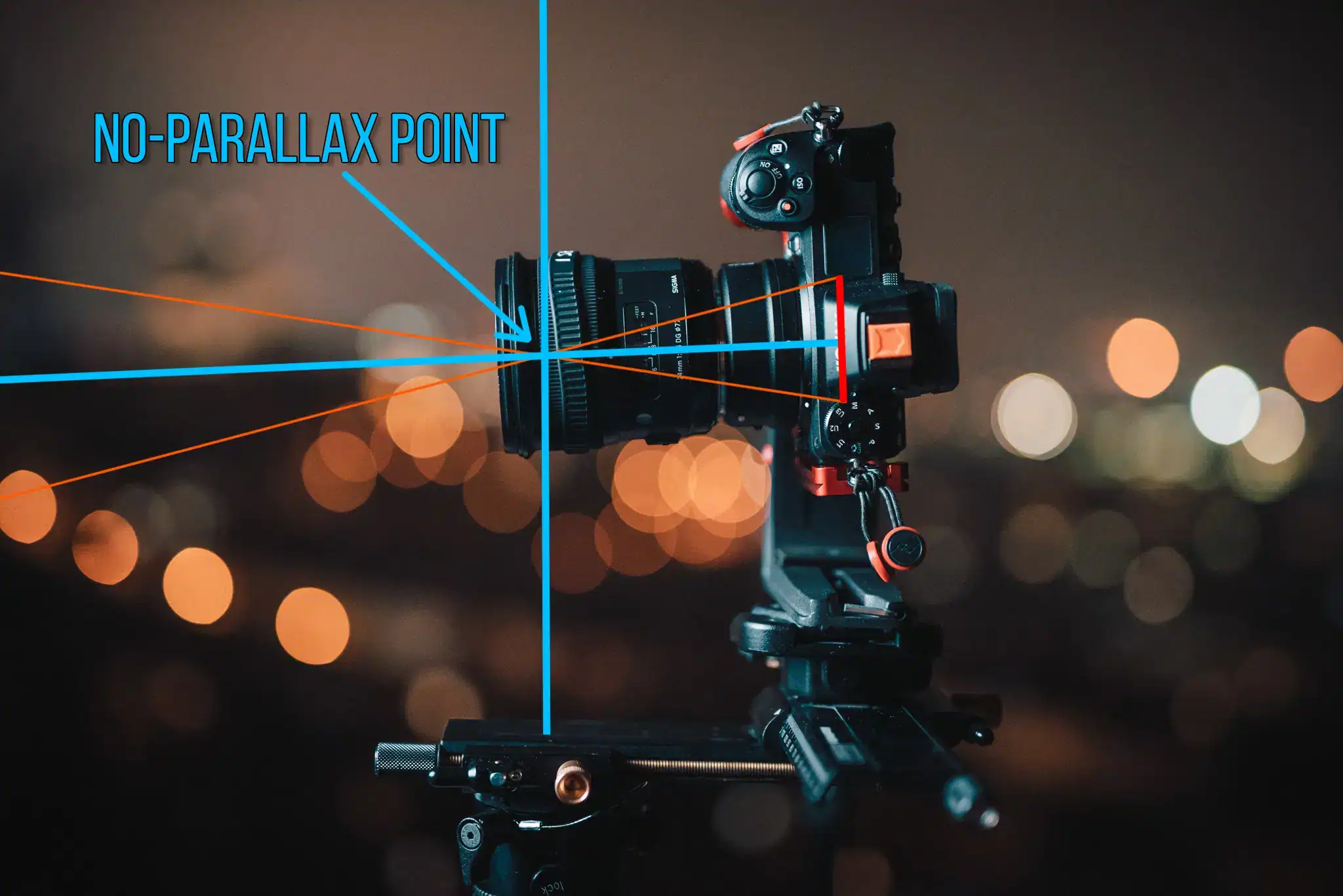
- Level and align: Level the tripod. On your panoramic head, slide the camera so the rotation occurs around the lens’s entrance pupil. Test by framing a close object against a distant edge; rotate left/right. If their relative position shifts, adjust fore‑aft until it doesn’t.
- Manual exposure and white balance: Meter a mid‑tone in the scene. Set M mode (e.g., f/8, shutter for proper exposure, ISO 100–200 daylight). Lock white balance (Daylight/Tungsten) to prevent color shifts across frames.
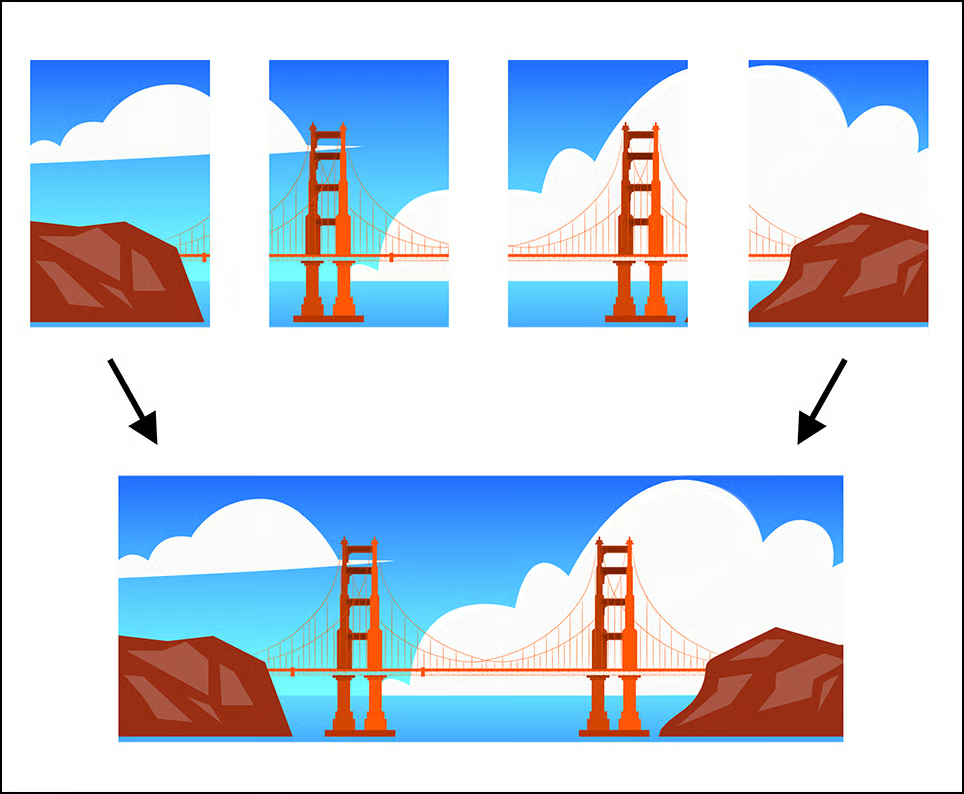
- Capture pattern: At 17mm, shoot 3 rows (+35°, 0°, −35°) with 8 shots per row at ~45° increments; add a zenith and a nadir shot. Aim for 20–25% overlap. At 24–28mm, increase shots per row or add a row to ensure full coverage.
- Nadir capture: After main rows, tilt the head down to shoot the ground plate for tripod removal later. If the tripod blocks, take a separate handheld nadir from slightly offset and patch in post.
HDR / High Dynamic Range Interiors
- Bracket ±2 EV (3–5 frames per angle) to hold window highlights and interior shadows. For very bright scenes, consider ±3 EV.
- Lock WB and focus. Use continuous bracket mode to speed up sequence and keep movement minimal between brackets.
- Merge HDR first (per position), then stitch the HDR frames into the panorama. This reduces seam mismatches from tone mapping.
Low-Light / Night Scenes
- Use tripod and remote. Start around f/5.6, ISO 200–800, and a shutter speed as needed (1–10 s) depending on wind and subject motion.
- Disable image stabilization if your lens/body has it; the 6D/6D Mark II have no IBIS, and the Tamron 17–28 lacks VC, so this is usually moot. For EF lenses with IS, turn it off on a tripod.
- Take a second full pass; long exposures increase the chance of a missed frame due to shake or stray light.
Crowded Events
- Two-pass method: First pass quickly for coverage; second pass wait for gaps in foot traffic. You can mask people later.
- Favor faster shutter (1/200–1/500) at f/5.6–f/8 and ISO 400–800 to freeze motion in key frames.
- Plan seams where motion is minimal (e.g., open floor, plain wall).
Special Setups (Pole / Car / Drone)
- Pole: Keep the pole vertical with a small bubble level. Use a light camera bracket and a safety tether. Minimize rotation speed; let vibrations settle before each exposure.
- Car: Use rigid suction mounts on clean panels; attach safety straps to structural points. Avoid highways; shoot in controlled, low‑traffic areas and obey local laws.
- Drone: For 6D/6D II this is impractical due to weight; if you need airborne panos, use a drone with spherical pano mode instead.
Recommended Settings & Pro Tips
Exposure & Focus
| Scenario | Aperture | Shutter | ISO | Notes |
|---|---|---|---|---|
| Daylight outdoor | f/8–f/11 | 1/100–1/250 | 100–200 | Lock WB to Daylight; aim for 20–25% overlap |
| Low light/night | f/4–f/5.6 | 1/30–8 s (tripod) | 200–800 | Remote trigger; turn off IS on EF lenses |
| Interior HDR | f/8 | Bracket ±2 EV | 100–400 | HDR merge first, then stitch |
| Action / moving subjects | f/5.6–f/8 | 1/200+ | 400–800 | Two-pass capture to manage motion |
Critical Tips
- Focus: Use manual focus at or near the hyperfocal distance for the chosen focal length and aperture (e.g., ~1.2–1.5 m at 17mm f/8 on full frame). Take a test frame at 100% to confirm corner sharpness.
- Nodal calibration: With your pano head, align fore‑aft so near/far edges don’t shift during yaw. Mark the rail position for 17mm, 24mm, and 28mm to speed future setups.
- White balance lock: Mixed lighting can cause visible seams. Set a Kelvin value or a preset and stick to it for the whole spin.
- RAW capture: Always shoot RAW for cleaner highlight recovery and consistent color across frames, especially when blending HDR.
- Drive mode: Use 2‑sec timer or remote shutter. On multi‑row panos, enable beep off and review off to speed the cycle.
Stitching & Post-Processing
Software Workflow
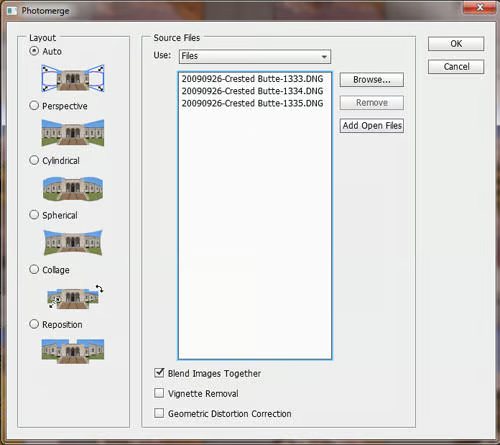
Import RAWs into Lightroom (or similar) for baseline corrections: lens profile, chromatic aberration removal, consistent WB and exposure. For HDR, merge brackets per position first. Then stitch in PTGui or Hugin. Rectilinear ultra‑wides like 17–28mm need more frames than fisheyes but retain straight architectural lines. Industry overlap guidelines: about 25–30% for fisheye, ~20–25% for rectilinear lenses, with more overlap in low‑texture scenes. For precision control, PTGui’s optimizer, masking, and vertical line constraints help keep walls straight and horizons level. For a review of PTGui’s strengths in pro workflows, see this overview by Fstoppers at the end of this paragraph. Why PTGui excels for complex panoramas.
Cleanup & Enhancement
- Nadir patch: Export a layered file and patch the tripod with a clone/heal pass, or use a logo/AI patcher.
- Color and noise: Apply gentle noise reduction to shadows; keep detail for zoom‑ins. Maintain consistent color across rows.
- Leveling: Use vertical lines and horizon controls to fix roll/yaw/pitch. Set the panorama’s horizon for natural viewing.
- Output: Export equirectangular 2:1 JPEG (8–12k wide for web) or 16‑bit TIFF for archival/print. For VR platforms, follow their maximum texture and file size guidance.
For a deeper dive on spherical pano math and expected resolution with different focal lengths and sensors, Panotools maintains a useful reference. Understanding spherical resolution for DSLRs.
Video: A concise walkthrough of shooting and stitching panoramas (multi‑row concepts apply directly).
Useful Tools & Resources
Software
- PTGui panorama stitching (masking, HDR, viewpoint correction)
- Hugin (open‑source alternative with robust control points)
- Lightroom / Photoshop (RAW prep, cleanup, nadir patch)
- AI tripod removal tools (for faster nadir patches)
Hardware
- Panoramic heads: Nodal Ninja, Leofoto, Really Right Stuff multi‑row rigs
- Carbon fiber tripods (stable, lighter for travel/poles)
- Leveling bases (Manfrotto, Leofoto, Sunwayfoto)
- Wireless remotes / intervalometers
- Pole extensions / car suction mounts with safety tethers
If you’re new to pano heads and nodal alignment, this illustrated tutorial is a great starting point. Panoramic head setup basics. For professional best practices on head setup and 360 photo pipelines, the Oculus creator guide is also excellent. Set up a panoramic head for high‑end 360 photos.
Real‑World Scenarios & Field Advice
Indoor Real Estate
Use 17–20mm to minimize distortion on walls and keep verticals straight. Shoot at f/8, ISO 100–200 with HDR ±2 EV to balance window highlights. Turn off ceiling fans and request people step back during the spin. Place the tripod near the room’s visual center to reduce perspective extremes.
Outdoor Sunset
Meter for the sky and bracket ±2 EV to protect highlights. Shoot quickly as light changes every minute. Lock WB around 5600–6000K so the sky color matches across frames. Wind can vibrate lighter tripods—hang a small weight from the center column.
Event Crowds
Expect motion. Plan seams along low‑detail regions (carpet, sky). Use faster shutter (1/200–1/500) and shoot two passes. If a person stands in one frame only, you can mask them out using a similar region from your second pass.
Rooftop / Pole Shooting
Safety first: add tethers, avoid overhangs, and check the load rating of your pole/tripod. Watch wind gusts; they amplify at height. Make smaller rotations and let vibrations die between exposures. Consider bumping ISO slightly to shorten shutter speeds for crisper frames.
Car-Mounted Capture
Only in safe, legal, controlled conditions. Secure mounts to clean, flat panels and use redundant straps. Park and shoot stationary for the full sphere to avoid parallax from moving subjects. Rolling captures are better suited to specialized rigs and 360 action cams.
Common Mistakes & How to Avoid Them
- Parallax error → Align the entrance pupil precisely and verify with a near/far test before shooting.
- Exposure flicker → Manual exposure and locked WB for the entire sequence.
- Missed coverage → Use a capture checklist (row angle, number of frames, zenith, nadir) and consider a second pass.
- Ghosting from movement → Two‑pass method and post‑masking in PTGui/Photoshop.
- Night noise → Keep ISO modest (200–800), extend shutter, and use remote release.
Frequently Asked Questions
- Can I shoot handheld panoramas with the Canon EOS 6D/6D Mark II?
Yes for single‑row landscapes, but for 360×180 spheres handheld is risky due to parallax and leveling issues. Use a tripod and pano head for interiors or anything with near‑field objects. Handheld can work outdoors with distant subjects, but expect more stitching cleanup.
- Is the Tamron 17–28mm f/2.8 wide enough for a single‑row 360?
No. With rectilinear 17–28mm on full frame, you’ll need multiple rows to cover zenith and nadir completely. At 17mm, plan for about 3 rows of 8 frames plus zenith and nadir.
- Can I mount the Tamron 17–28mm Di III RXD on a Canon 6D/6D Mark II?
Not practically. It’s a Sony E‑mount lens and there is no reliable E‑to‑EF DSLR adapter. Use an EF‑mount ultra‑wide with similar focal lengths (e.g., Canon EF 16–35mm). The workflow and settings here still apply.
- Do I need HDR for interiors with bright windows?
Usually yes. Bracket ±2 EV (or more for bright exteriors) to preserve window detail and interior shadows, then HDR‑merge per camera position before stitching.
- What ISO range is safe on these cameras for low light?
For high‑detail panos, keep ISO as low as feasible: ISO 100–400 ideal, 800 acceptable. The 6D and 6D Mark II can go higher, but noise and color fidelity suffer when viewers zoom in.
- Can I create Custom Modes for pano shooting?
Yes. Program a C1 or C2 with M mode, your typical f/8, ISO 100, fixed WB, manual focus, self‑timer or remote, and drive mode for brackets. It speeds setup on location.
- How do I avoid flare with an ultra‑wide at sunset?
Shade the lens with your hand or flag, avoid pointing directly at the sun across multiple frames, and use a consistent hood. If flare appears in only a few frames, mask them with cleaner frames from a second pass.
- What’s the best tripod head for this setup?
A multi‑row panoramic head with fore‑aft and vertical sliders (e.g., Nodal Ninja, Leofoto) allows precise entrance pupil alignment and easy zenith/nadir coverage. Add a leveling base for faster setup.
Safety, Limitations & Trustworthy Practice
Be candid about gear limits: the Tamron 17–28 Di III RXD is not EF‑mount, so pair your Canon 6D/6D II with an EF ultra‑wide instead. Always secure your rig in crowds, on rooftops, and on vehicles. Keep a duplicate pass for backup coverage and maintain a simple folder structure (Scene/Row/Frame) for easy recovery if a frame goes missing. For additional guidance on panoramic head setup and DSLR-based 360 pipelines, see these respected resources: DSLR virtual tour FAQ and lens guide.