Why This Camera & Lens Are Great for Panoramas
If you want clean, high-resolution 360° panoramas with natural perspective, a full-frame Canon body like the EOS 6D or 6D Mark II paired with a fast 14mm rectilinear prime is an excellent formula. The 6D series offers forgiving low-light performance, large pixels, and reliable manual controls—key advantages for tripod-based panorama work. The Sony FE 14mm f/1.8 GM is one of the sharpest ultra-wides available, with superb corner performance, low coma, minimal chromatic aberration, and excellent light transmission; it’s a fantastic focal length for single-row or two-row 360° captures.
Important compatibility note: The Sony FE 14mm f/1.8 GM is a native Sony E-mount lens, while the Canon EOS 6D and 6D Mark II use the Canon EF mount (DSLR). Due to flange distance, there is no practical adapter to mount an FE lens on EF bodies. To follow this guide on a 6D/6D Mark II, use a comparable EF-mount rectilinear ultra-wide such as the Canon EF 14mm f/2.8L II, Sigma 14mm f/1.8 Art, or Samyang/Rokinon 14mm f/2.8. All settings, overlap, and workflow below apply directly to those EF alternatives and are optically equivalent for panorama technique.
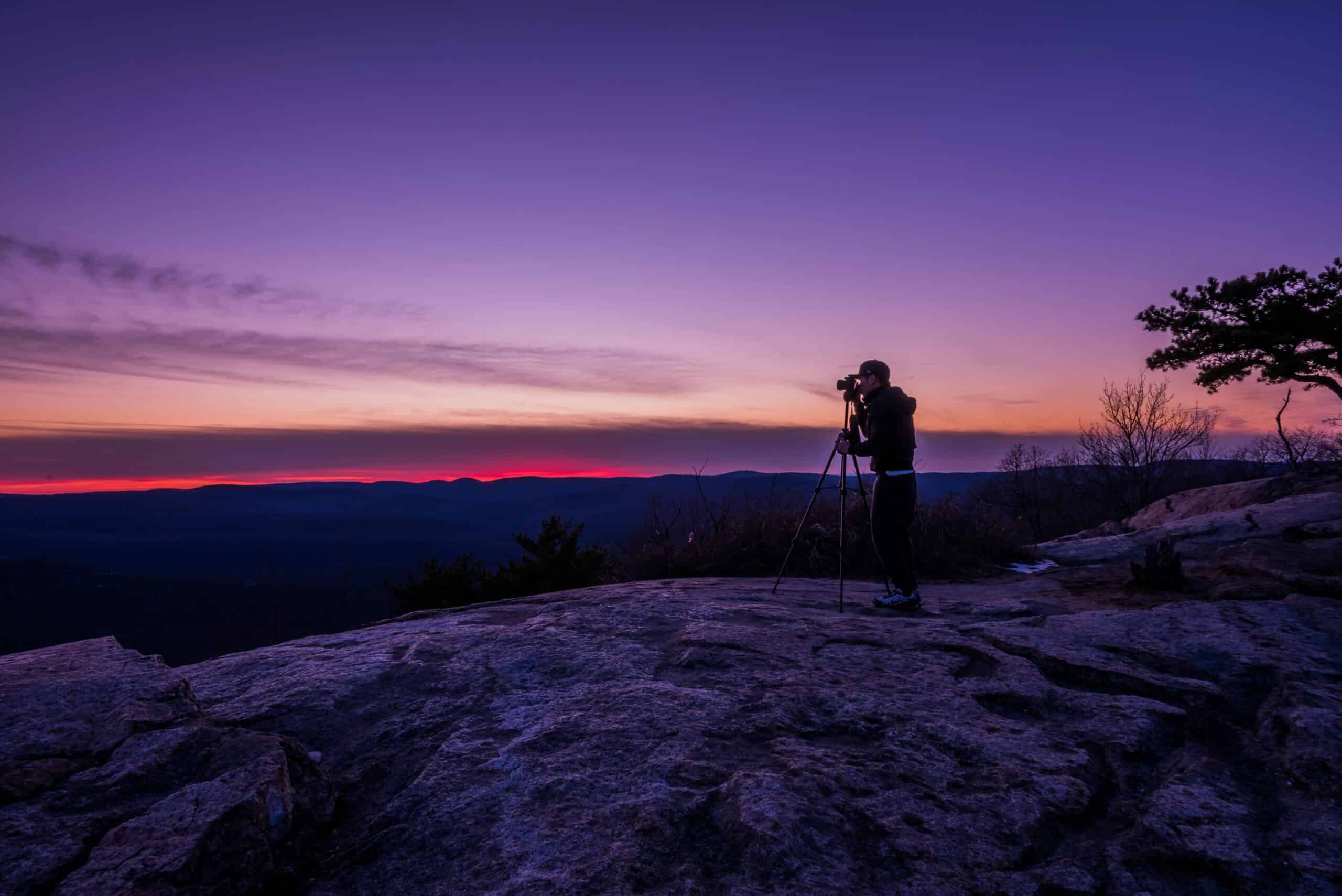
Why a 14mm rectilinear? On full frame, 14mm gives a very wide field of view (~104° horizontal) without the characteristic fisheye distortion. It requires more frames than a fisheye, but produces a natural, distortion-free look ideal for architecture, real estate, and landscapes. With a calibrated panoramic head, you can cover 360×180° with 6–8 images around plus zenith and nadir shots, yielding high detail and minimal stitching errors.
Quick Setup Overview
- Camera: Canon EOS 6D (20.2MP full-frame, ~6.55µm pixel pitch) or EOS 6D Mark II (26.2MP full-frame, ~5.76µm pixel pitch). Dynamic range at base ISO ~12 EV; clean ISO to 800–1600 for pano work if well exposed.
- Lens: Sony FE 14mm f/1.8 GM (rectilinear ultra-wide, very sharp from f/2–f/8, low coma/CA). For EF mount use Canon EF 14mm f/2.8L II, Sigma 14mm f/1.8 Art, or Samyang 14mm f/2.8 instead with identical shooting approach.
- Estimated shots & overlap (full-frame, lens in portrait on a pano head):
- Speed set: 6 around at ~60° yaw steps, +1–2 zenith, +1 nadir (25–30% overlap).
- Safe set: 8 around at 45° yaw steps, +2 zenith, +1–2 nadir (30%+ overlap). Recommended for interiors.
- Difficulty: Intermediate. Very approachable with a calibrated panoramic head.
Planning & On-Site Preparation
Evaluate Shooting Environment
Scan the scene for moving elements (people, cars, foliage) and reflective or refractive surfaces (glass, mirrors, polished floors). The wider the lens, the more likely you’ll catch bright light sources that can flare; plan camera orientation to keep strong lights off-axis. If you must shoot through glass, get the lens as close as safely possible (1–3 cm) and use a rubber lens hood to reduce reflections and ghosting.
Match Gear to Scene Goals
The EOS 6D/6D Mark II sensors deliver clean files at ISO 100–400; they also handle ISO 800–1600 well when properly exposed. Their large pixels and Canon’s “Silent LV” (electronic first curtain) help reduce micro-shake during long exposures—vital in low light. A 14mm rectilinear prime gives a natural perspective for architecture and landscapes. Compared to fisheye lenses, you’ll shoot more frames, but you’ll avoid the heavy defishing process and edge stretching that can degrade texture detail.
Pre-shoot Checklist
- Batteries charged; extra memory cards. The 6D/6D II have single card slots—consider periodic offloads or duplicate a “safety pass.”
- Clean front element and sensor; ultra-wide lenses reveal dust, flare, and smears.
- Tripod leveled; panoramic head pre-calibrated for the lens’ no-parallax point.
- Safety: If on rooftops or using a pole/car mount, tether your gear, watch wind gusts, and confirm all clamps/knobs are locked.
- Plan for a second full rotation as backup; it can save a job if one frame is blurred or blocked by passersby.
Essential Gear & Setup
Core Gear
- Panoramic head with fore–aft sliders and rotator detents. This lets you align the lens’ entrance pupil (no-parallax point) over the rotation axis, eliminating parallax errors and making stitches seamless.
- Stable tripod with a leveling base or half-ball bowl. Leveling the base (not the camera) ensures each yaw step stays true.
- Remote trigger or camera app. On Canon DSLRs, use a 2-sec self-timer or a wired remote; enable Silent Live View to reduce vibration.
Optional Add-ons
- Carbon fiber pole or car mount for unique viewpoints. Always use a safety line; check wind loading; keep car speeds low and avoid traffic.
- Small LED panels or bounce flash for dim interiors (bounce only; avoid direct hotspots that vary frame-to-frame).
- Rain covers and microfiber cloths. Ultra-wides pick up spray and drizzle instantly.
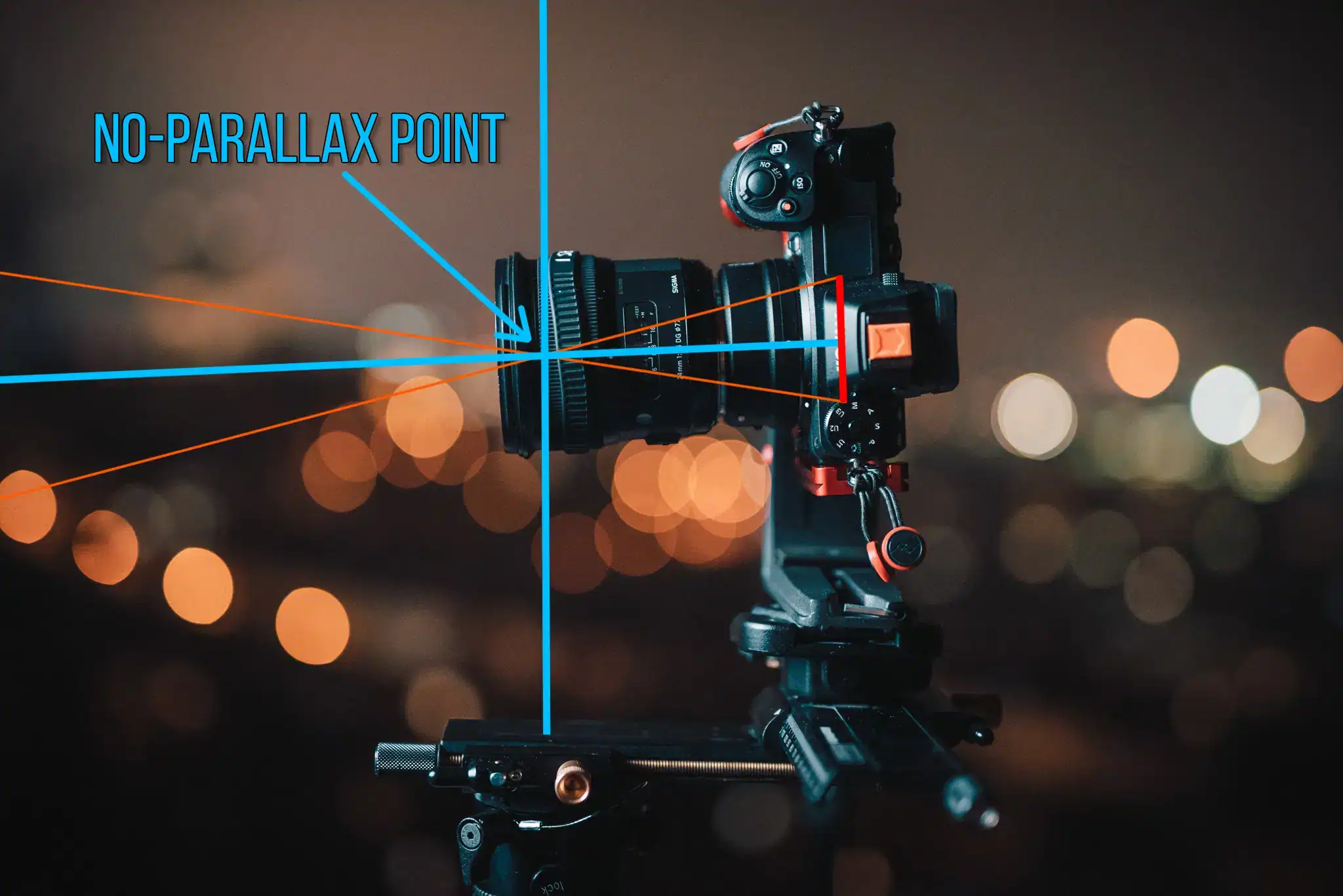
Finding the No-Parallax Point (Entrance Pupil)
Set two vertical objects (e.g., a light stand near and a pole far) and frame them overlapping near the edge. Rotate the camera on your pano head. Slide the lens forward/back on the rail until the two objects no longer shift relative to each other during rotation. Mark this position on your rail for repeatable setup. With rectilinear 14mm primes, the entrance pupil typically sits near the front element; exact position varies by lens design.
For a visual walkthrough of panoramic head alignment, this short video is a helpful primer.
Step-by-Step Shooting Guide
Standard Static Scenes
- Level the tripod and lock the leveling base. Mount the pano head and set the lens to the pre-marked entrance pupil position.
- Switch to Manual exposure, Manual white balance (e.g., Daylight or 5200K), and Manual focus. Use Live View at 10× to focus about one-third into the scene or set hyperfocal distance (at f/8 on 14mm full-frame, hyperfocal is roughly 1 m; focus ~1 m and everything from ~0.5 m to infinity will be sharp).
- Set aperture to f/8 for maximum sharpness across the frame with minimal diffraction; adjust shutter speed for exposure; keep ISO as low as possible (ISO 100–200 in daylight).
- Capture your around-the-horizon shots using detents (e.g., every 45° for 8 shots, or 60° for 6 shots). Ensure 25–35% overlap between frames.
- Pitch up 45–60° and capture 1–2 zenith shots; for complex ceilings, use two overlapping frames.
- Capture a nadir (down) frame for tripod removal. If the tripod blocks too much, take an offset handheld nadir and patch later.
HDR / High Dynamic Range Interiors
- Bracket ±2 EV (3 frames on EOS 6D; the 6D Mark II allows up to 7 frames, e.g., -3/-2/-1/0/+1/+2/+3 EV). Keep WB locked and focus fixed.
- Either pre-merge each view to an HDR DNG/TIFF before stitching, or use exposure fusion in PTGui. Be consistent across the entire rotation.
Low-Light / Night Scenes
- Use a tripod, Silent Live View (EFCS), and a remote/self-timer. Start at f/4–f/5.6, ISO 200–800, and adjust shutter speed accordingly. The 6D/6D II handle ISO 800–1600 well if you expose to the right.
- Turn off Long Exposure NR during capture to avoid delays; apply noise reduction uniformly in post.
Crowded Events
- Do two passes: first to establish coverage, second to catch gaps. Use faster shutter speeds (1/200+), ISO 400–800, and consider 8 around for more blend options.
- In post, mask moving people or vehicles using layers or PTGui’s masking tools.
Special Setups (Pole / Car / Elevated)
- Secure all clamps; tether camera/lens; limit exposure to wind. On a car, keep speeds very low and avoid traffic or pedestrians.
- Use higher shutter speeds (1/250+) to minimize vibration blur. Rotate more slowly, and overshoot overlap to help stitching.
Recommended Settings & Pro Tips
Exposure & Focus
| Scenario | Aperture | Shutter | ISO | Notes |
|---|---|---|---|---|
| Daylight outdoor | f/8–f/11 | 1/100–1/250 | 100–200 | Lock WB (Daylight/5200K). Use Silent LV to reduce shake. |
| Low light/night | f/4–f/5.6 | 1/30–1/60 (or longer on tripod) | 200–800 | Tripod + remote; avoid pushing ISO above 1600 unless necessary. |
| Interior HDR | f/8 | Bracket ±2 EV | 100–400 | Balance windows vs lamps. Merge to HDR DNG or use PTGui fusion. |
| Action / moving subjects | f/5.6–f/8 | 1/200+ | 400–800 | Freeze motion; shoot two passes for clean masks. |
Critical Tips
- Manual focus at or near hyperfocal keeps frames consistent and reduces breathing variations.
- Nodal calibration: mark your rail positions for your specific lens and orientation; repeatability saves time on location.
- White balance lock: avoid Auto WB; mixed color casts across frames are hard to fix uniformly.
- Shoot RAW for full dynamic range and consistent color grading across the panorama.
- Stabilization: The 6D/6D II bodies lack IBIS. If your EF lens has IS, turn it off on a tripod to avoid drift.
- Mirror vibration: Use Live View Silent Shooting (EFCS) or mirror lockup with a 2-sec timer to eliminate micro-blur.
Stitching & Post-Processing
Software Workflow
Import RAWs and apply global adjustments (lens profile off for consistent geometry during stitch, subtle sharpening, same WB). For HDR brackets, either pre-merge each angle to a single HDR file (consistent look), or load bracketed sets directly into PTGui/Hugin for exposure fusion. Rectilinear ultra-wide shots typically need 25–35% overlap. PTGui excels at complex panoramas and masking; Hugin is a capable open-source option. For E2E virtual tours, export a 2:1 equirectangular (e.g., 16000×8000) JPEG/TIFF suitable for viewers and platforms.
For software comparisons and workflow depth, see this PTGui review and best practices insights toward pro-grade stitching. PTGui review and tips on Fstoppers
Cleanup & Enhancement
- Nadir patch: capture an offset ground shot and use PTGui’s Viewpoint correction or clone in Photoshop. AI content-aware tools can speed this up.
- Color balance: unify tone and WB across the sky/ceiling. Use a gradient or local adjustments if needed.
- Noise reduction: apply moderate NR to shadow areas; avoid smearing fine textures like brick or foliage.
- Leveling: set horizon and verticals in your stitcher; correct roll/yaw/pitch until the panorama “feels” level in a 360 viewer.
- Export: deliver equirectangular JPEG (quality 90–95) for web VR; keep a high-bit TIFF master for archiving.
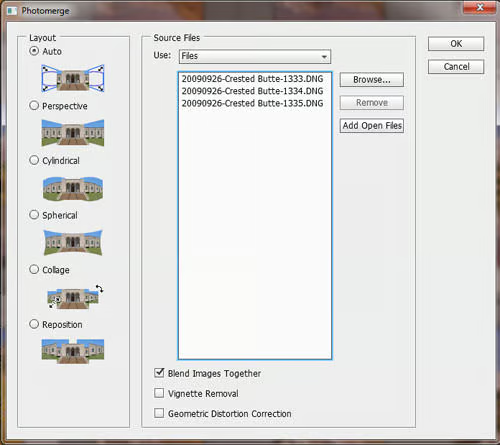
For a fundamentals refresher on panoramic techniques and focal length considerations, this guide is helpful. Panoramas, focal lengths, and Photoshop basics
Useful Tools & Resources
Software
- PTGui panorama stitching (industry standard for control and reliability).
- Hugin open source (great value, active community).
- Lightroom / Photoshop for RAW, HDR merge, and cleanup.
- AI tripod removal and content-aware fill for fast nadir patching.
Hardware
- Panoramic heads: Nodal Ninja, Leofoto, or similar modular rails and indexed rotators.
- Sturdy carbon fiber tripods with a leveling base or half-ball.
- Wireless remotes (Canon RS-80N3 equivalent or intervalometers).
- Pole extensions/car mounts—with safety tethers and rated clamps.
For a deeper dive into setting up a panoramic head, start with this practical tutorial. Panoramic head setup tutorial
For additional DSLR/Mirrorless 360 photo workflow guidelines, see this platform developer overview. DSLR/Mirrorless 360 capture and stitch guide
Common Mistakes & How to Avoid Them
- Parallax error → Properly align the entrance pupil on your pano head; re-check with near/far object test before every job.
- Exposure flicker → Use Manual exposure and locked WB across the entire rotation; avoid Auto ISO and Auto WB.
- Tripod shadows or self-appearance → Shoot a clean nadir and plan your position relative to the sun.
- Ghosting from movement → Overshoot overlap and use masking in the stitcher; consider two passes at different moments.
- Night noise and blur → Keep ISO moderate (≤1600 on 6D/6D II), use EFCS and a remote, and favor longer exposures over high ISO when on a tripod.
Field-Proven Scenarios
Indoor Real Estate
Mount on a leveled tripod in the room’s center or the most open corner. Shoot at f/8, ISO 100–200. Use HDR brackets ±2 EV to balance bright windows and interior shadows. Prefer 8 around for more overlap near door frames and wall edges; one zenith, one nadir. Patch nadir with an offset ground shot to remove the tripod cleanly.
Sunset Landscape
Golden hour and twilight require careful exposure. Meter for midtones, expose to the right without clipping highlights. Use f/8, ISO 100–200, and shutter as needed. If dynamic range is high, bracket ±2 EV. Consider a second full pass a few minutes later; sometimes the sky improves and you can blend in the best sky.
Crowded Event
Work fast: 1/200–1/400 at f/5.6–f/8, ISO 400–800. Use 8 around to give your stitcher more options to mask moving people. Make a second pass and pick the cleanest overlaps in post.
Rooftop or Pole
Safety first: tether everything, watch wind, and check all knobs. Use higher shutter speeds (1/250+), a slightly higher ISO if needed, and rotate slowly. Shoot an extra pass at the horizon level; elevated vibrations make redundancy pay off.
Frequently Asked Questions
- Can I mount the Sony FE 14mm f/1.8 GM on a Canon EOS 6D or 6D Mark II?
No. FE-to-EF adaptation isn’t practical due to flange distance. Use an EF-mount alternative (Canon EF 14/2.8L II, Sigma 14/1.8 Art, or Samyang 14/2.8) with identical pano technique.
- Is a 14mm rectilinear wide enough for single-row 360°?
Yes, in portrait orientation. Plan 6–8 shots around the horizon plus zenith and nadir. For complex ceilings or tight interiors, use 8 around and 2 zenith shots for safety.
- Do I need HDR for interiors with bright windows?
Usually. Bracket ±2 EV (3–7 frames depending on camera). Merge to HDR before stitching or use exposure fusion in PTGui for balanced results without halos.
- How do I avoid parallax issues?
Use a panoramic head and align the lens’ entrance pupil over the rotator axis. Verify with a near/far object test. Keep focus fixed and don’t change zoom (prime lenses are best).
- What ISO range is safe on the 6D/6D Mark II?
ISO 100–400 is ideal. ISO 800–1600 is very usable if you expose well and apply modest noise reduction. Prefer longer shutter speeds on a tripod over higher ISO.
- Can I shoot handheld panoramas with this setup?
You can for partial panos, but for 360×180° with clean stitches and interiors, a tripod and pano head are strongly recommended. Handheld requires faster shutter (1/200+), extra overlap (40%+), and careful panning.
- Should I set custom modes for pano?
Yes. Program C1 with Manual exposure, RAW, fixed WB, Silent LV, and 2-sec timer; C2 for HDR with AEB ±2 EV. This speeds up on-site workflow and avoids missed frames.
- How do I reduce flare with a 14mm?
Avoid pointing directly at bright lights. Shade the lens with your hand (keep it out of frame) or time the rotation so the sun is just off-axis. Clean the front element meticulously.
Safety, Reliability & Backup Practices
Wind and height multiply risk: use safety tethers and don’t extend center columns outdoors unless necessary. On rooftops, maintain distance from edges and secure bags. For car mounts, double up suction cups, inspect surfaces, and keep speeds very low. With single card slots in the 6D/6D II, implement redundancy: shoot a second rotation, carry duplicate cards, or offload to a backup device between rooms/locations. Consistent naming and an end-of-shoot checklist (frame count, coverage, and a quick PTGui test stitch on-site if possible) prevent costly reshoots.
For additional foundational advice from seasoned panoramic shooters, these resources are excellent starting points: Panorama best techniques discussion