Why This Camera & Lens Are Great for Panoramas
If you’re researching how to shoot panorama with Canon EOS 6D / 6D Mark II & Sony FE 12-24mm f/4 G, you’re likely aiming for ultra-wide, high-quality 360 photos with a dependable full-frame body. The Canon EOS 6D (20.2MP, full-frame, ~6.6µm pixel pitch) and the EOS 6D Mark II (26.2MP, full-frame, ~5.8µm pixel pitch) are known for excellent high-ISO performance and robust battery life—two things that matter when you’re shooting many frames per panorama. The Sony FE 12-24mm f/4 G is a rectilinear ultra-wide zoom with a sharp center, good flare resistance for a bulbous element, and practical f/4 brightness across the range, making it well-suited for interiors, architecture, and landscapes.
Important compatibility note: the Sony FE 12-24mm f/4 G is an E-mount lens designed for Sony mirrorless cameras and does not natively mount to Canon EF bodies (EOS 6D or 6D Mark II). There is no practical adapter that preserves infinity focus and automation from FE to EF. If you already own this lens, consider pairing it with a Sony full-frame body for capture and then follow the techniques below. If you must stay on the 6D/6D Mark II, use an equivalent EF-mount rectilinear ultra-wide such as the Canon EF 11-24mm f/4L, EF 16-35mm f/4L IS, EF 17-40mm f/4L, or Samyang/Rokinon 14mm f/2.8. The shooting workflow, nodal calibration, overlap, and stitching guidance in this article apply directly to all of these rectilinear options.
Why a rectilinear lens? Unlike fisheyes, rectilinear lenses preserve straight lines, which is ideal for architecture and real estate. The trade-off is you’ll need more shots to complete a 360×180 sphere. With a 12–16mm rectilinear on full frame, expect multi-row capture to cleanly cover zenith and nadir with safe overlap for stitching.
Quick Setup Overview
- Camera: Canon EOS 6D / 6D Mark II — Full-frame (36×24mm). 6D: 20.2MP (~6.6µm pixel pitch, strong high-ISO). 6D Mark II: 26.2MP (~5.8µm pixel pitch), faster Live View AF, slightly lower base-ISO DR but very capable for panoramas.
- Lens: Sony FE 12-24mm f/4 G — Rectilinear ultra-wide zoom, constant f/4, good central sharpness, moderate corner softness at 12mm wide open, mild distortion and CA that stitchers correct well. Compatibility note: Not natively mountable on EOS 6D/6D II; use a Sony body or pick an EF-mount alternative.
- Estimated shots & overlap (full-frame rectilinear):
- At 12mm: 3 rows × 6 shots around (approx. 60° pitch steps, 30% overlap) + 1 zenith + 1 nadir ≈ 20 shots total.
- At 16mm: 3 rows × 8 shots + 1 zenith + 1 nadir ≈ 26 shots.
- At 24mm: 4 rows × 10–12 shots + zenith + nadir ≈ 42–50 shots.
- Difficulty: Intermediate (multi-row alignment and careful nodal calibration required).
Planning & On-Site Preparation
Evaluate Shooting Environment
Assess lighting contrast, moving subjects, and reflective surfaces. For interiors, watch for mixed light (tungsten vs daylight) and large windows that may demand HDR. Outdoors, check the sun’s position and wind; wind-driven sway can ruin sharpness. If shooting near glass, keep the front element 5–10 cm away and slightly angle off-axis to reduce reflections and ghosting; use a black cloth to block side light if needed.
Match Gear to Scene Goals
The EOS 6D/6D Mark II sensors deliver clean files at ISO 100–400 for static tripod work; ISO 800–1600 remains usable if wind or crowds force faster shutters. The Sony FE 12-24mm f/4 G (or EF 11–24mm/16–35mm equivalents) is ideal for rectilinear 360 photos where straight lines matter—real estate, architecture, and cityscapes. A fisheye lens would cut shot count dramatically, but at the cost of distortion and edge stretching; since you’re likely targeting straight walls and ceilings, rectilinear is safer for professional results.
Pre-shoot Checklist
- Charge batteries, clear/format cards, clean lens and sensor. Ultra-wide angles make dust and smudges very visible.
- Calibrate your panoramic head for the lens’s no-parallax point (NPP) and pack an Allen key or coin for on-site tweaks.
- Level the tripod with a leveling base; correct leveling simplifies stitching and minimizes horizon fixing later.
- Safety: on rooftops, use a sandbag and tether the tripod; for car-mounted or pole work, secure a safety line and check wind loads.
- Backup workflow: when time allows, shoot a second full pass. It’s cheap insurance if a frame is soft or someone walked through.
Essential Gear & Setup
Core Gear
- Panoramic head: A multi-row pano head lets you place the lens’s entrance pupil (nodal point) exactly over the rotation axes, eliminating parallax. This is critical for stitching scenes with near objects (furniture, railings, tree branches).
- Stable tripod with leveling base: A leveling base lets you get the head perfectly level fast. Less frustration, more consistent overlap.
- Remote trigger/app: On the 6D/6D II, use a cable release, Canon Camera Connect, or a 2-second timer to avoid vibrations.
Optional Add-ons
- Pole/car mount: Great for crowded events and unique perspectives. Use a guy line and tether. Limit shutter speeds to 1/250s+ and shoot bursts to improve your odds.
- Lighting aids: Small LED panels or bounced flash for dim interiors (avoid creating hotspots on glossy surfaces).
- Weather protection: Rain covers, microfiber cloths, and a rocket blower. The bulbous front of ultra-wide lenses attracts droplets and dust.
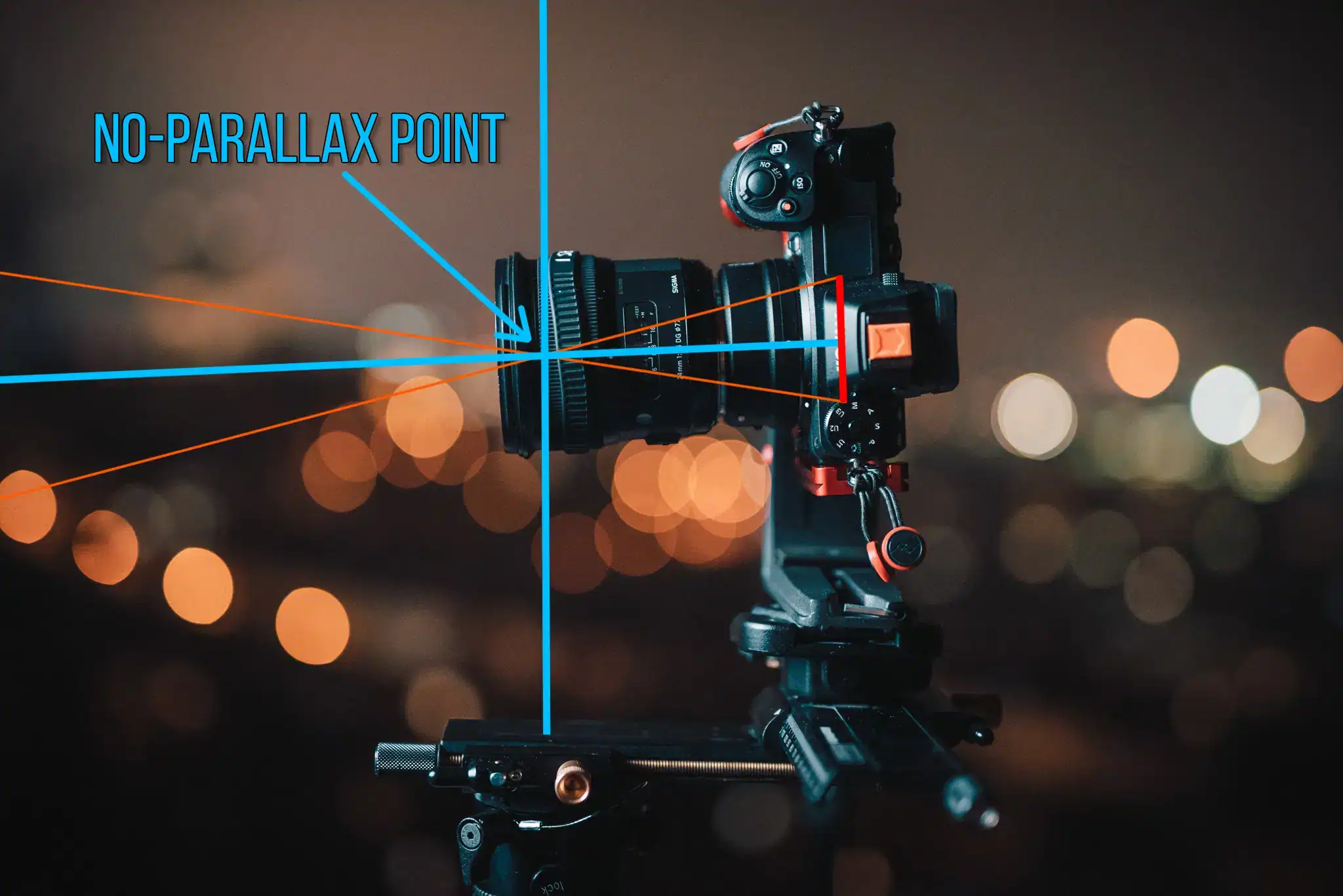
Need a deeper primer on nodal setup? This panoramic head walkthrough is a solid reference to visualize and test the no-parallax point alignment: Panoramic head tutorial.
Step-by-Step Shooting Guide
Standard Static Scenes
- Level tripod and align the nodal point: With a rectilinear lens at 12–16mm, parallax shows quickly. Place a light stand or pole close to the lens and align it against a distant feature in Live View. Rotate the rig; if alignment shifts, adjust the rail until foreground and background remain aligned.
- Manual exposure and locked white balance: Set Manual mode. Meter the mid-tones (not the brightest windows), then lock shutter, aperture, and ISO. Set WB to Daylight or a Kelvin value (e.g., 5200K) to avoid stitching color shifts.
- Focus: Switch to manual focus. At 12–14mm, f/8–f/11, set focus slightly past 0.7 m to cover near-to-infinity. The hyperfocal distance at 12mm/f8 on full frame is roughly 0.6 m; focusing just beyond ensures far subjects are sharp.
- Capture pattern: For 12mm, shoot three rows around at +60°, 0°, and −60° pitch, with 6 shots per row (about 60° yaw steps). Add one zenith (tilt up ~90°) and one nadir shot. Rotate consistently (clockwise) and mind overlap (~30%).
- Nadir capture for tripod removal: Tilt down and shoot the floor with a small lateral shift to patch the tripod footprint. Some shooters capture 2–3 nadir frames for easier patching.
HDR / High Dynamic Range Interiors
- Bracket ±2 EV, 3–5 frames per angle, to balance bright windows and interior shadows. Turn off Auto Lighting Optimizer and any exposure smoothing that changes exposure per shot.
- Keep WB locked and avoid flicker: Do not use Auto WB when bracketing; mixed WB across brackets creates stitching seams and inconsistent colors.
- Noise mitigation: On the 6D/6D II, ISO 100–200 is ideal on a tripod. If people are moving, ISO 400–800 is still clean; noise cleans up well after HDR merge.
Low-Light / Night Scenes
- Use longer exposures rather than high ISO: Start at f/5.6–f/8, ISO 100–200, and lengthen shutter to 5–15s if the scene is static. The 6D/6D II offer excellent long-exposure performance when properly supported.
- Stability: Use a remote or 2s timer, mirror lock-up (6D/6D II), and enable Live View to minimize mirror slap. Turn off any lens stabilization if present (most UWA primes/zooms here lack IS/OSS anyway).
- Wind management: Hang a small sandbag from the tripod apex, shield the lens with your body, and shoot a redundant row in case of vibration.
Crowded Events
- Two passes approach: First pass quickly for coverage, second pass waiting for gaps in foot traffic. Later, mask the best frames in post.
- Faster shutter: Aim for 1/200s+ at f/5.6–f/8, ISO 400–800, to freeze motion. Slightly reduce overlap to speed the rotation, but keep at least 25%.
Special Setups (Pole / Car / Elevated)
- Safety and tethers: Always tether pole or car mount; check wind loads. Keep the pole vertical using a bubble level. Avoid overhead power lines.
- Vibration control: Use burst mode and later pick the sharpest frame at each angle. For car mounts, park and let vibrations settle before shooting.
Recommended Settings & Pro Tips
Exposure & Focus
| Scenario | Aperture | Shutter | ISO | Notes |
|---|---|---|---|---|
| Daylight outdoor | f/8–f/11 | 1/100–1/250 | 100–200 | Lock WB (Daylight/5200K); watch flare around the sun |
| Low light/night | f/4–f/5.6 | 1/30–15s | 100–400 | Tripod, remote, mirror lock-up; disable long-exposure NR during brackets |
| Interior HDR | f/8 | Bracket ±2 EV | 100–400 | 3–5 bracketed frames; turn off Auto WB |
| Action / moving subjects | f/5.6–f/8 | 1/200+ | 400–800 | Shoot two passes, mask people later |
Critical Tips
- Manual focus at (or slightly beyond) hyperfocal distance: At 12mm/f8 on full frame, ~0.6–0.7 m covers almost everything to infinity.
- Nodal point calibration: Mark your rail position for 12mm and 16mm to speed setup. Slightly different focal lengths need different positions.
- White balance lock: Keep WB fixed per panorama to avoid tone shifts across seams, especially under mixed lighting.
- RAW shooting: For rectilinear UWA, RAW flexibility is critical to fix corner vignetting, CA, and color cast while preserving dynamic range.
- Stabilization: If your lens has stabilization, switch it off on a tripod to avoid micro-blur from IS motor corrections.
- Mirror lock-up and Live View: On EOS 6D/6D II, they reduce vibrations at slower shutters for tack-sharp frames.
Stitching & Post-Processing
Software Workflow
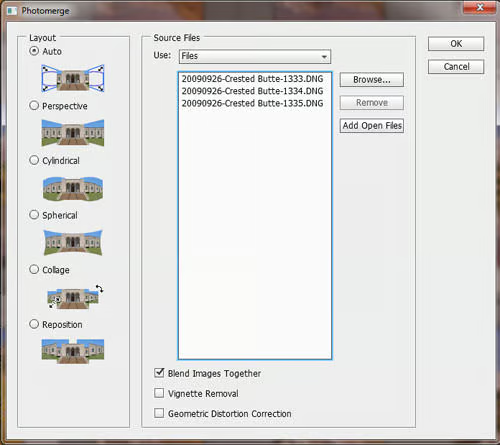
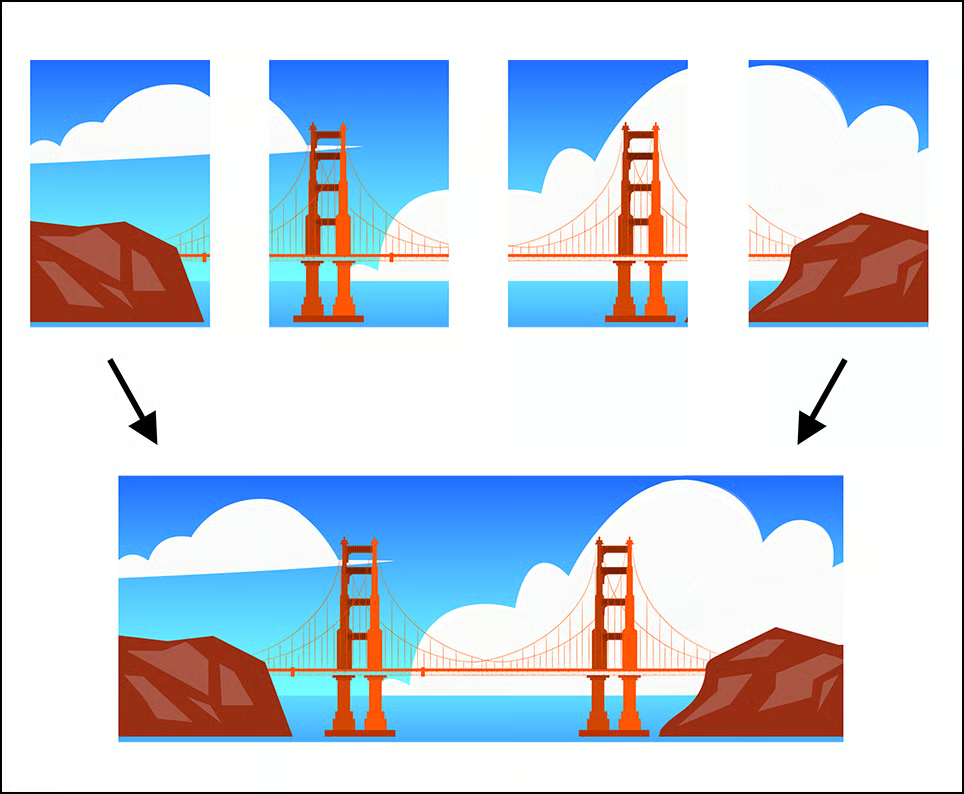
Ingest RAWs into Lightroom or your preferred editor and apply consistent baseline corrections (lens profile, CA removal, identical WB). Export 16-bit TIFFs (if merging HDR first, do the HDR merges per angle, then export). For stitching, PTGui is the industry standard due to its robust control point generation, masking, and horizon tools. Hugin is a powerful free alternative; Photoshop can stitch simpler single-row panoramas but struggles with complex multi-row 360s. Aim for ~25–30% overlap with wide rectilinear lenses. PTGui’s optimizer usually handles mild distortion and vignetting well. For background on why PTGui is favored by many pros, see this review: PTGui review on Fstoppers.
Cleanup & Enhancement
- Nadir patch: Use PTGui’s Viewpoint correction or patch the tripod in Photoshop/Affinity Photo. AI-based content-aware tools speed up clean results.
- Color correction and denoise: Apply uniform color grading and targeted noise reduction for shadow areas, especially in HDR panoramas.
- Horizon leveling: Use the stitching software’s roll/yaw/pitch tools. For architectural sets, align verticals for a natural look.
- Export: For VR, export an equirectangular 2:1 image (e.g., 12,000×6,000 px) as a JPEG or TIFF. Verify metadata for 360 viewers or virtual tour platforms.
For additional best practices on capturing and delivering DSLR 360 photos for VR, Meta’s guide is a helpful companion: Using a DSLR or mirrorless camera to shoot a 360 photo.
Useful Tools & Resources
Software
- PTGui panorama stitching (masking, control points, viewpoint correction)
- Hugin open-source stitcher
- Lightroom / Photoshop for RAW prep and retouching
- AI tripod removal or content-aware fill tools
Hardware
- Panoramic heads: Nodal Ninja, Leofoto, 3D-printed indexing rings for common focal lengths
- Carbon fiber tripods with leveling bases
- Wireless remote shutters or intervalometers
- Pole extensions and car suction mounts (with safety tethers)
Note: Check official documentation for current features and compatibility. This overview is based on field use and standard industry practices. For a concise Q&A-style primer on gear selection and 360 capture with DSLRs, this resource is also excellent: DSLR virtual tour gear guide.
Common Mistakes & How to Avoid Them
- Parallax error: Calibrate the nodal point and don’t change focal length mid-shoot. Keep near objects consistent across frames.
- Exposure flicker: Always use Manual exposure and locked WB. Don’t let auto ISO slip in.
- Tripod shadows and footprints: Shoot a dedicated nadir and patch it. Time your captures to avoid direct harsh shadows if possible.
- Ghosting from motion: Take two passes and mask the cleanest frames later. Increase shutter speed for crowds.
- Underlap: With rectilinear UWA, keep 25–30% overlap minimum, more if you have fine repeating textures (tiles, grids).
- Dirty front element: Ultra-wide lenses make dust and smudges obvious—inspect and clean every few shots.
Field-Proven Case Studies
Indoor Real Estate (Bright Windows)
Use 12–14mm at f/8 with ±2EV bracketing. WB fixed around 5000–5200K. Shoot 3 rows × 6 around, plus zenith/nadir. Merge brackets per angle before stitching to maintain consistent tone mapping. Mask window highlights if necessary. The 6D/6D II’s low ISO performance delivers clean base frames; don’t be afraid of 5–10 second exposures if the room is static.
Outdoor Sunset Cityscape
Shoot at ISO 100–200, f/8–f/11, bracket if you want sky and building detail. Wind is your enemy—stabilize the rig and shoot a duplicate row. Use flare-aware positioning; the Sony FE 12-24 (or EF 11-24) handles sun just outside the frame better than many UWA zooms.
Event Crowds (Street Festival)
Switch to faster shutters (1/200s+), ISO 400–800, and shoot two passes. Single-row won’t cover a full sphere at 12–16mm rectilinear; stick with multi-row but move quickly. Later, blend the frames with minimal motion blur. If you must shoot handheld, tilt your body instead of the camera to approximate nodal rotation, but expect more stitching cleanup.
Rooftop or Pole Capture
Secure everything: strap, tether, and sandbag. Use 1/250–1/500s, f/5.6–f/8, ISO 400–800. Shoot bursts and pick the sharpest frames. Consider fewer shots with higher overlap to reduce the time the rig is exposed to wind gusts.
Compatibility Caveat and Practical Alternatives
Because the Sony FE 12-24mm f/4 G is not mountable on Canon EF bodies, you have two practical paths:
- Use a Sony full-frame body with the FE 12-24mm and follow this guide exactly.
- Stay on the 6D/6D Mark II and choose an EF-mount ultra-wide: Canon EF 11-24mm f/4L (closest match), EF 16-35mm f/4L IS, EF 17-40mm f/4L, or Samyang 14mm f/2.8. The pano workflow, overlap, and nodal alignment remain the same; just recalibrate your nodal point for the chosen focal length.
If you’re optimizing shot count vs. resolution, consult spherical resolution charts to estimate final equirectangular size for your focal length and sensor: DSLR spherical resolution reference.
Frequently Asked Questions
- Can I shoot handheld panoramas with the Canon 6D / 6D Mark II?
Yes, for single-row or partial panoramas. For full 360×180 spheres with nearby objects, a tripod and panoramic head are strongly recommended. Handheld multi-row attempts often suffer parallax and alignment issues, especially with rectilinear lenses.
- Is the Sony FE 12-24mm f/4 G wide enough for a single-row 360?
No. At 12mm rectilinear on full frame, vertical coverage is around 90°, so a single row cannot cover zenith and nadir. Plan on at least three rows plus zenith and nadir for a full sphere.
- Do I need HDR for interiors with bright windows?
Usually yes. Bracket ±2 EV (3–5 frames) per angle to capture window detail and interior shadows cleanly. Merge HDR per view before stitching for consistent results.
- How do I avoid parallax issues with this setup?
Use a multi-row panoramic head and calibrate the no-parallax point at your chosen focal length (12, 14, 16mm). Mark the rail positions so you can reproduce the alignment quickly on location.
- What ISO range is safe on the EOS 6D/6D Mark II in low light?
On a tripod, stay at ISO 100–200 and use longer shutters for static scenes. If motion forces faster shutter speeds, ISO 400–800 remains clean; ISO 1600–3200 is usable with careful denoising.
- Can I set up Custom Modes (C1/C2) for pano work?
Yes. Store manual exposure, fixed WB, RAW, mirror lock-up, self-timer/remote settings, and Live View preferences to speed up on-site setup.
Safety, Care, and Backup Workflow
Ultra-wide rectilinear lenses often have large, protruding front elements. Use the built-in hood carefully and keep the cap on until the moment of shooting. Avoid placing the tripod where passersby can bump it; use a tether on rooftops and near edges. In rain or spray, carry a microfiber cloth and wipe between rows to keep droplets from ruining multiple frames.
Backup strategy: If the scene allows, shoot a second full pass. At home, back up to two locations (local SSD and cloud). Keep RAWs and exported 16-bit TIFFs from HDR merges so you can restitch later if software improves or a client needs a different projection. For additional practical tips on setting up high-end 360 photos with a pano head, refer to this concise guide: Set up a panoramic head for high‑end 360 photos.
Wrap-Up: Making the Most of Your Full-Frame Ultra-Wide
To master how to shoot panorama with Canon EOS 6D / 6D Mark II & Sony FE 12-24mm f/4 G, focus on fundamentals: precise nodal alignment, consistent manual exposure and white balance, and disciplined overlap. While the FE 12-24mm isn’t EF-compatible, the techniques here translate directly to EF ultra-wides that pair perfectly with the 6D/6D Mark II. With a calibrated panoramic head, a leveled tripod, and a proven stitching workflow in PTGui or Hugin, you’ll deliver sharp, artifact-free 360 photos for real estate, architecture, events, and VR experiences.