Why This Camera & Lens Are Great for Panoramas
The Canon EOS 6D / 6D Mark II paired with the Sigma 8mm f/3.5 EX DG Circular Fisheye is a proven, compact, and cost-effective kit for shooting fast, high-coverage 360° panoramas. On both cameras’ full-frame sensors (36×24 mm), the Sigma 8mm produces a circular image with a 180° field of view across the short dimension, letting you cover the entire sphere with just a few shots. Fewer frames means faster capture, fewer stitching seams, and less risk of ghosting in dynamic scenes.
Technical strengths that matter for panoramas:
- Sensor and resolution: EOS 6D at 20.2 MP (approx. 6.55 µm pixel pitch) and 6D Mark II at 26.2 MP (approx. 5.76 µm pixel pitch). Expect clean, detailed equirectangular outputs around ~9K–12K px wide when using 3–4 around shots with sensible overlap, depending on your stitch and output scaling.
- Dynamic range and ISO: 6D is well-regarded for low-light cleanliness; both bodies do well at ISO 100–1600 for critical work, with tolerable noise up to ~3200 when needed. For interiors with bright windows, bracket HDR to extend dynamic range.
- Handling: Big buttons, top LCD, and Canon ergonomics make it easy to lock exposure and white balance. The 6D Mark II adds a fully articulating screen and Dual Pixel AF for easy prefocus before switching to manual.
- Lens type: The Sigma 8mm is a circular fisheye. That means ultra-wide coverage and minimal shot count. Distortion is expected (and helpful!); you’ll harness fisheye projection in PTGui/Hugin, then output equirectangular.
- Compatibility: EF mount lens fits both 6D bodies directly. No adapters, no fuss.
Quick Setup Overview
- Camera: Canon EOS 6D / 6D Mark II — Full-frame (36×24 mm); 6D: 20.2 MP; 6D Mark II: 26.2 MP; excellent high-ISO behavior for a DSLR in this class.
- Lens: Sigma 8mm f/3.5 EX DG Circular Fisheye — circular fisheye, 180° FOV across the frame’s short edge. Sharpest around f/5.6–f/8; moderate lateral CA and flare if the sun or strong lights are near the frame.
- Estimated shots & overlap:
- Speed run: 3 around (120° yaw) + optional nadir (ground) shot. Works outdoors with distant subjects.
- Reliable: 4 around (90° yaw) + nadir. Recommended for interiors and close objects to improve coverage and control seams.
- Overlap target: ~30–40% between frames for robust control point generation.
- Difficulty: Easy to Moderate — the fisheye makes capture simple; careful nodal alignment and exposure control are the main skills.
Planning & On-Site Preparation
Evaluate Shooting Environment
Look for changing light, moving subjects, reflective surfaces (glass, polished floors), and tight spaces. In interiors with glass, avoid placing the camera too close to reflections; a bit of distance reduces flare/ghosting and makes masking easier. Note the sun position outdoors—strong highlights near the edge of a circular fisheye frame can cause flare and low-contrast areas.
Match Gear to Scene Goals
This combo excels when you need fast coverage and minimal frames. The 6D/6D Mark II offer solid base ISO dynamic range; ISO 100–400 is pristine, 800–1600 is still very usable, and 3200 can save a night scene with careful noise reduction. The fisheye advantage is fewer shots (3–4 around), which is perfect for windy rooftops, crowds, or time-constrained real estate shoots. The trade-off is fisheye distortion and the circular footprint, but stitching software handles this easily.
Pre-shoot Checklist
- Power and media: Fully charge LP-E6/LP-E6N batteries; carry spares. Use fast, reliable SD cards (UHS-I is fine).
- Cleanliness: Wipe the fisheye’s front element meticulously; any smudge is magnified by the field of view. Check the sensor for dust.
- Tripod and pano head: Level the tripod. Calibrate the pano head to the lens’s no-parallax point before the job; mark your rail positions with tape for speed.
- Safety: On rooftops or poles, tether the rig, watch wind gusts, and avoid standing under the rig. For car mounting, check vibration damping and obey local laws.
- Backup plan: When possible, shoot a second full round at the end for redundancy. If bracketing HDR, verify that all brackets fired for every yaw angle.
Essential Gear & Setup
Core Gear
- Panoramic head: A nodal (entrance pupil) aligned head eliminates parallax by rotating the camera around the lens’s no-parallax point. This is fundamental for stitching clean seams, especially indoors or near objects.
- Stable tripod with leveling base: A leveling base or half-ball saves time. Keeping the vertical axis true means your yaw increments remain consistent.
- Remote trigger or Canon app: Use a 2s timer, wired remote, or Canon Camera Connect to avoid vibrations. Live View also helps by keeping the mirror up on the 6D/6D II.
Optional Add-ons
- Pole or car mount: Great for elevated or moving vantage points, but secure everything. Add a safety tether and mind wind; the circular fisheye sees everything, including flexing poles.
- Lighting aids: Small LED panels for dim interiors; bounce or practicals to lift shadows without altering the scene’s character too much.
- Weather gear: Rain covers, microfiber cloths, and silica packs. The fisheye’s bulbous front element needs extra care.
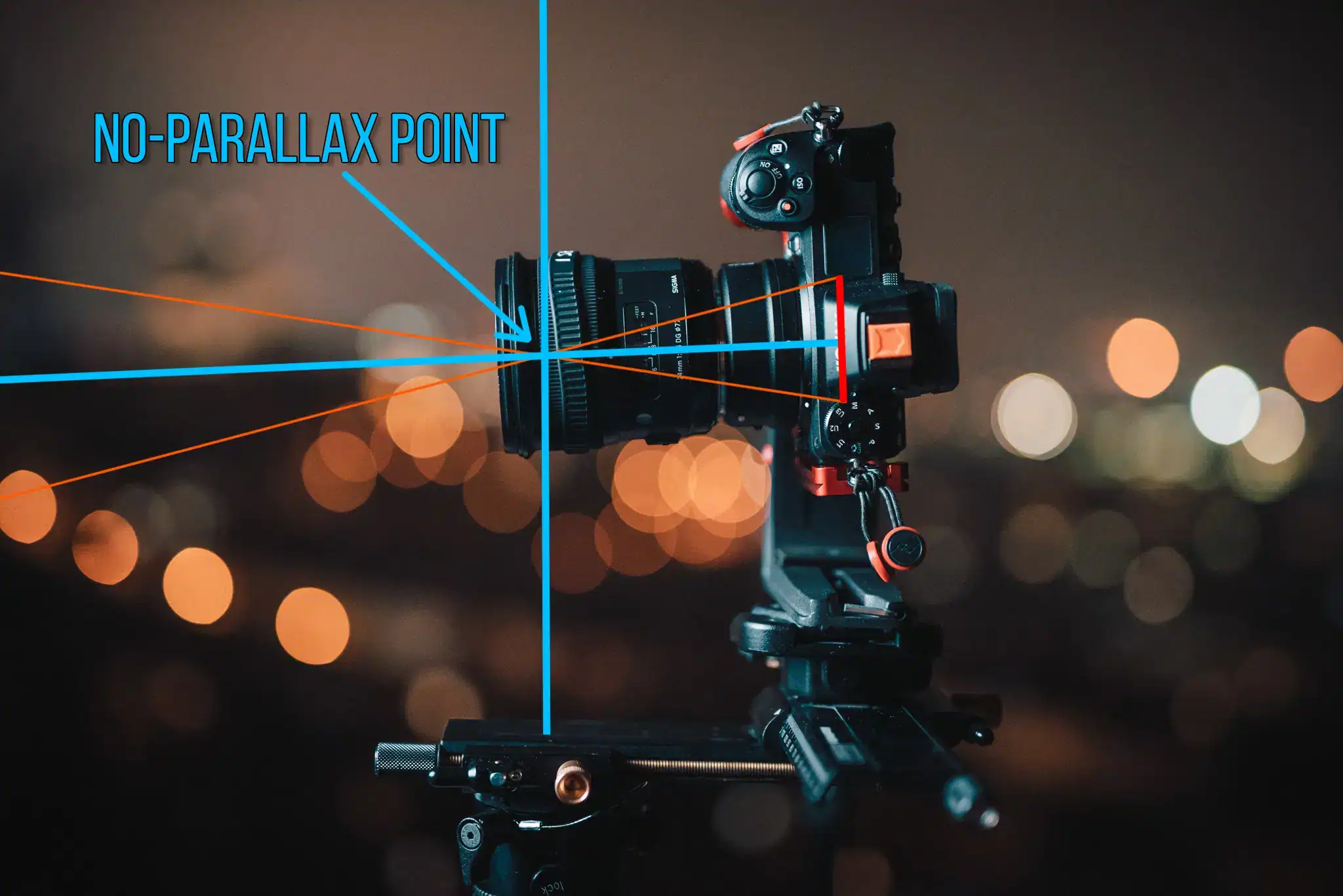
Video: Setting up a panoramic head
New to nodal alignment? This short video demonstrates the essentials of setting up a pano head for clean stitches.
Step-by-Step Shooting Guide
Standard Static Scenes
- Level tripod & align the nodal point: With the Sigma 8mm mounted, adjust the fore–aft slider so that nearby foreground objects do not shift relative to the background as you yaw the camera. Start with the rotation point roughly under the middle of the lens barrel; refine until parallax disappears. Mark this position with tape for repeatability.
- Manual exposure and locked white balance: Set M mode. Meter for the midtones and protect highlights. Lock WB to a Kelvin value (e.g., 5200K daylight, 3200K tungsten) or a custom reading to avoid color shifts across frames.
- Frame sequence and overlap: For speed outdoors, capture 3 frames at 0° pitch with 120° yaw increments. For interiors or near subjects, shoot 4 around at 90° yaw. Keep at least 30% overlap. Rotate smoothly and confirm that the circular image fully covers the horizon line in each frame.
- Take the nadir: After the around shots, tilt down and take a ground shot to patch the tripod later. If you can, offset the tripod slightly and take a second nadir to aid clean patching.
HDR / High Dynamic Range Interiors
- Bracket ±2 EV (3–5 frames): With bright windows and darker interiors, set AEB for ±2 EV in 3 or 5 frames. Keep ISO low (100–200) to minimize noise accumulation.
- Lock WB and focus: Avoid AF hunting between brackets. Prefocus using Live View, then switch to MF. Consistent color is crucial for clean HDR merges and stitches.
Low-Light / Night Scenes
- Long exposures at low ISO: On the 6D/6D II, ISO 100–400 produces the cleanest files. Use 1–10 seconds as needed at f/4–f/5.6. Enable mirror lockup or shoot in Live View to reduce vibrations.
- Stability: Use a remote trigger or 2s timer. Disable image stabilization if using an adapted IS lens (the Sigma 8mm has no IS). Hang a weight from the tripod for extra damping.
Crowded Events
- Two-pass strategy: First pass to ensure full coverage; second pass when people move to fill gaps. You can later mask between passes to minimize ghosting.
- Use 4 around for redundancy: More overlap gives your stitcher more options when aligning moving subjects.
Special Setups (Pole / Car / Drone)
- Pole: Keep rotations deliberate and smooth; let vibrations settle before shooting. Use a safety tether. A remote intervalometer helps for hands-free capture.
- Car mount: Plan safe routes and low speeds to minimize blur and vibration. Consider higher shutter speeds (1/250–1/500) and 4 around for reliability.
- Drone: This combo is DSLR-based and heavy; not practical for most drones. Use specialized gimbals if attempting, and follow regulations strictly.
Recommended Settings & Pro Tips
Exposure & Focus
| Scenario | Aperture | Shutter | ISO | Notes |
|---|---|---|---|---|
| Daylight outdoor | f/8–f/11 | 1/100–1/250 | 100–200 | Lock WB (daylight); use 3 around for speed |
| Low light/night | f/4–f/5.6 | 1/30–2s+ | 100–800 | Tripod, remote trigger; use Live View to minimize vibration |
| Interior HDR | f/8 | Bracket ±2 EV | 100–400 | Balance windows & lamps; 4 around + nadir |
| Action / moving subjects | f/5.6–f/8 | 1/200+ | 400–800 | Freeze motion; consider two-pass capture |
Critical Tips
- Manual focus at hyperfocal: At 8mm and f/8 on full frame, set focus just short of infinity (roughly 0.6–1 m) to keep near-to-far sharp. Use Live View at 10× to confirm, then tape the ring.
- Nodal calibration: Place two vertical objects (near and far). Pan left/right; adjust the fore–aft rail until the near object no longer shifts relative to the far one. Save this position for the Sigma 8mm on your 6D/6D II.
- White balance lock: Mixed lighting? Set a custom WB from a gray card or choose a Kelvin value and stick to it across the whole set.
- RAW over JPEG: Shoot RAW to preserve dynamic range and correct chromatic aberration and vignetting in post.
- Mirror lock & silent shooting: On the 6D/6D Mark II, use Live View or MLU + 2s timer to minimize shake. No IBIS on these bodies, so tripod discipline matters.
Stitching & Post-Processing
Software Workflow
Import RAWs, apply lens corrections (CA and vignetting), then stitch in a dedicated tool. PTGui is industry-standard for speed and reliability with fisheyes. Hugin is a powerful open-source alternative. With a circular fisheye, fewer images and strong overlap make control point generation straightforward. Aim for ~30–40% overlap and use a fisheye lens model in the stitcher. Export an equirectangular projection for virtual tours or 360 platforms.
For reference on resolution and coverage, see spherical resolution guidelines and field recommendations from the pano community. Panotools spherical resolution. For software choices and reviews, PTGui frequently tops practitioner lists for reliability. PTGui review on Fstoppers.
Cleanup & Enhancement
- Nadir patch: Use a dedicated nadir frame for an easy patch. Many editors (Photoshop, Affinity) and AI tools can remove tripods quickly.
- Color and noise: Equalize color casts between frames. Apply moderate noise reduction for high-ISO night scenes.
- Horizon leveling: In PTGui/Hugin, use vertical control points or the level tool to straighten the horizon and correct roll/pitch/yaw.
- Export: For the web/VR, export as equirectangular JPEG at 8K–12K width; for archival or high-end tours, keep 16-bit TIFF intermediates.
Want a deeper primer on DSLR 360 workflows and platform specifics? Oculus’s creator docs provide a clean overview. Using a DSLR to shoot and stitch a 360 photo.
Useful Tools & Resources
Software
- PTGui panorama stitching
- Hugin (open source)
- Lightroom / Photoshop for RAW and retouching
- AI tools for tripod/nadir removal
Hardware
- Panoramic heads (Nodal Ninja, Leofoto, Really Right Stuff)
- Carbon fiber tripods with leveling base
- Wireless remote shutters / intervalometers
- Pole extensions and car mounts (with safety tethers)
If you need a visual refresher on nodal alignment and pano head fundamentals, this tutorial is concise and practical. Panoramic head tutorial.
Common Mistakes & How to Avoid Them
- Parallax error → Align the entrance pupil precisely; verify with near/far objects before the shoot.
- Exposure flicker → Use manual exposure and locked WB; avoid auto ISO or auto WB mid-sequence.
- Tripod shadows or footprints → Shoot a nadir frame and patch; adjust your position slightly if the sun is causing hard shadows.
- Ghosting from moving subjects → Shoot a second pass and mask in post for clean results.
- Night noise and blur → Keep ISO modest (100–800), use longer shutters on a stable tripod, and trigger remotely.
- Flare with the fisheye → Shade the lens with your hand (kept outside the circular frame), and avoid pointing directly at strong point sources.
Frequently Asked Questions
-
Can I shoot handheld panoramas with the Canon EOS 6D / 6D Mark II?
Yes, but expect more stitching challenges. A circular fisheye reduces the shot count to 3–4 around, which helps, but without a nodal head you may see parallax seams in tight spaces. Handheld is fine for distant landscapes; for interiors, stick to a tripod and pano head.
-
Is the Sigma 8mm f/3.5 EX DG Circular Fisheye wide enough for a single-row 360?
Absolutely. That’s the point of a circular fisheye on full frame. Use 3 around (120° yaw) for speed or 4 around (90° yaw) + a nadir for robust coverage, especially indoors or near objects.
-
Do I need HDR for interiors with bright windows?
Usually yes. The 6D/6D II have decent dynamic range, but bright windows will often clip at a single exposure. Bracket ±2 EV in 3–5 frames, merge to HDR per angle, then stitch for the cleanest results.
-
How do I avoid parallax issues with this lens?
Use a calibrated pano head and rotate around the lens’s entrance pupil. Set up two vertical objects (near and far) and adjust the fore–aft slider until there’s no relative shift when panning. Save that position for the Sigma 8mm so you can repeat it quickly.
-
What ISO range is safe on the 6D / 6D Mark II for low-light panoramas?
For critical detail, stay ISO 100–400 and lengthen shutter. ISO 800–1600 remains usable with careful noise reduction. ISO 3200 can work in a pinch for events or moving scenes where shutter speed matters.
-
Can I set up Custom Shooting Modes (C1/C2) for pano work?
Yes. Save Manual mode, RAW, fixed WB, Live View, and your preferred aperture (e.g., f/8) to C1. Save an HDR/bracketing variant to C2. This speeds up switching between outdoor single exposure and interior HDR.
-
How can I reduce flare with a circular fisheye?
Avoid pointing directly toward the sun or bright lamps. Use your hand or a flag to block stray light (keep it outside the circular frame!). Clean the front element meticulously—tiny smudges can cause big veiling flare.
-
What’s the best tripod head for this setup?
A compact, well-marked nodal head (e.g., Nodal Ninja/Leofoto multi-row) with a leveling base. A ring clamp specific to fisheyes can simplify rotation, but a standard L-bracket on a fore–aft rail works well when properly calibrated.
Field-Proven Scenarios
Indoor Real Estate (Mixed Lighting)
Use 4 around + nadir, f/8, ISO 100–200. Bracket ±2 EV (3–5 frames) per yaw angle. Lock WB to a custom Kelvin to avoid color shifts. Merge HDRs first, then stitch. The 6D’s low read noise and the 6D Mark II’s extra resolution both deliver crisp equirects with clean window detail after HDR.
Outdoor Sunset (High Contrast)
For moving clouds, skip long HDR sequences; try a tighter 3-frame bracket at ±2 EV and 3 around for speed. Prioritize highlight protection—expose for the sky—then lift shadows in post. The Sigma’s flare susceptibility means shielding the sun during the most direct frames helps.
Crowded Event (People and Motion)
Shoot 4 around for redundancy. Use 1/200–1/500 at ISO 400–800 to freeze motion. Do two passes; in post, mask between frames to remove ghosts. A fisheye’s small shot count reduces the time people have to move between frames.
Rooftop / Pole Shooting
Wind is your enemy. Use a carbon tripod or stout pole, wait for gusts to pass, and add a tether. Shoot 3 around to minimize time aloft. The 6D/6D II’s Live View and 2s timer limit shake, and the Sigma’s large depth of field keeps focus locked at f/8.
Car-Mounted Capture
Plan a quiet route. Use high shutter speeds and 4 around. Keep overlap generous; vibrations can add micro-blur, so oversampling improves PTGui’s control point confidence.
Safety, Limitations & Trustworthy Practice
These DSLRs lack in-body stabilization; rely on a solid support and mirror management (Live View or MLU). The Sigma 8mm’s front element is exposed—use a lens cap when not shooting, keep a blower and microfiber handy, and avoid bumping into nearby objects in tight rooms. On rooftops or poles, tether your rig and keep clear zones under the camera. For paid work, always capture a backup round and verify your histogram before leaving the site.
For an additional structured overview of DSLR 360 workflows and gear considerations, see this practical guide covering cameras, lenses, and virtual tour needs. DSLR virtual tour camera & lens guide.