
Why This Camera & Lens Are Great for Panoramas
If you’re researching how to shoot panorama with Canon EOS 6D / 6D Mark II & Fujifilm XF 8-16mm f/2.8 R LM WR, you’re clearly aiming for high-quality, ultra-wide coverage with dependable image quality. The Canon EOS 6D and 6D Mark II are full-frame DSLRs prized for clean files, solid battery life, and stable long-exposure performance. The Fujifilm XF 8-16mm f/2.8 is one of the sharpest ultra-wide rectilinear zooms available, offering a 12–24mm full-frame equivalent field of view, fast f/2.8 aperture, and strong corner sharpness by f/5.6–8.
Important compatibility note: the Fujifilm XF 8-16mm is an X-mount APS-C lens that does not natively fit Canon EF mount (EOS 6D/6D Mark II). There are no practical adapters that preserve focus/aperture control or cover the full-frame image circle. You have two reliable paths:
- Path A (Canon-based): Use the 6D/6D Mark II with an EF-mount ultrawide rectilinear or fisheye lens (e.g., EF 8-15mm fisheye, EF 16-35mm, EF 11-24mm). All instructions below apply directly to your Canon body; shot counts are provided for similar focal lengths.
- Path B (Fujifilm-based): Use the XF 8-16mm on a Fujifilm X-series body (X-T/X-H). The shooting and stitching techniques are identical; we include tested shot counts for 8mm and 16mm on APS-C.
This article keeps the focus on the 6D/6D Mark II shooting workflow while giving specific guidance for the XF 8-16mm focal lengths on APS-C, so you can translate technique whether you stick with Canon or deploy a Fujifilm body to take advantage of the XF lens.
Quick Setup Overview
- Camera: Canon EOS 6D (20.2MP full-frame, ~6.55µm pixel pitch, ~12 EV DR at ISO 100) or EOS 6D Mark II (26.2MP full-frame, ~5.76µm pixel pitch, ~11.9 EV DR at ISO 100). Robust at ISO 100–800; ISO 1600 usable with careful exposure and NR.
- Lens: Fujifilm XF 8-16mm f/2.8 R LM WR (rectilinear APS-C; 12–24mm FF equivalent; excellent sharpness by f/5.6–f/8; minimal coma at f/4–f/5.6; some barrel distortion at 8mm corrected in software; large bulbous element, no front filters). Note: not mount-compatible with 6D bodies.
- Estimated shots & overlap (rectilinear ultrawide, 30% overlap recommended):
- APS-C 8mm (≈12mm FF equiv): 6 shots per row × 3 rows (+zenith +nadir) ≈ 20 shots total.
- APS-C 16mm (≈24mm FF equiv): 8 shots per row × 3 rows (+zenith +nadir) ≈ 26 shots total.
- Full-frame 16mm (e.g., EF 16-35 at 16mm): 6–8 shots per row × 3 rows (+zenith +nadir) ≈ 20–26 shots total.
- Difficulty: Intermediate — easier with a panoramic head; more shots than fisheye but straighter lines and cleaner architecture.
Planning & On-Site Preparation
Evaluate Shooting Environment
Look for changing light, moving people, reflective surfaces (glass, polished floors), and wind (for poles/roof). For glass, keep the lens as close as possible (1–3 cm) and shoot at a slight angle to reduce reflections and ghosting. In interiors with windows, anticipate extreme dynamic range and plan for HDR brackets.
Match Gear to Scene Goals
The EOS 6D/6D Mark II files are clean at low ISO and handle long exposures well. On these bodies, ISO 100–400 is optimal; ISO 800 is still strong, and ISO 1600 can work with careful exposure to the right and noise reduction in post. The Fujifilm XF 8-16mm (on a Fuji body) gives rectilinear straight lines—ideal for real estate, architecture, and virtual tours. Rectilinear lenses require more shots than fisheyes but avoid the characteristic fisheye bending and give natural-looking rooms.
Pre-shoot Checklist
- Charge batteries, clear and format cards, clean lens and sensor.
- Level your tripod; calibrate your panoramic head for the lens’s no-parallax point (NPP).
- Safety: assess wind, rooftop edges, and bystander movement; tether pole/camera when elevated.
- Backup plan: capture a full second pass; if time permits, shoot a nadir patch and an extra zenith.
Essential Gear & Setup
Core Gear
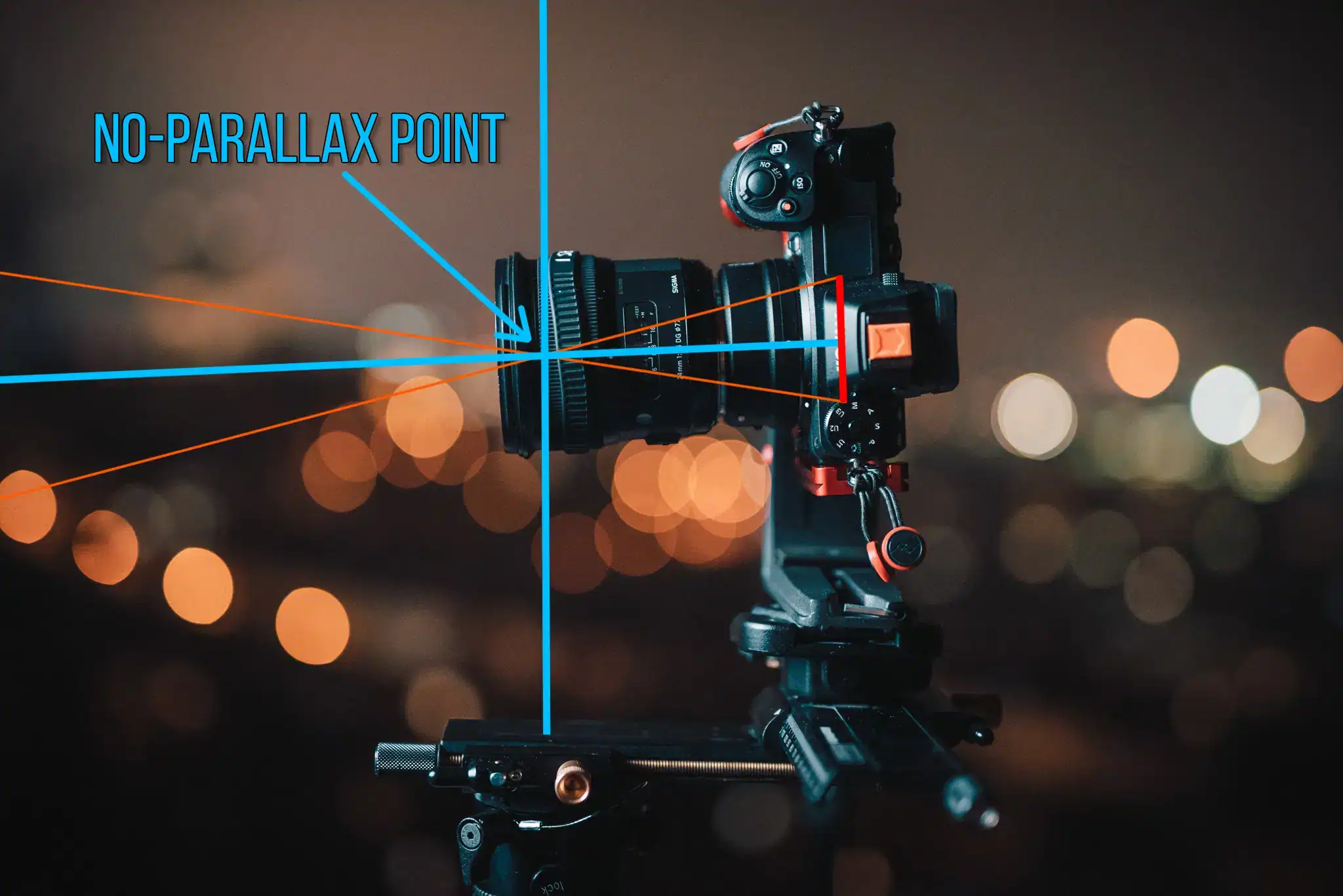
- Panoramic head: Aligns the lens’s NPP with the rotation axis to eliminate parallax when foreground/background overlap. This is crucial for clean stitches, especially with rectilinear lenses.
- Stable tripod with leveling base: A leveled yaw axis gives you clean horizons and less post-rotation.
- Remote trigger or app: Reduces vibration; use 2–s self-timer if a remote isn’t available.
Optional Add-ons
- Pole or car mount: Always secure a safety tether; avoid high winds. Keep rotation slow and deliberate to minimize vibrations.
- Lighting aids: Small LED panels or bounced flash for dark interiors (avoid mixed WB if possible).
- Weather protection: Rain covers and microfiber cloths; the XF 8-16mm is WR, but the Canon 6D series needs protection in heavy weather.
Step-by-Step Shooting Guide
Standard Static Scenes
- Level the tripod and align the nodal point. Place a near object (e.g., light stand) and a far object in the same line of sight. Rotate the camera—if the foreground shifts against the background, slide the lens on the rail until the shift disappears. Mark that rail position for both ends of your zoom (8mm and 16mm on APS-C; typical EF positions for your Canon ultrawide).
- Use manual exposure and lock white balance. Shoot a test at the brightest frame; set exposure so highlights aren’t clipped (check histogram). Lock WB (Daylight/Tungsten/Kelvin) to avoid color shifts across frames.
- Capture with the recommended overlap. For 12mm FF equiv (APS-C 8mm): 3 rows at pitches +35°, 0°, −35°; 6 frames per row at 60° yaw steps. Add a zenith (+90°) and a nadir (−90°) frame. For 24mm FF equiv (APS-C 16mm): 8 frames per row at 45° yaw steps (3 rows), plus zenith and nadir.
- Shoot a dedicated nadir. After the main sequence, tilt down and shoot the ground for tripod removal. If using a multi-row head, offset the camera slightly to capture a clean ground patch.
HDR / High Dynamic Range Interiors
- Bracket ±2 EV (3–5 exposures) to hold window highlights and interior shadows. Keep aperture fixed; vary shutter speed only.
- Keep WB locked across brackets. Mixed lighting can cause inconsistency otherwise; choose Kelvin (e.g., 4000–5000K for modern interiors) if unsure.
Low-Light / Night Scenes
- Use longer shutter speeds on a sturdy tripod. On 6D/6D Mark II, ISO 100–800 is ideal; ISO 1600 is acceptable with noise reduction. The XF 8-16mm at f/2.8 helps if you’re on a Fuji body, but for maximum sharpness stop to f/4–f/5.6 when possible.
- Use a remote trigger or 2–s timer and disable any stabilizer (most ultrawides used here lack OIS; 6D bodies do not have IBIS). Mirror lock-up can further reduce vibration on DSLRs.
Crowded Events
- Do two passes. First, shoot for coverage; second, wait for gaps to get clean plates. Keep the tripod in the exact same spot.
- In post, mask people between passes for a cleaner, less ghosted panorama.
Special Setups (Pole / Car / Drone)
- Secure all gear with a safety tether. For pole shots, keep the center of gravity aligned and add guy lines in wind. On cars, use vibration-damped suction mounts and drive slowly on even surfaces.
- Rotate slowly; use higher shutter speeds (1/250–1/500) if the platform vibrates, and increase ISO carefully to maintain exposure.
Want to see a professional panoramic head workflow? This clear walkthrough is worth watching:
Recommended Settings & Pro Tips
Exposure & Focus
| Scenario | Aperture | Shutter | ISO | Notes |
|---|---|---|---|---|
| Daylight outdoor | f/8–f/11 | 1/100–1/250 | 100–200 | Lock WB (Daylight); best corner sharpness |
| Low light/night | f/4–f/5.6 | 1/30–1/60 (or longer on tripod) | 400–800 (up to 1600 on 6D/6D II if needed) | Use remote/timer; expose to the right to tame noise |
| Interior HDR | f/8 | Bracket ±2 EV | 100–400 | Hold highlight detail in windows; consistent WB |
| Action / moving subjects | f/5.6–f/8 | 1/200+ | 400–800 | Short exposures; shoot two passes to aid masking |
Critical Tips
- Manual focus at the hyperfocal distance (around 1–2 m at 12–16mm and f/8 on APS-C; slightly longer on full-frame). Use magnified Live View to nail focus, then switch AF off.
- Nodal calibration: Mark your rail position for 8mm and 16mm (APS-C) or for your EF ultrawide focal. Re-check if you add filters or change focus distance significantly.
- White balance lock: Mixed lighting causes shifts; choose a fixed preset or Kelvin value and keep it constant.
- RAW over JPEG: You’ll gain headroom for HDR, WB correction, and noise reduction—key for clean 360 photos.
- Stabilization: 6D/6D Mark II have no IBIS; if your lens has OIS, switch it off on a tripod to prevent micro-blur.
Stitching & Post-Processing
Software Workflow
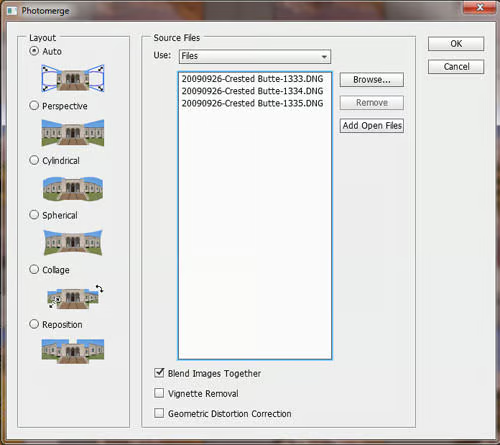
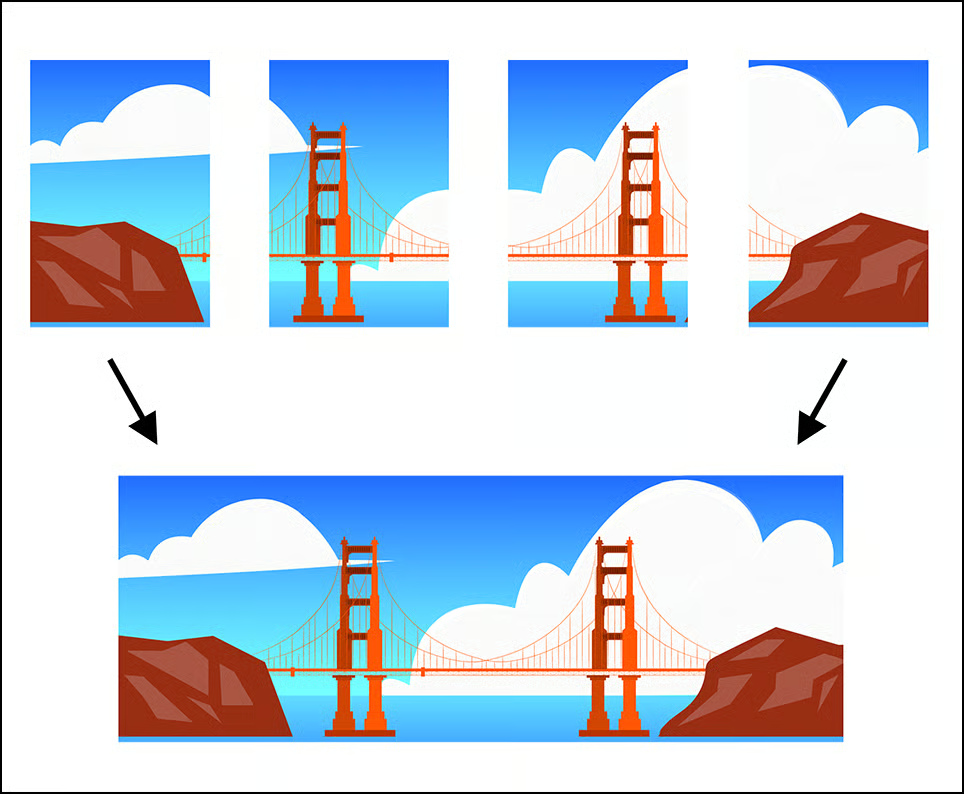
PTGui is the industry workhorse for 360 stitching—fast, accurate, and great with HDR brackets and control points. Hugin is a capable open-source alternative. Rectilinear ultrawides need more frames than fisheyes but produce straighter lines—ideal for real estate. Aim for ~30% overlap for rectilinear and ~25–30% for fisheye. Export equirectangular at 2:1 aspect for VR players (e.g., 12000×6000px for high-res tours).
Want a deeper dive on pro stitching workflows? See this field-tested PTGui review for when and why it outperforms others. PTGui review: strengths for complex panoramas
Cleanup & Enhancement
- Tripod/nadir patch: Capture a dedicated nadir, then patch with content-aware fill or a logo plate. Many AI tools accelerate this step.
- Color and noise: Match color across rows; apply mild luminance noise reduction to high-ISO frames; avoid over-sharpening edges.
- Level and horizon: Use roll/yaw/pitch controls in your stitcher; set verticals upright for architecture.
- Export: Create a 16-bit TIFF master; deliver JPEG equirectangular for web and keep a layered project file for revisions.
For a concise, step-by-step primer tailored to DSLR/mirrorless 360 workflows, review the official guidance here: Using a DSLR or mirrorless to shoot and stitch a 360 photo
Useful Tools & Resources
Software
- PTGui panorama stitching
- Hugin open source
- Lightroom / Photoshop for RAW and retouching
- AI tripod removal tools for fast nadir patches
Hardware
- Panoramic heads (Nodal Ninja, Leofoto, Fanotec)
- Carbon fiber tripods with leveling base
- Wireless remote shutters or intervalometers
- Pole extensions / car suction mounts (with safety tethers)
If you’re new to nodal alignment, this illustrated guide is a great starting point: How to set up a panoramic head
Disclaimer: software/hardware names provided for search reference; check official sites for specs and updates.
Field-Proven Scenarios
Indoor Real Estate (Low-Light + Windows)
Mount your Canon EOS 6D/6D Mark II on a leveled tripod with a panoramic head. Use f/8, ISO 100–200, and bracket ±2 EV at each yaw step. Turn off all automatic lens corrections in-camera (you’ll correct in RAW). Lock WB to a Kelvin value that fits the room’s dominant light. For glass walls, shoot with the lens close to the glass at a slight angle to minimize reflections. Expect 6–8 shots per row, 3 rows, plus zenith and nadir with rectilinear ultrawide.
Sunset Overlook (High Dynamic Range + Wind)
Wind is the enemy of sharp multi-row panoramas. Weigh down your tripod, use a 2–s timer, and consider a slightly faster shutter (1/125–1/250) with ISO 200–400. Take an extra pass to compensate for moving foliage; blend the cleanest pieces in post. Expose for the sky highlights; capture a 3–5 shot HDR bracket where the sun is in frame.
Event Floor (Crowds + Motion)
Time two passes: one for coverage and one for clean plates. Keep people-friendly shutter speeds (1/200+ if you prefer less motion blur) and ISO 400–800. Mask moving subjects later. If you must shoot handheld, keep elbows in, rotate around your body’s vertical axis, and overshoot overlap (40%+) to help the stitcher—but a tripod/head is still far superior.
Rooftop or Pole Shooting (Safety First)
Use a safety tether. Avoid gusty conditions. If you’re elevating the camera on a pole, shorten exposures (raise ISO carefully), add guy lines, and rotate slowly. Pre-mark your nodal settings so you can work fast before light changes.
Compatibility, Safety & Limitations
Compatibility: The Fujifilm XF 8-16mm f/2.8 is an X-mount APS-C lens and does not practically adapt to Canon EOS 6D/6D Mark II EF mount. To achieve the same look on your Canon, use an EF ultrawide rectilinear (e.g., EF 16-35mm) or a fisheye (EF 8-15mm) if you want fewer shots per panorama. If you own the XF 8-16mm, pair it with a Fujifilm X body to follow the same technique and shot counts included here.
Lens handling: The XF 8-16mm has a bulbous front element—use the fixed hood for protection; don’t set it down front-first. No front filter threads; mind rain and salt spray. Keep a microfiber cloth handy.
Safety: On rooftops or poles, always tether the camera. Do not overreach to capture the nadir. If wind picks up, stop and reassess. Consider shooting an extra safety sequence for backups.
Deep-Dive Reading
For a full virtual tour gear overview (DSLR vs fisheye vs ultrawide), this guide is well regarded: DSLR 360/virtual tour gear overview
Common Mistakes & How to Avoid Them
- Parallax error → Always align the lens’s no-parallax point with the rotation axis; re-check after changing focal length.
- Exposure flicker → Use full manual exposure and locked white balance across all frames.
- Tripod shadows and footprints → Capture a nadir frame or plan a logo patch.
- Ghosting from movement → Shoot two passes and mask in post; increase shutter speed when practical.
- Night noise → Use low ISO and long exposures on a tripod; expose to the right; apply selective noise reduction.
Frequently Asked Questions
- Can I mount the Fujifilm XF 8-16mm f/2.8 on a Canon EOS 6D/6D Mark II?
No. It’s an X-mount APS-C lens with no practical EF adapter that preserves focus/aperture and proper image circle. Use an EF ultrawide on your Canon, or use the XF lens on a Fujifilm X body.
- Is the XF 8-16mm wide enough for single-row 360 panoramas?
Not for full spherical coverage. At 8mm APS-C (≈12mm FF equiv) you’ll typically shoot 3 rows (about 6 frames each) plus zenith/nadir—around 20 total. A fisheye can reduce that to as few as 4–6 shots plus zenith/nadir, but with fisheye distortion that must be handled in stitching.
- Do I need HDR for interiors with bright windows?
Usually yes. Bracket ±2 EV (3–5 exposures) to capture window highlights and room shadows. Keep aperture and ISO fixed; vary shutter speed only.
- How do I avoid parallax issues?
Calibrate the no-parallax point on a panoramic head. Use a near object aligned with a far object and rotate—adjust the rail until relative movement disappears. Mark the rail for each focal length you use frequently.
- What ISO range is safe on the EOS 6D/6D Mark II for panoramas?
ISO 100–400 is ideal; ISO 800 remains very good; ISO 1600 is workable with careful exposure and noise reduction. For night interiors, prefer longer shutter times over pushing ISO.
- Can I set custom modes for panoramas on the 6D Mark II?
Yes. Program C1/C2 for pano: Manual exposure, fixed WB, RAW, mirror lock-up, 2–s timer or remote, and your preferred aperture (f/8) and ISO. This speeds up on-site setup.
- How can I reduce flare at 8–12mm equivalent?
Avoid strong backlight when possible. Shade the lens with your hand just outside frame. Slightly adjust yaw so the sun sits behind an object; clean the front element to reduce veiling flare.
- What’s the best tripod head for this setup?
A multi-row panoramic head with fore–aft and lateral rails (e.g., Nodal Ninja, Leofoto) lets you align the NPP and shoot multi-row with precision. A leveling base under the head saves time.
Bonus: Visual Aids
Conclusion
Learning how to shoot panorama with Canon EOS 6D / 6D Mark II & Fujifilm XF 8-16mm f/2.8 R LM WR boils down to three pillars: proper nodal alignment, consistent exposure/color, and enough overlap for robust stitching. While the XF 8-16mm isn’t compatible with Canon EF bodies, the techniques and shot counts here translate directly whether you switch to an EF ultrawide on your 6D/6D Mark II or use the XF zoom on a Fujifilm X body. Calibrate once, work methodically, and you’ll produce clean, high-resolution 360 photos ready for virtual tours and immersive presentations.