Why This Camera & Lens Are Great for Panoramas
If you want to learn how to shoot panorama with Canon EOS 6D / 6D Mark II & AstrHori 12mm f/2.8 Fisheye, you’ve picked a proven full-frame combo that’s both affordable and highly capable. The 6D (20.2MP, ~6.55μm pixel pitch) and 6D Mark II (26.2MP, ~5.76μm pixel pitch) deliver excellent high-ISO performance and solid dynamic range at base ISO—ideal for 360 photo capture where consistent exposure and low noise are critical. The larger pixel pitch on the 6D gives it a slight edge in very low light, while the 6D Mark II provides more resolution for fine detail in architectural scenes.
The AstrHori 12mm f/2.8 Fisheye is a manual-focus diagonal fisheye designed for full-frame. On full-frame, it offers an extremely wide diagonal field of view (approx. 180° diagonal, ~150–160° horizontal), which reduces the number of shots needed for a full 360×180° sphere compared to a rectilinear ultra-wide. As a fisheye, it will introduce characteristic barrel distortion, but stitching tools handle this well and the reduced shot count speeds up shooting in dynamic environments. The Canon EF mount body ensures broad compatibility with panoramic heads and remote accessories; just confirm you have the correct AstrHori mount (EF for DSLR) before heading out.
Quick Setup Overview
- Camera: Canon EOS 6D / 6D Mark II — Full-frame sensor (6D: 20.2MP, ~6.55μm pixels; 6D Mark II: 26.2MP, ~5.76μm pixels). Strong high-ISO performance; base ISO DR ~12 EV class.
- Lens: AstrHori 12mm f/2.8 Fisheye — diagonal fisheye, manual focus, sharp from f/5.6–f/8, some typical fisheye CA at edges (correctable in post).
- Estimated shots & overlap (field-tested):
- Standard 360: 6 shots around at 0° or +10° tilt (60° yaw spacing) + 1 zenith + 1 nadir (8 total).
- Speed mode: 6 around + nadir only (rely on overlap to close zenith; works in open sky, but less ideal indoors).
- High-detail: 8 around + zenith + nadir (10 total) for maximum stitch margin.
- Overlap target: 30–35% around, 25–30% vertical.
- Difficulty: Easy to Intermediate (manual focus and nodal alignment needed, but shot count is low).
Planning & On-Site Preparation
Evaluate Shooting Environment
Look for moving elements (people, cars, foliage) and reflective surfaces (glass, polished floors). In interiors with glass, keep the lens a reasonable distance from the glass (30–60 cm) and angle slightly to minimize reflections and flare. For sunsets, plan your rotation direction so exposure remains consistent and you minimize the time difference between frames near the sun.
Match Gear to Scene Goals
This combo excels because the 6D/6D Mark II sensors handle ISO 800–1600 well, which lets you stop down to f/8 for edge-to-edge sharpness without dragging shutter speeds too long. The AstrHori 12mm fisheye minimizes shot count—perfect for dynamic environments or when you are on a pole/rooftop where time and stability are limited. The tradeoff is fisheye distortion, which is handled in stitching software. For interiors with bright windows, lean on bracketing (±2 EV) to overcome the camera’s dynamic range limits while preserving highlight detail.
Pre-shoot Checklist
- Charge batteries, clear/format storage, clean lens and sensor.
- Level tripod on a leveling base; verify pano head is calibrated for the lens’s no-parallax (entrance pupil) point.
- Safety: check wind, rooftop edges, and any rigging (poles or car mounts). Always tether gear with a secondary strap.
- Backup: shoot a second pass or an extra safety round if the light is changing or the scene is busy.
Essential Gear & Setup
Core Gear
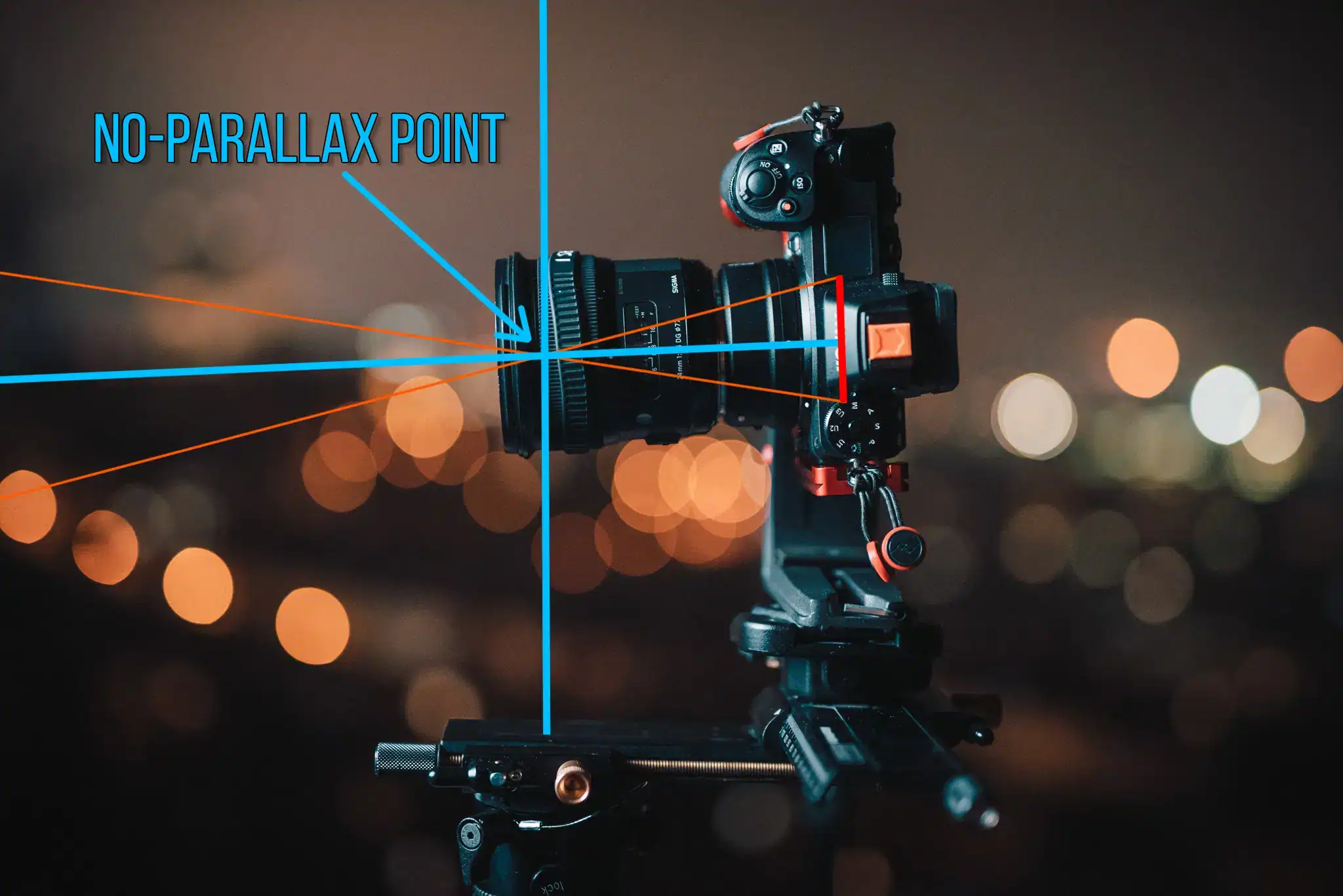
- Panoramic head: Lets you rotate around the lens’s entrance pupil, eliminating parallax so seams stitch cleanly. Use fore-aft rail adjustments to dial in the no-parallax point.
- Stable tripod with leveling base: Faster setup and a straight horizon—not optional for professional results.
- Remote trigger or Canon app: Prevents vibration and lets you keep hands off the camera while bracketing.
Optional Add-ons
- Pole or car mount: Great for elevated or moving shots, but secure everything with safety lines; watch wind loads and vibration.
- Lighting aids: Small LED panels for dark interiors; be careful not to create hotspots that vary per shot.
- Weather protection: Rain covers and lens hoods; a microfiber cloth for fast wipe-downs in mist or sea spray.
For a deeper look at panoramic head fundamentals and why the entrance pupil matters, see this panoramic head tutorial. Panoramic head tutorial (360Rumors)
Step-by-Step Shooting Guide
Standard Static Scenes
- Level and align: Level the tripod with a leveling base. Mount the panoramic head and camera. Adjust the fore-aft rail so the rotation passes through the lens’s entrance pupil. As a starting point for the AstrHori 12mm on a Canon EF body, begin with the entrance pupil roughly 50–60 mm forward of the sensor plane mark (Ø) and fine-tune using the parallax test (two vertical targets at near and far distances; rotate 30° and adjust until relative positions don’t shift).
- Manual exposure and WB: Set the camera to Manual mode. Meter the midtones, then lock exposure and white balance (Daylight outdoors, or a fixed Kelvin value indoors). Locking both prevents flicker and color shifts between frames.
- Capture sequence: Shoot 6 frames around at 60° yaw spacing, at 0° or +10° tilt for safer zenith coverage. For total coverage, add a zenith shot (+90°) and a nadir shot (–90°). Try to keep 30–35% overlap between frames.
- Nadir capture: For removing the tripod, either shoot a dedicated nadir frame by offsetting the camera above the footprint (using a nadir adapter) or capture a handheld patch shot after the main sequence.
HDR / High Dynamic Range Interiors
- Bracket ±2 EV: Use 3–5 exposures per camera angle (e.g., –2/0/+2 or –4/–2/0/+2/+4 for extreme windows). Keep the same aperture and WB across all brackets.
- Consistency: Use a 2-second timer or remote; try to complete a full rotation quickly so light doesn’t change too much between angles.
Low-Light / Night Scenes
- Aperture and ISO: Stop down to f/5.6–f/8 if possible. On the 6D/6DII, ISO 100–800 is pristine, 1600 is very good, 3200 is usable with careful noise reduction. For static scenes on tripod, use longer shutter speeds rather than pushing ISO too high.
- Stability: Use mirror lockup + 2s timer or a remote. Disable lens IS if present (the AstrHori fisheye has no IS), and avoid touching the rig between shots.
Crowded Events
- Two passes: First, a quick baseline pass; second, wait for gaps to reduce ghosting. Mark your yaw increments so re-framing is repeatable.
- Post masking: Plan to mask moving people in post (use the clean frames from the second pass).
Special Setups (Pole / Car / Drone)
- Pole: Tether the rig; keep shutter speeds fast (1/250–1/500) to freeze sway. Consider 6 around only and skip zenith if sky is clean (software can close the top).
- Car mount: Use heavy-duty suction mounts and a safety tether. High shutter speeds and higher ISO are preferable to motion blur; avoid bumpy roads and strong crosswinds.
- Drone: The 6D series is heavy; this is typically impractical. Consider dedicated drone platforms or lighter mirrorless rigs if aerial is required.
Recommended Settings & Pro Tips
Exposure & Focus
| Scenario | Aperture | Shutter | ISO | Notes |
|---|---|---|---|---|
| Daylight outdoor | f/8–f/11 | 1/100–1/250 | 100–200 | Lock WB to Daylight; prioritize DR at ISO 100. |
| Low light/night | f/4–f/5.6 | 1/30–1/60 (tripod) | 400–1600 | Use remote; 6D/6DII remain clean to ISO 1600, 3200 with NR. |
| Interior HDR | f/8 | Bracket ±2 EV | 100–400 | Expose for midtones; bracket for windows and lamps. |
| Action / moving subjects | f/5.6–f/8 | 1/200+ | 400–800 | Use faster shutter to freeze motion; consider two-pass capture. |
Critical Tips
- Focus: Set manual focus to about 0.7–1.0 m at f/8; on a 12mm FF fisheye, the hyperfocal distance is roughly 0.6 m at f/8 (CoC ~0.03mm), giving near-to-infinity sharpness.
- Nodal calibration: Start with the entrance pupil ~50–60 mm forward of the sensor plane and fine-tune with the near/far object method. Mark your rail once dialed in for fast repeatability.
- White balance: Lock a fixed WB (Kelvin or Daylight/Tungsten) to avoid color shifts that complicate stitching.
- RAW capture: Shoot RAW (or RAW+JPEG) to maximize DR and color latitude, especially for HDR panorama workflows.
- Stabilization: The 6D/6DII bodies do not have IBIS; if you ever mount an IS lens on a tripod, disable IS to prevent micro-vibrations.
Stitching & Post-Processing
Software Workflow
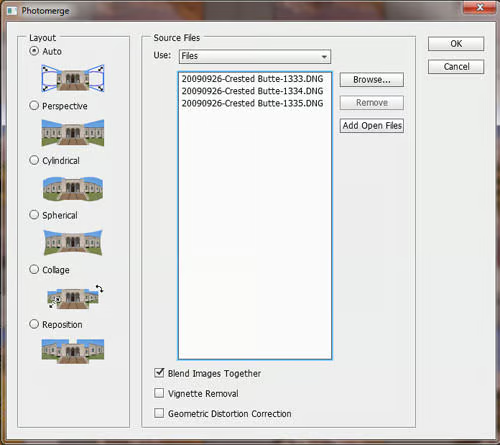
Import your images (and HDR brackets if used) into your stitching software. PTGui is a top choice for fisheye panoramas—it recognizes fisheye geometry, optimizes control points, and offers a robust mask and blend workflow. Hugin is a powerful open-source alternative. Typical overlap recommendations are ~25–35% for fisheye and ~20–25% for rectilinear. With a 12mm diagonal fisheye, expect fewer shots and a relatively easy stitch. After stitching, export an equirectangular projection (2:1 aspect) for VR/360 platforms.
For an in-depth review of PTGui’s capabilities for pro panoramas, see this guide. PTGui in-depth review (Fstoppers)
Cleanup & Enhancement
- Nadir patch: Clone out the tripod or use an AI tool or patch graphic. If you shot a dedicated nadir frame, align and blend it for a seamless floor.
- Color and noise: Correct WB and tint, then apply noise reduction (more for ISO ≥1600). Avoid over-sharpening sky or gradients.
- Horizon leveling: Use automatic vertical alignment, then manually tweak yaw/pitch/roll to make vertical lines perfectly straight.
- Export: Save a 16-bit TIFF master and a compressed JPEG for delivery. For VR platforms, export 2:1 equirectangular at 8K–12K width for crisp results.
If you’re new to end-to-end DSLR 360 workflows, Meta’s creator documentation provides a solid overview of best practices. Using a DSLR to shoot and stitch a 360 photo (Meta)
Useful Tools & Resources
Software
- PTGui panorama stitching
- Hugin open source
- Lightroom / Photoshop for RAW and finishing
- AI tripod/nadir removal utilities
Hardware
- Panoramic heads (Nodal Ninja, Leofoto, or equivalent)
- Carbon fiber tripods (stable but portable)
- Leveling bases for rapid horizon setup
- Wireless remote shutters or intervalometers
- Pole extensions / car mounts with safety tethers
Disclaimer: software/hardware names provided for search reference; check official sites for details.
Common Mistakes & How to Avoid Them
- Parallax error → align the entrance pupil precisely; test with near/far objects.
- Exposure flicker → Manual mode and locked WB; avoid auto ISO and auto WB during the sequence.
- Tripod shadows → Reframe or shoot a proper nadir; patch in post.
- Ghosting from movement → Two-pass strategy and masking in stitching software.
- Night noise → Prefer longer shutter on tripod; keep ISO at or under 1600 when possible and apply selective noise reduction.
Looking for more fundamentals and community-tested tips? This Q&A thread compiles proven techniques from many shooters. Best techniques to take 360 panoramas (StackExchange)
Field-Proven Scenarios and Settings
Indoor Real Estate (Windows + Mixed Lighting)
Use f/8, ISO 100–200. Set shutter for midtone, then bracket ±2 EV (3–5 shots per angle). Capture 6 around + zenith + nadir. Keep WB fixed (e.g., 4000–4600K if mixed daylight/tungsten). In post, blend HDR first (either in PTGui’s HDR mode or pre-merge HDRs), then stitch. Finalize with vertical alignment so lines are perfectly straight.
Outdoor Sunset
Shoot quickly to minimize exposure shifts. Lock at f/8, ISO 100–200, 1/125–1/250 s. Start near the sun, rotate steadily. If the contrast is extreme, do a lightweight bracket (–2/0/+2). Add a zenith shot to avoid a stretched sky seam.
Event Crowds
Choose 1/250 s or faster at f/5.6–f/8 and ISO 400–800. Do two passes; the second pass should be timed for gaps in traffic. In post, mask moving subjects using the clean frames from the second pass.
Rooftop or Pole Shooting
Wind is the enemy. Keep the pole as short as needed, use 1/250–1/500 s, and accept higher ISO (800–1600). Shoot 6 around only if the sky is clean to reduce time aloft. Always tether the equipment.
Car-Mounted Capture
Use professional-grade suction mounts and a safety line. Favor 1/1000 s if possible, ISO 800–1600, and shoot short bursts at each yaw position when the car stops safely. Avoid busy roads and always comply with local laws.
Frequently Asked Questions
- Can I shoot handheld panoramas with the Canon EOS 6D / 6D Mark II?
Yes, in a pinch. Use 1/125–1/250 s, ISO 400–800, and keep 30–40% overlap. However, handheld can introduce parallax and misalignment—tripod + pano head is strongly recommended for clean seams, especially indoors with foreground objects.
- Is the AstrHori 12mm f/2.8 wide enough for single-row 360?
Yes. On full-frame it’s a diagonal fisheye that typically needs 6 shots around plus a zenith and nadir to ensure reliable coverage and clean stitch margins. In open skies you can sometimes skip the zenith, but it’s safer to include it.
- Do I need HDR for interiors with bright windows?
Usually. Bracketing ±2 EV (3–5 exposures) preserves window highlights and deep shadows without pushing ISO. Merge HDRs consistently before or during stitching to avoid artifacts.
- How do I avoid parallax issues with this lens?
Calibrate the entrance pupil on your panoramic head. Start with the entrance pupil about 50–60 mm in front of the sensor plane and fine-tune using the near/far object method. Mark your rail position once set for fast, repeatable alignment.
- What ISO range is safe on the 6D/6D Mark II in low light?
ISO 100–800 is effectively noise-free, ISO 1600 remains very good, ISO 3200 is usable with careful noise reduction. Prefer longer shutter times on a tripod instead of pushing ISO whenever possible.
- Can I set up Custom Shooting Modes for pano work?
Yes. Save Manual exposure, fixed WB, RAW, mirror lockup, and your typical aperture (e.g., f/8) to C1/C2 for quick recall—handy when moving between locations.
- How can I reduce flare with a fisheye?
Avoid direct strong backlight; slightly angle the camera and use your hand or a flag just out of frame to shade the front element. Clean the front element carefully—fisheyes show smudges easily.
- What panoramic head should I buy for this setup?
Choose a head with precise fore-aft and vertical adjustment (e.g., Nodal Ninja or Leofoto), a robust rotator with detents (60°/45°), and a leveling base. The ability to lock repeatable positions speeds up consistent, high-quality results.
Safety, Reliability, and Trustworthy Workflow
Always confirm your AstrHori 12mm mount is compatible with your Canon EF DSLR body. On rooftops or poles, use a secondary tether; never position gear above people without a safety line. For professional jobs, build redundancy: shoot a backup pass, keep dual cards or frequent backups, and export both a master TIFF and a delivery JPEG. For an additional perspective on best practices with panoramic heads and 360 capture, this guide is helpful. Set up a panoramic head for high-end 360 photos (Meta)