Why This Camera & Lens Are Great for Panoramas
If you’re researching how to shoot panorama with Canon EOS 5D Mark IV & Olympus 8mm f/1.8 PRO Fisheye, you’re clearly aiming for fast, high‑quality 360° capture. The Canon EOS 5D Mark IV is a robust full‑frame DSLR with a 30.4MP 36×24 mm sensor, ~5.36 µm pixel pitch, and class‑leading reliability. At ISO 100, its dynamic range is around 13+ EV, which preserves highlight detail in skies and window views while maintaining clean shadows. Its battery life, mirror lock‑up, and consistent color make it a workhorse for panoramas. On the optics side, an 8mm fisheye is the most efficient way to cover the entire sphere with minimal shots, which helps when scenes are dynamic (moving clouds, people, traffic).
Important mount note: the Olympus 8mm f/1.8 PRO is a Micro Four Thirds lens and cannot be natively mounted on a Canon EF body like the 5D Mark IV (due to flange distance and image circle coverage). The guidance below applies to an 8mm fisheye field of view on full frame. In practice with the 5D Mark IV, use an EF‑mount circular/diagonal fisheye with similar coverage (e.g., Canon EF 8–15mm f/4L Fisheye USM at 8mm for circular coverage or at ~12–15mm for diagonal; Sigma 8mm f/3.5 EX DG Circular Fisheye). If you already own the Olympus 8mm, it is better paired with an MFT body; the techniques here still apply 1:1 to any 8mm fisheye workflow.
Quick Setup Overview
- Camera: Canon EOS 5D Mark IV — Full‑Frame 36×24 mm, 30.4MP; pixel pitch ~5.36 µm; DR at base ~13+ EV; native ISO 100–32,000 (expand 50–102,400).
- Lens: Olympus 8mm f/1.8 PRO Fisheye — ultra‑wide diagonal fisheye for MFT; very sharp by f/4–f/5.6; low CA for a fisheye; note: not EF‑mountable. Use an EF fisheye with similar FOV on the 5D Mark IV.
- Estimated shots & overlap (with an 8mm circular fisheye on full frame): 4 around at 0° tilt + 1 zenith + 1 nadir with ~30% overlap. In controlled scenes, 3 around + Z + N may work but risks coverage gaps. With a 15mm diagonal fisheye: 6 around + Z + N.
- Difficulty: Easy–Medium (easy once nodal point is calibrated; medium for complex interiors/HDR).
Planning & On-Site Preparation
Evaluate Shooting Environment
Scan the scene before you set up. Identify moving subjects (people, vehicles, trees in wind), reflective surfaces (glass, polished floors), and direct light sources. If shooting through glass, get the front element as close as safely possible (a few millimeters to 1 cm) to minimize reflections and ghosting. Watch for the sun or bright lights entering the fisheye’s 180° FOV; small angle changes can reduce flare dramatically.
Match Gear to Scene Goals
The 5D Mark IV’s dynamic range and color are excellent for sunset cityscapes and interior real estate work. For indoor scenes with windows, expect to bracket ±2 EV (or more) to maintain detail. For moving crowds or wind-blown foliage, a fisheye minimizes total frames, reducing subject movement between shots. The 5D Mark IV is clean at ISO 100–400; ISO 800–1600 remains very usable if you must shorten shutter speeds.
Pre‑shoot Checklist
- Batteries charged; empty, fast cards ready; lens and sensor cleaned.
- Tripod leveled; panoramic head calibrated to the lens’s no‑parallax (entrance pupil) point.
- Safety checks: wind gusts, rooftop rails, tethered mounts if elevating a pole. Avoid public obstructions.
- Backup workflow: when possible, shoot a second full round of the panorama in case of blinks, people intrusions, or alignment errors.
Essential Gear & Setup
Core Gear
- Panoramic head: A rotator with click‑stops and a fore/aft rail to place the lens’s entrance pupil over the rotation axis. This eliminates parallax and is critical for perfect stitches.
- Stable tripod with leveling base: A bubble level or half‑ball leveling base speeds setup and keeps the horizon true.
- Remote trigger or Canon app: Avoid camera shake; on the 5D Mark IV, enable mirror lock‑up or shoot in Live View for minimal vibration.
Optional Add‑ons
- Pole or car mount: Use a safety tether. Wind and vibration rise dramatically with height and speed; rotate slowly and use faster shutter speeds.
- Lighting aids: For dim interiors, small LED panels or bounced flash can lift deep shadows (avoid creating hot spots that change between frames).
- Weather protection: Rain cover and lens hood for drizzle; microfiber for mist/spray.
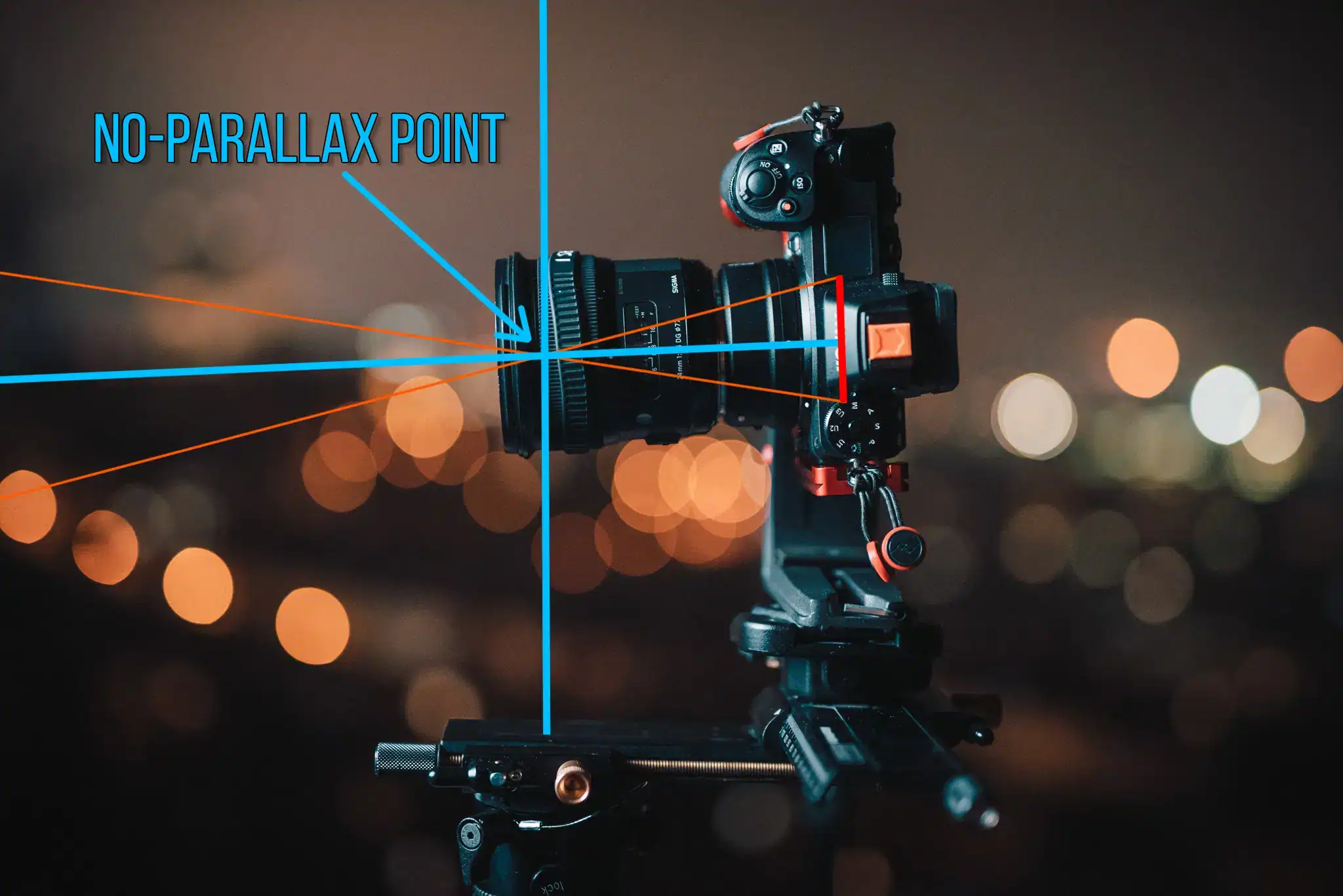
If you’re new to panoramic heads, this concise panoramic head tutorial explains the why and how with diagrams and practical advice. Read the panoramic head setup fundamentals.
Step-by-Step Shooting Guide
Standard Static Scenes
- Level the tripod: Use the leveling base. A level rig makes stitching faster and keeps the horizon straight.
- Align the nodal point: Adjust the fore/aft rail until close foreground and distant background objects maintain alignment while you pan. Mark this position on the rail for your fisheye.
- Manual exposure and locked white balance: Set manual mode. Meter the brightest area you must preserve (e.g., sky or window highlights) and expose to protect highlights. Set WB (e.g., Daylight or custom Kelvin) to avoid color shifts between frames.
- Focus and lock: With a fisheye, depth of field is generous. At f/8, set manual focus to around the hyperfocal (~0.3–0.5 m for 8mm) to keep everything sharp; confirm at 10× Live View.
- Capture sequence: For an 8mm circular fisheye on full frame, shoot 4 around at 0° tilt with ~90° yaw steps, then 1 zenith and 1 nadir. For safety, add a second nadir after rotating the tripod 180° (useful for tripod patching).
HDR / High Dynamic Range Interiors
- Bracket ±2 EV (3–7 frames): The 5D Mark IV supports up to 7‑frame AEB; 5 frames at 2 EV is a strong starting point for bright windows and dark interiors.
- Keep WB locked and focus fixed: Avoid shifting color or focus across the bracket series, which complicates stitching.
- Use a remote and mirror lock‑up/Live View: Keep the rig rock‑steady, especially at longer exposures.
Low‑Light / Night Scenes
- Start around f/4–f/5.6, ISO 100–400 on tripod: Let shutter speed extend (1–8 s) as needed. The 5D Mark IV is clean at ISO 400; ISO 800–1600 is workable if wind or subject motion forces faster speeds.
- Enable 2‑second self‑timer or use a remote: Prevent micro‑shake in long exposures.
- Watch for flare and ghosting from streetlights: Slightly reframe or use your hand or a flag to shade the lens between exposures (never in frame).
Crowded Events
- Two passes: First a fast pass for coverage; then a second pass waiting for gaps to minimize ghosting. You’ll mask later in post.
- Prioritize human faces and signage: If possible, capture those panels twice to give yourself a clean option during masking.
- Avoid moving objects on seams: Start your rotation where crowds are densest so overlaps fall on less critical textures.
Special Setups (Pole / Car / Elevated)
- Secure everything: Use a safety tether on the camera and head. Check tightness of the pole joints; test in low wind only. For car rigs, avoid highways and monitor vibrations.
- Shorten exposure times: Use ISO 400–800 and faster shutter speeds (1/200–1/500) to freeze pole sway and car vibrations; shoot more overlap to help the stitcher.
- Rotate slowly and steadily: Sudden acceleration introduces blur and misalignment.
Recommended Settings & Pro Tips
Exposure & Focus
| Scenario | Aperture | Shutter | ISO | Notes |
|---|---|---|---|---|
| Daylight outdoor | f/8–f/11 | 1/100–1/250 | 100–200 | Lock WB (Daylight/5600K) for consistent color |
| Low light / night | f/4–f/5.6 | 1/30–8 s (tripod) | 100–800 | Use remote and Live View to reduce vibration |
| Interior HDR | f/8 | Bracket ±2 EV (3–7F) | 100–400 | Preserve window highlights and lamp color |
| Action / crowds | f/5.6–f/8 | 1/200+ | 400–800 | Freeze motion; do a second pass for clean plates |
Critical Tips
- Manual focus at hyperfocal: With an 8mm fisheye, set around 0.3–0.5 m at f/8 for front‑to‑back sharpness. Confirm in Live View.
- Mark your entrance pupil: Once you find the nodal position on the rail for your fisheye, scribe or tape the spot to speed future setups.
- White balance lock: Mixed lighting (tungsten + daylight) can vary frame‑to‑frame. Set a neutral Kelvin or custom WB card before shooting.
- RAW over JPEG: The 5D Mark IV’s 14‑bit RAW preserves DR for HDR merges and color correction.
- Stabilization: The 5D Mark IV has no IBIS; if your EF lens has IS, turn it off on a tripod to avoid micro‑corrections during long exposures.
- Mirror lock‑up: Use Live View or mirror lock‑up to reduce vibration, especially when shooting at 1/15–1 s.
Stitching & Post‑Processing
Software Workflow
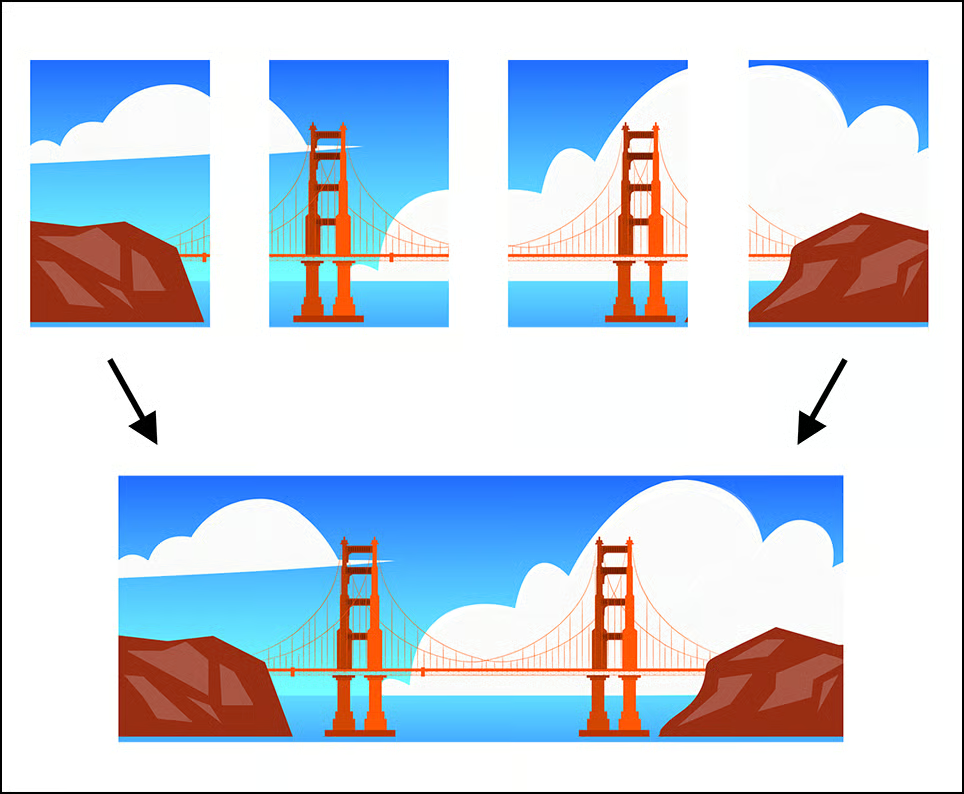
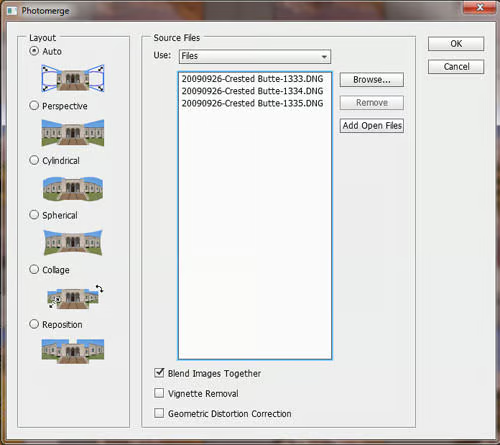
Import your frames into a stitcher like PTGui (industry standard), Hugin (open source), or alternatives. For an 8mm circular fisheye on full frame, set lens type to “circular fisheye” with 180° FOV; for diagonal fisheye use “full‑frame fisheye.” Aim for ~25–30% overlap with fisheyes; ~20–25% with rectilinear lenses. Optimize control points, correct pitch/roll/yaw, and choose equirectangular output (2:1). Export a 12K–16K wide JPEG/TIFF for high‑quality virtual tours. For further reading on professional DSLR 360 workflows, see Meta’s best‑practice guide. Professional 360 photo workflow with DSLR.
Cleanup & Enhancement
- Nadir patch: Shoot a clean nadir tile by offsetting the tripod or use an AI tripod removal tool, then patch in Photoshop.
- Color and noise: Apply a consistent color grade. Use luminance noise reduction for high‑ISO night shots; avoid over‑smoothing textures.
- Horizon leveling: Use PTGui’s Vertical Lines tool or Re‑optimize to fix any roll/pitch errors.
- Output formats: Save a master TIFF; export a web‑ready JPEG (quality 9–11). For VR viewers, a 2:1 equirectangular is standard.
PTGui is widely regarded as the fastest, most reliable stitcher for complex fisheye sets; this review explains why its optimizer and masking tools matter for pro work. Why PTGui excels at panoramas.
Useful Tools & Resources
Software
- PTGui (fast fisheye stitching, advanced masking)
- Hugin (open source, robust control point tools)
- Lightroom / Photoshop (HDR merge, color, nadir patch)
- AI tripod removal and sky replacement tools
Hardware
- Panoramic heads: Nodal Ninja, Leofoto, and similar rail systems
- Carbon fiber tripods with leveling bases
- Wireless remotes / intervalometers
- Pole extensions and car mounts (use safety tethers)
To estimate final resolution with different lenses and shot counts, the PanoTools wiki is a valuable reference. DSLR spherical resolution guidelines.
Disclaimer: software/hardware names are provided for research; confirm current features and compatibility on official sites.
Common Mistakes & How to Avoid Them
- Parallax error → Calibrate and use the lens’s entrance pupil over the rotation axis; don’t move the tripod between frames.
- Exposure flicker → Manual exposure and locked WB. Don’t let auto ISO or auto WB vary between panels.
- Tripod shadows / photographer reflections → Plan sun direction, shoot a separate nadir, and patch cleanly.
- Ghosting from movement → Capture a second pass and use masking to blend clean areas.
- Night noise → Keep ISO as low as practical; extend shutter with a sturdy tripod and remote trigger.
- Flare with fisheye → Shade the lens with a flag (keep it out of frame) and adjust angles to keep bright sources near the frame edge.
Field‑Tested Case Studies
Indoor Real Estate (Bright Windows)
Use f/8, ISO 100–200, and 5‑frame bracketing at ±2 EV. Keep WB locked (e.g., 5000–5600K). With an 8mm circular fisheye on the 5D Mark IV, 4 around + Z + N covers most rooms. In PTGui, use exposure fusion or merge exposure sets first in Lightroom, then stitch. Mask reflections in mirrors and chrome fixtures.
Outdoor Sunset (High DR, Wind)
Set f/8, ISO 100–200; bracket if necessary. If wind is moving foliage, increase shutter to 1/125–1/250 by raising ISO to 400–800. Capture quickly to reduce color shifts across frames. For the zenith, tilt slightly away from the sun to minimize flare.
Crowded Event (People Everywhere)
Use f/5.6–f/8, ISO 400–800, 1/200–1/500. Shoot two rounds. Mark seam‑sensitive panels (faces, signage) for retouching. In the stitcher, place seams across low‑contrast backgrounds.
Rooftop / Pole Shooting
Safety first: tether the camera and head; avoid gusty conditions. Shorten exposure times (1/250–1/500) and shoot extra overlap (~40%). Expect to hand‑level in post; add a horizon control line in PTGui to straighten.
Compatibility & Best‑Fit Alternatives
Because the Olympus 8mm f/1.8 PRO is an MFT lens, it does not physically adapt to Canon EF without complex optics and would not cover full frame. For the 5D Mark IV, use an EF‑mount fisheye with similar coverage. Popular choices include the Canon EF 8–15mm f/4L Fisheye USM (at 8mm for circular, or ~12–15mm for diagonal) and the Sigma 8mm f/3.5 Circular Fisheye. The shooting and stitching methods in this guide remain identical; only the nodal point position and exact shot count may vary by lens.
For a broader perspective on choosing cameras and lenses for virtual tours, this field guide is a helpful companion. DSLR virtual tour cameras and lens guide.
Frequently Asked Questions
-
Can I shoot handheld panoramas with the Canon EOS 5D Mark IV?
Yes, for casual single‑row panos outdoors. For seamless 360×180 VR, use a tripod and panoramic head to eliminate parallax. Handheld works if subjects are distant and you overshoot overlap, but expect more stitching cleanup.
-
Is the Olympus 8mm f/1.8 PRO wide enough for a single‑row 360 on full frame?
On MFT, it’s a diagonal 180° fisheye. On a full‑frame 5D Mark IV, it isn’t mountable/covering, so use an EF circular fisheye (e.g., Canon 8–15 at 8mm). With an 8mm circular fisheye, 4 around + zenith + nadir is a reliable full‑sphere set.
-
Do I need HDR for interiors with bright windows?
Often yes. Bracketing ±2 EV (3–7 frames) preserves both window views and interior detail. The 5D Mark IV’s DR is good, but bracketing yields cleaner results and less noise in shadows.
-
How do I avoid parallax issues?
Calibrate the entrance pupil (no‑parallax point) on your pano head once and mark it. Keep the camera level and rotate only around the vertical axis of the entrance pupil—don’t shift the tripod between frames.
-
What ISO range is safe on the 5D Mark IV in low light?
ISO 100–400 is ideal for maximum DR on a tripod. ISO 800–1600 is still very usable for faster shutter speeds (events, wind). Above that, expect increased noise and reduced highlight latitude.
-
Can I set up Custom Shooting Modes (C1/C2) for pano?
Yes. Save Manual exposure, fixed WB, manual focus, and mirror lock‑up/Live View to a custom mode. It speeds setup when moving between locations.
-
How do I reduce flare with a fisheye?
Avoid pointing directly at strong light sources. Small angle changes can eliminate ghosts. Use your hand or a flag just out of frame to shade; clean the front element frequently.
-
What’s the best tripod head for this setup?
A dedicated panoramic head with fore/aft rail and click‑stop rotator (e.g., Nodal Ninja, Leofoto). For pole work, a lightweight ring clamp head reduces lever arm torque.
Safety, Reliability & Workflow Trust
Always secure your rig, especially on rooftops or poles. Use tethers, monitor wind, and keep bystanders clear. Protect the lens with a cap between locations; fisheyes have large, exposed front elements. Back up cards on‑site (laptop + SSD) and keep a duplicate off your person when traveling. When in doubt about rigging or site permissions, get written approval. For a deeper primer on setting up a panoramic head and capture principles, see this training resource. Set up a panoramic head for high‑end 360 photos.
Wrap‑Up
To master how to shoot panorama with Canon EOS 5D Mark IV & Olympus 8mm f/1.8 PRO Fisheye, remember the keys: lock exposure and WB, align the entrance pupil, use a fisheye to minimize frames, and stitch with reliable software. While the Olympus 8mm isn’t natively compatible with EF full frame, an equivalent EF fisheye gives you the same streamlined workflow. With careful planning and a clean capture, your 5D Mark IV will deliver crisp, low‑noise 360° images that stitch fast and present beautifully on any VR platform.