
Why This Camera & Lens Are Great for Panoramas
If you want to learn how to shoot panorama with Sony a7R V & Tokina ATX-i 11-20mm f/2.8, you’re pairing a state-of-the-art high-resolution full-frame body with a bright, rectilinear ultra-wide zoom. The Sony a7R V’s 61MP full-frame BSI sensor (approx. 9504 × 6336 resolution, 3.76 µm pixel pitch) delivers excellent detail and class-leading dynamic range (~14.5–15 EV at base ISO). Its 5-axis IBIS, precise peaking, and customizable controls make manual pano capture quick and consistent. Meanwhile, the Tokina ATX-i 11–20mm f/2.8 (APS-C, rectilinear) is a sharp, fast, and distortion-controlled ultra-wide; it preserves straight lines for architecture and real estate while offering a flexible zoom range for different overlap strategies.
Because the Tokina ATX-i 11–20mm is an APS-C DSLR lens, mounting on a Sony a7R V typically involves an EF–E or F–E smart adapter. The a7R V will automatically switch to APS-C crop (or you can force Crop mode), yielding ~26MP files. That’s still ample resolution for high-quality 360 photos and virtual tours, while the f/2.8 aperture helps keep ISO low in dim interiors. This rectilinear lens requires more frames than a fisheye for a full 360×180, but rewards you with natural-looking lines and less stretching at the poles, which is ideal for architecture and landscapes where realism matters.
Quick Setup Overview
- Camera: Sony a7R V — Full-frame 61MP BSI sensor, ~3.76 µm pixel pitch, excellent DR; APS-C crop output ~26MP. IBIS up to 8 stops (CIPA) and reliable manual aids (magnification/peaking).
- Lens: Tokina ATX-i 11–20mm f/2.8 — APS-C rectilinear ultra-wide zoom, constant f/2.8. Good center sharpness from f/4; best overall across the frame around f/5.6–f/8. Mild barrel distortion and lateral CA at 11mm, both easily corrected in post.
- Estimated shots & overlap (360×180, rectilinear, ~30% overlap):
- At 11mm (APS-C): 8 around at +35°, 8 around at −35°, + 1 zenith + 1 nadir = 18 frames (balanced speed/quality). Alternative: 12 around at 0° + zenith + nadir = ~14 frames (requires careful coverage near poles).
- At 16–20mm (APS-C): 12 around × 3 rows (e.g., +45°, 0°, −45°) + zenith + nadir = 38 frames, for maximum sharpness and minimal edge distortion.
- Difficulty: Moderate (requires nodal alignment and multi-row capture for full spheres).
Planning & On-Site Preparation
Evaluate Shooting Environment
Walk the scene and anticipate problem areas: reflections (glass, polished floors), moving objects (people, cars, trees in wind), and extreme brightness differences (bright windows + dim interiors). If shooting through glass, get as close as possible (1–2 cm) to reduce reflections and ghosting, and place the lens perpendicular to the glass.
Match Gear to Scene Goals
The a7R V’s high dynamic range is a lifesaver for sunrise/sunset and interiors with mixed lighting, letting you expose for midtones and still recover highlights and shadows—especially if you bracket for HDR. The 11–20mm rectilinear zoom is perfect for architectural fidelity: straight walls stay straight, and you can choose 11mm for fewer frames or 16–20mm for better corner sharpness and easier stitching at the expense of more shots. The a7R V stays impressively clean at ISO 100–400; ISO 800–1600 is still usable for night scenes, but keeping ISO at 400–800 on tripod is a sweet spot for clean detail.
Pre-shoot Checklist
- Battery charged (NP-FZ100), formatted cards (CFexpress Type A / SD UHS-II), and lens/sensor cleaned.
- Panoramic head calibrated to the lens’ no-parallax point; tripod leveled via a leveling base.
- Disable IBIS on tripod to prevent micro-shake; use remote trigger or Sony Imaging Edge app.
- Safety first: secure straps, tether on rooftops/poles, watch wind loads, and avoid unstable surfaces.
- Backup workflow: when time allows, shoot a second full pass (especially for client work or changing light).
Essential Gear & Setup
Core Gear
- Panoramic head: Lets you rotate around the lens’ entrance pupil (no-parallax point) to minimize parallax, the main cause of stitching errors with close objects.
- Stable tripod with leveling base: Leveling once at the base means your yaw rotation stays level—critical for clean stitches and level horizons.
- Remote trigger or app: Avoids camera shake and keeps your sequence consistent.
Optional Add-ons
- Pole or car mount: Great for crowds or tight spaces; always tether your rig and consider wind and vibration. Limit speed and avoid gusty conditions.
- Continuous lights or flash for interiors: For real estate, even a small LED panel helps balance dark corners without pushing ISO.
- Weather protection: Rain covers, microfiber towels, and silica packs keep your gear safe and your front element dry.
Step-by-Step Shooting Guide
Standard Static Scenes
- Level and align: Level your tripod. On the pano head, slide the camera so that rotation occurs around the lens’ no-parallax point. For the Tokina 11–20, expect the entrance pupil to sit forward of the mount; find it empirically by aligning two vertical objects (one near, one far) and rotating—adjust fore/aft until they don’t shift relative to each other.
- Manual exposure and WB: Set Manual mode and lock White Balance (Daylight, Tungsten, or a custom Kelvin) to avoid flicker and color shifts across frames.
- Capture with overlap: For 11mm APS-C, a reliable pattern is 8 around at +35°, 8 around at −35°, plus 1 zenith and 1 nadir (around 18 frames). Aim for ~30% horizontal and vertical overlap. Use f/8, ISO 100–200, and shutter as needed.
- Take a nadir: Shoot a ground shot to patch tripod/feet later. If you can, move the tripod aside and shoot a clean plate where the tripod was.

HDR / High Dynamic Range Interiors
- Bracketed exposures: Use ±2 EV (3 or 5 frames) to balance bright windows and interior shadows. The a7R V’s 61MP sensor retains excellent highlight data at base ISO—shoot at ISO 100–200 if possible.
- Keep settings locked: Lock WB, aperture (typically f/8), and focus. Only shutter speed should vary across brackets.
- Sequence consistency: For each view, shoot all brackets before rotating to the next yaw step to keep the light consistent.
Low-Light / Night Scenes
- Stabilize and slow down: With a sturdy tripod, shoot at ISO 100–400 where possible; extend shutter time rather than pushing ISO. If wind is present, use lower tripod height to reduce sway.
- IBIS off, remote on: Turn off stabilization to prevent micro-motion on a tripod. Use a remote / 2s timer / app control.
- Mind hot spots: Bright streetlights can flare. Use your hand or lens hood to flag stray light between frames.
Crowded Events
- Two passes: First pass for coverage, second pass waiting for gaps in movement near seams.
- Plan seam locations: Rotate so seams fall on less-busy backgrounds (sky, plain walls), simplifying masking in post.
- Use faster shutter: Aim for 1/200–1/250 at f/5.6–f/8, ISO 400–800, depending on light.
Special Setups (Pole / Car / Drone)
- Secure everything: Use a rigid pole rated for your payload and a safety tether. Watch wind load; even the a7R V + Tokina + head can become a sail.
- Rotate slowly: Vibrations blur details at 61MP. Pause briefly after each yaw step before releasing the shutter.
- Short exposures: Prefer higher ISO (400–800) and a faster shutter over long exposures when vibration is unavoidable.
Recommended Settings & Pro Tips
Exposure & Focus
| Scenario | Aperture | Shutter | ISO | Notes |
|---|---|---|---|---|
| Daylight outdoor | f/8–f/11 | 1/100–1/250 | 100–200 | Lock WB (Daylight); avoid IBIS on tripod |
| Low light/night | f/4–f/5.6 | 1/30–1/60 (or longer on tripod) | 400–800 | Remote release; watch flare from point lights |
| Interior HDR | f/8 | Bracket ±2 EV | 100–400 | Shutter varies only; WB/focus locked |
| Action / moving subjects | f/5.6–f/8 | 1/200+ | 400–800 | Two-pass strategy to reduce ghosts |
Critical Tips
- Manual focus: Use magnification and peaking on the a7R V, then switch AF off. Focus near the hyperfocal distance (at 11–16mm, f/8, focusing 1–1.5 m out often keeps everything sharp).
- Nodal alignment: Mark the fore/aft rail position on your pano head for 11mm and 16–20mm to switch quickly. Each focal length has a slightly different entrance pupil location.
- White balance lock: Mixed lighting (tungsten + daylight) causes frame-to-frame shifts if WB is on Auto. Use a fixed Kelvin or a custom WB reading.
- RAW first: Shoot RAW for best highlight recovery and color control. The a7R V’s files hold significant latitude, especially at base ISO.
- Stabilization: Turn off IBIS on tripod. Handheld panos are possible in a pinch, but for 360×180 accuracy, a head and tripod are strongly recommended.
Stitching & Post-Processing
Software Workflow
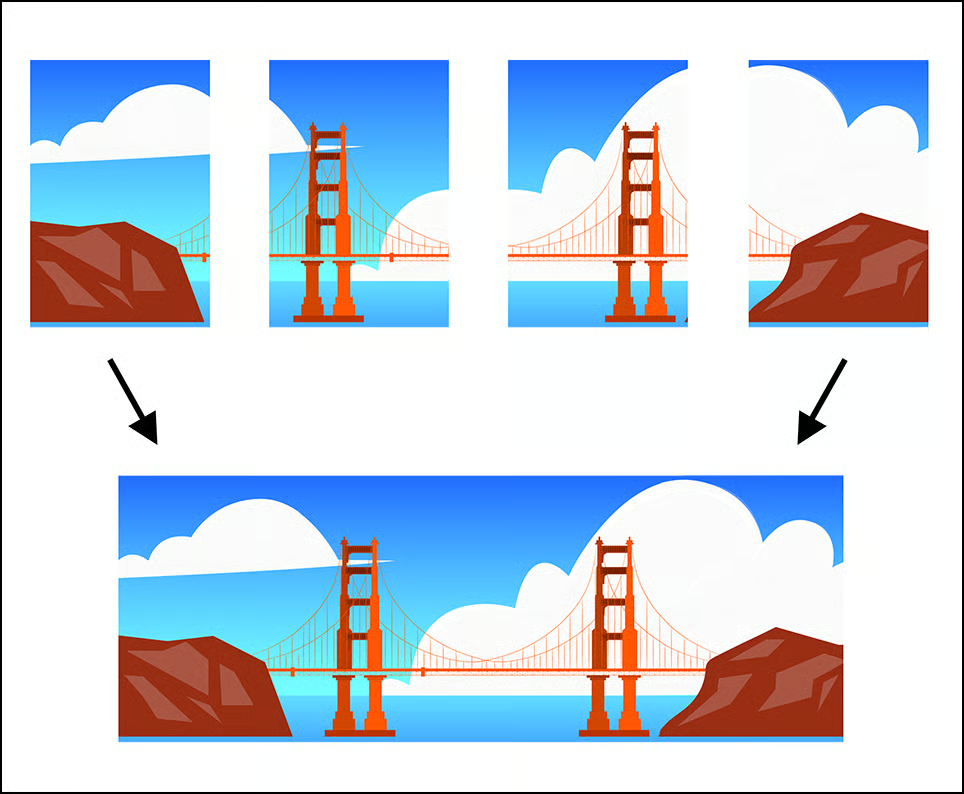
For this rectilinear setup, PTGui and Hugin handle control points and optimizer steps well. Import sequences (or HDR stacks), set lens type to rectilinear, confirm focal length and crop factor (APS-C), and aim for ~25–35% overlap. Rectilinear lenses require more frames but produce natural architectural lines without fishy curvature. PTGui’s masking is excellent for crowds and moving foliage, while Hugin is a strong open-source alternative. For Lightroom/Photoshop users, you can merge panoramas, then export to an equirectangular projection for VR when needed, but dedicated pano tools offer more control and better nadir/zenith handling. See an in-depth PTGui review for strengths in complex projects at the end of this section.
Cleanup & Enhancement
- Tripod/nadir patch: Use a clean plate, clone/heal in Photoshop, or try AI-based patchers. PTGui’s Viewpoint correction can help with tricky nadirs.
- Color consistency: Match color and contrast across the panorama; correct mixed lighting (HSL and local adjustments).
- Noise and sharpening: Apply gentle noise reduction for night scenes and conservative sharpening to avoid haloing along stitched seams.
- Leveling: Set horizon and correct yaw/pitch/roll. The a7R V’s 61MP files are unforgiving of tiny misalignments.
- Export: For VR, export equirectangular 2:1 at 8–12K on the long side from your ~26MP APS-C images; for web, 6–8K is often ideal. Keep a layered master (TIFF/PSB) for future edits.
For a methodical primer on panoramic heads and alignment, see this panoramic head tutorial. For a deep dive into PTGui’s capabilities and why many professionals prefer it, read the Fstoppers review linked below. For publishing 360 photos to VR platforms, Meta’s DSLR/ML guide is also helpful. Panoramic head primer. PTGui professional overview. DSLR/Mirrorless to 360 workflow.
Useful Tools & Resources
Software
- PTGui panorama stitching
- Hugin open source
- Lightroom / Photoshop for RAW and finishing
- AI tripod removal / cloning tools
Hardware
- Panoramic heads (Nodal Ninja, Leofoto, Sunwayfoto)
- Carbon fiber tripods with leveling base
- Wireless remote shutters or Sony Imaging Edge Mobile
- Pole extensions / car suction mounts with safety tethers
Disclaimer: brand names are provided for research; confirm compatibility (especially adapters) for your exact lens mount and workflow.
Field Scenarios & Proven Setups
Indoor Real Estate (Mixed Lighting)
Use 11–14mm to minimize frame count in tight rooms. Shoot at f/8, ISO 100–200, and bracket ±2 EV (3–5 exposures). Keep WB fixed (e.g., 4000–4500K for warm interiors with daylight spill). Turn off all fans and ask people to hold positions to reduce motion artifacts near seams.
Outdoor Sunset (High DR)
Expose midtones at ISO 100. Consider a 5-shot bracket (−4 to +4 EV) only for frames facing the sun; use 3-shot brackets elsewhere. Plan the seam away from the sun to simplify blending.
Event Crowds (Motion Control)
At 11–16mm, capture one fast pass at 1/250, ISO 400–800, then a second “clean-up” pass for troublesome seams. In PTGui, mask in the cleaner subjects and mask out the overlaps with heavy motion.
Rooftop or Pole Shooting (Safety First)
Keep your rig compact. Use a short, rigid pole and a small panoramic head. Balance the camera so it doesn’t twist and always tether. Favor faster shutters and ISO 400–800 to counter micro-vibrations.
Common Mistakes & How to Avoid Them
- Parallax errors: Always align the no-parallax point and avoid shifting the tripod between frames.
- Exposure flicker: Don’t leave WB or exposure on Auto; lock them for the entire sequence.
- Insufficient overlap: Use ~30% overlap with rectilinear lenses, especially near the poles.
- Tripod shadows and footprints: Capture a nadir clean plate for easy patching.
- High ISO noise at night: Keep ISO to 400–800 and extend exposure on a tripod; the a7R V resolves very fine detail and reveals noise more readily at 61MP.
Frequently Asked Questions
- Can I shoot handheld panoramas with the Sony a7R V?
Yes, for simple single-row panos. For 360×180 with close objects, a tripod and panoramic head are strongly recommended. The a7R V’s resolution reveals tiny alignment errors, so handheld should be reserved for distant landscapes and partial panos.
- Is the Tokina ATX-i 11–20mm f/2.8 wide enough for a single-row 360?
At 11mm APS-C, you can attempt a single row of ~12 frames plus zenith and nadir, but coverage near the poles is tight. For consistent results, use two rows (e.g., ±35°) plus zenith and nadir (~18 frames).
- Do I need HDR for interiors with bright windows?
Usually, yes. Bracket ±2 EV (3–5 frames) to capture both window highlights and interior shadows. The a7R V’s dynamic range helps, but bracketing produces cleaner mid-tones and avoids clipped windows.
- How do I avoid parallax issues with this lens?
Mount the a7R V on a calibrated panoramic head, then find the lens’ entrance pupil at each focal length. Align two objects (near/far) and adjust the fore/aft rail until there’s no relative shift when yawing. Mark those rail positions for 11, 14, 16, and 20mm for quick setup next time.
- What ISO range is safe on the a7R V for low light panoramas?
ISO 100–400 is ideal; ISO 800–1600 is acceptable when you need faster shutter speeds. On a tripod, favor slower shutter over high ISO to keep fine textures clean at 61MP.
Additional Notes on Compatibility & Workflow Confidence
Because the Tokina ATX-i 11–20mm f/2.8 is an APS-C DSLR lens, plan to use an appropriate EF–E or F–E adapter with electronic aperture control. The a7R V will switch to APS-C crop mode automatically (or set it manually). Autofocus performance depends on the adapter; for panoramas, manual focus is preferred anyway. If you frequently shoot 360s on Sony, consider marking your pano head for consistent nodal alignment per focal length and enabling Custom Modes on the a7R V to recall “Pano Settings” quickly (Manual exposure, fixed WB, IBIS off, RAW, focus peaking on).
For more background on panorama techniques and equipment choices, the following references are helpful and vetted by the community: Best techniques to take 360 panoramas (community Q&A).
