
Why This Camera & Lens Are Great for Panoramas
The Sony a7R V paired with the Sigma 8mm f/3.5 EX DG Circular Fisheye is a proven, high-efficiency combo for creating 360° panoramas and virtual tours. The a7R V’s 61MP full-frame sensor (approximately 36×24 mm, pixel pitch ~3.76 µm) delivers exceptional resolving power and dynamic range (~14.7 EV at ISO 100), letting you push shadows and protect highlights in complex scenes. Its 5-axis IBIS (up to 8 stops compensation), reliable manual focus aids (magnification, peaking), and robust file options (lossless compressed RAW) make it a flexible platform for both interiors and exteriors.
The Sigma 8mm f/3.5 EX DG is a circular fisheye designed for full-frame. It projects a 180° field of view in all directions as a circle within the frame, allowing you to cover the full sphere with as few as 3–4 shots. In practice, that means faster capture, fewer stitching seams, and better consistency in dynamic lighting. Distortion is intentional and handled by pano software; what matters is parallax control and overlap, which are both straightforward with this lens when you shoot from the lens’s no-parallax point on a panoramic head. Mounting note: this lens often requires an adapter on the a7R V (e.g., Sony LA-EA5 for A-mount or Sigma MC-11 for Canon EF versions). Autofocus is not critical for panoramas; manual focus is recommended for consistency.
Quick Setup Overview
- Camera: Sony a7R V — Full-frame 61MP (9504×6336), excellent DR, strong low-ISO performance, 5-axis IBIS, dual slots (CFexpress Type A/SD UHS-II).
- Lens: Sigma 8mm f/3.5 EX DG Circular Fisheye — Circular fisheye, ~180° across, sharp from f/5.6–f/8, some edge CA and vignetting wide open, ideal for minimal-shot 360 capture.
- Estimated shots & overlap (tested):
- Fast capture: 3 shots around (120° yaw), tilt 0°, plus 1 nadir (recommended). ~30–40% overlap.
- Safe capture: 4 shots around (90° yaw), tilt 0°, slight pitch-up (+5°) to close zenith gap, plus 1 nadir.
- HDR interiors: same patterns as above, bracketed ±2 EV per position.
- Difficulty: Easy once nodal point is calibrated (2/5).
Planning & On-Site Preparation
Evaluate Shooting Environment
Survey the scene for moving subjects, reflective surfaces (glass, polished floors), and strong backlight sources. For glass, shoot perpendicular, shade the lens if possible, and keep the front element 5–15 cm away to reduce flare and internal reflections. In high-contrast exteriors (sunset/sunrise), plan an HDR bracket to balance sky and foreground detail. Mind wind and vibration—especially if shooting on rooftops or with a pole mount.
Match Gear to Scene Goals
The a7R V’s wide dynamic range and clean base ISO make it ideal for interiors and real estate. With the Sigma 8mm circular fisheye, you’ll need fewer frames, which helps when there’s motion (crowds, trees in wind) or when you must work quickly. Use ISO 100–200 outdoors for maximal quality; indoors, ISO 400–800 is a safe working range on the a7R V, with 1600–3200 still usable if you expose to the right and denoise in post. The fisheye’s distortion is normal and will be corrected during stitching—what matters is clean overlap and parallax-free rotation.
Pre-shoot Checklist
- Power & storage: Fully charged batteries; fast cards (UHS-II or CFexpress Type A). 61MP RAW is heavy—bring redundancy.
- Clean optics: Front element and sensor. Fisheye elements are prone to flare—keep them spotless.
- Tripod & head: Leveling base and panoramic head pre-calibrated to the lens’s no-parallax point.
- Safety: Weigh down tripod in wind; use tethers on rooftops and poles; check car mounts for secure fastening and route straps away from moving parts.
- Backup workflow: If time allows, shoot a second pass with the same exposure. It saves projects when a frame later proves unusable.
Essential Gear & Setup
Core Gear
- Panoramic head: Lets you rotate around the lens’s entrance pupil (nodal point) to eliminate parallax and stitch errors. Calibrate once and mark the rail positions for this lens and camera.
- Stable tripod with leveling base: Leveling the head keeps horizons true and simplifies stitching. A leveling base speeds setup dramatically.
- Remote trigger or Sony Imaging Edge Mobile: Prevents micro-shake; use a 2-sec timer if you don’t have a remote.
Optional Add-ons
- Pole or car mount: Great for elevated views or vehicle-based capture. Always tether, watch wind loads, and avoid high speeds or gusts that cause vibration.
- Lighting aids: Small LED panels for dark interiors; aim away from reflective surfaces to avoid hot spots.
- Weather protection: Rain covers and lens hoods; fisheyes are flare-prone—shade the sun with a flag when possible.

Step-by-Step Shooting Guide
Standard Static Scenes
- Level and align: Level the tripod using a leveling base. On the pano head, position the camera so the rotation occurs around the lens’s entrance pupil. To calibrate, line up two vertical objects (one near, one far) and rotate—adjust until there’s no relative shift.
- Lock exposure and white balance: Switch to manual exposure and manual WB (Daylight/Cloudy or set Kelvin). Disable auto ISO. Set the same exposure for every frame to avoid seams and flicker.
- Capture sequence: With the Sigma 8mm circular fisheye:
- 3 shots around: 0°, 120°, 240° at tilt 0°, then a nadir shot. This often covers the sphere with strong overlap.
- Or 4 shots around: 0°, 90°, 180°, 270° at tilt 0°, slight pitch-up (+5°) on each frame; then nadir for a cleaner zenith.
- Nadir capture: Point the camera down to cover the tripod area. A “viewpoint correction” in PTGui can also help patch the ground later.
HDR / High Dynamic Range Interiors
- Bracket exposure ±2 EV (3–5 frames) at each position to balance windows and interior shadows. If possible, use single-shot brackets (not continuous burst) to preserve 14-bit RAW depth.
- Lock white balance and keep ISO low (100–400). Merge HDR frames per angle before stitching, or let PTGui handle exposure fusion. Keep the camera perfectly still through the series.
Low-Light / Night Scenes
- Use a sturdy tripod and remote; enable EFCS or mechanical shutter to reduce shutter shock. Turn IBIS off on a locked tripod.
- Settings guideline: f/4–f/5.6, 1/30–1/60s, ISO 400–800. For very dark scenes, extend shutter rather than pushing ISO past 1600 if quality is critical.
Crowded Events
- Shoot two passes: first for structure, second to catch gaps in movement. Take extra frames where traffic is heavy to give yourself masking options.
- In post, mask or blend moving people between frames. If a person is split across stitches, use a single frame for that area and mask neighboring overlaps.
Special Setups (Pole / Car / Drone)
- Pole: Secure clamps, tether the camera, and keep the pole vertical. Use faster shutter speeds (1/200s+) to fight sway and shoot 4-around for safety.
- Car: Use vibration-damping mounts, soft suspension, and shoot when stopped. Avoid high speeds and strong wind. A quick 3-around + nadir workflow minimizes time curbside.
Recommended Settings & Pro Tips
Exposure & Focus
| Scenario | Aperture | Shutter | ISO | Notes |
|---|---|---|---|---|
| Daylight outdoor | f/8–f/11 | 1/100–1/250 | 100–200 | Lock WB (Daylight/Cloudy). Avoid blown highlights. |
| Low light / night | f/4–f/5.6 | 1/30–1/60 | 400–800 | Tripod + remote; extend shutter before pushing ISO past 1600. |
| Interior HDR | f/8 | Bracket ±2 EV | 100–400 | Keep the camera still during brackets; merge before stitching if possible. |
| Action / crowds | f/5.6–f/8 | 1/200+ | 400–800 | Freeze motion; do a second pass for clean plates. |
Critical Tips
- Manual focus: With 8mm, DOF is huge. At f/8, set focus ~0.4–0.6 m (or just short of infinity) and leave it—everything from near foreground to infinity stays sharp.
- Nodal point calibration: Start with the camera centered over the rotation axis. Align a near object against a far object and rotate; adjust fore-aft on the rail until there is no relative shift.
- White balance lock: Use a fixed WB (Kelvin or preset). Mixed lighting? Choose a neutral baseline and correct per-frame tint in RAW if needed.
- RAW vs JPEG: Shoot RAW (lossless compressed) to exploit the a7R V’s dynamic range and to correct fisheye CA and vignetting.
- IBIS and tripod: Turn IBIS off when the camera is locked on a tripod to prevent sensor micro-movements during exposure.
- Bit depth: Avoid high-speed continuous bracketing if you want 14-bit RAW depth. Use single or low-speed bracket capture.
Real-World Case Studies
Indoor Real Estate
Goal: crisp details, accurate color, balanced windows. Settings: f/8, ISO 100–200, tripod, 4-around + nadir, ±2 EV bracket. Lock WB to ~4000–5000K depending on ambient. Merge HDR per angle before stitching to keep noise and color consistent between frames.
Outdoor Sunset on a Rooftop
Goal: clean skyline, strong highlight retention. Settings: f/8, ISO 100, 1/125s base exposure, ±2 EV bracket. Use a weighted tripod, watch wind. Try 4-around with slight pitch-up to fill the zenith. Consider a second pass after the sun dips for a blended, flare-free sun area.
Event Crowds
Goal: minimize ghosting. Settings: f/5.6–f/8, 1/250s, ISO 400–800. Capture two complete rounds. In post, keep the most consistent set of people per sector and mask out duplicates or half-people at seams.
Rooftop / Pole Shooting
Goal: elevated viewpoint. Use a carbon pole with a rigid pano head; tether the camera. Shoot 4-around quickly at 1/200–1/500s, ISO 200–400, f/5.6–f/8. Keep the pole vertical and avoid gusts.
Stitching & Post-Processing
Software Workflow
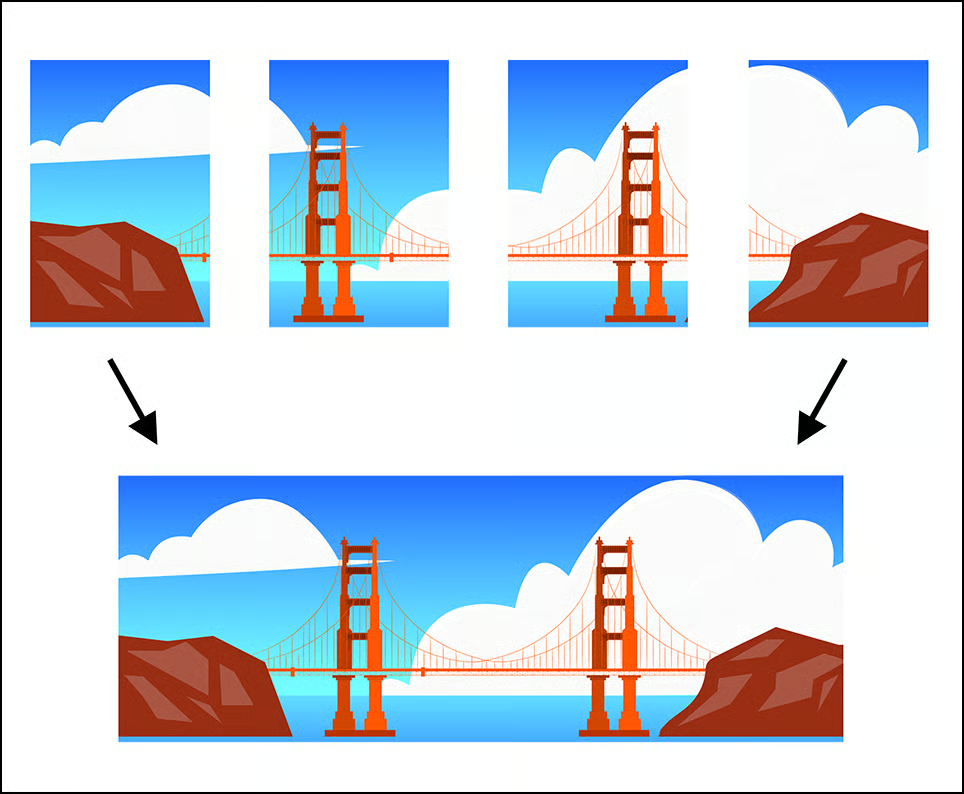
Import RAWs to Lightroom or Capture One for basic corrections (lens CA, exposure normalization if needed). For stitching, PTGui is the industry workhorse; Hugin is a capable open-source alternative. With a circular fisheye, set lens type appropriately (circular fisheye, 8.0 mm) and crop the circle correctly. Use 25–35% overlap. The fisheye’s coverage helps the optimizer place reliable control points, and the nadir can be patched with viewpoint correction or cloned after export. For platform delivery (web/VR), export an equirectangular (2:1 ratio) JPEG or TIFF. A well-shot 61MP circular-fisheye set typically yields a clean 10K–14K x 5K–7K equirectangular.
To go deeper, see a step-by-step panoramic head primer and PTGui-focused reviews for best practices at the pro level. Panoramic head setup tutorial. PTGui review and stitching insights.
Cleanup & Enhancement
- Nadir patch: Use “viewpoint” optimization in PTGui or retouch in Photoshop. Consider AI-based tripod removal tools for speed.
- Color/contrast: Apply gentle contrast curves and uniform white balance. Use local adjustments to balance windows and lamp areas.
- Noise reduction: Apply moderate NR to shadows from HDR merges, especially at ISO 800+.
- Leveling: Correct horizon tilt and verticals (roll/yaw/pitch) to avoid viewer discomfort in VR.
- Export: 8K (7680×3840) for the web; 10K–16K for premium views. Keep JPG quality high (85–92) to conserve detail.
For an end-to-end DSLR/mirrorless 360 pipeline, the Meta/Oculus creator docs are concise and practical: Using a mirrorless camera to shoot and stitch a 360 photo.
Watch: Panorama Head Setup Essentials
Seeing the nodal calibration steps once will save you hours. This video covers practical alignment and shooting flow you can adapt to the a7R V + 8mm circular fisheye combo.
Useful Tools & Resources
Software
- PTGui panorama stitching
- Hugin (open source)
- Lightroom / Photoshop
- AI tripod removal tools
Hardware
- Panoramic heads (Nodal Ninja, Leofoto)
- Carbon fiber tripods with leveling base
- Wireless remote shutters
- Pole extensions / car mounts (with safety tethers)
Disclaimer: product names provided for research; check official sites for latest specs and compatibility.
Safety, Limitations & Data Integrity
Fisheye front elements are exposed—use a cap when not shooting and shade against direct sun to minimize flare. Always tether on rooftops or with poles. Turn off IBIS on a tripod to avoid micro-blur. In scenes with very close foreground objects (within 30–50 cm), even perfect nodal alignment can be challenging—shoot extra overlap and avoid near objects crossing seams. For data safety, enable dual recording to both card slots and back up immediately after the shoot. With 61MP files, plan storage: RAW+HDR brackets can exceed several GB per panorama.
Common Mistakes & How to Avoid Them
- Parallax error: Calibrate the nodal point; ensure all rotations use the pano head’s indexed detents.
- Exposure flicker: Manual exposure and locked white balance. Avoid auto ISO.
- Tripod shadows and footprints: Shoot a dedicated nadir and patch in post.
- Ghosting from motion: Capture a second pass and mask in post. Use faster shutter speeds in wind.
- High ISO noise: Prefer longer exposure at low ISO on tripod; reserve ISO 1600–3200 for unavoidable low light.
- Flare with fisheye: Shade the sun, watch bright fixtures, and consider slight reframing to keep intense sources off-axis.
Frequently Asked Questions
- Can I shoot handheld panoramas with the Sony a7R V?
Yes for basic 120°–180° panos, but for full 360×180 spheres, a tripod and pano head are strongly recommended. Handheld introduces parallax and inconsistent overlap that complicate stitching—especially indoors with near objects.
- Is the Sigma 8mm f/3.5 circular fisheye wide enough for a single-row 360?
Yes. With 3 or 4 frames around plus a nadir, you can cover a full sphere. Many shoots succeed with 3-around at 0° tilt, but 4-around + nadir is the safe pattern for minimal patching.
- Do I need HDR for interiors with bright windows?
Usually. Bracket ±2 EV (3–5 shots) at each yaw position to retain highlight detail outside and clean shadows inside. Merge before stitching or use exposure fusion in PTGui.
- How do I avoid parallax issues with this combo?
Use a pano head and calibrate the entrance pupil. Mark your rail positions for the a7R V + Sigma 8mm so you can repeat them quickly on every job.
- What ISO range is safe on the a7R V in low light?
For premium VR exports, keep ISO 100–800 when possible. ISO 1600–3200 is still workable if you expose well and denoise. Prefer longer shutter over higher ISO when on a solid tripod.
- Can I create a custom “pano” setup on the a7R V?
Yes. Save manual exposure, manual WB, RAW, IBIS off, 2-sec timer, and single-shot AEB to a memory recall slot (MR). This speeds field work and reduces setup errors.
- How do I reduce flare with a circular fisheye?
Avoid pointing directly into strong lights; use your hand or a small flag just outside the frame to shade the front element, and remove any protective filters that can cause reflections.
- Which tripod head works best here?
A compact multi-row panoramic head that supports fore-aft rail adjustment (e.g., Nodal Ninja or Leofoto) is ideal. Indexed detents at 90°/120° simplify repeatable yaw positions.
In the Field: Visual Examples
Expert Notes and References
For a thorough pano head walkthrough and creative options beyond the basics, this practical guide is a solid reference: Panoramic head tutorial. If you’re building a professional workflow, study best practices for DSLR/mirrorless 360 pipelines here: DSLR/mirrorless 360 workflow from Meta/Oculus. For modern stitching approaches and template-based workflows, see this review: PTGui in professional panorama production.
